




Subscribe to Bankless or sign in
Over the past few weeks, the timeline’s watched another great crypto rivalry form, Pump vs. Fomo, as the two compete to own crypto’s everyday product: speculation.
Fomo has become one of the clearest examples of what that product can look like when wrapped in a great consumer experience. It makes trading social, public, and trackable, letting you follow traders, watch their positions, tail them, countertrade them, and see the whole thing play out in real time.
This design has afforded the app strong growth, letting it capitalize on returning speculative tailwinds as Fomo became a central place to participate in the meme fervor on Robinhood Chain, events which sent its weekly fees and trader count sky high.
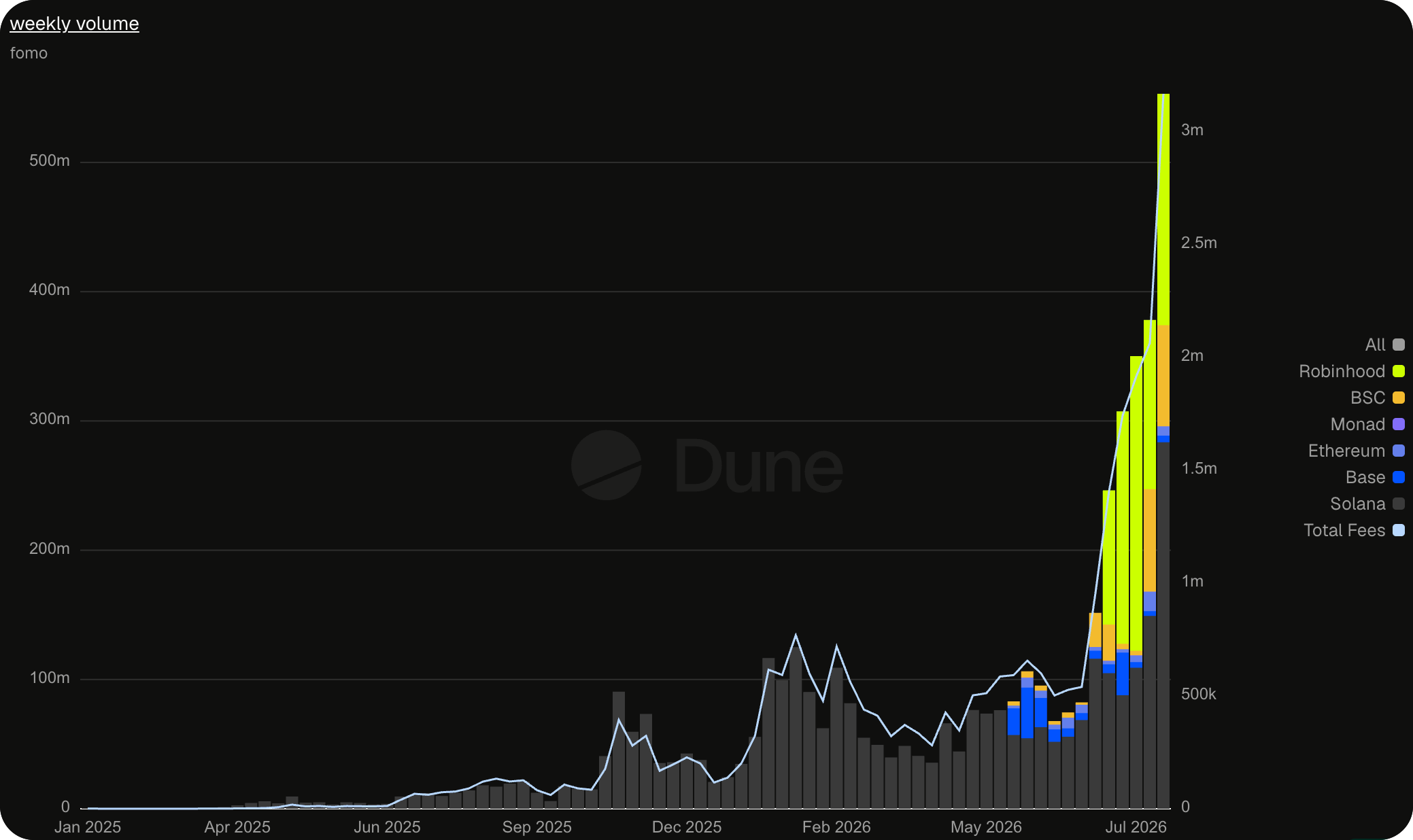
But Solana remains crypto’s home for speculation, Pump remains at the center of it, and Pump doesn’t really want to share.
Fomo is having tremendous success serving up infrastructure that Pump owns through a better consumer interface, effectively acting as a middleman between Solana’s speculative infrastructure and would-be speculators.
I don’t mean middleman here derogatorily. Fomo has a product people clearly want, and the fees it’s generating are pretty good evidence that people are willing to pay for that experience.
At the end of the day though, much of what Fomo has built can, in theory, also be built by Pump, which is exactly what we’re now seeing as Pump adds a myriad of social features to its own app, competing to be the "home page" of speculation.
That leaves the two in this strange position where they’re partners underneath and competitors on top. Fomo owns the consumer relationship, while Pump often owns much of the infrastructure executing the trade.
Now Pump wants both.
To do this, it looks to be pulling out all the stops, allegedly attempting to poach prominent traders from Fomo with contracts promising tens of thousands of dollars per month to move their activity onto Pump.
Pump[.]fun is actively throwing big checks at top @fomo users to get them to migrate exclusively to @Pumpfun
— Coinerhit (@coinerhit) August 9, 2026
It all started with a post by @CLR_Fomo on Aug 8, sharing contract screenshots
The terms were wild:
• $20k signing bonus + $30k/month • Full migration (funds +… pic.twitter.com/Su42EoDlMN
By no means is this illegal, or even necessarily scandalous. It’s really just an incredibly well-capitalized company paying to acquire users who themselves have distribution.
Pump’s also offering zero app fees, a feature it can afford since it already monetizes through bonding curves and PumpSwap, subsidizing the front end in a way Fomo cannot.
Enjoying this article?
Subscribe to Bankless or sign in
That’s caused some of the timeline to decry the fees Fomo charges, but that misses what people are actually paying for.
They’re paying for the experience around the trade: finding people to follow, seeing what they’re buying, tracking performance, getting alerts, and doing all of it from an interface that makes crypto considerably easier to use.
Fomo needs those fees because that experience is its business. Pump can give the experience away because its business already exists underneath it.
What’s particularly interesting here to me is two things.
- First, this is another example of successful crypto infrastructure looking to vertically integrate upward into distribution.
We’re seeing something similar with Uniswap on Robinhood Chain right now. After becoming core plumbing for trading on the chain, it’s now promoting its own launchpad rather than simply remaining the infrastructure powering everyone else’s.
 David Christopher
Pump’s effectively doing the same thing on Solana. It already owns much of the infrastructure powering speculation and now wants to own the consumer layer sitting above it too.
- Second, I believe the rivalry between Pump and Fomo will ultimately come down to trust.
Pump has a rough reputation among parts of crypto, deserved or not, given its place at the center of the speculative economy and everything that’s come with that. Allegations that it’s paying traders to migrate don’t particularly help this reputation either.
Fomo, meanwhile, is newer, has less baggage, and has built its product around making trading more visible, trackable, and social.
But social trading is only as valuable as the signal you’re following.
 David Christopher
Someone can buy publicly through one wallet while selling through another. They can build a position before calling it. They can dump on their followers. Blockchain transparency makes this kind of social trading possible, but it doesn’t automatically make the people doing it trustworthy.
At the end of the day, where people trade will come down to which platform can best preserve the integrity of what users are seeing.
If traders are bundling, hiding activity across secondary wallets, or dumping on followers, people (obviously) stop trusting the signal. And once that happens, there goes the value of the social layers these apps are fighting over.
It'll be interesting to see the lengths each company will go to protect that trust.

