




Subscribe to Bankless or sign in
This week, trading app Fomo announced its close of a $75 million Series B, an outlier in a funding market where rounds that size have gone quiet.
Most raises are not pulling nine figures right now, and the ones that are tend to sell institutional infrastructure, not a trading app built for normal people. So the round is worth taking note of.
It only makes sense once you see what Fomo actually is: the latest, and so far the most successful, product in a long evolution of social trading.
We have raised a $75M Series B from @IndexVentures and @usv, with continued support from @benchmark! pic.twitter.com/uFgqlgmxTL
— fomo (@fomo) June 22, 2026
Trading Is Already Social
As those in crypto know, investing increasingly originates from feeds. Instead of consulting brokers, investors, particularly younger ones, turn to Twitter, TikTok, YouTube, and Reddit.
Nowhere is this more the case than in crypto given how central Twitter is to our industry, directing flows just as much as it does discussion and interaction. And because all of it happens onchain, where wallets and balances are public, the dynamic only sharpens. Traders follow KOLs, watch wallets, track what they're buying, and try to front-run where liquidity moves next.
To do so, they stitched together Twitter feeds, wallet trackers, terminals, Telegram bots, and a DEX interface. This put a barrier around the great game of speculation: most people weren't able or willing to go to those lengths.
Fomo, and other apps like it, intend to change that.
in light of @fomo's $75m series b, wanted to reiterate how bullish i am on social trading as crypto's next meta. i grew up online grinding fortnite with friends, learning from streamers i never met. trading is simply the next thing that goes social. everyone wants to learn to… https://t.co/oNxg0SQoed
— will owens (@wowens) June 23, 2026
Fomo Packages the Feed
Fomo's founder Se Yong Park, who recently came on the Bankless podcast, calls the app "trading for the rest of us."
The app collapses the whole social stack traders used to assemble by hand into one feed: discovery, execution, identity, reputation, public theses, and visible buys and sells. You sign in with Google or Apple, fund with Apple Pay, a debit card, a bank transfer, or crypto, and start trading without ever touching a wallet, gas, a bridge, or a chain you have to think about.
Out of the 650,000 signups Fomo's had so far, roughly 30% converted into traders, so close to 200,000 people have ever placed a trade. About 70,000 of them arrived through traditional fiat onramps rather than crypto rails, showcasing the success of Fomo's formula in expanding past the already tapped out, crypto-native crowd.
Enjoying this article?
Subscribe to Bankless or sign in
 Bankless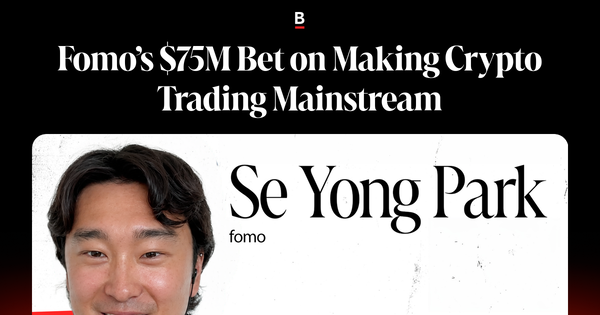
Fomo is by no means the only company building for this new era of investing. In May we saw the release of  Robinhood Social in beta, a feed for finding and tracking trades and traders. Elsewhere in crypto, Bullpen and Legend Trade continue to develop perpetuals trading into something like a sport while paste.trade is translating financial content (podcasts, newsletters) into an ever-updating feed of trades to tail.
Everywhere companies are understanding that discovery has moved upstream, out of charts and reports and into social interfaces, and they're adapting accordingly.
The Feed Doesn't Remove the Game
The advantages of embracing these changes are real.
As a user, I'd say Fomo's app goes a long way toward making trading easier and legible, with the added benefit of not having to camp on Twitter for trades. But transitioning trading into these social environments does not change the game underneath it.
Trading (also known as speculating) is a very PvP dynamic, particularly onchain and, as such, people will exploit every edge they have, including selling on their followers. It's the classic exit-liquidity problem which apps like Fomo can improve, though not erase.
Just because someone's on Fomo doesn't mean they can't accumulate tokens from private wallets, buy publicly on Fomo to broadcast conviction, and exit as soon as followers arrive. Se acknowledges this and hopes "radical transparency" can help here as, in theory, if people get continually burned by following a particular account, they will stop doing so.
I do think, however, these risks are the price of admission for memes, a disappointing reality anyone trading memes has to accept.
the main issue with crypto competition today is that no one wants to see anyone else win. it reminds me of the little kid who would sabotage games just because they weren’t winning. we need to do better as an industry if we want to bring blockchain technology to the masses. doing…
— se (@seyong) June 24, 2026
Where We Go Next
That is the problem a maturing platform has reason to solve.
Any app that collapses discovery, identity, and execution into one surface inherits a new job: keeping its environment honest. As Fomo scales, it is not hard to imagine social trading apps borrowing from the market-surveillance playbook used by platforms like  Polymarket and Kalshi: onchain analytics that flag suspicious wallet activity, coordinated trading, or accounts whose public behavior does not match the flows around them.
But monitoring only goes so far. The deeper variable is the instrument itself, because each market comes with its own degree of perceived or real fairness. Memecoins and prediction markets sit at the fragile end of that spectrum. Both can be shaped by insiders, coordinated promotion, asymmetric information, and narratives that turn before the average user understands what happened. Perps on larger assets sit closer to the fair end. They are still risky, but they are less dependent on hidden deployer behavior, bundled launches, or opaque coordination. That makes them an arguably cleaner surface for social trading: users can take a view quickly, follow other traders, and build public track records around markets that are harder to manipulate (good that Fomo recently added them).
Perps, made simple.
— fomo (@fomo) June 19, 2026
Equity, pre-IPO, crypto, indices, and commodities perps. All in one place.
The future of perps is social.
Trade them all on fomo. pic.twitter.com/OjzTCaEIjJ
Overall, the real risk is not any single bad actor. It’s users collectively deciding the game cannot be won. Not every meme launch is a cabal, not all prediction markets turn on insider information, and sharp traders can learn to separate fair games from rigged ones. But keeping the game winnable is what these platforms ultimately have to protect, a mission which I expect we’ll see deeper investment in as feeds absorb more and more trading platforms.


