

Subscribe to Bankless or sign in
This year's EthCC event in Cannes has fielded its first major announcement: the  Ethereum Economic Zone.
Led by the  Gnosis and ZisK teams and with funding from the Ethereum Foundation, this new effort is aimed at ending fragmentation in the Ethereum ecosystem for good, so let's dig into what's being proposed.
How We Got Here
L2s were meant to extend Ethereum blockspace, and they have. Alongside this expansion, L2s have seen fragmented liquidity. Your coins on  Arbitrum or
  Base or
  Polygon can't readily interact with contracts on the L1 or other L2s without being bridged over, which costs money and time.
Of course, this isn't some new diagnosis.
At Devcon SEA in late 2024, Gnosis co-founder Martin Köppelmann gave a talk called "Ethereum Needs Native L2," highlighting the range of trust assumptions that hamper interoperability among L2s. In response, he called for ZK-proven rollups that can synchronously read and write across each other and Ethereum.
At the time, our very own Ryan Sean Adams hailed this concept as the "Ethereum 3.0 vision." Now, the Ethereum Economic Zone project is officially taking up the mantle of this vision and preparing to bring it to fruition.
And while, to be sure, Köppelmann was calling for Ethereum-native rollups literally, the EEZ approach is downstream of his 2024 diagnosis and is aimed at actualizing a broader and more permissionless approach. EEZ rollups can be native and based, or external and not based; it will just depend on their architectural choices.
Who's Building the EEZ
Gnosis is the quiet development juggernaut that has created iconic onchain infra like CoW Protocol, Safe multisigs, the Zodiac DAO architecture, the Conditional Tokens format underpinning Polymarket predictions, Gnosis Chain, Gnosis Pay, etc.
adoption without surrender pic.twitter.com/rNibi7tUgp
— Gnosis (@gnosis_) March 29, 2026
On the ZK side, ZisK, spearheaded by Jordi Baylina, has innovated an efficient and open-source zkVM design that can bring real-time proving to the execution of Ethereum ecosystem smart contracts.
Importantly, though, neither Gnosis nor ZisK or any other entity "owns" the EEZ stack; the Ethereum Foundation is funding this initiative "as shared Ethereum infrastructure that is credibly neutral," and its results will be free and open source for all.
Enjoying this article?
Subscribe to Bankless or sign in
How the EEZ Will Work
Simply put, the Ethereum Economic Zone is an L1-L2 framework centered around synchronous composability, i.e. real-time interoperability.
In other words, rollups plugged into the EEZ will be able to call contracts on the L1 or other L2s and receive a response in a single transaction. This will power atomic executions across chains so that it will feel like you're just using a single chain.
In this sense, contracts on EEZ chains will work as if they did in fact live on the same chain. Transactions will complete atomically across the relevant networks, or not fire at all in the case of some error.
From Baylina's previous research, we can infer the anchors here will be proxy smart contracts, i.e. when a contract on one chain acts on behalf of a contract on another chain. If you're on Ethereum you'd just call a proxy – the proxy would handle the transaction and apply the state changes to the given L2, and voila.
And perhaps most notably, this "single chain UX, multichain results" shift can and will be implemented without Ethereum having to make any protocol-level changes, as the EEZ will depend on smart contracts + real-time ZK proving.
All that said, the main tradeoff L2s will have to accept in opting into this EEZ system is having to re-org when Ethereum re-orgs, as Martin Köppelmann has noted. That would be a technical thorn but hardly some major pain point. Rollups running their own sequencers would need to accommodate this melding, which is certainly possible.
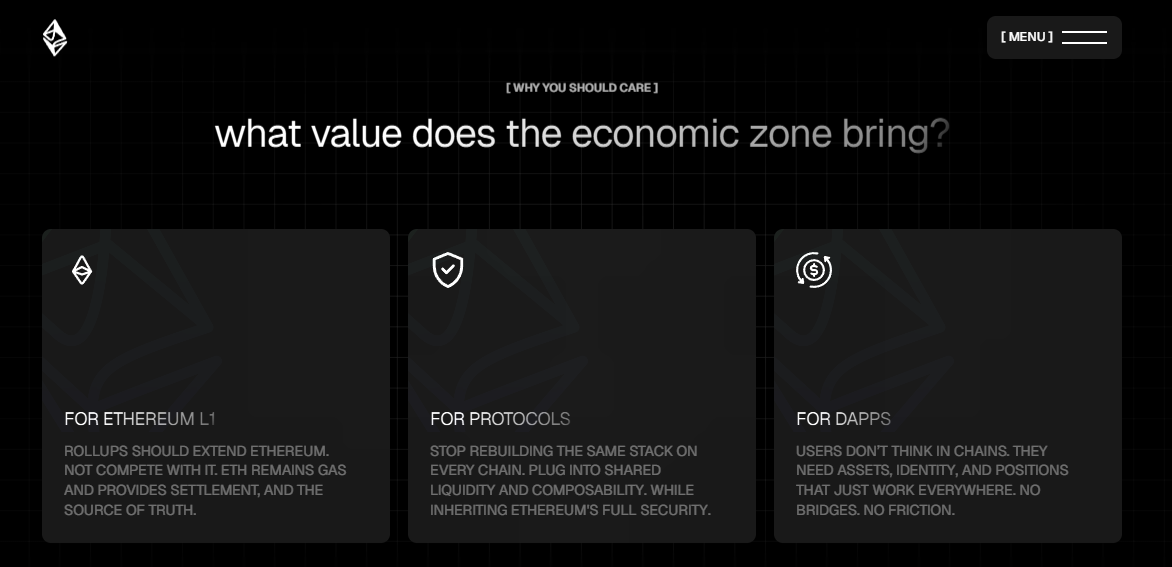
Why It Matters
Imagine an  Aave position on Ethereum interacting with a
  Uniswap pool on Unichain (or a Morpho vault on Base, or a Fluid vault on Arbitrum, etc.) in a single transaction without bridging.
That's the future that the EEZ project is working to usher in. And while there are still some hardware and proving strides to be made before this vision fully matures, we're on the verge of the needed breakthroughs.
The payoff should be more consolidation and dominance for Ethereum. As RSA put it:
"If Ethereum pulls this off—if it unites its chains into an integrated economic zone—while shipping quantum upgrades and L1 scaling of Lean Ethereum in parallel...
Ethereum will gain an unstoppable network effect.
It will finally deliver on its core promise.
Ethereum = world ledger.
ETH = world reserve asset."
That is the big idea. So for now while we wait for the EEZ to come to life, be sure to follow the project for updates and track additional launch partners as they come aboard since the coalition has only just begun.
The "Ethereum 3.0 vision" is what @RyanSAdams called it
— Sebastian Bürgel (@SCBuergel) March 29, 2026
That vision is now a mission and it's called "Ethereum Economic Zones"
Incredibly proud to be team Gnosis ☺️ https://t.co/OMQLnosqLH