



Subscribe to Bankless or sign in
Prediction markets have turned politics, sports, crypto prices, and world events into one of finance’s fastest-growing products.
Kalshi is already pushing beyond them.
After launching what it calls the first regulated perpetual futures exchange in the US, Kalshi is preparing to expand from crypto into commodities. Yesterday, David Hoffman sat down with John Wang, who works across Kalshi’s crypto and perpetuals products, to understand how this fits into the company’s broader plan.
Prediction markets are by no means the endgame, Wang explained. Rather, they effectively serve as a top-of-the-funnel play: bringing users onto the platform, aggregating information those users can trade against, and giving the exchange a signal layer it can carry into conventional products as a point of differentiation.
All across crypto, exchanges that have “made it” have set their sights on becoming an everything exchange: a super-app for every level of finance. Kalshi has locked onto that target too.
EARLY ACCESS - "We Want to Be Bigger Than the CME" | @Kalshi's @j0hnwang
— Bankless (@Bankless) August 5, 2026
🟢 Out now for Bankless Premium subscribers
📅Out on public feeds Monday, August 10
Sign up for early access and the ad-free version now👇https://t.co/iwUikrDxwm
Prediction Markets as the Wedge and Regulated Perps
Kalshi already uses prediction markets as an additional signal for traders evaluating other positions.
On its Bitcoin perps page (see below), users can see prediction data showing whether traders expect BTC to close the day higher or lower. It’s a useful feature to add alongside price, funding rates, and the order book, and arguably a more approachable signal (or counter-signal) for an everyday trader.
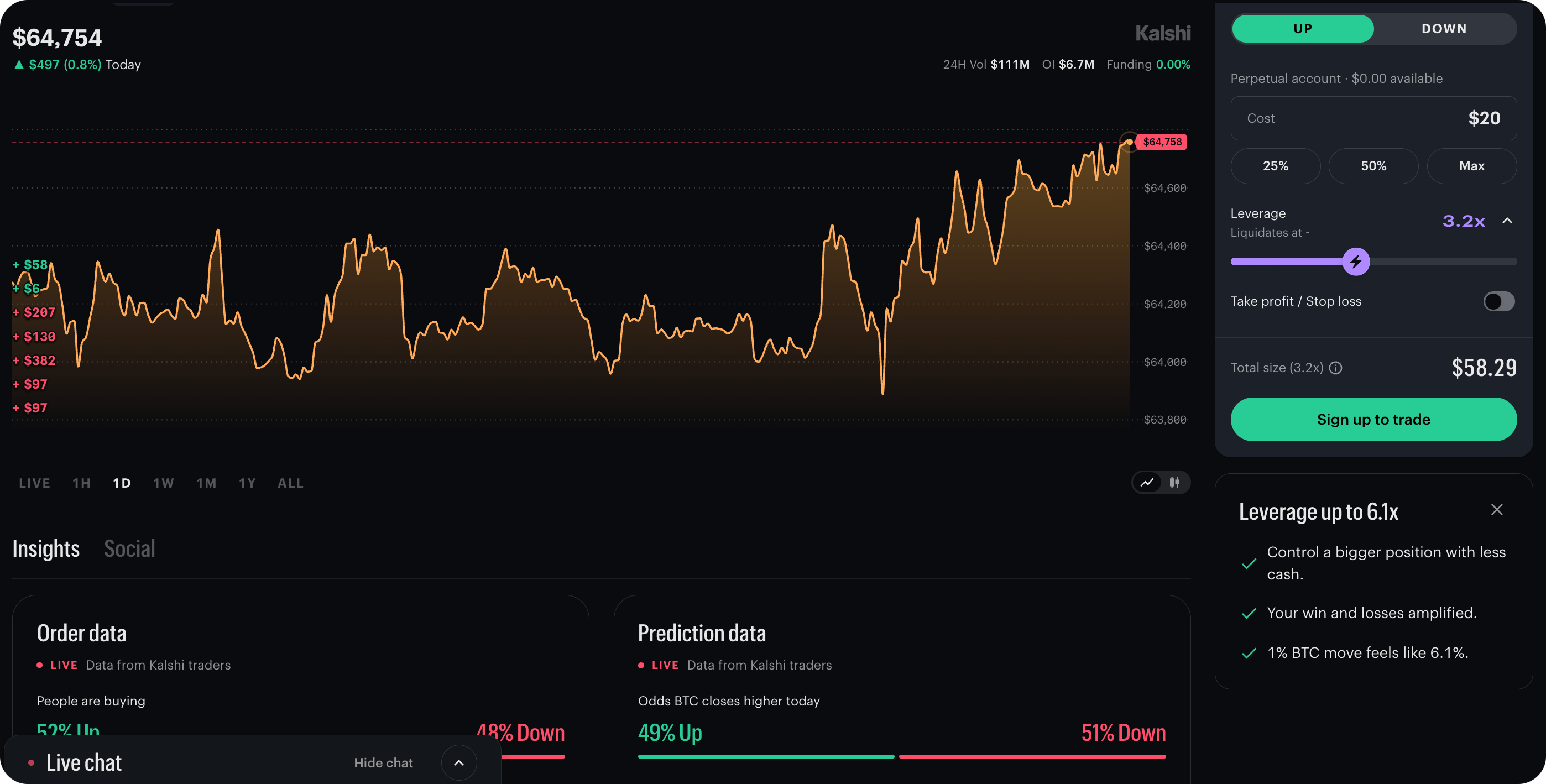
It also creates a progression between products. Someone can arrive to trade whether Bitcoin reaches a price, then use Kalshi’s perps product to express the same view with leverage.
But Wang sees that information layer as only one part of the pitch. Kalshi still has to compete with platforms like Hyperliquid and Lighter on the fundamentals traders care about most: fees, liquidity, interfaces, and execution. Wang argues Kalshi is already competitive on many of them, offering low fees, professional tooling, and enough liquidity to absorb six-figure orders without facing severe slippage.
These features give Kalshi a credible baseline against crypto-native perps platforms, though they do not immediately make it the bigger draw. Pushing Kalshi over that finish line is where regulation comes in.
Enjoying this article?
Subscribe to Bankless or sign in
The Regulated Perps Bet
Kalshi believes its regulatory status is a boon, allowing it to attract more of the users and capital needed to grow those products, particularly as perpetuals expand into real-world assets.
As a CFTC-regulated exchange, Kalshi can operate openly in the United States, integrate with large brokers, and serve institutions through infrastructure they already use. That expands both the amount of traders it can reach and, arguably more important, its access to liquidity providers that offshore and onchain venues may struggle to serve compliantly.
This matters most for commodities and other real-world assets, whose traders and liquidity are largely concentrated in the United States.
Wang said Kalshi is preparing to launch gold and silver perps, with further asset classes expected to follow, effectively testing whether Kalshi can turn that regulatory access into a meaningful advantage.
So, the strategy for competing with Hyperliquid and Lighter rests on both advantages working together: prediction markets give Kalshi a differentiated signal and acquisition funnel, while regulation gives it a path toward broader distribution and deeper RWA liquidity.
An Exchange for Every Risk
Perps are only the first expansion.
Wang says Kalshi ultimately wants to become one of the largest exchanges in the world, combining the regulatory position of CME with the shipping speed and customer relationship of a technology company.
That vision goes beyond crypto and commodity perps to include a much wider range of financial contracts: political indices, weather contracts, block trades, and bespoke institutional hedges.
The goal is that an institution with some particular exposure can approach Kalshi and request a market around it. Kalshi can spin up an event contract and open it to a broader pool of traders and market makers. A hedge once negotiated privately through an OTC desk can instead be priced in a public market.
That is the larger wager behind Kalshi’s expansion. Prediction markets are the engine, bringing in users and producing information that can feed into perps, commodities, and eventually institutional products. The intended destination is a platform where almost any asset, event, or precisely defined risk can trade.
If you’re tracking prediction markets, I’d recommend giving the full conversation a listen. The two also discuss insider trading, institutional adoption, Kalshi’s rivalry with Polymarket, and whether prediction markets can preserve their value as they become mainstream financial infrastructure.
 Bankless