

Subscribe to Bankless or sign in
Real world assets, or RWAs, have been the big onchain sensation this year, as billions of dollars have started flowing through tokenized stocks, tokenized treasuries, tokenized gold, etc.
Yet there are cultural RWAs, too, like tokenized Pokémon cards, lifted up by the rising tide of gacha platforms like Collector Crypt, Phygitals, and Monster where users can pay to randomly pull choice cards (which are vaulted IRL but represented by NFTs onchain).
However, RWAs feel like the terrain of institutions and suits. And Pokémon gachas and the like have significant offchain dependencies. So what about something funner, something more crypto, perhaps a fully onchain gacha that's native to  Ethereum and true to its culture?
Here, cue in Fake World Assets.
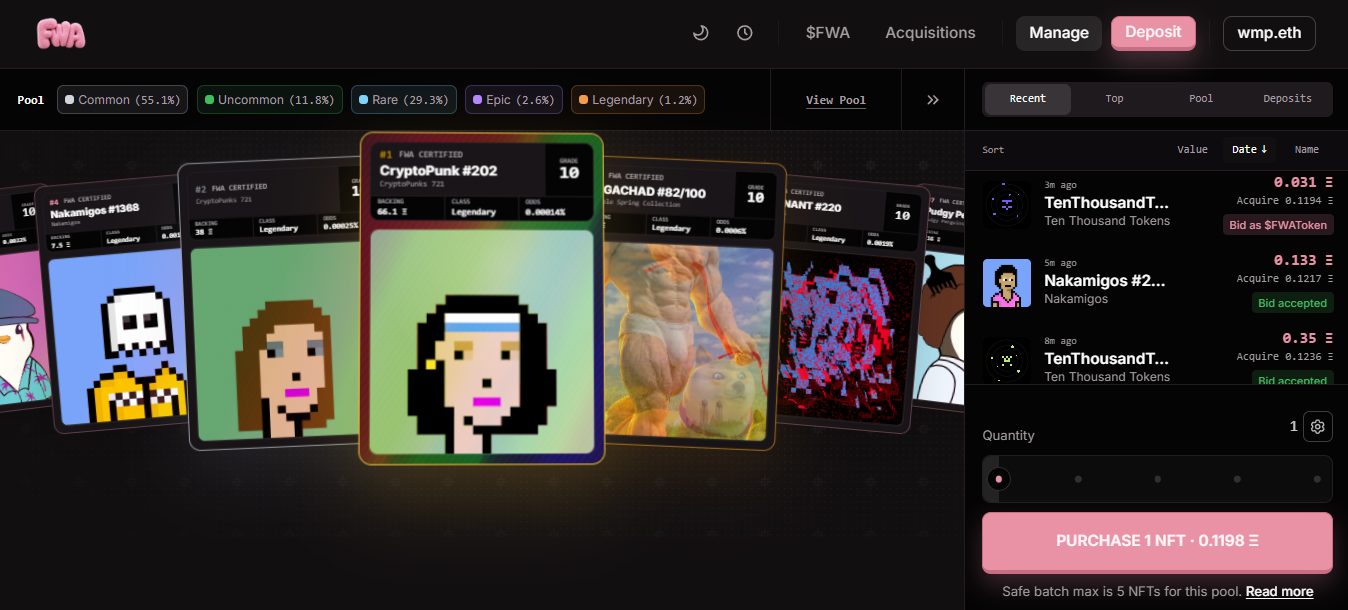
TokenWorks, a self-funded duo (h/t Adam and Teto), has built some of the most creative NFT projects in recent years like PunkStrategy, Ten Thousand Tokens, and FundingWorks. Their latest experiment is Fake World Assets, which is a rather elegantly designed onchain NFT gacha protocol.
It might sound silly at first, as Ethereum NFTs have been declared dead 1000s of times already, so how cool can this new project possibly be? Very cool, at least if the early traction here is any indication.
Indeed, FWA's contracts are among the most active on Ethereum right now. Since its official (re)launch on July 20th, the protocol has facilitated ~90,000 transactions, ~35,000 purchases, and ~2,000 ETH in volume so far. If FWA was listed on DefiLlama, it would've appeared in the top 20 revenue generators in all of crypto yesterday.
its gonna be sooo embarrassing when the team of two at TokenWorks with 0 VC funding saves Ethereum and laps everyone
— Adam (@Rhynotic) July 23, 2026
I can attest that the early interest isn't just a gimmick either, as FWA has a legitimately novel protocol design and a unique go-to-market strategy, the latter of which some people are already affectionately calling "loss-to-earn" because of how the project's $FWA rewards loop works.
Plus, it's just fun to put in a small amount of ETH for a pull and a chance at winning a legendary NFT like a CryptoPunk. Users stock this gacha themselves with their own NFT deposits, so the prizes are arbitrary and will fluctuate, but for instance at the moment the biggest prize possible is a CryptoPunk backed by 66 ETH.
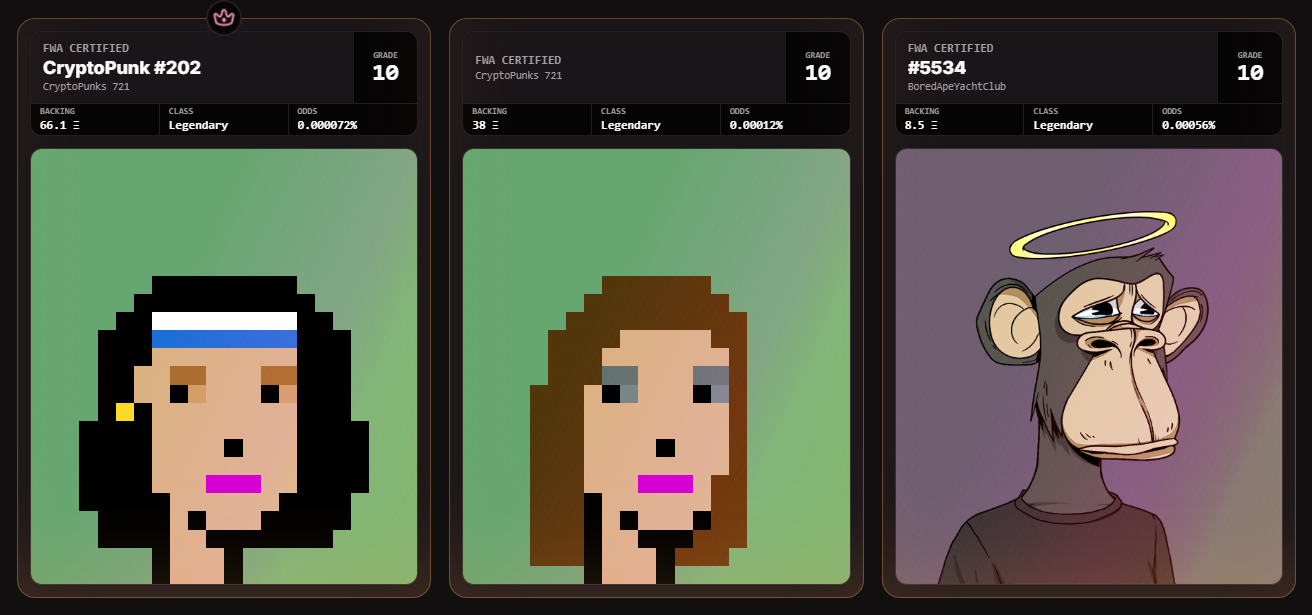
The odds of you getting that 'Punk on any given pull are super small, and those odds are determined by the ETH backing supplied by the 'Punk's depositor (and by the rest of the NFTs and ETH in the pool at that time). The more ETH supplied, the lower an NFT's selection weight will be. But if you were to win that 'Punk, you couldn't keep the ETH and the 66 ETH backing. You'd have four options:
- Keep the NFT and do whatever you want with it, e.g. hold it, borrow against it on Gondi, relist it on OpenSea, etc.
- Auto-relist the NFT into the FWA protocol as your own deposit. In the hypothetical that you won a 'Punk, this route would only make sense if you're willing to risk a hearty ETH backing (if you go too low, the 'Punk will get pulled quickly) and the 'Punk itself (as someone could win it from you next). Depositors earn ETH and $FWA rewards, so there's an interesting risk/reward dynamic to consider.
- Accept 85% of the ETH backing instead of the NFT. So in the case of the 'Punk backed by 66 ETH, you could opt to keep 56.1 ETH to do what you want with, which in turn would send the 'Punk back to its original depositor.
- Accept the 85% payout in the $FWA token instead of ETH, so for example in our top prize scenario, this would mean slamming 56.1 ETH straight into $FWA.
According to the FWA Pulse tracker dashboard by Priyeshu, 78% of user settlements are currently taking the fourth option, the $FWA payout. Why? For the first 15 days of FWA while $FWA bootstrapping emissions are live (i.e. 1% to depositors, 1% to purchasers per day until Aug. 4th), all external buys are disabled, so the only way to acquire $FWA right now is by actually using the gacha.
Hence, the "loss to earn" moniker. Even if you don't get a great pull, you have the consolation of a $FWA payout, and if $FWA performs well going forward, you'll have earned back what you spent on a bad pull and maybe then some.
And of course, you can choose $FWA on good pulls as well. One of my coolest pulls so far was a slick CrypToadz, which I was tempted to keep, but I went for the $FWA route to add to my stack while things are early. This is the dominant strategy we're seeing in the emissions phase, and full disclosure, it's what I've been doing so far besides an ETH claim here and there.
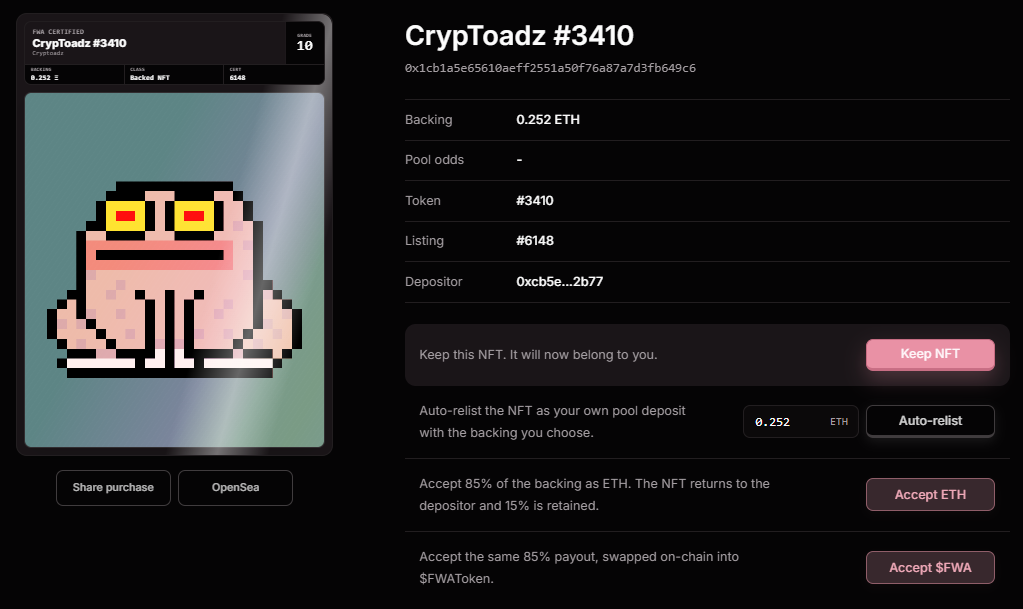
So with all that general context out of the way, let's say you're curious to try FWA but you're approaching this as a total beginner that's been out of the loop. You've got two main avenues to participate, namely either as a purchaser or as a depositor (or as both).
Purchasing is simple enough, you'd just need ETH. The average pull price over time is presently 0.0568 ETH, but that's been trending up as the FWA pool has swelled with fatter deposits, such that a pull this instant would set you back 0.1082 ETH. Per the docs, this price isn't fixed but fluctuates constantly depending on the protocol's estimation of the "average value of the position you might receive."
If you do decide to make a pull, randomness derived through  Chainlink VRF will determine what you win. And since deposits are arbitrary, the rarity tiers will ebb and flow. For instance, today it's actually more likely to win a "Rare" NFT (22% odds) than an "Uncommon" NFT (17.4%) on FWA just because people are starting to pile in with higher ETH backings. These percentages won't look exactly the same tonight, or tomorrow, and so on.
Enjoying this article?
Subscribe to Bankless or sign in

Then once your pull is in (it will take at least 6 Ethereum blocks to reveal), you'll face the four options I mentioned earlier: keep the NFT, auto-relist the NFT, accept the ETH payout, or accept an $FWA payout instead.
Just know the risk, i.e. you might spend 0.1 ETH on a pull and, in light of the odds, get a "Common" NFT backed by 0.04 ETH. The NFT isn't sexy, and you'd be down on ETH, so the $FWA payout would be your main consolation. Also, during the emissions phase 1% of the $FWA supply is split every 24 hours across all successful pulls (claimable once the day rolls over), so this would be another small consolation.
As for depositing, it's straightforward too if you'd prefer to operate as the house. FWA supports 48 NFT collections and counting, with the cheapest entry point being Ten Thousand Tokens, which have a floor of ~0.05 ETH on  OpenSea right now. So if you have any of the supported NFTs, you could just go to the FWA Deposit page, pick your desired NFT and backing amount, and fire it in.
Every pull's purchase fee, minus the protocol's cut, gets split equally across all active listings, so your deposited NFT will earn ETH on every spin anyone makes, plus a share of depositor-side emissions through Aug. 4th.
Each day for the first 15 days, 1% of the FWA token supply is distributed to purchasers and another 1% to depositors.
— TokenWorks™ (@token_works) July 23, 2026
Depositors can claim at any time, whereas purchasers can claim after the day is over.
Day 3. pic.twitter.com/4UADXQc0PA
These rewards were very juicy in the first few days of FWA when there were only a few hundred NFTs in the pool, but now that there are nearly 2,000 NFTs deposited, the rewards have thinned some according to the wider distributions, so that's just something to keep in mind.
Your main consideration here is backing amount. If you back your NFT with a small amount of ETH, like 0.04 ETH, its position weighting will lead to it being pulled very quickly, which will minimize the amount of time that you're in the pool and earning rewards. If you back your deposit with a lot of ETH, e.g. 1 ETH, it will stay in the pool earning much longer.
In other words, a deposit is a two-sided quote on your own NFT. Your backing sets your selection odds and serves as an irrevocable standing bid, so you need to be at peace with both sides of the trade.
If a winner keeps your NFT, your backing will be returned and your compensation is whatever fees and emissions you accrued while it sat in the pool. If a winner cashes out against your bid instead, your NFT returns to you and the 85% payout comes out of your backing. The idea, then, is to place your backing at a number where neither outcome would upset you.
Plus, keep in mind that there are no guarantees here with regard to duration. The main risk for depositors is that randomness can select your NFT far earlier than its weighted average suggests, in turn ending its earnings before it went into the green.
5/ Why deposit?
— Quit (@0xQuit) July 22, 2026
Each successful pull distributes ETH fees across the active listings, so an NFT can earn while it sits in the pool.
The EV on this is roughly neutral, but it also comes with $fwa token emissions, and of course a gambling angle (you could end up EV+ or EV-)
What comes next then? External $FWA buys being activated will be a big thread to watch, plus keep an eye on what happens when the initial 15-day $FWA emissions end, after which $FWA buybacks are slated to be split across depositors, purchasers, and token burns. This design suggests the flywheel can keep spinning even after the inaugural incentives end.
It will also be interesting to see how the protocol itself evolves from here. Jack Butcher just released an entirely new collection into FWA's gacha, so expect more drops like this to come. Maybe this protocol becomes permissionless and the new NFT launchpad? Whatever happens, it's going to expand, and in turn it will inspire new spinoffs. For example, I've already seen growing chatter for an FWA-style stock token gacha on Robinhood Chain.
Theoretically, FWA can scale up to supporting millions of deposits, and TokenWorks is exploring adding support for assets beyond NFTs, presumably starting with Ethereum ERC-20 tokens and then beyond, so this is undoubtedly only the beginning for this project.
In any case, the vibes are good. FWA feels like an old school DeFi yield farm, though to approach it as just a farm is a mistake. Most fundamentally, it's a prime example of how you can build an entire business atop a  Uniswap V4 hook, as path.eth has aptly noted, and in a non-stodgy way.
Ultimately people on Ethereum are having fun onchain again. They're sweeping NFTs again to buy more NFTs. They're discussing, and strategizing, and thinking up new creative possibilities. It's a heartening surge, to be sure, so let's see where things go with FWA from here.
Fake World Assets could single-handedly bring attention back to NFTs
— seedphrase (@seedphrase) July 22, 2026