


Subscribe to Bankless or sign in
Dear Bankless,
If you’ve been around NFTs for even a little bit, you’ve probably seen more than a handful of right-click savers.
These are folks who see no point in NFTs (and particularly high-value NFT transactions) because anyone can “right-click save” an NFT’s image file to their computer or smartphone, etc.
I understand this perspective, especially while the NFT ecosystem is so early and thus many people aren’t yet familiar with how NFTs work. However, I also think this view stems from an outdated interpretation of things, i.e. “things” only deriving worth via utility value (e.g. I can use this car to drive to work) and exchange value (e.g. I can trade this car in for two smaller cars).
What right-click savers are really missing, then, is that things clearly also derive worth from a third avenue, which is sign value. And what’s interesting with NFTs is that in some cases they emphasize or embrace sign value (i.e. social value) over utility and exchange value!
Let’s dive deeper into what I mean here by talking through some of the ideas of Jean Baudrillard, a 20th-century French philosopher renowned for pioneering the theory of sign value ⬇️
-WMP
NFTs: Stores of (Sign) Value
Baudrillard was a philosopher who, among other things, explored how signs, or significations, impacted our lives.
Enjoying this article?
Subscribe to Bankless or sign in
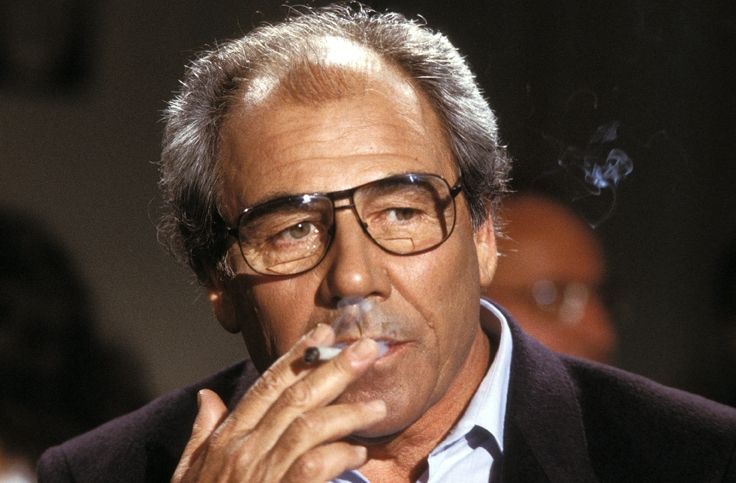
Jean Baudrillard, the French philosopher and sociologist. A “sign” socially signifies something in a system of differences, for example a Lamborghini signifies wealth compared to a junk car, a CryptoPunk signifies superior prestige and style in the
 Ethereum community compared to other collectibles, etc.
 What a sign signifies = sign value. Moreover, sign values are developed by various kinds of social labor. With the churn of mass media and new technologies in recent decades, an incredible proliferation of signs means sign value is now a paramount factor to consider when valuing an object.
Another way of saying the above? It’s no longer adequate to evaluate commodities, including NFTs, through a strictly economic lens. Cultural interpretation is a must, too. The way to more fully understand things is to understand them in their social contexts.
Accordingly, Baudrillard critiqued traditional theories of political economy like capitalism and communism. Why? They hyper-emphasized production, and thus objects’ utility value and exchange value, and failed to account for sign value at all. In contrast, Baudrillard argued that in our contemporary times culture-centric sign value had become dominant over utility value and exchange value.
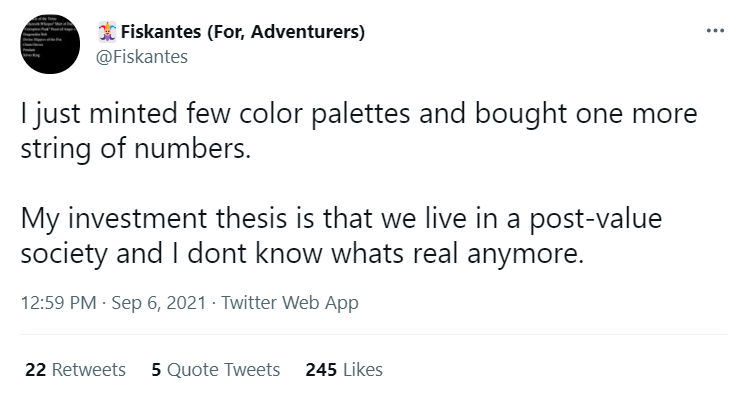
And the award for the most Baudrillardian Crypto Twitter comment ever goes to … Fiskantes! For example, consider how old viral memes are being resurrected by their creators as NFTs lately. The sign value (i.e. the social power, the memetic energy, the “this is one of the greatest memes of all-time!” status) of these NFTs are paramount, followed by their exchange value and then their utility value.
When a right-click saver sees a huge NFT sale and is flabbergasted, they’re mostly failing to account for that NFT’s sign value. They’re failing to realize its value is in no small part derived through its social dimensions.
It’s also worth noting that for Baudrillard sign value wasn’t just something he realized the old schools of thought had missed -- it additionally pointed the way to symbolic exchanges, i.e. creative interactions steered by culture rather than dominated by traditional concerns of utility and exchange value.
Baudrillard thought over-emphasizing utility and exchange value stifled people. He argued the path to personal sovereignty and happiness lay in embracing humanity’s nature for excess, the “expenditure, waste, festivities, sacrifices, and so on, in which [people] are sovereign and free to expend the excesses of their energy.”
Sounds a bit like the NFT ecosystem, right? Seriously, Baudrillard said folks could pursue sovereignty by fostering a general economy of “expenditure, giving, sacrifice, and destruction to escape determination by existing imperatives of utility.” In the very least, never has such a general economy been more possible than it is today thanks to (memetically-charged) NFTs.
To circle back and finally conclude: what right-click savers don’t realize is that their screenshots have zero sign value, whereas the NFTs they’re screenshotting typically have significant sign value. We live in a society after all …


Action steps
- 🌺 Read Rhizomatic NFTs by Metaversal
- 👩🏫️ Read Understanding the value of Nyan Cat and the Metaverse by Maria Paula Fernández
- 🎨 Read Decentralized Arts #3 by Bankless DAO