
🔒 FREE PREVIEW: Upgrade to unlock full access. Join Bankless Premium.

Sponsor: MetaMask - Swap thousands of tokens on every major network.

- 🔵 Trump Family's
 World Liberty Financial Sued for Extortion. What began as a governance dispute between Justin Sun and World Liberty Financial has spiraled into a lawsuit and volley of personal attacks.
 - 💸 FTX Bankruptcy Liquidators Disposed of Cursor Stake for $200k, Now Worth Billions. Elon Musk’s 'SpaceXAI' has struck a $60B purchase option to acquire the AI startup.
- 👩⚖️
 Coinbase Dodges Securities Claims in WLUNA Lawsuit, Case Remanded to Arbitration. Securities law claims targeting Coinbase’s handling of WLUNA during the 2022 Terra collapse have been dismissed.
| Prices as of 5pm ET | 24hr | 7d |

|
Crypto $2.63T | ↗ 3.9% | ↗ 4.4% |

|
BTC $78,753 | ↗ 4.2% | ↗ 5.4% |

|
ETH $2,403 | ↗ 3.8% | ↗ 2.1% |

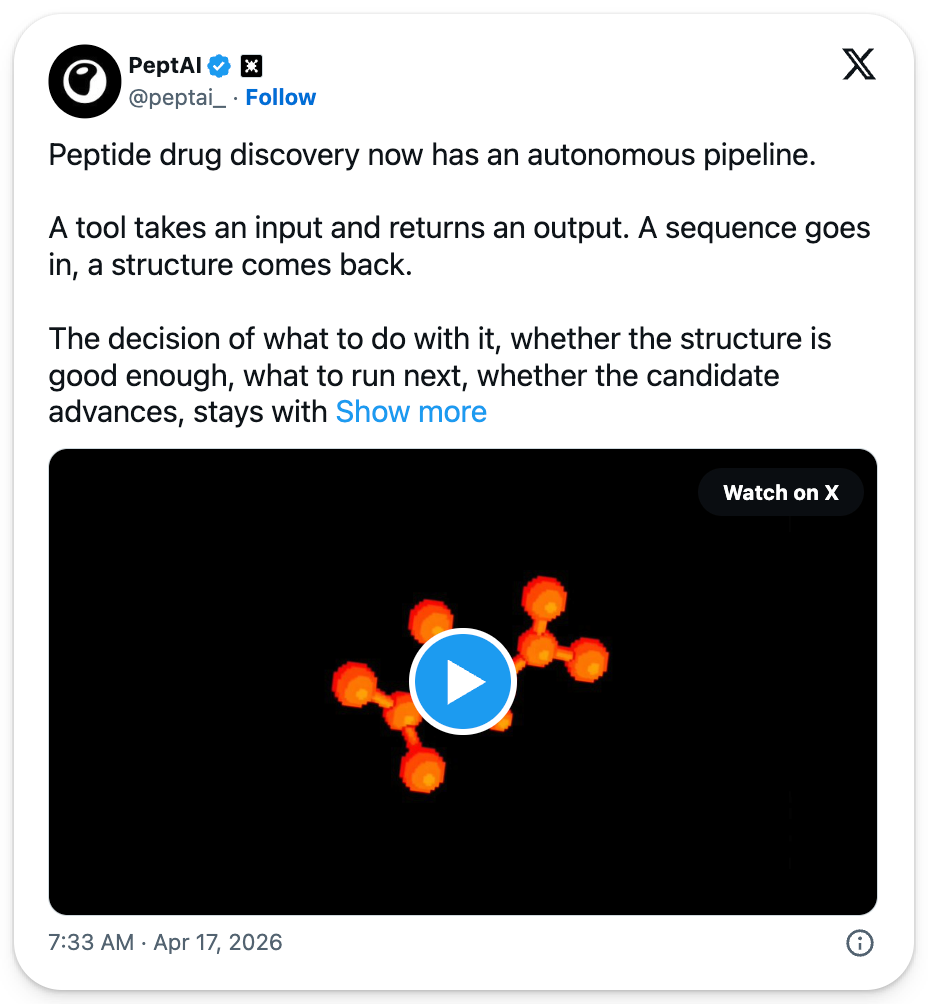
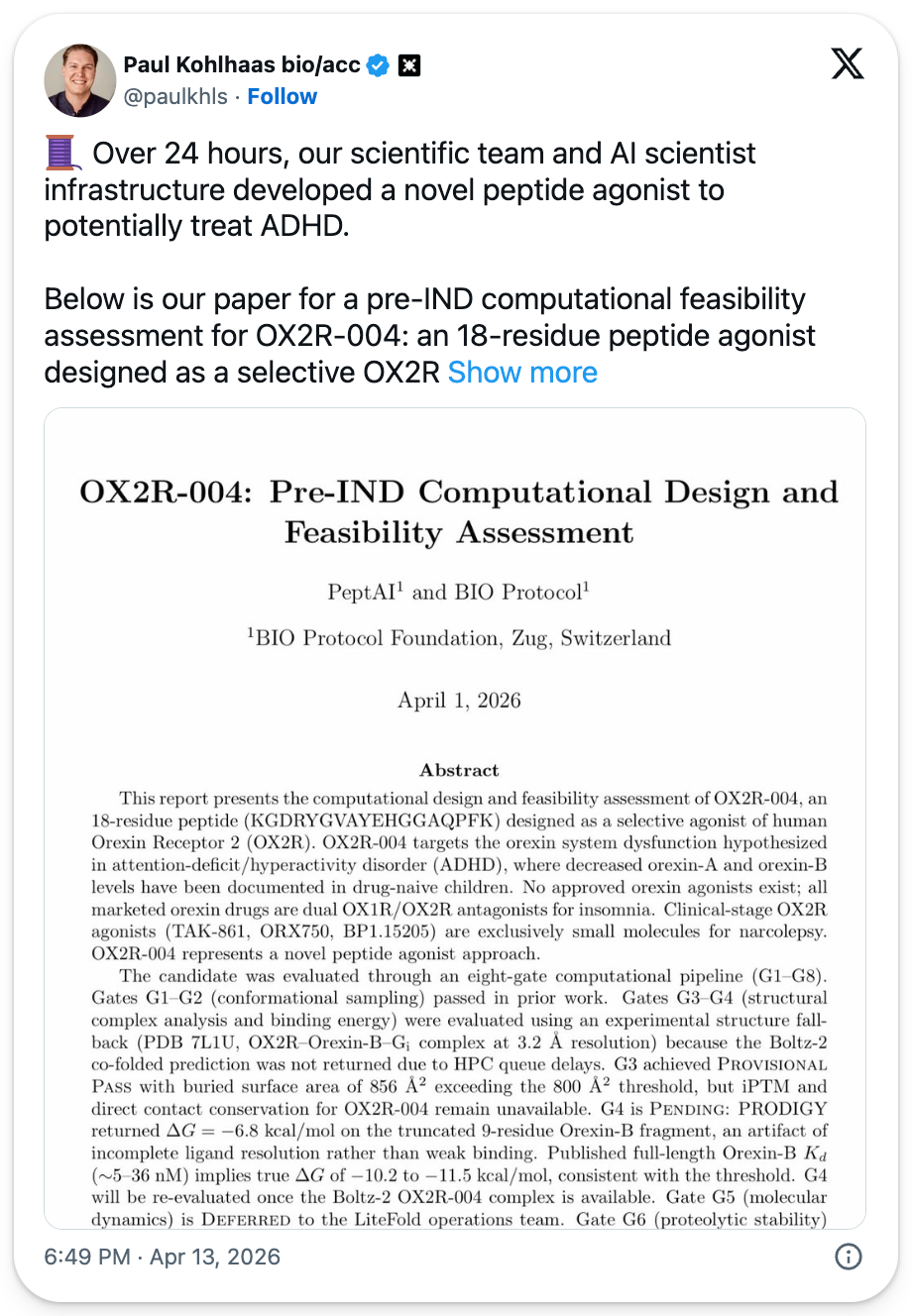
Last week, DeSci funding platform Bio Protocol's CEO announced his team had designed a novel drug candidate for ADHD in roughly 24 hours using AI.
The team's AI scientist, PeptAI, ran the candidate through a simulated testing pipeline, flagged real problems honestly, and priced the first physical lab test at $500 to $600. Full validation might run $1,000 to $1,500. Traditional pharma spends millions and takes years to reach a similar decision point.
Welcome to the AI-enabled future of DeSci discovery.
This complexity collapse changes who gets to decide which diseases are worth studying and which questions get asked in the first place. Drug development has always been gated at the earliest stage by the capital, not by the science. Research gets funded when it aligns with commercial priorities or "hot" topics, leaving plenty of valuable areas of interest unfunded. DeSci has been working on funding that gap for years, but the entire ambition stayed kneecapped by the cost of drug discovery itself.
AI changes the math, magnifying the potential ROI of DeSci's community-scale funding.
In other words, with discovery costs collapsing, a DAO treasury can now fund a candidate all the way to the point where real lab data exists. That puts entire categories of research within reach that pharma was never going to touch. The biology behind ADHD's orexin system has been documented for years. No institution with the capital to develop a drug around it has chosen to do so. PeptAI did.
The Bio Protocol intersection
For this combo of community funding and "agentic science," Bio Protocol has become a central node.
It’s the token-governed platform routing capital to specialized research DAOs through community governance. Over the past few months, it has pushed just as hard on the agentic science side. PeptAI’s success with OX2R-004 is the latest proof point, but not the only one. In January, the team released BIOS, an AI scientist that coordinates specialized agents for literature search and computational analysis.
 David Christopher
The point is that Bio Protocol is running both engines at once. Community fundraising and agentic science are incredibly synergistic: if AI can design candidates cheaply enough that communities can fund them directly, the earliest stage of drug discovery stops depending on institutional gatekeeping.
The hurdles the two-engine thesis can't clear alone
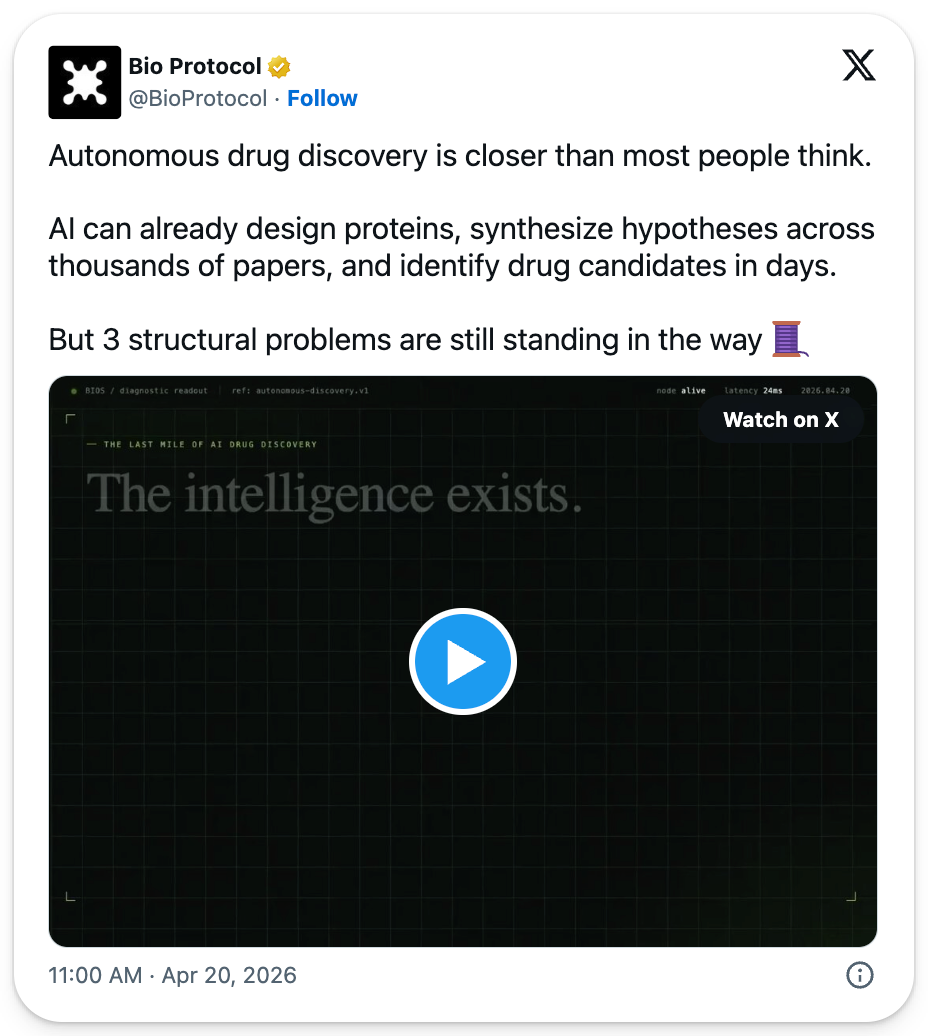
Bio Protocol has been honest that AI and community fundraising together still leave three structural problems. In a recent post, the team has named them explicitly, and they roughly track the path from candidate to approved drug.
Enjoying this article?
Subscribe to Bankless or sign in
The first is data inaccessibility. The training data AI needs to reliably model how drugs behave in the body sits locked inside pharmaceutical companies that spent decades collecting it and treat it as a competitive weapon.
Molecule, another DeSci protocol closely intertwined with Bio Protocol, is building the open layer inside the DeSci ecosystem. Expanding beyond its initial functions as an IP monetization layer, the company released a new core primitive in February, the Molecule “Lab”: an onchain container that holds a project's research data, IP, and treasury in one place.
As a result, research milestones, success stories, and failed experiments all stay on the record instead of disappearing when a company shuts down or a grant expires, so future researchers and AI agents can build on the work without repeating it.
To further seed this layer, the Labs feed into Science Beach, a commons Molecule and Bio Protocol are jointly building where AI agents and humans post hypotheses, critique each other's work, and branch off promising directions in public.
The second is wet labs: physical environments where compounds are tested. Even a well-characterized candidate still needs physical validation on biological material, which adds weeks of contracting and coordination. No amount of AI removes this physical step.
The third, and the one I'd add to their list, is clinical trials. That's the stage where candidates get tested on humans, and it still runs on the old capital structure. Nothing in the DeSci stack currently reaches that far.
What this opens up
The earliest and historically most arbitrary stage of drug development, the one where somebody decides whether a question is worth asking at all, is no longer gated by institutional capital.
A novel ADHD candidate that would never have survived a pharma budget committee now has a clear path to real lab data for a fraction of the historical cost. Multiply that across the diseases pharma ignores because they're rare, unprofitable, or scientifically unconventional, and the scale of what gets studied changes.
Yet, the standard path to an approved drug still runs long after this point. After wet lab validation comes preclinical safety testing, roughly $500,000 to $2 million. Then an Investigational New Drug (IND) application to the FDA. Then clinical trials in three phases, with combined costs from tens of million to several hundred million dollars.
DeSci gets candidates to the start of that path with something real in hand, a characterized compound with published binding data and a permanent record of every decision. That is a different starting point for a Pharma conversation than a hypothesis and a funding pitch. The clinical stage is the next frontier, and DeSci is aware of the gap.
There's a cultural shift underway that pairs naturally with what DeSci is building. The rise of peptide culture and stories like GitLab co-founder Sid Sijbrandij using AI to fight his own cancer, or Australian tech entrepreneur Paul Conyngham helping treat his dog Rosie's cancer with ChatGPT, point to a growing cohort of people motivated by personal stakes rather than commercial ones.
Clinical validation still matters. Doctors still matter. What's changed is that people with the motivation to ask novel questions now have tools that can carry those questions to real scientific answers. The hurdles to get something all the way to the finish line remain. But the undercurrent eroding them can be felt growing, and will only get stronger from here.
Trade thousands of tokens across Ethereum, Solana, Bitcoin, TRON, Monad, and more in just one tap. Advanced security, MEV and front-run protection, and deep multi-pool liquidity. All self-custodial, all on MetaMask.

🔒 FREE PREVIEW: Upgrade to unlock full access. Join Bankless Premium.
What if DeFi’s next growth wave comes not from another crypto-native loop, but from bringing real emerging-market yield onchain?
In this episode, we unpack how Brix is starting with the Turkish carry trade, using tokenized money market fund exposure to open access to local yield opportunities that most global investors cannot easily reach.
Watch the full episode on Bankless.com 👇