The NFT UX Revolution
Innovations like the Ethereum Economic Zone and EIP-8141 are about to change everything around NFTs.
Sponsor: MegaETH — Crypto has new apps, finally.
| Forever onchain games 👾 | ||
|
||
| 📍 See the full post |

The UX in the  Ethereum ecosystem is getting some big makeovers, and two new advances spring to mind here in particular: the EEZ and EIP-8141.
These mechanisms will have tons of streamlining implications for DeFi, agentic onchain commerce, etc. Yet they'll also totally smoothen how we build and use consumer crypto apps, onchain games, onchain social, NFTs, and any "squishier" stuff like this.
Let's dig into what I mean to give you an idea of what's coming.
First, the EEZ
Yesterday, I wrote about the Ethereum Economic Zone, the big initial announcement out of this year's EthCC event from the  Gnosis and ZisK teams.
 William M. Peaster Mar 30, 2026 • 4 min read
To quickly recap:
- The EEZ = an L1-L2 framework. It'll offer synchronous composability, meaning rollups (that opt in) will be able to call smart contracts on Ethereum or on other EEZ L2s and thereafter receive a response in real-time, within a single atomic transaction.
- This system will cut the need for bridging (and the associated time and costs) among EEZ chains, and it won't require any additional trust assumptions beyond Ethereum itself. In other words, transacting anywhere in the EEZ will feel like transacting on a singular Ethereum.
All that said, my post was a brief primer, and I didn't get much into the advantages the EEZ will offer beyond a few short DeFi examples. The EEZ will also be a game changer for everything around NFTs, though, and to understand why, it helps to look at where crosschain NFT experiments stand today.
For example, a few weeks ago marka (a friend and longtime reader of Metaversal!) and Backseats (a very talented onchain builder) unveiled a cool crosschain hair trait mint for their Chonks PFP collection, which is one of my fav  Base collectibles projects.
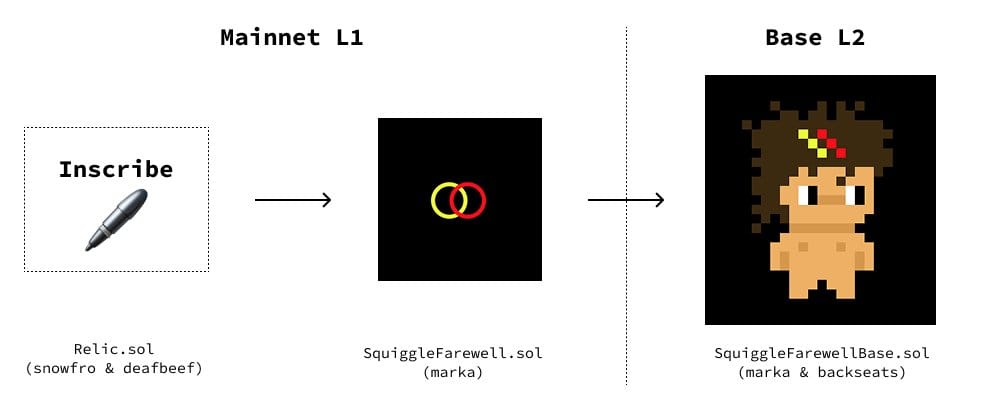
This creative mint used LayerZero's lzRead protocol to read minters' inscriptions from Snowfro's Relic contract on Ethereum, and then repurposed that data to shape unique generative "Farewell Fro" hair traits that were collectable on Base.
Enjoying this article?
Subscribe to Bankless or sign in
This is the kind of creative composability that I love to see onchain, and the mint went off without a hitch. It worked entirely as intended, and people minted easily. Yet I zoom in here just because this experiment can illustrate the current technical constraints of crosschain NFT experiences.
For instance, minting a Farewell Fro was asynchronous, since the collecting process took a few minutes to finalize as LayerZero's Decentralized Verifier Networks (DVNs) had to confirm the crosschain data first. Secondly, DVNs are trust-minimized but not completely trustless, so they served as intermediaries in this sense.
Moreover, the interaction here was read-only: the trait was shaped by mainnet data, but it couldn't update state on Ethereum in the same transaction. It's not that the Chonks maestros needed this specific utility for this particular trait drop, to be clear, but it'd be a powerful option nonetheless.
This brings me 'round to my first main point, which is that the EEZ approach is compelling precisely because it can address all three of these constraints simultaneously.
With EEZ support, a crosschain mint like the Chonks Fro could read an Ethereum contract (e.g. Snowfro's Relic contract) from Base, compose the unique trait output, and then deliver it to the minter on Base atomically within a single transaction (so you'd wait seconds instead of minutes), and with no intermediaries, just Ethereum + ZK proofs.
Plus, NFTs under the EEZ paradigm could lead to new kinds of crosschain dynamics, e.g. L2 traits that update continuously in real-time based on your onchain activity on the L1 or vice versa, or onchain games with assets (e.g. ERC-6551 NFTs) that can make reads and calls across EEZ chains without bridging. The prospects for unprecedented multichain games built this way will be wide open.
Of course, not every L2 will opt into the EEZ system, and non-EVM chains will keep doing their thing. Yet for the EVM ecosystem specifically, the EEZ is poised to bring major streamlining, with the closest reference being Ethereum itself before L2 fragmentation began.
But EEZ + NFTs is only half the picture I want to sketch. For Part 2 of this series, which I'll publish Thursday this week, I'll drill down into EIP-8141, Ethereum's incoming account abstraction (AA) overhaul.
What the EEZ wants to do for the friction between chains, EIP-8141 is aimed at doing for the friction within transactions. It's powerful in its own right, and combined with something like the EEZ, it'll broadly improve the UX around NFTs. More on this on Thursday!
We're past "in it for the tech" or "in it for the money." MegaETH is bringing you products worth using, powered by USDM.

Bankless
It’s time to break up with your bank, and join the movement for a better world.