Formal Verification Summer
Formal verification looks like crypto's best shot at becoming real financial infrastructure.

| 24h Majors & Movers | ||||||

|
BTC $62.5k | ↗ 1% |

|
HYPE $56 | ↗ 1% | |

|
ETH $1.6k | ↗ 0% |

|
INX $.008 | ↗ 24% | |

|
SOL $65 | ↗ 1% |

|
XMR $353 | ↗ 9% | |
Sponsor: Bitget – Trade U.S. Stocks via Crypto on Bitget!
Enjoying this article?
Subscribe to Bankless or sign in
- 🏦 Citigroup is reportedly building a blockchain platform that'll let institutional clients and affluent investors trade tokenized shares of private companies, according to the Wall Street Journal.
- 🤖
 Coinbase just launched Coinbase for Agents, letting you hook your AI agent straight into your Coinbase account so it can trade and run strategies on your behalf within limits you set.
 - 🪙 After calling for index-tracking synthetic stables earlier this month,
 Vitalik Buterin just highlighted a handful of teams that are already working on this sort of options-based (rather than debt-based) model.

Welcome to the age of Mythos, where finding and exploiting a bug in open-source code costs a sliver of what the bug is worth.
Legacy Raydium pools were exploited yesterday, Humanity was gutted by a private-key compromise on Monday, and  Zcash is still rebuilding trust after patching a vulnerability that could have secretly inflated its shielded supply. All the while, discussion swirls around formal verification, the software paradigm that could make crypto the weapons-grade infra that the modern financial system demands.
The timing forces a reckoning crypto has dodged for years. Blockchains hold real money in public, value that can't be edited, and they are open to adversaries who never stop probing. For most of crypto's history, speed was prioritized over security, building with the loose guardrails of consumer software.
Yet crypto is most certainly not just consumer software and it must stop acting like it is. We’ve seen steps in the right direction here and adopting formal verification is the next big piece of progress.
What Formal Verification Actually Is
Formal verification treats software like a mathematical object instead of a product you poke at until it seems fine.
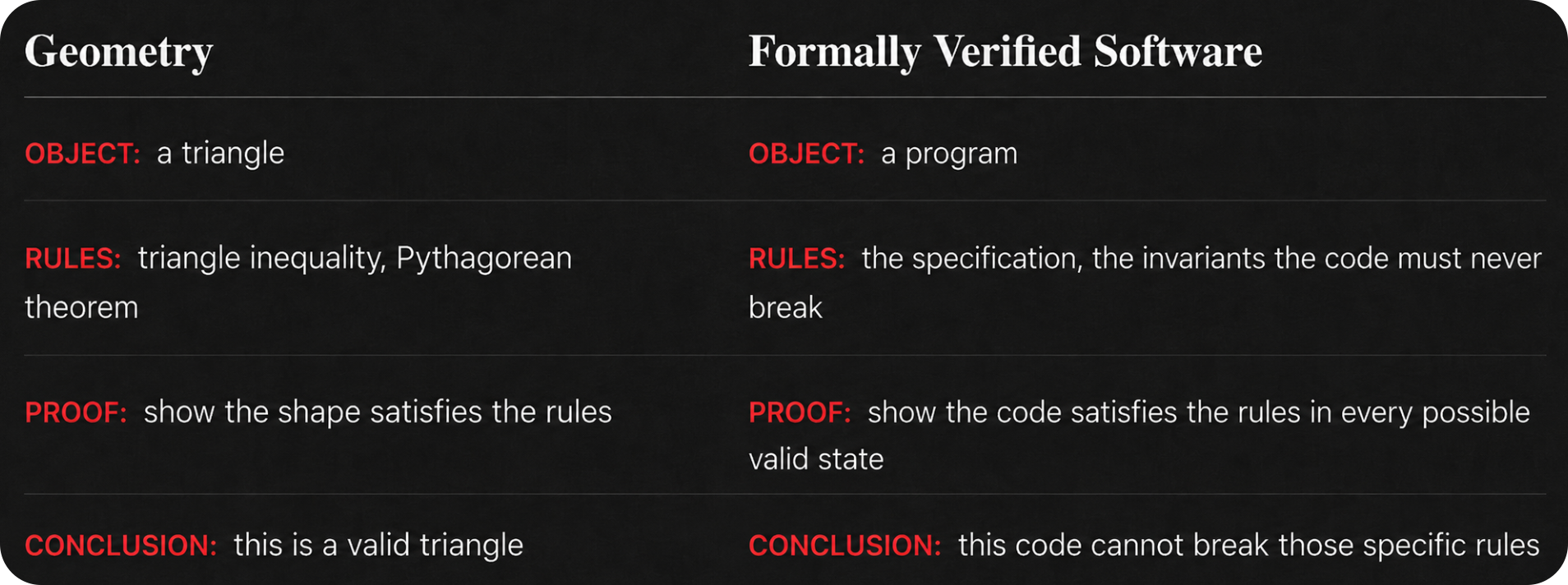
Say somebody shows you a shape and claims it's a triangle. How do you verify it? You don't eyeball it. You check it against the rules of a triangle: the two shorter sides must add up to more than the longest side, and if it’s a right triangle, the sides must satisfy the Pythagorean theorem. These concepts may be foreign or long dormant to you, as they are to me, but I share them to emphasize how people "prove" mathematical objects, like shapes, are what they say they are. Formal verification runs the same play on code.
Most software gets checked by testing: throw inputs at it and see if anything breaks. But testing like this only ever tells you about the cases you tried.
Formal verification asks the opposite question. Not "did it break in the cases we ran," but "can it break this rule at all, inside the system we defined?" You write down a rule the code must never violate, then prove no allowed input and situation can violate it. Testing hunts for counterexamples. Verification proves there are no counterexamples to that specific rule under the assumptions you wrote down.
The process looks roughly like this:
- Write the code.
- Write the rules the code must obey. These are the specifications and invariants.
- Use Lean or another formal tool to prove: "This code cannot violate these rules."
- If the proof passes, you have mathematical evidence that the code satisfies those rules.
- If the proof fails, either the code is wrong, the rule is written wrong, the proof is incomplete, or the assumptions are too weak.
None of this is new. It came out of the 1960s software crisis, when systems outgrew anyone's ability to reason about them by hand and computer scientist Edsger Dijkstra pointed out that testing reveals the presence of bugs, never their absence. For decades it stayed niche, reserved for chips, aerospace, and cryptography, because doing it by hand was slow and demanded specialists. AI, as it does with exploits, changes the math here, making it far cheaper to write specifications, identify the rules the software must always follow, and produce proofs, which is the reason spreading this across crypto now is realistic.
One catch though: a proof is only as good as its rules. Prove the wrong specification and the code will faithfully obey a worthless rulebook. Formal verification proves code follows the rules. It can't tell you the rules were wise.
Why Crypto Is Built for This
What makes crypto the natural home for this is simple: the asset at risk is capital, and exploited capital is simply just gone. There's no in-between.
A broken e-commerce site can get patched, rolled back, and have lost funds refunded. That’s not the case for smart contracts. So the applications follow the highest-stakes parts of the stack: prove a vault never releases more than was deposited, that a bridge never mints more than was locked, that a wallet's spending limits can't be bypassed, that consensus stays safe under its assumptions.
Zero-knowledge systems are where it bites hardest, as Zcash reminded us. A ZK proof confirms a transaction followed the rules written into the circuit. It says nothing about whether those rules in the circuit, effectively the rulebook for Orchard’s pool, were right to begin with.
 David Christopher
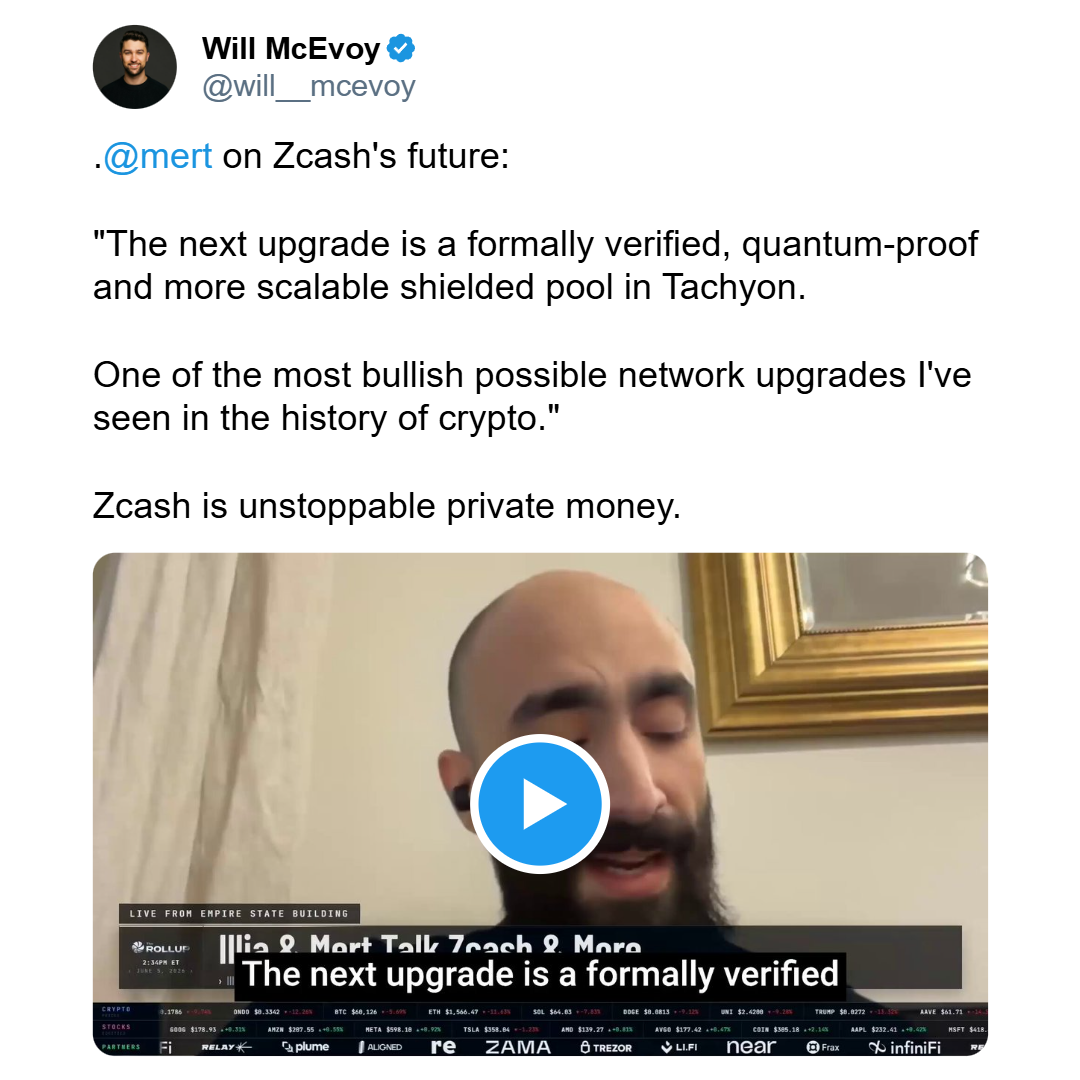
Formal verification aims one level deeper, at whether the rulebook enforces what the protocol claims to. That is exactly the gap Zcash is now trying to close.
At the end of the day, the likely final state of crypto isn't every line of code formally verified. It's a secure core, including consensus, bridges, wallets, token accounting, virtual machines, compilers, and ZK circuits, that is small, explicit, and machine-checked, with the messy edges free to move fast around it.
What's at stake is bigger than any single exploit. It's whether crypto can offer anything beyond speculation. I’ve touched on, more than once, how the math of DeFi no longer checks out: you risk your principal to earn 4 or 5% a year, while the same capital on perps or a memecoin carries a shot at 10x. Through this lens, it’s quite understandable why “degeneracy” abounds. The risk-reward is simply better.
 David Christopher
That's the real cost of an industry that can't prove its core won't break. If putting money onchain means accepting it can disappear in one bad circuit, one stale contract, or one broken bridge, the only products that survive are the ones which offer returns to justify those risks. That leaves us with an onchain financial system whose promised utility is not worth the technical hazard. It undermines trust in tech intended to be trustless, which certainly contributes to the current malaise felt by those in our industry.
Formal verification is what can change that equation, separating casinos with APIs and financial infrastructure worthy of replacing our archaic, existing systems.
Bitget’s Stocks 2.0 brings 500 major equities and ETFs (like Tesla and NVIDIA) directly to your portfolio. Enjoy 1:1 mapping, deep liquidity, and USDT dividend payouts with ultra-low 0.04% fees.

Bankless
It’s time to break up with your bank, and join the movement for a better world.