DeFi's Due Diligence Super Tool
Transparency doesn't equal legibility, so Herd is turning DeFi vaults into something humans can actually audit.

To navigate DeFi cautiously, you can read docs, check analytics, deposit small, prune approvals, and so forth. But still, if you don't truly understand what you're using, and how it connects to other onchain money legos, you can get burned all the same.
The big challenge when it comes to modern DeFi vaults specifically is that they aren't single contracts you can readily digest on Etherscan. Today, just one vault position can touch 100s of interlinked smart contracts like adapters, wrappers, operator wallets, etc.
For instance, consider the recent Summer.fi exploit. Attackers extracted ~$6M by weaponizing a functionally worthless Stream Finance-tainted token three layers deep inside one of the +60 adapter positions across the project's two affected vaults. The curators (i.e. the risk managers who set and maintain vault strategies) never caught the dependency, as it was off their radar.
Fortunately, it's precisely these sorts of blind spots that Herd is now bringing vision to.
new homepage 😇
— ilemi (@andrewhong5297) June 22, 2026
an inventory of Herd's core offerings:
- Token balance sheets with risk reporting and monitoring (in beta)
- MCP/CLI block explorer (never manually browse etherscan again)
- Human readable contracts and transactions, with deeper data than any other platform… pic.twitter.com/JIRuP6gpJc
It's the project of Andrew Hong, the former  Dune Analytics "Headmaster," who just walked through the current intricacies of DeFi vaults with David Hoffman on the latest Bankless episode.
Enjoying this article?
Subscribe to Bankless or sign in
I learned of Herd through this convo, and after doing more digging through the project's docs and blog, I'm a believer. Its offerings are obviously much needed in crypto, where radical transparency exists, sure, though dense illegibility has reigned.
 Bankless
Zooming in then, you can think of Herd as a specialized block explorer fused with AI research tooling, currently live on  Ethereum and Base. The three main pillars as far as features go are:
- The Explorer, a human-readable alternative to Etherscan that surfaces decoded transactions, contract roles + permissions (i.e. who can move funds and how), and version diffs across upgrades.
- DoubleClick, which turns any token or vault into a live balance sheet graph that maps every reserve, wrapper, and counterparty behind it. Assets on one side, liabilities (i.e. everywhere the token gets rewrapped and redeployed downstream) on the other. This UI would've exposed Summer Finance's bad-debt stowaway, for example, and it's how Hong's team dissected the exploit after the fact.
- The Herd MCP, a resource for AI agent workflows that lets you plug Herd's entire explorer system into Claude, Codex, or Cursor. From there, you can ask your agent to decode transactions, inspect a contract's permissions topology, profile wallets, trace a vault's allocations, etc., and all via regular text commands.
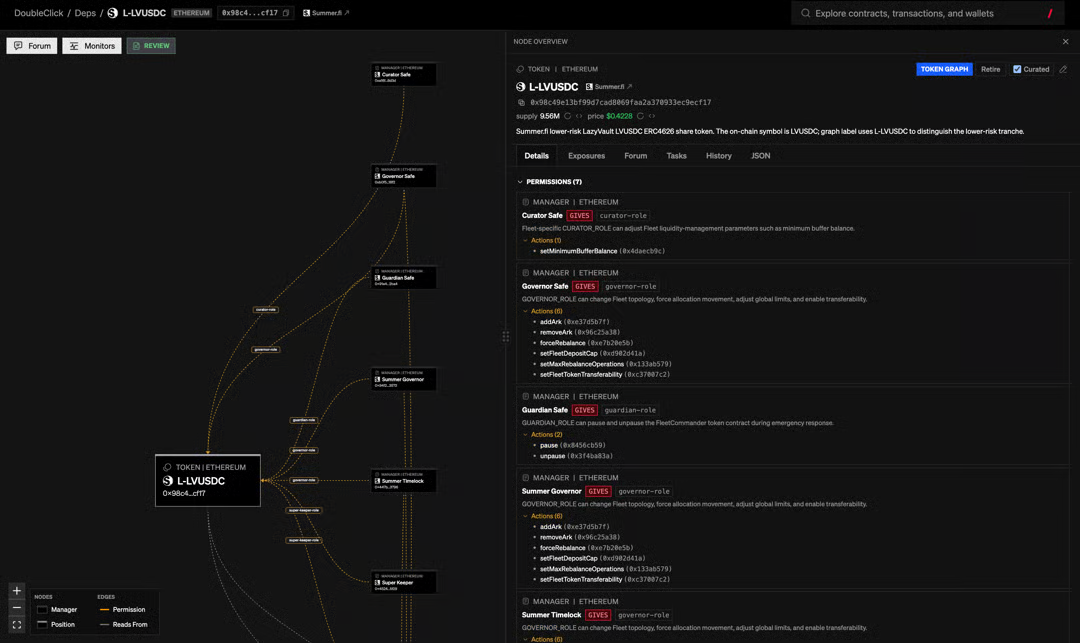
Notably, DeFi teams like Steakhouse and Chaos Labs already use Herd, though do note that the platform's DoubleClick graph system is gated behind a private beta at the moment (which you can request access to just by supplying your email on the Herd website).
That said, you can freely start experimenting with the Explorer and Herd MCP today. And even if these resources are more technical than you care to tinker with, the good news is they'll benefit all casual DeFi users as more protocol teams, curators, etc. adopt them toward better understandings—and better disclosures—of their projects' weak links. That's the vision.
"[T]he industry needs to be more transparent about the risks depositors are getting into," as Hong said on X yesterday, adding:
"Just showing a yield number and a rating I think is a recipe for financial disaster [...] and is how we will end up back at 'banks' and fully centralized solutions again."
I agree. We don't need superficial, incomplete scorings. The way to the fully mature version of DeFi will require different stakeholders having the capability of bird's-eye view comprehension. Herd's a great step in that direction, so consider it for your onchain toolbox accordingly.
William M. Peaster
William M. Peaster, Senior Writer, has been with Bankless since January 2021. Immersed in Ethereum since 2017, he covers the onchain frontier with a particular interest in art, games, and other culture apps. He has a background in creative writing and writes fiction in his free time.