Breaking Down Ethereum's Fusaka Upgrade
The much-hyped protocol upgrade goes live tomorrow. Here's what it brings to Ethereum.


Ethereum's Fusaka upgrade is finally almost here.
The hard fork marks the second major protocol update of 2025 — proof that the network can iterate at an ambitious clip without sacrificing stability.
What started as a broad roadmap with 45+  Ethereum Improvement Proposals (EIPs) has crystallized into a focused package of 12, all centered on making Ethereum cheaper, faster, and easier to use. PeerDAS — the ability for nodes to verify data without downloading everything — spearheads this effort, with everything else either supporting that scaling goal or network accessibility.
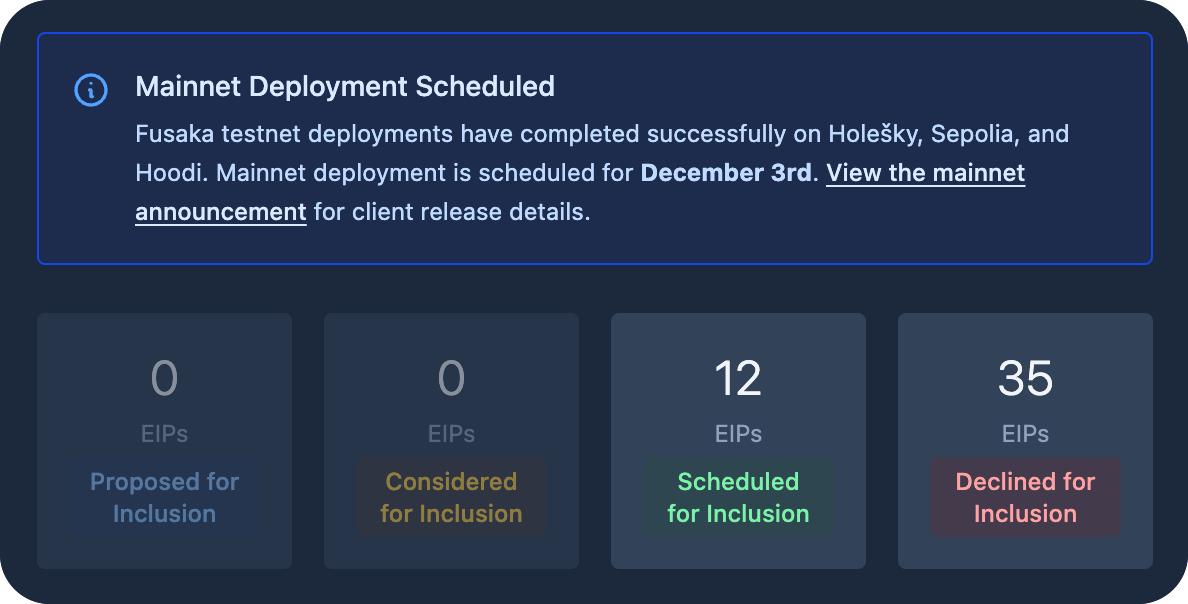
Let's take a look at what's actually changing 👇
For Users
The headline improvement is simple: Layer 2 transactions get significantly cheaper.
PeerDAS (EIP-7594) enables rollups to post more data to Ethereum at lower costs, which in turn passes savings directly to users through reduced transaction fees. Combined with improvements to how blob fees work (EIP-7918), costs become not only lower, but also more predictable over time rather than spiking unpredictably during high demand.
On the wallet side, Fusaka brings passkey support (EIP-7951). Instead of managing seed phrases, you can sign transactions using your phone's built-in biometrics — Face ID, fingerprint sensors, the security features already built into billions of devices. In other words, this EIP brings wallets up to the security standards people already expect from modern apps, further lessening the divide between “everyday” applications and “crypto” applications.
Ethereum is about to 10x the wallet UX.
— Jarrod Watts (@jarrodwatts) November 27, 2025
The Fusaka upgrade includes EIP-7951 - support for the signature scheme that the iPhones use to power things like Face ID.
Meaning you'll soon be able to sign transactions with your face.
Huge win for bringing normal people on-chain. pic.twitter.com/7Ad38m4Oxz
For L2s and Builders
Fusaka gives Layer 2s room to grow while laying groundwork for instant-feel applications.
8x Data Capacity
Just like for users, PeerDAS will benefit L2s and nodes. By enabling nodes to verify network state with only a fraction of blob data, PeerDAS effectively lessens the load on these operators, allowing them to 8x their throughput while keeping hardware requirements reasonable. For rollups, this means significantly more space at lower prices — the capacity to serve exponentially more users without hitting Ethereum's bottleneck.
Adaptive Scaling
Blob Parameter Only (BPO) forks (EIP-7892) let Ethereum increase data capacity between major upgrades. After Fusaka, the network can coordinate to bump blob counts from 6 to 9, then 12, and beyond — without waiting for another hard fork. This gives Ethereum flexibility to respond to L2 demand in real time rather than making rollups wait months or even years, for the next upgrade.
Enjoying this article?
Subscribe to Bankless or sign in
Sustainable Fee Markets
While PeerDAS lowers costs, the blob fee floor of EIP-7918 acts as something of a necessary countermeasure, preventing pricing from collapsing during low activity, ensuring L2s always pay a meaningful price for the resources they use. This upgrade keeps the network economics sustainable as the ecosystem scales, while also making costs more predictable for builders planning long-term.
Near-Instant Confirmations
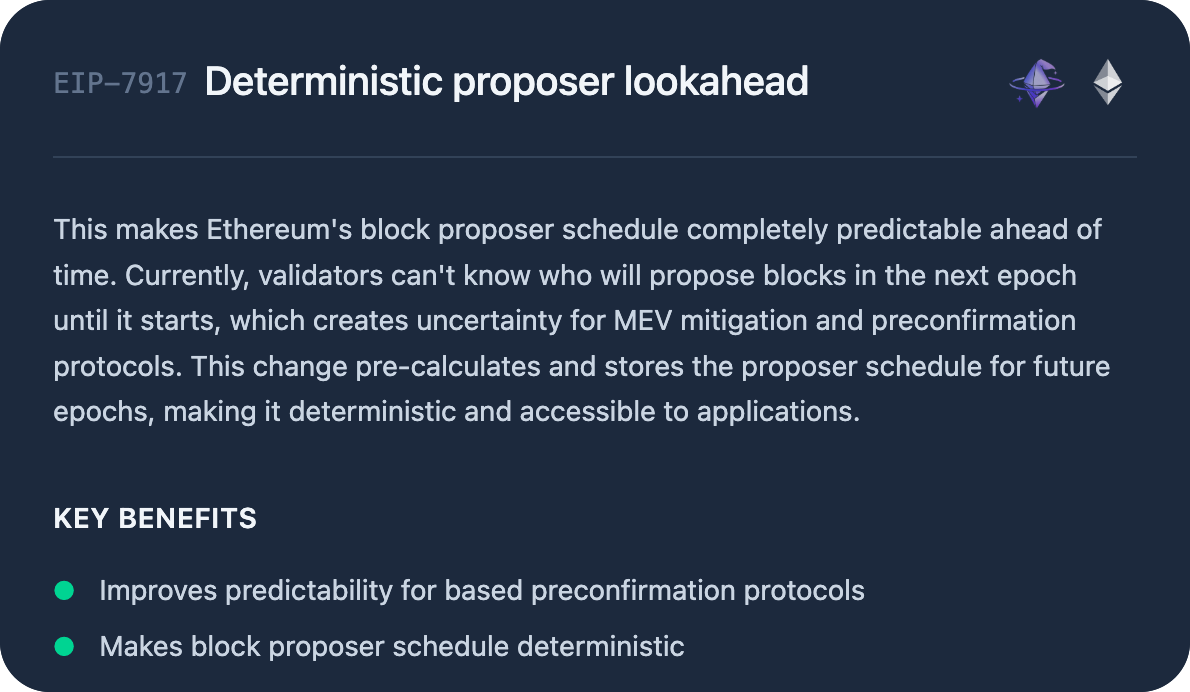
Deterministic proposer lookahead (EIP-7917) makes the block schedule completely predictable, enabling based preconfirmations — commitments from upcoming proposers that guarantee transactions will land before blocks are produced. Instead of always waiting 12+ seconds for confirmation, users could see instant feedback — a timely upgrade as the perpetuals landscape keeps heating up, and also useful in cases like gaming.
More Throughput
The gas limit rises to 60M (EIP-7935), up from 45M, increasing network capacity by roughly 33%. A transaction gas cap (EIP-7825) at 16.7M keeps individual transactions from dominating entire blocks. Together, this means more room for complex contracts and batch operations without constantly hitting limits.
Then we have the smaller improvements that round out the builder experience. A new opcode (EIP-7939) makes certain complex mathematical operations significantly cheaper. Fixes to cryptographic functions (EIP-7823, EIP-7883) eliminate underpriced operations that could be exploited. A block size limit (EIP-7934) prevents oversized blocks from causing network issues. None of these are headline features, but together they harden Ethereum for higher throughput.
1/ The Fusaka upgrade is coming December 3rd.
— Ethereum (@ethereum) December 1, 2025
Ethereum is securely scaling.
Are you ready to support the changes?
Here’s what developers across the ecosystem need to do to prepare 🧵 pic.twitter.com/aHArhmJWnX
For Node Operators
Fusaka grows Ethereum's capacity while keeping node operation realistic for regular people.
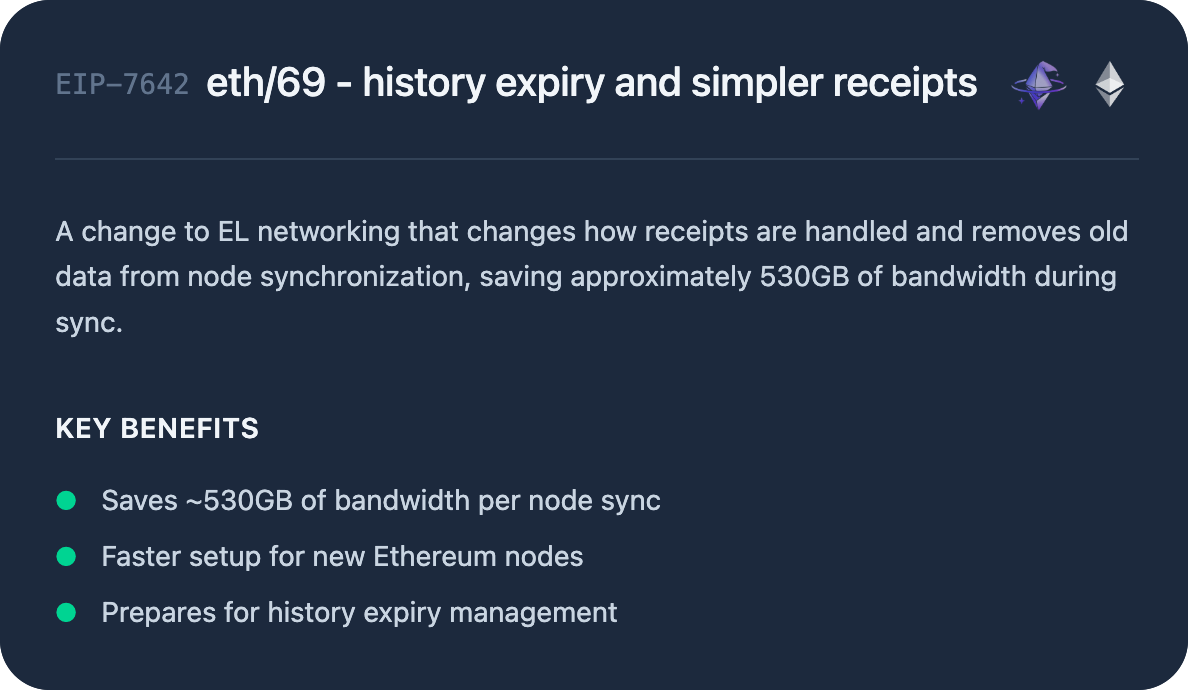
With PeerDAS dramatically cutting data requirements, full nodes will store only 1/8th of blob data, slashing bandwidth by roughly 80%. Solo stakers will see around 50% reduction in the bandwidth they need to download network data, though the bandwidth they need to upload network data will increase 2-3x initially (rising to 5x as blob counts grow over time). History expiry (EIP-7642) drops old pre-Merge data, further reducing disk space for new operators.
Overall, Ethereum gains massive capacity while keeping solo staking viable. You won't need datacenter-grade hardware to run a node, even as the network processes significantly more data.
The Bottom Line
While it may seem like Fusaka is all about pragmatic upgrades to the network and the experience of using it, it also makes progress on Ethereum’s original promise: making digital systems more accessible, more efficient, and less dependent on intermediaries.
- For users, it's cheaper fees and wallets that work like the apps they already trust.
- For L2s, it's ensuring the economics to keep the network growing.
- For builders, it's infrastructure that enables instant-feel applications.
- For node operators, it's sustainable scaling without requiring everyone to lean on centralized cloud providers.
We should all be quite proud of Ethereum and its ecosystem. Two major upgrades in one year — Pectra in May, Fusaka tomorrow — demonstrate that the Ethereum Foundation is heeding feedback to accelerate network development, showing us that the change ups earlier this year really did mark the beginning of a new era for the network. While many challenges lie ahead, I for one am confident Ethereum will continue to address them, coordinating efficiently and executing on what matters.
Ethereum is securely scaling, unlocking the next era of onchain growth.
— Ethereum (@ethereum) December 1, 2025
You can celebrate the Fusaka upgrade at the @ethStaker community watch party.
> Fusaka goes live: Dec 3, 2025 at 21:49:11 UTC.
> Watch party starts: 21:20 UTC, ~30 mins before
Links to join are below ↓

David Christopher
David is a writer/analyst at Bankless. Prior to joining Bankless, he worked for a series of early-stage crypto startups and on grants from the Ethereum, Solana, and Urbit Foundations. He graduated from Skidmore College in New York. He currently lives in the Midwest and enjoys NFTs, but no longer participates in them.