




Subscribe to Bankless or sign in
My previous article was about why I'm still bullish on crypto games. However, I think it's also worth pointing out that I'm excited for the new kinds of resources that crypto and cryptography can make possible around games.
For instance, I'm a very high level Moira in Overwatch. That only means something to me, but it's also only known to me and to the game developers at Blizzard. The reputation is siloed in Blizzard servers and lacks composability with other infra, whether offchain or onchain.
It'd be nice if my XP, achievements, badges, and etc. were open instead and portable beyond just one company's servers or my PlayStation or my PC. You could build new experiences this way. For instance, let's say I wanted to airdrop tryout invitations for an esports team to the top 20 European support players over level 300. If the data was open and composable and interoperable, then I could programmatically generate a shortlist of candidates and then send them an invitation + claimable sponsored wallets to cover their tryout costs, all in just a few button clicks.
That'd be pretty cool to say the least, but it's also just one trivial example of what we can imagine up around games. This use case and endless more like it could be powered by what we might call an Open Achievements system, which could act like a universal gaming credential layer (and could also be connected with any other credential layer, in any direction).
How to build it, though? It would need to be built atop a broader and frankly unprecedented system, so here I turn again to 0xPARC's programmable cryptography research, which I touched on in my recent piece about the prospects of onchain social apps + hallucinated servers.
Specifically, 0xPARC researcher gubsheep has conceptualized the Universal Protocol, an adapter that would use cryptographic primitives (zkSNARKs, recursive zk, Multi-Party Computation, plus more theoretical mechanisms like Obfuscation) to translate and privately compose among any data sources, e.g. Xbox achievements, Overwatch ranks,  ENS profiles, DeFi holdings, Twitter accounts, government IDs, credit reports, and so forth. None of these sources would need to share a common standard since this adapter would speak all their languages, as it were.
Enjoying this article?
Subscribe to Bankless or sign in
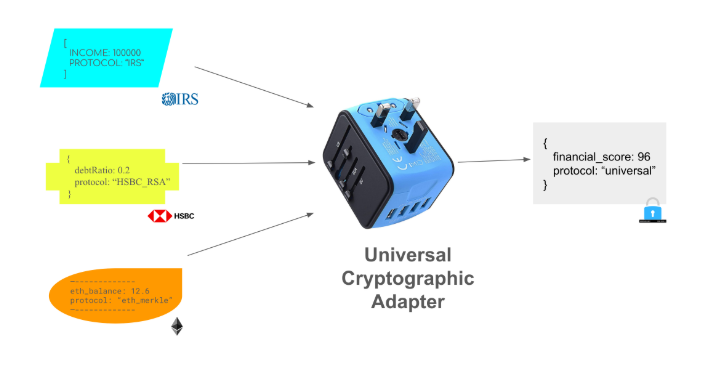
Importantly, for this sort of system I also wouldn't need Blizzard's sign-off to pipe in my Moira level info, or any sort of "walled garden" data like that. With an open protocol like TLSNotary, I could generate a proof that Blizzard's servers have in fact confirmed that achievement to me. And then voila, that aspect of my reputation could be liberated for tons of different uses via something like gubsheep's conception of a Universal Protocol adapter.
I'm simplifying a lot, but this brings me back around to my idea of an Open Achievements system for gamers. It could be like a tooling layer built on the components I've mentioned above, namely for easily formatting and composing with gaming credentials through a universal cryptographic adapter.
And I'll concede that this might sound like a silly or overengineered idea, but conversely I'd argue that it's mindboggling how many new use cases it would open up. For example, if a new crypto game wanted to target beta testers with lots of experience in specific mainstream games, they could run a query through a system like Open Achievements, and then get an anonymized list of potential invite candidates that they could airdrop claimable NFT access keys to.
That's just one example I have top of mind, but it's clear to me that we'd be limited mainly by our imaginations here. And of course, it goes without saying that a universal cryptographic adapter would have implications far beyond just gaming. It would eventually stretch across all the personal and professional aspects of our digital lives, e.g. accounting, healthcare, social profiles, work milestones, and metaversal achievements, among other things.
Ultimately there's still plenty of research to do here, and we'll need more advances in cryptography to get to the point where such a universal adapter (and thus the things we can build in and around it, like Open Achievements) becomes feasible in production. But I think it's important to start thinking and dreaming about these kinds of possibilities early, and particularly in the crypto gaming scene where there is so much soul-searching going on right now.
Don't despair too much, then, because what's coming will be good. We are moving toward a point where neither identity nor reputation nor apps (in the case of hallucinated servers) will be constrained by any single company or even physical servers. Today it's impossible to envision all the different use cases that will arrive from this paradigm, but the grand hope is to actualize a digital world where the people working and playing in it are always put first, rather than the other way around.


