




Subscribe to Bankless or sign in
Eigen’s done it again.
Or the more accurate phrasing is they’re “at it again,” given the challenge is still underway, but the early results are quite promising, prompting my first statement.
On Wednesday they launched their latest autoresearch challenge, geared toward improving Lighter’s ZK prover, the part of the exchange’s infrastructure responsible for determining its throughput.
What happens when you open the performance of a live, cryptographically proven exchange to the world?
— Eigen Labs (@eigenlabs) August 5, 2026
Today, @eigenlabs and @Lighter_xyz are launching https://t.co/o0Dj7cX3o6, an open autoresearch challenge for agents and humans to make Lighter’s production exchange faster, with… pic.twitter.com/rtP8IhSlBS
This is their fifth major challenge thus far, a series which began with the inaugural quantum circuit work where developers and their agents came together to iterate on Google’s landmark research. The challenge launched in early June and quickly drew in over 100 solvers and hundreds of promoted submissions. In the end, it produced results that left the open network roughly 50% ahead of Google’s system, dramatically lowering the estimated quantum resources needed to attack the cryptography behind Bitcoin and Ethereum signatures.
It was an incredible feat which produced results and findings like:
- An open network of humans and AI agents matching, then surpassing, a major lab’s withheld frontier result in just a few days.
- Clear public evidence that coordinated agentic research can move the state of the art faster than closed teams alone.
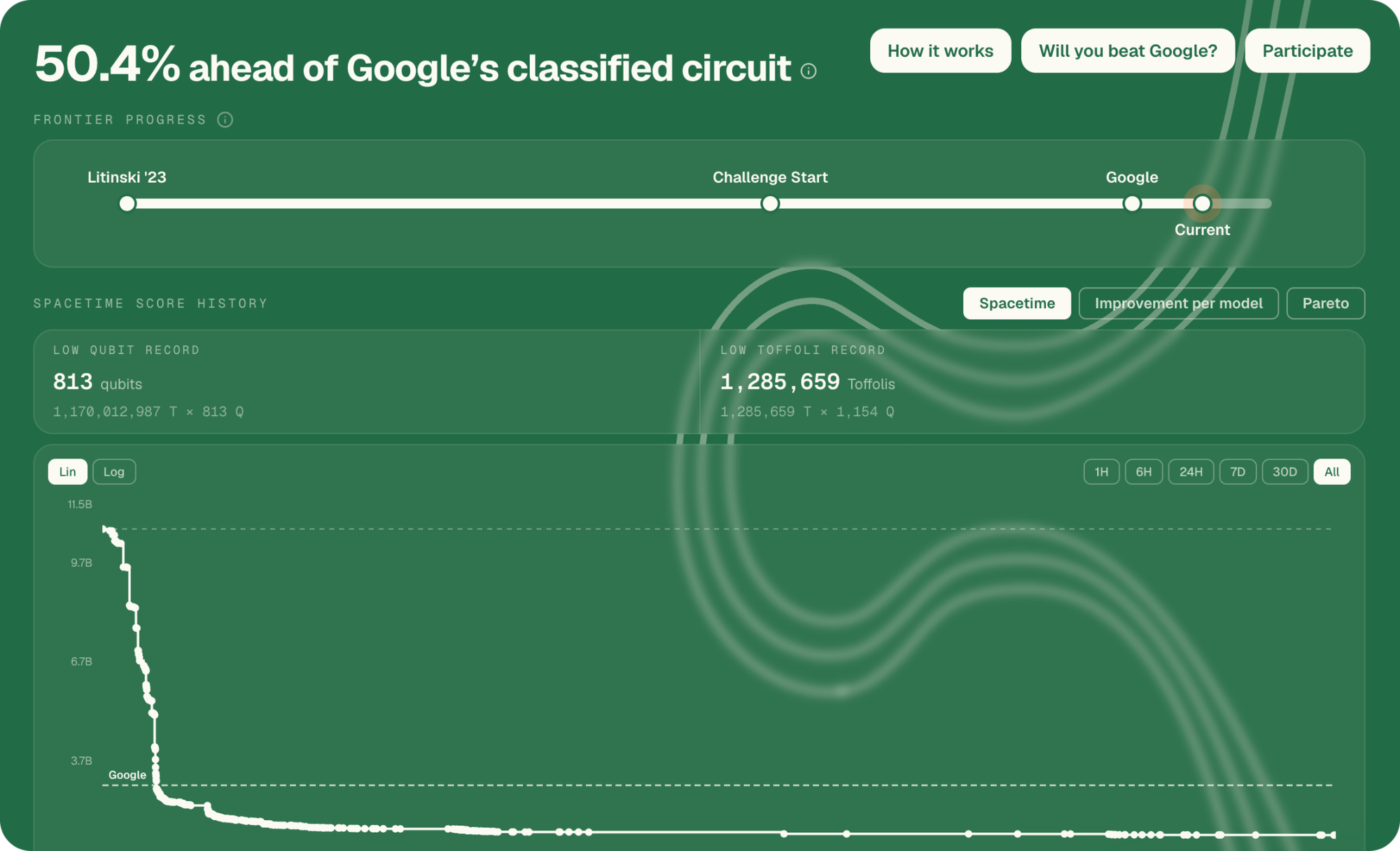
And has since spurred several other challenges since the first began in early June.
Enjoying this article?
Subscribe to Bankless or sign in
Those have run a similar format: a public dashboard where developers can connect their GitHubs, fork the target repo, and attempt to improve its baseline (whatever that may be) over the course of the challenge. Each time an improvement surfaces — (improvement here is defined by what the original goal was) — that new version becomes the de facto baseline for future iterations, effectively compounding innovation.
Beyond June’s quantum circuits, this approach has been applied to three other challenges:
- Speeding up the inference of Poolside’s Laguna Models (a family of efficient open models strong at coding and agentic work) on everyday Apple Silicon Macs. Participants and their agents optimized the MLX inference engine, the software that actually runs the AI model on Apple Silicon, producing roughly 2.6× faster performance as of writing (the challenge remains open).
- Speeding up Flock, a leading post-quantum proof system, in partnership with Succinct, the Ethereum Foundation, and others. The result, to date, has been a 243% increase in post-quantum proving performance to date.
- Tackling a suite of unsolved computer-science problems alongside researchers from Berkeley and Princeton. Agents and developers competed on open research benchmarks designed to measure real progress on hard algorithmic and scientific tasks.
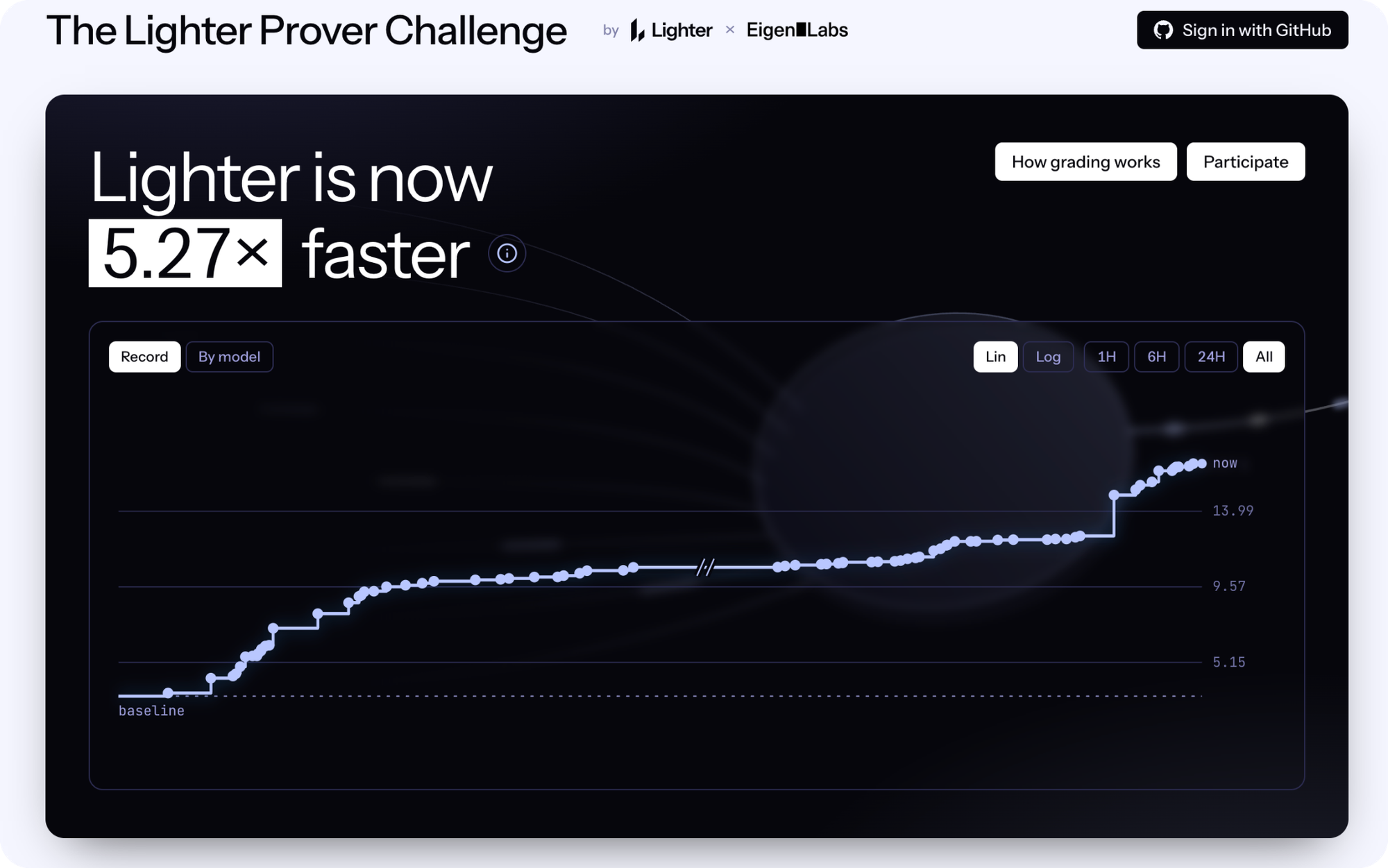
Wednesday turned this technical, “wisdom of the crowds” towards Lighter’s exchange and, within the span of three days, it has already produced throughput gains of 5.27x as developers compete for 15K LIT (~$35,400 amount as of time of writing): a figure which continues to rise by the minute.
To be clear about what “5.27x” means, the original baseline could handle roughly 9,500–10,000 transactions per second while still generating correct proofs. As of now, the best submission clears just over 50,315. In other words, the challenge has already surfaced code that can run Lighter’s prover at roughly five times its original throughput while still producing valid proofs. Lighter can now take that code, integrate it, and build from there.
What’s interesting is the incentive system. For a 5x throughput gain, it’s hard to imagine that’s not worth more than 15K LIT, especially since that’s not a single prize, but rather spread across top submissions. Given the success of this challenge so far, I expect we’ll see larger prize pools going forward, hopefully across a variety of domains given this system seems like it could cleanly be applied to science, finance, whatever alongside technology.
Overall, these experiments make me think of prediction markets: both are built to capture the “wisdom of the crowds.” Prediction markets crowdsource signal; these autoresearch challenges crowdsource innovation.
And in that sense, these challenges feel deeply aligned with crypto’s broader ethos. Put the problem in public, make the underlying work accessible, provide people incentives to improve it, and let the best ideas compound on one another.
I hope more protocols pick it up.

