


Subscribe to Bankless or sign in
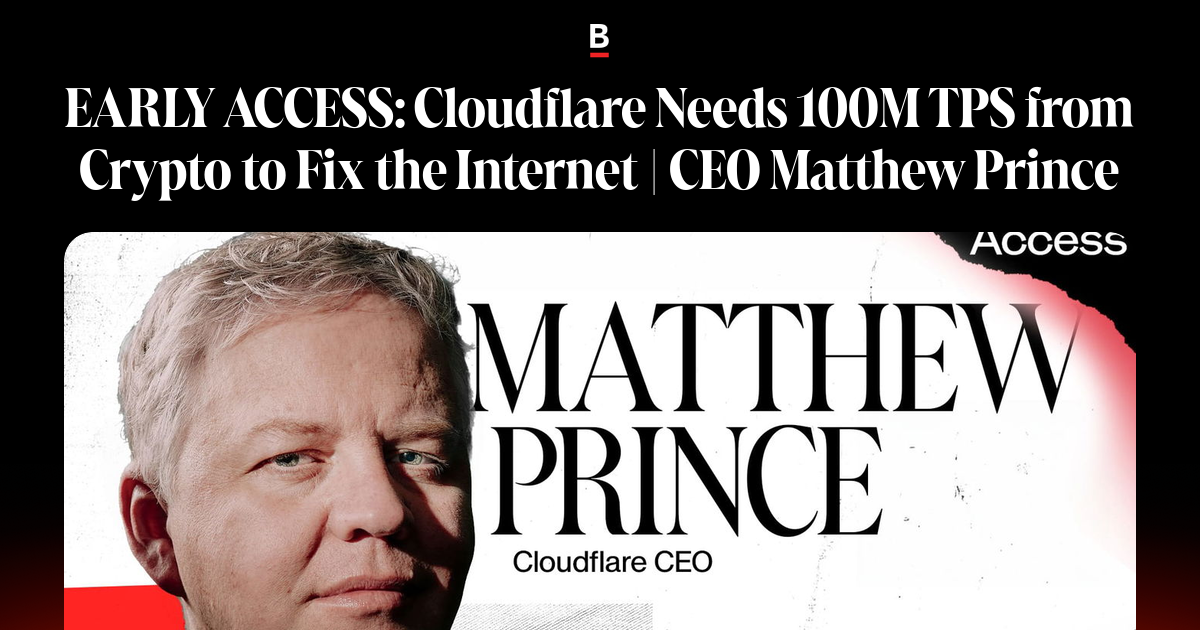
Cloudflare sits in front of about 20% of the internet, giving CEO Matthew Prince a clear view of bots outpacing human traffic. He expects the internet's current business model to break in the first half of next year, driving the final nail into the ad model's coffin.
As  Marc Andreessen highlighted on Bankless in 2022, internet ads became the micropayments the internet never had. Human eyeballs drifting over a banner ad, and maybe even clicking in, financed the content that fueled the internet's growth.
Yet bots don't click on ads, meaning this model no longer works.
Since AI Overviews became Google's default in 2024, referral traffic from Google itself is down 20x,  OpenAI 1,500x, and Anthropic 60,000x. AI companies are taking the work, returning nearly nothing, and selling the output back to readers. Prince's read is understandably bleak: independent publishers go first, then publishing more broadly, if nothing changes.
Prince sees a solution though in stablecoins and x402 that Cloudflare's building towards: letting websites gatekeep their content and force agents to pay a microtransaction to consume what their human orchestrator asked for.
He just needs a 100 million TPS blockchain to make it work.
INTERVIEW: The CEO of @Cloudflare thinks
"we are on the cusp of a golden age of content creation"
....because AI Agents + Stablecoins can shift the internet from an ad-based business model, to direct monetization
Cloudflare is working on their $NET stablecoin in order to… pic.twitter.com/pBHsO08SsH— Bankless (@Bankless) May 21, 2026Enjoying this article?
Subscribe to Bankless or sign in
What Cloudflare Built First
Step one began last July with Content Independence Day, when Cloudflare gave every customer a switch to block AI crawlers. The key word is switch. Many sites, including Cloudflare itself, want their content in the LLMs, and Cloudflare actively helps those sites get scraped efficiently. The point isn't blocking. It's that once a publisher can withhold access, they can price it. Without withholding, there's nothing to negotiate.
x402 is actually designed to be a mechanism to monetize against scrapers (pay-per-scrape), as well as enable scraping APIs to monetize via LLM tool call (ie Firecrawl)
— kevin (@kleffew94) March 19, 2026
Check out:https://t.co/LXQyLjBFdK
The 100M TPS Problem
The next step is monetizing the access publishers allow. Cloudflare's answer is a three-layer toll gate: pay-per-crawl as the gate, x402 as the payment standard, NET Dollar underneath for settlement.
NET Dollar, or more precisely the chains underneath it, is the bottleneck. Prince estimates 1-10% of the 500 million requests Cloudflare processes per second are monetizable, meaning a chain would need to support 5-50 million transactions per second of stablecoin settlement. The fastest blockchain he's tested only does 2 million. Tempo, Arc, Base. None can do it yet.
We need a blockchain with 100 million TPS to save the internet.
Prince's Vision for the Future
If the rails get built, Prince sees content economics following Spotify's path: AI subscription revenue pooled and streamed to creators when their material is used to generate answers. This may even create a "request-for-content" model, he explains, where AI companies request original, hyper-local content that they can't synthesize. We're already seeing this premium exemplified in the price points Reddit's able to charge for licensing its data, a dynamic which may actually give indie publishers an edge if executed correctly.
In the end, this shift presents a real chance to eradicate slop and usher in an era where original thought gets surfaced and repeatedly rewarded. Despite the sheer amount of restructuring that needs to be done,
Prince is optimistic, and so am I. Be sure to catch all his thoughts in our latest podcast episode, too.
 Bankless