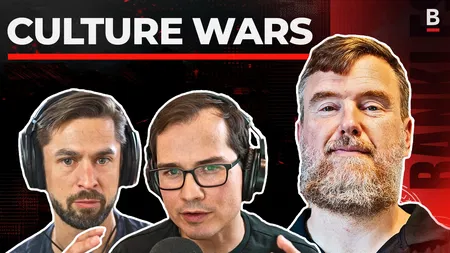
The Case for Authoritarianism | Vitalik Buterin & Noah Smith
Downfall of Liberalism?

Up next
All episodes 00:18:51
Podcast Premium
00:18:51
Podcast Premium
DEBRIEF: The Greg Lukianoff Interview
 01:34:51
Podcast
01:34:51
Podcast
Why We Should Fight for Freedom of Speech | Greg Lukianoff
 01:16:49
Podcast
01:16:49
Podcast
ROLLUP: ETH Beats SEC! | Trump Coin? | LayerZero Token | ETH ETF Trading Soon
 00:31:35
Podcast Premium
00:31:35
Podcast Premium
PREMIUM: EthCC 2024 with Co-Founder Jerome de Tychey
 01:47:54
Podcast
01:47:54
Podcast
Diaries of an ETH Maxi on Wall Street | Sam Jernigan
 00:51:29
Podcast
00:51:29
Podcast
ETH to $22k by 2030? | VanEck's Matthew Sigel
 00:14:42
Podcast Premium
00:14:42
Podcast Premium
DEBRIEF - The Richard Teng Interview
 01:14:19
Podcast
01:14:19
Podcast
CZ, Bull Market Predictions & The Future of Binance | New CEO Richard Teng
Inside the episode
What if the information anarchy of the internet spells the downfall of liberalism?
Economist Noah Smith and Ethereum Founder Vitalik Buterin join us for a fascinating discussion on why Authoritarianism might be the answer to the current information warfare. Yes, you heard that right.
We start the episode by defining liberalism, how it has brought excessive polarization and why totalitarianism might be the only solution left. We then steelman the case against this same argument and how blockchains and crypto could play a role in all this.
TIMESTAMPS
0:00 Intro
8:53 Defining Liberalism
21:50 Information Warfare
42:17 Summarizing the Argument
55:09 Could the Thesis be Wrong?
1:11:12 Information Leviathans
1:34:13 The Role of Blockchains
1:38:22 Closing & Disclaimers
RESOURCES
Transcript
The Chinese government and the Russian government have a lot of resources devoted to pushing their message out there. And the US government doesn't,
right? Liberalism doesn't. US government sits back and says, you know, from an Olympian remove and is like, I am the overall mighty hegemon of information. And so I'm going to let all these tiny little actors play it out, you know. And then one of those tiny little actors is the government of China, a country four times the size of the United States, with, you know, arguably a higher GDP than the United States.
Welcome to Bankless, where we explore the case for authoritarianism. What did I just say? What? Get into that. This is Ryan John Adams. I'm here with David Hoffman, and we're here to help you become more bankless. Now, I want to make it clear before we get into this episode both of our guests today do not want authoritarianism to win the 21st century. Okay?
Quite the opposite. I think both have dedicated their lives in various ways to pursuing anti-authoritarian ideas and in Vitalik's uh case technologies. So today's episode is more of a steel man. The question is: if totalitarianism outcompetes free societies and wins the 21st centuries, how might it win? And
what if the information anarchy of the internet spells the downfall of liberalism? This is a fascinating conversation with Noah Smith, who is an economist, and Vitalik Butrin, who you know from crypto. I would call this topic a non crypto topic today, but actually game theorizing on how the authoritarians might beat us might just be the most crypto thing ever, David.
Bankless were, of course, known to be a crypto podcast. But if you are a longtime listener of Bankless, you know that at the end of the crypto rabbit hole comes conversations on how do we structure society and which structures do better than others, and how should we prepare for uh unfavorable structures like authoritarianism and how can we prevent that in the first place? And with this episode, we kind of skip straight to the bottom of the rabbit hole, talking about how technology is changing, society is changing, and how that's going to impact the way that society is organized. So, without further ado, let's go ahead and get right into the conversation with Vitalik Buterin and Noah Smith. But first, a moment to talk about some of these fantastic sponsors.
Bankless Nation, we are very excited to bring on two uh repeat guests. We have Noah Smith, he's an economist. He writes on his substack called Noah Opinion. He writes about current events, macro, econ, geopolitics, some philosophy mixed in. Is there anything that Noah does not write about? Noah, welcome back to Bankless.
Hey, great to be back.
We also have Vitalik Buterin. He is a uh philosopher, I would say, in the context of today's conversation. And uh you probably know him as a co founder of Ethereum. Vitalik, welcome to Bankless as well.
Thank you. Good to be back.
So we are doing this episode on a post, uh, an argument that Noah put out on his Substack. And uh the title of that post is How Liberal Democracy Might Lose the Twenty First Century. And I want to provide some context for why we're having a bankless episode on this. Like, isn't bankless a crypto podcast? And this is certainly a crypto-adjacent topic, but um I guess I'll I'll give some framing for this. You know, when I read Noah's article, I was kind of um a know your enemy type of reaction uh for me because bankless listeners will know we are very much a friend of uh liberalism in um you know, lowercase L, you know, civic rights, free speech, free markets, private property. We want that to succeed. I mean, we have a horse in this race. And I think in order to help it succeed, you have to understand the points at which it will fail. Liberalism, that is. So in the in the past, I think, especially in the in the way that I was brought it brought up, I've been guilty of a blind faith in liberalism. You know, like it'll obviously win. I think I'm sort of a maybe, maybe a victim of just like a child in the US, like growing up in the 90s. Uh, and I don't want to live in a blind faith of like liberalism will always win. I want to live in an actual reality. And I think that's why Noah's article was so uh instructive. And so uh Noah has this argument for how authoritarianism might actually outcompete Western liberal democracies. And Vitalik, I think you called his argument. I saw a Farcaster uh a tweet about this.
The strongest case for authoritarianism. So uh I I think you thought it was a pretty good case. And I know you have some takes here. So that's what we're gonna do in today's conversation. Number one, we want to just frame out the argument. So have Noah explain it, and maybe Vitalik have you help. And then two, we want to talk about maybe the counterpoints to this argument. And then three, we want to finish off with where do we go from here? Does that sound good?
Amazing. I'm getting thumbs up. All right. So let's start with you, Noah. So let's let's frame this up because I think we need some um background. Can you just explain what we mean by liberalism and why so many of us have uh this blind faith in it? I can't be the only one. So explain liberalism and and why uh it just feels like everybody thinks that that liberalism has has won already, uh at least in the West.
Well, so when people say liberalism, there's really, I think, um three things that they mean.
The first thing is markets, your
right to basically buy and sell stuff if you want. The second is and own stuff, et cetera, property rights, all that. The second is um democracy, your ability to elect your leaders. And the third is kind of uh civil rights, your ability to kind of
do whatever you want.
As long as it doesn't hurt anybody else, of course, that's always being who knows what that really means. But but that's those are sort of the three things people mean when they say liberalism. Um, your ability to elect your leaders, live your life the way you want to, and buy and sell stuff.
Okay, so Noah, why yeah you start the article this way. Why were we raised in this this age? And you say you were raised in this age of liberal triumphalism, like this this sense that liberalism has won already?
Right. So in the in the 20th century, at the beginning of the 20th century, people we we were just in the middle of uh the industrial revolution, the really fastest part of it. And people kind of didn't know how society was going to be organized. There were a lot of I different ideas about how we were gonna organize an industrial society, and nobody really knew what that was gonna look like.
And varieties of socialism from evolutionary socialism, you know, which is basically what
Sweden looks like now, to, you know, revolutionary socialism, which is basically, you know, I don't know what North Korea or something, Cuba maybe looks like now. Um so, and then and then of course you had various other things, social Darwinism and um and you know
um various kind of racial supremacy theories. And then you had
uh, you know, in the United States, the the big idea that everyone was pushing was that both
Free, you know, free enterprise, which is what we now call economic liberalism. Free enterprise and democracy were both good things. And that was the best way to organize society, or at least American society. So that so these there were sort of all these hats on the ring of what uh you know society is going to look like once we move from farms to factories and offices.
And um, and I think that by the end of the 20th century, that question had been answered, you know, in in favor of liberal democracy by most people. Uh, you know,
in in China.
uh which was still you know still a lot poorer than America at that time, they were,
you know, experimenting with various ways to liberalize the society, and people, you know, were were experiencing many
kind of new freedoms, uh new personal freedoms, and uh, you know, economic freedoms and sort of personal freedoms, if not democracy, right? They didn't have democracy, but but you could certainly you could do a Mao impersonation as a joke in 2004 or something. You, you know, and lots of people did this professionally. Yeah, these Mao impersonators, they were women by the way, who
And so um, and so
you know, and of course, Russia had the Yeltsin period, and um, and even in the early Putin period, people thought like, oh, Putin's gonna be a liberal, blah, blah, blah, because he had the support of educated, sort of liberal thinking elites in the city. And so
by the, by the end of the 20th century, by the 1990s and early 2000s, I think that people generally thought, okay, this is what works. It was Francis Fukuyama's uh you know thesis, The End of History, blah, blah, blah.
And so I think that now it's the strength of China that's really challenging that. And not just the strength of China, but the weakness of the United States. So the so the United States has looked remarkably weak since um
at least 2008. So in the War on Terror period, the United States looked kind of
angry and pissed off about 9 11, was becoming less liberal.
But then in 2008, you know, the United States economic
you know, model sort of appeared to have collapsed the kind of financialized uh capitalism that we had. And then in, you know, after the election of Trump and the the, you know
Divisive rise of social media movements, I would say. People started asking, okay, is this society just total chaos? And then after that, you know, we we started discovering all these things that our society had lost, seemingly lost the ability to do, like build housing, right? Or build trains, or build literally anything. And so, so America got this uh image as the build nothing country. And China almost seemed a mirror image of that. Whereas in China, you could build anything you want because the government just says do it and you do it. And um, you know, China was economically growing and strong. And then if you go to their cities, you see giant, glittering new malls and massive high train stations and beautiful high speed trains that can take you anywhere really fast. And you see um, you know, LEDs on all the buildings, right? And then and then drones delivering stuff right to your doorstep. I don't know, or little, little delivery robots anyway. And so then um
So all of these things I think have caused people to question
was Fukuyama
not just wrong, but the opposite of right?
Is
Uh, you know, is China-style authoritarianism actually gonna win now? Is that is that the model that that works now? And so I was trying to think, okay, how could that be true? You know, of course, it's possible that there's no model that really works and it's all just contingent in the fact that China happens to be this really big country that has historically authoritarian instincts and happens to be only at a third of American per capita GDP anyway, and uh, you know, is sort of in its rising phase and looks really strong and just happens to be really big, and it's all just this big illusion, and they put LEDs on the buildings, but actually they don't really look that nice. But I want to steel man the idea that authoritarianism is going to win in the 21st century. And I thought, okay, so how do I do that? Right. And I thought.
What was the strength of liberalism? Why did we think it might have succeeded in the 20th century? And why might that l uh strength turn into a weakness now in the 21st century? And the only thing I could think of was the internet. That's the only thing that's different now. Like, people aren't different, like very much, right? We're tiny, we have less lead poisoning, maybe. I don't know. But like, you know, industry isn't that different. Like there's a few different things. The main thing that's different now, between now and 1992, is the internet.
And so I was thinking, how could the internet have totally changed the game in terms of whether liberalism or, you know, sort of, I don't know, authoritarian, totalitarianism, whatever,
naturally is stronger. And so I thought, well, the internet's all about information. So what's the strength of liberalism with regard to information? The strength of liberalism with regard to information, everybody will tell you, Friedrich Hayduk will tell you, Friedrich Hayek will tell you, and a lot of people tell you, it's to aggregate information. So briefly, Hayek's theory is that a market aggregates information about costs and uh and preferences, and that you know, you know what to produce, right? Producers know what to produce because they know what people want to buy and they know what their costs are gonna be gonna be. And you consumers know what to consume because you know they know what the producer costs are gonna be. And so that analogously, you can think of democracy as revealing information about what voters want.
And you can think of you know civil society as revealing information about how people want to live, right? People argue about whether they like this or that music, I don't know. Or um
Uh, whether they think gay marriage is okay. So then you you aggregate this stuff with public debate, the marketplace of ideas. So you can think of liberalism as this giant information aggregator.
Now,
how does the internet change that? Well, the internet um makes information aggregation much easier,
right? So we can get information much more easily. Maybe that actually reduces the benefit of liberalism because it reduces, you know, you can an authoritarian state can get much better data about what to produce, what to tell people to produce.
And uh, you know, an authoritarian state can get much better in you know, information about whether the voter whether the citizenry is angry and you need to respond to what they want.
And you can get much better information about what kind of things, what kind of behaviors you can restrict with only pissing off a few people, well, versus what kind of behaviors you you would piss off everybody by restricting. And so authoritarian states can get all this information from the internet, especially with AI, especially with sort of universal surveillance, kind of the your phone is like a surveillance device that tells you everything about what everything you do in your whole life can send to a central party apparatus or some authoritarian organ and um tell you everything about you. And so now maybe that information gathering has gotten so easy for authoritarian states. Now, now that doesn't mean I think they're better at it because of technology, but maybe they're less bad. Maybe they're they still have a disadvantage, but it's ameliorated, right? It's it's less bad than it used to be. Meanwhile, what advantage maybe there were some advantages that authoritarian states always had over liberal states that have gotten worse or have gotten more pronounced in the age of the internet. So, for example, uh disadvantages of liberalism that were always there that have been exacerbated by the internet. And so I was thinking, okay, well, uh, in the internet, we spend all our time on Twitter just arguing, and the smartest people in the world are wasting their time arguing on Twitter, like with complete idiots who think that, like, you know, they're like, but did you adjust the inflation-adjusted graph for inflation? And like, how many times, like, is it is it worthwhile to have the highest IQ people on the planet sitting there explaining once again that yes, inflation adjusted means you have adjusted for inflation? Thank you very much. And so that's, you know, giant waste of time. And so when I look at financial capitalism, I look at, you know, Elon Musk literally had to drive himself nuts to just to get funding for enough funding to build some cars. Whereas the people who run BYD did not in China, right? They did not have to drive themselves nuts. Maybe they're nuts anyway. I've never met them, but Elon.
had to basically break himself with stress over the Model 3 rollout raising money to do this thing because the f uh funding wouldn't wouldn't give him the money just, you know, because like, oh, cars, cool. And like and so maybe um maybe this is analogous to a lot of things in financial capitalism. Maybe the idea that uh fundraising for long-term projects is so goddamn hard
That uh because everybody is out there saying, it'll never work, it'll never work, and then people are there, it will work, you know, or just bullshitting, pumping and dumping and blah, blah, blah, blah, blah. That in order to keep the fickle market focused on a very long providing capital for a very long-term project, uh, you know, for a large public company, maybe that's just not possible. And that's why GM and Ford and all these old line companies seem so unresponsive, is because the everything is just quarterly earnings. And it's this information tournament where you have to, you know, if you really want to invest for the future, you've got to spend inordinate excessive amounts of time uh, you know, on the internet yelling that you're good.
Um, and so maybe this was always a problem with financial capitalism, and I think it probably was, but now that the internet allows massive real-time dissemination of bullshit information, like all the people who said the model three would never work and would break Tesla and Tesla would die and it would never nobody would buy it and it would never succeed. Right? They're all those people and they're like, Tesla Tesla's gonna fail, Tesla's gonna fail. And then, you know.
That that is what required Elon Musk to drive himself nuts fundraising. And I think that that maybe that is so so I think of this as an information tournament. You've got people yelling bullshit, and you've got people yelling truth, and truth does not automatically drive out bullshit because bullshit is very easy and cheap to generate, right? You don't, um
it's really easy to make a misleading graph.
You know, it's hard to make a graph that teaches you something. It's easy to make a graph that if you decide on your point ahead of time, you just want to bullshit. It's easy to make that graph. It's easy to make bullshit arguments from an ideological standpoint. It's like an ideological ideology is like a muscle suit. So everybody just, you know, herps their derp, as I as I would love to say. Um, and so everybody just throws their ideology, you know, into the into the ring and it just becomes this giant shouting match. And so meanwhile in China, they're just like, okay, there's just one ideology, it's Xi Jinping thought. What is Xi Jinping thought? Well, it's it's not really anything interesting. It's just this one dude, and he's sort of a boomer conservative, and he's like, let's make some cars, duh.

Ryan Sean Adams
Crypto investor going bankless.
.png-336efc5e35995e6b184e7e830baa688b.png)

.jpg-48bb3b8a9a7a83dee5836f716023f733.jpg)
.png-a616dc52961c1edd72b0c1fdf5f47e7a.png)
.png-cde5b9c0aa4838d09c634abbd1136ff2.png)