The Standard Reserve Is Building a New Kind of Bank Onchain
The Standard Reserve turns bank charters into soulbound NFTs and monetary policy into code.


I've always had a soft spot for DeFi x NFT crossovers, and there's a particularly intriguing one revving up on Robinhood Chain this week.
The project, The Standard Reserve, wants to become a new kind of sovereign onchain banking system. It's an experiment, to be sure, but it's got the potential to generate a lot of activity, so let's catch you up on the big ideas here.
What's up
The Standard Reserve is planned as a de facto central bank protocol that will answer to no one, only to its programmable onchain monetary policy.
Created by developer 0xBeans, TSR is kicking things off with its Genesis Charter Mint today.
The Standard Reserve is coming on September 14.
— The Standard Reserve (@standard_rsv) September 10, 2026
Both audits have found 0 critical vulnerabilities, reports will be made public before launch.
More details coming over the next few days. pic.twitter.com/ylv6F7BVbB
Why this, how it works
Consider what we've seen with reserve currency plays before like Olympus DAO and OHM, i.e. emissions printed on a fixed schedule regardless of demand, sell pressure outpacing buyers, then downward spiralling, etc.
TSR's answer to that old pattern? Make its own issuance responsive instead of scheduled, tying it to one main signal, namely ETH flows, instead of a preset curve.
As such, the entire TSR system is designed to run through one market, which is an ETH/STANDARD pool on Uniswap v4 that's governed by a custom hook. Every epoch, that hook measures net ETH flow into and out of that pool.
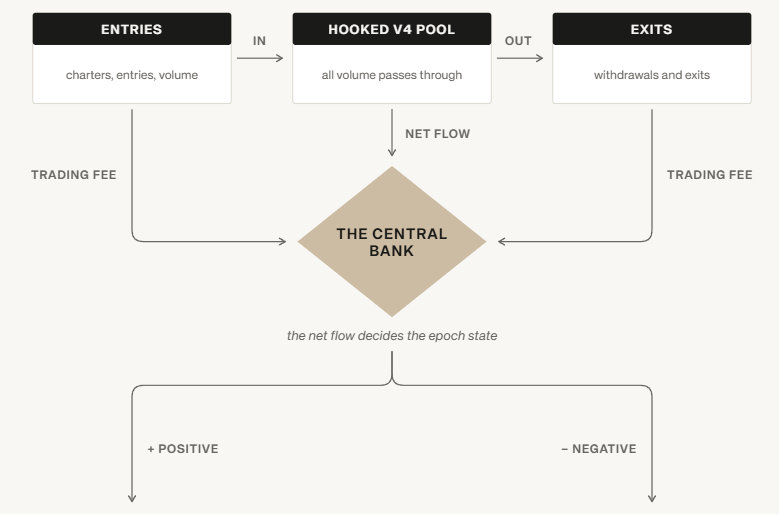
Positive flow triggers expansion, i.e. issuance climbs, and fees route to a vault that buys tokenized gold and deepens liquidity. Negative flow triggers contraction, i.e. issuance gets cut immediately, and fees flip to buybacks and burns instead.
STANDARD itself is the protocol's native currency, which is capped at 1B tokens. 100M of these are locked permanently as protocol-owned liquidity and the remaining 900M are in reserve as an issuance budget.
Enjoying this article?
Subscribe to Bankless or sign in
Notably, these tokens only mint when someone withdraws, and they burn constantly through buybacks, exit fees, and TSR's license system, which I'll explain below.
Charters and branches
The NFT element of TSR has to do with its Charters, which are soulbound NFTs that give you the "banker" role.
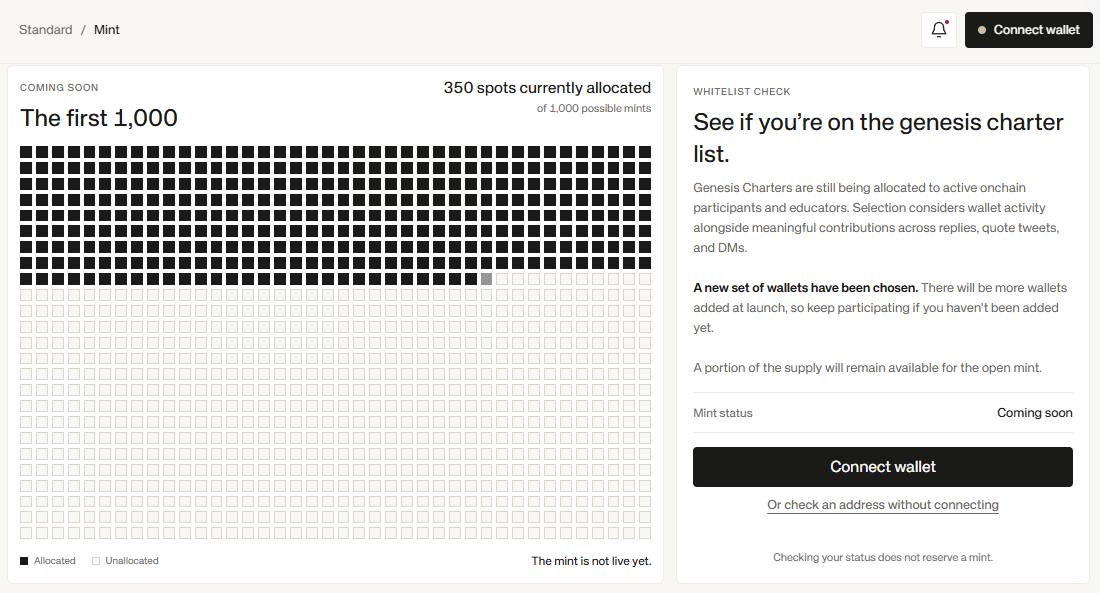
In other words, these nontransferable assets are licenses to earn a cut of the protocol's issuance. There are 1,000 Founding Charters (some allowlisted, some public) going out at genesis. The allowlist opens at 5:30 PM ET with a 0.15 ETH liquidity fee, while any remaining spots will be sold through a public descending Dutch auction starting at 8:30 PM ET at 1.25 ETH and falling toward a 0.15 ETH floor. At 9 PM ET, the auction ends, liquidity is added, and STANDARD trading opens. 100% of mint proceeds go toward initial liquidity and protocol vaults, with none going to the team. New Charters can later be auctioned daily in ETH, though those auctions aren't enabled at launch.
Importantly, each charter opens with one branch and can grow to 10, and every extra branch has to be bought with an expansion license, paid entirely in STANDARD and burned on the spot. The specific benefit? "Each branch is one share of every epoch’s issue," per the whitepaper.
Accordingly, the smartest move an existing banker can make, opening more branches, is also the biggest lever the protocol has for shrinking supply.
To cash out, bankers must retire a branch, which mints your share of the accrued balance to your wallet, minus a resolution fee that scales with how much of the system is trying to exit at once.
Half of the resolution fee burns, while the other half gets paid to bankers who stayed. This dynamic flips the incentive of a bank run, as the ones scrambling for the exit end up paying the ones who hold steady.
Zooming out
We'll have to see how this planned flywheel fares in the wake of its monetary machinery coming online through its charters, expansions, and so on.
Can TSR sidestep the graveyard of reflexive, OHM-lineage designs? Can it become a tour de force on Robinhood Chain? Can STANDARD consistently attract bankers over the long run?
Only time will tell. But I admire 0xBeans's previous work, and I think the banking license NFT model here is smart and innovative. Keep this one on your radar now that the launch is in motion.

William M. Peaster
William M. Peaster, Senior Writer, has been with Bankless since January 2021. Immersed in Ethereum since 2017, he covers the onchain frontier with a particular interest in art, games, and other culture apps. He has a background in creative writing and writes fiction in his free time.