Variational Is Quietly Climbing the Perps Leaderboard
Still in private beta, Variational is already moving billions via its RFQ model.


We've covered Hyperliquid and Lighter a good bit this year, which is fitting considering that these platforms are very dominant onchain perpetuals exchanges.
Yet take note, as there's a fresher challenger becoming a force to be reckoned with in this field, and it's doing so through an app that's impressively still in private beta. This challenger is Variational.
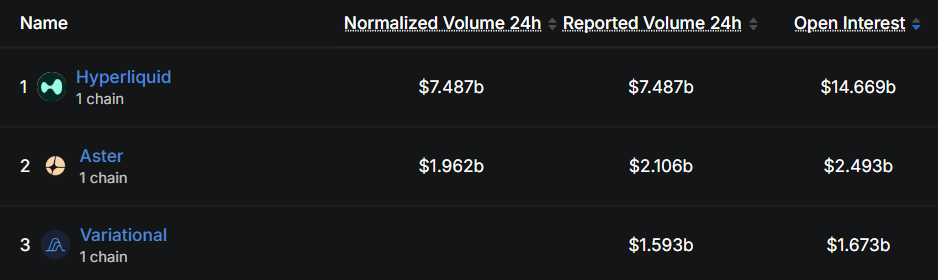
As you can see in my screenshot of DefiLlama's perps tracker above, Variational's facilitated +$1.59B in trading volume on the day, putting it only behind Hyperliquid and Aster in that span. It's also done +$34B in 30D volume, so today's performance is par for the course as of late.
These are encouraging activity levels for a platform that's not fully public yet. But to really grasp Variational's prospects and how the project can set itself apart going forward, it helps to know the big ideas here.
An RFQ play
Order book exchanges like Hyperliquid work well for crypto perps because plenty of market makers are willing to take either side of a trade without knowing who's on the other end.
This dynamic breaks down when it comes to real world assets (RWAs) and other traditional finance instruments onchain, though, because TradFi dealers generally insist on knowing exactly who they're trading with before they'll price and hedge a position.
Here, cue in Variational, which relies on a bespoke P2P trading model instead.
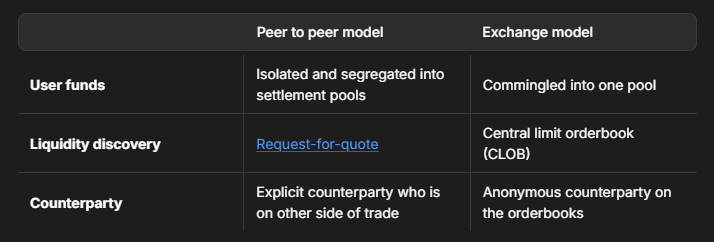
Rather than bootstrap its own order book for every new market, Variational specifically runs as a request-for-quote (RFQ) protocol, i.e. a trader submits an order and the market maker responds with a price, no public book involved.
In practice, this plays out through Omni, Variational's flagship trading app, where the sole market maker on the other side of every trade is the Omni Liquidity Provider (OLP).
OLP prices markets by pulling in liquidity from CEXs, DEXs, and (increasingly) direct TradFi dealer relationships, then hedges its own resulting exposure across those same venues. And since Omni doesn't need to pay outside MMs to bootstrap each new listing, it can afford to run zero trading fees. The protocol instead earns its cut (currently ~20%) from the spreads OLP captures.
On the risk side, the P2P element is that every trader faces their counterparty (i.e. OLP) inside their own segregated settlement pool, which is an isolated onchain contract holding just that user's collateral and positions.
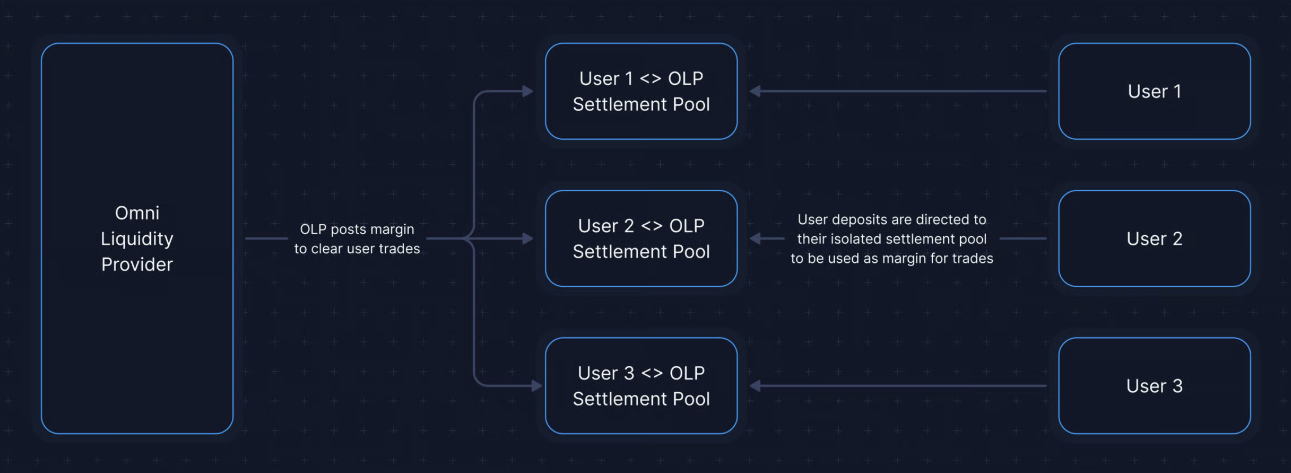
Accordingly, if one trader's position implodes, the damage stays contained to their pool rather than bleeding into everyone else's, with this model marking a stark contrast from traditional exchanges, where losses can end up socialized across the whole platform.
Swaps surge
So Variational's early architecture is interesting and unique, though technical novelty alone doesn't translate to momentum.
Enjoying this article?
Subscribe to Bankless or sign in
For that you need advances, so we must consider catalysts too. The latest major one was the project's September 1st introduction of Swaps to its Omni private beta, starting with the gold (XAU) and Nasdaq-100 (US100) markets and with dozens more on the slate.
Liquidity for more than 100 swap markets have already been sourced through OLP's initial TradFi agreements.
— Variational (@variational_io) September 5, 2026
New commodities, single stocks, and more will be listed in the coming weeks. pic.twitter.com/xzyrBxfWqa
While a Variational perp still behaves like a typical crypto perpetual, i.e. 24/7 trading with a variable funding rate set by long/short imbalance, a Variational swap sources its liquidity directly from signed TradFi dealer agreements, and it charges a predictable carry rate benchmarked to standard USD borrowing costs.
Per a DefiLlama Research spotlight published this week, that structure's predictability and tight execution is already attracting a trading surge. As their analysts noted yesterday:
"In the week since launch, Swaps have processed $2.8 billion in lifetime volume, with total open interest across the three live markets peaking at $245 million on September 8. US100S has emerged as the largest individual swap market, with open interest reaching $83 million on September 8. It also carries the highest trading activity of the three, with 24-hour volume hitting $416 million on the same day."
So you can fairly say we're seeing some early validation of Variational's thesis, namely that dealer-sourced liquidity, rather than an aggregated crypto order book, is a strong natural onramp for bringing traditional markets fully onchain. And if the platform can field this much open interest while Omni's still not fully public, you have to imagine there's plenty more room to grow.
The VAR token
Another upcoming intrigue worth tracking here is $VAR, Variational's planned token.
For now, the main thing we know tangibly is that roughly 50% of the eventual $VAR supply has been earmarked to be distributed to the Variational community over time as allocated through various initiatives.
We can safely assume one of these initiatives is the Omni Points program, which has been running weekly distributions every Friday since it launched back in December 2025, and with boosts stacked atop for referrals, volume achievements, and so on.
For week 38 of the Omni points program, 150,000 points were distributed across 24,618 accounts. pic.twitter.com/3Z5vLUifUw
— Variational (@variational_io) September 4, 2026
Variational's own docs say these weekly drops are set to conclude no later than the end of Q3 2026, i.e. September 30th. That's barely three weeks out, but of course this deadline could very well be pushed back, so we'll have to wait and see what the next official word is here.
Whatever happens, it seems an airdrop is on the horizon, but also consider what else $VAR could be used for. In the project docs, the only explicit potential use case highlighted presently is buy-and-burns:
"Variational may allocate a portion of fee revenue to purchases of $VAR, with acquired tokens burned. Such allocations of revenue and in what amount and frequency, will be determined by the Variational Foundation and may be modified or discontinued at any time."
Thus it also seems likely that in time we'll see some portion of that ~20% cut of OLP's spreads that currently flows into the protocol treasury become routed into either automated or discretionary $VAR buybacks and burns. Directionally bullish, I say.
In the meantime as we look ahead, Variational still has a variety of big roadmap releases beyond $VAR coming, like the Omni public mainnet launch and the rollout of its institutional derivatives trading platform, Variational Pro. If the project can pull these off and keep adding new features and new markets, it can become a dominant force on perps leaderboards for years to come. Keep this one on your radar accordingly.

William M. Peaster
William M. Peaster, Senior Writer, has been with Bankless since January 2021. Immersed in Ethereum since 2017, he covers the onchain frontier with a particular interest in art, games, and other culture apps. He has a background in creative writing and writes fiction in his free time.