Fearing Frontier Labs, Longing Inference Markets
A suspicious OpenAI encounter highlights growing distrust around AI data, and why Venice and onchain inference markets may benefit.


On Monday, Tristan Buckmaster of NYU released a statement detailing an absurd, and somewhat suspicious, encounter he recently had with OpenAI.
For the past year, the NYU professor has been working with a colleague, Anthropic in-house mathematician Levent Alpöge, on a set of elusive fluid dynamics problems, using LLMs like OpenAI's Codex, where they had been putting project drafts. Their research centered on smooth forcing, a niche direction Buckmaster says almost nobody else was pursuing.
After a major breakthrough in August, Buckmaster heard that rumors about their work had reached OpenAI and contacted the company on September 3.
This started a series of conversations best read directly from Buckmaster, but which progressed roughly like this:
- OpenAI told Buckmaster an internal model had produced a forced Navier-Stokes result (involving the famously difficult equations describing how viscous fluids move) using smooth forcing, the same niche direction he and Levent had been pursuing. OpenAI later acknowledged its effort began only days earlier, after hearing the same rumor.
- Buckmaster asked whether the model had seen or been trained on the Codex sessions containing their drafts. He was told it did not "look up user data," but says he never received an answer to the training question.
- OpenAI researcher Sebastien Bubeck proposed coordinating their releases, including an option where Buckmaster alone would present OpenAI's result. Buckmaster says Bubeck wanted Levent removed because he worked at Anthropic, while offering to say the pair deserved the $1M Clay Prize.
- When Buckmaster declined and said he would go public, he says he was asked, "Why would you ruin your career?"
OpenAI denies accessing their unpublished work or using their prompts to direct its agents, though it also says it "cannot rule out" de-identified data from their use of its products having helped improve its models.
We congratulate Levent Alpöge and Tristan Buckmaster on their remarkable mathematical work.
— OpenAI (@OpenAI) September 8, 2026
We (the researchers and the agents) did not see any of their work through any means until they released it publicly — in particular, no specific user data was accessed in order to solve… https://t.co/otJKRHnQgb
Buckmaster stresses that he does not know whether his data was used and is not accusing OpenAI of theft. Still, the strange overlap, proposed credit arrangement, and lingering training question makes me raise one, if not both, eyebrows.
Regardless of what truly happened, what stands out to me is the distrust mounting around these models as their capabilities grow. Personally, I find myself increasingly willing to share more with AI while also increasingly wary of what I share. It's not like people didn't know their data could be used, but that bargain feels more troublesome as the models get significantly better and the information we give them becomes more valuable. Personal agents only push this further, requiring access to our files, work, preferences, conversations, and whatever else we let them touch to actually be useful.
Enjoying this article?
Subscribe to Bankless or sign in
Palantir CEO Alex Karp recently described a similar concern among enterprise customers, asking, "Why would they get access to my data if they're going to build my alpha?"
Amid this debacle, $VVV, Venice's governance token, skyrocketed yesterday, rising roughly 40% to break new all-time highs. The fit is obvious: a private inference platform catching a bid as distrust mounts around frontier-lab data policies.
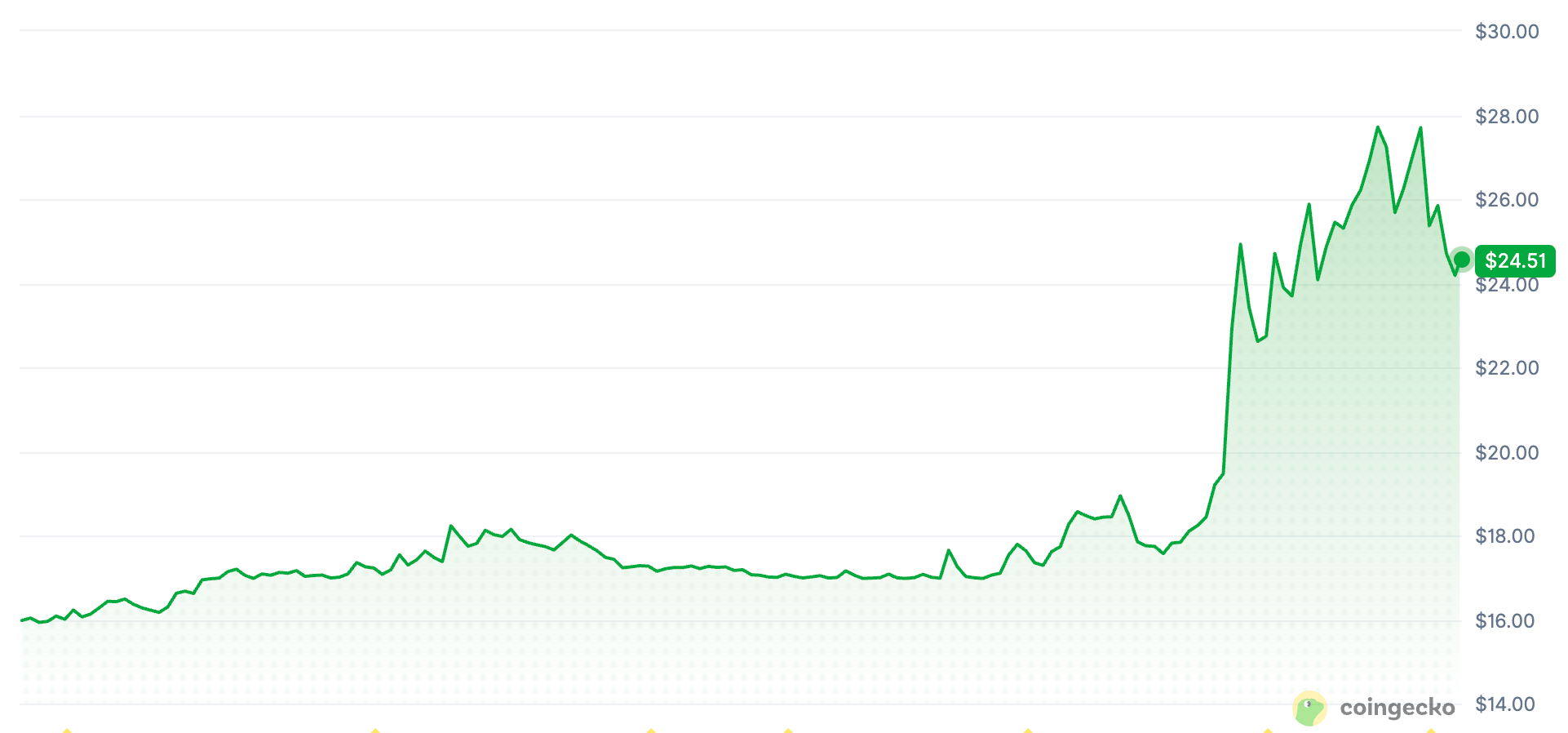
Venice may be the headliner here, but it's only one of a growing number of inference markets offering open, flexible access to intelligence, letting users tap different models for different tasks rather than committing to one provider. In crypto, these markets have been growing particularly quickly around x402, where inference has emerged as one of the protocol's clearest early use cases.
BlockRun, an inference gateway, is currently x402's largest active merchant by transaction count, while Surplus Intelligence saw its largest day ever for requests yesterday. There is clearly demand building for accessing intelligence through these open markets.
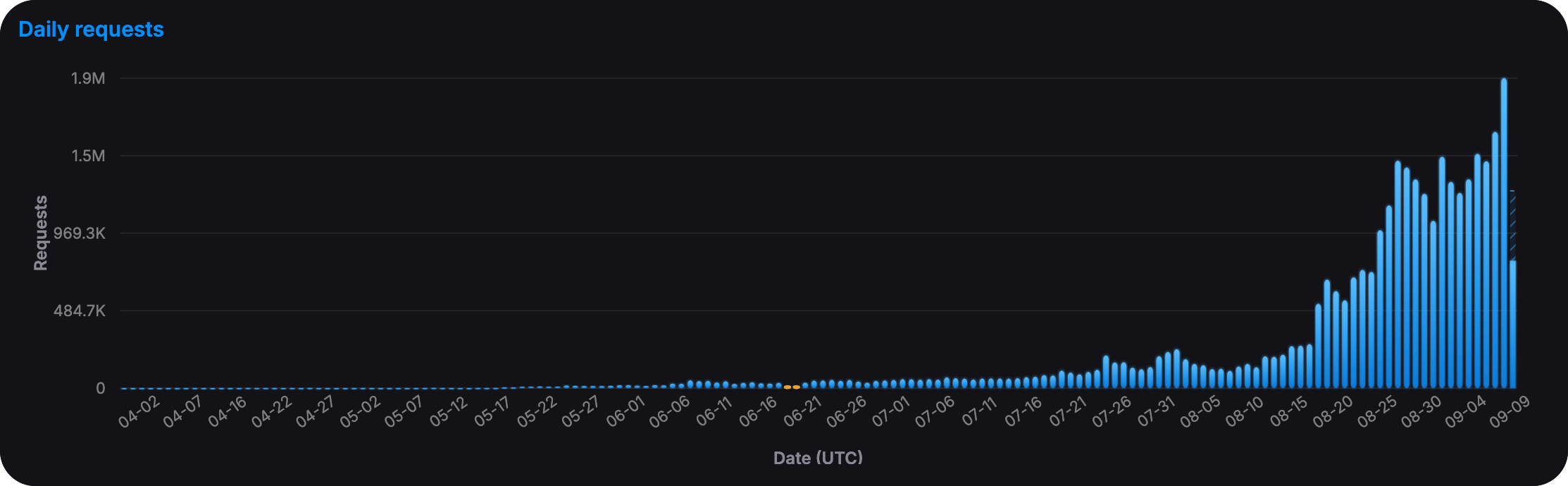
These routes also bring an increasingly relevant privacy byproduct: pseudonymity. Paying from a wallet rather than through an account tied directly to an email, card, or KYC profile creates some separation between the person making the request and the lab ultimately servicing it.
Of course, the end model provider still sees the actual prompt, and highly specific work can identify its author even without a name. But a router can decouple some of the direct link between the user and the lab, while platforms like Venice can go further with zero-retention, TEE, or end-to-end encrypted models.
The catch is that the strongest verifiable privacy today generally requires stepping away from the absolute frontier models controlled by OpenAI, Anthropic, or Google. There remains a trade-off between frontier intelligence and how much control users can retain over their data.
Still, as the information we hand AI becomes more valuable, I expect that separation to matter more. Open inference markets, particularly onchain ones, look like an early step toward more controlled access to intelligence: giving users more choice, abstracting away some of their identity, and creating a foundation on which stronger privacy can be built.

David Christopher
David is a writer/analyst at Bankless. Prior to joining Bankless, he worked for a series of early-stage crypto startups and on grants from the Ethereum, Solana, and Urbit Foundations. He graduated from Skidmore College in New York. He currently lives in the Midwest and enjoys NFTs, but no longer participates in them.