The SEC's Big Shift
Getting crypto policy across the finish line has been a struggle in 2026, but the SEC is pushing clarity elsewhere.

Sponsor: Brix — Access real-world yield in DeFi. Built on MegaETH.

- 💸 SEC Exempts 'Crypto Interface Providers' from Broker-Dealer Registration. New guidance clarifies when crypto interfaces can operate without broker-dealer registration, and where the limits lie.
- 🥷
 Kraken Discloses Extortion Attempt, Says No Client Funds At Risk. The crypto exchange is coordinating with law enforcement to address an ongoing extortion attempt.
 - 🤔
 Circle CEO Defends Much-Critiqued Response to Drift Hack. Jeremy Allaire says that unilateral intervention poses a moral quandary, and wants liability carveouts that shield stablecoin issuers.
| Prices as of 6pm ET | 24hr | 7d |

|
Crypto $2.48T | ↗ 5.2% | ↗ 8.0% |

|
BTC $74,383 | ↗ 5.1% | ↗ 7.6% |

|
ETH $2,349 | ↗ 6.9% | ↗ 10.6% |
The  Ethereum L1 has two kinds of clients, consensus and execution. Consensus clients handle the proof-of-stake (PoS) layer, while execution clients manage Ethereum Virtual Machine (EVM) state, i.e. facilitating transactions and executing smart contracts.
These infra layers aren't always all that flashy, but Reth's reveal of their 2.0 execution client is interesting for a few reasons.
Reth is notably a  Paradigm Research project, built and led by many of the same people behind Tempo, the permissioned, payments-optimized EVM L1 that has stirred plenty of tension in the Ethereum community in recent months. As an EVM solution, Reth supports node operators on both Ethereum and Tempo.
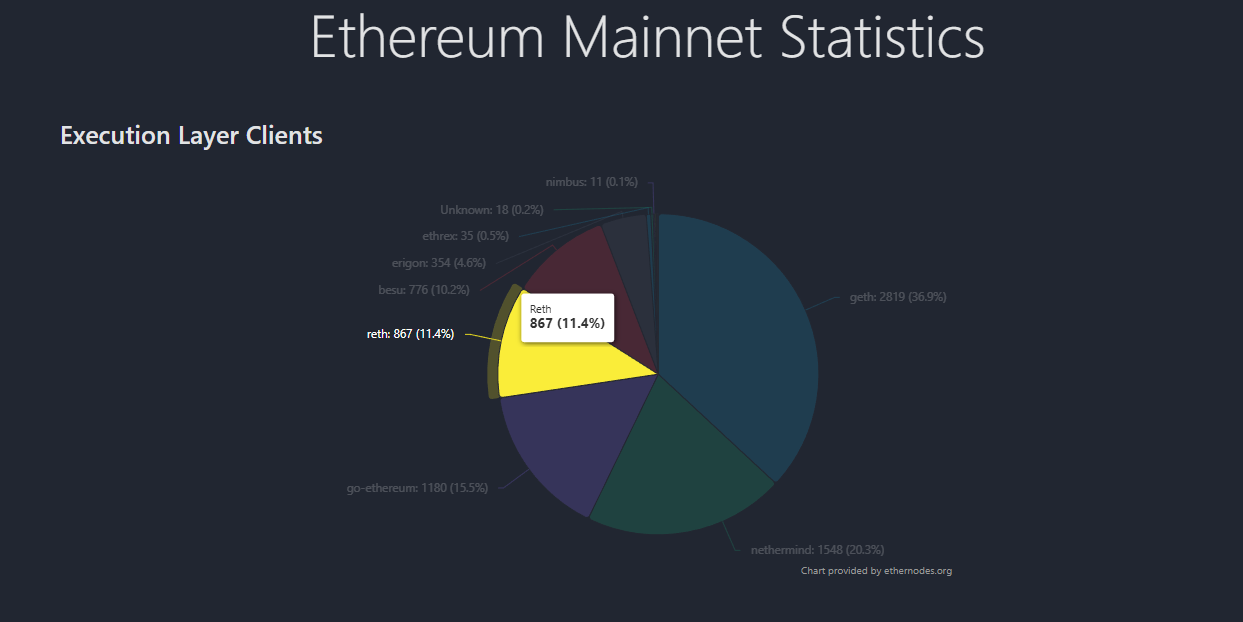
Reth, which debuted two years ago, is also currently the fourth-largest Ethereum execution client by adoption, lagging behind Geth, Nethermind, and Go-ethereum. Are the technical upgrades in 2.0 poised to help the client rise further in popularity?
Let's take a deeper look.
Gigagas Gains
Gas is the unit Ethereum uses to measure computational work. For context, the Ethereum L1 currently has a gas limit around 60 million gas per block, and the average Ethereum block takes ~12 seconds.
By extension, gigagas is the technical measurement for 1 billion gas units. This is why one of the main headliner advances in Reth 2.0 is that the client can now process 1.7 gigagas/s on the right hardware. 1.7 billion gas units of work every second!
Enjoying this article?
Subscribe to Bankless or sign in
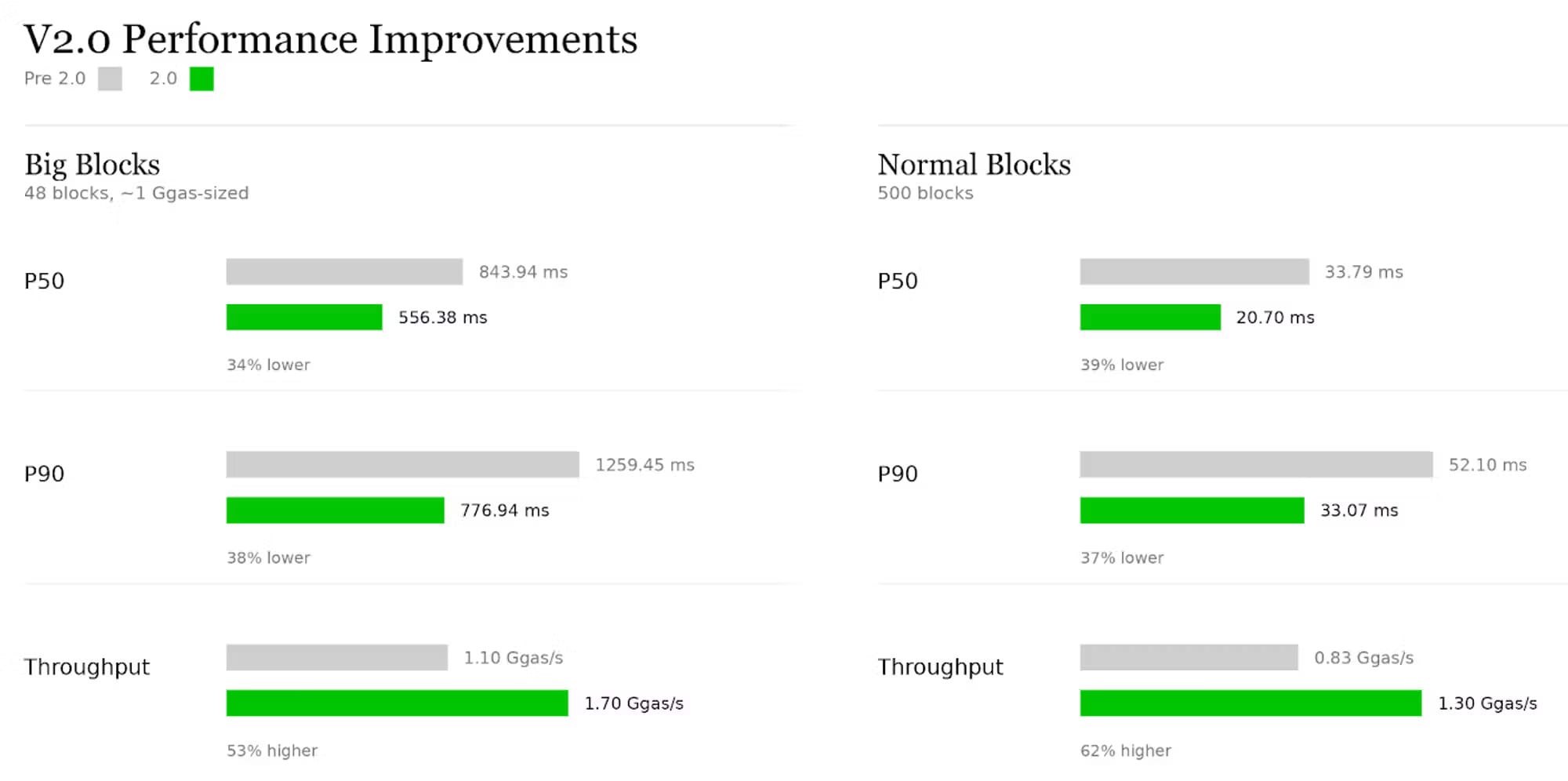
While Ethereum researcher  Justin Drake has discussed (on Bankless!) the path to 1 gigagas per second on the Ethereum L1, the reality is that in today's numbers, Reth 2.0 can already process the equivalent of roughly 28 Ethereum mainnet blocks per second. So, the performance gains here likely have more to do with Paradigm's interest in building for future scaling needs of Tempo's permissioned validator set.
Smarter State & Storage
Every time a block is processed, Ethereum needs to compute something called the state root, which is basically a fingerprint of the entire state of the chain at that time.
Clients have needed to wait for all transactions in a block to finish completing before computations could begin, which created chokepoints.
Reth 2.0 solves this with two improvements working together: a Sparse Trie Cache and Partial Proofs. The former takes snapshots of relevant state between blocks, while the latter essentially halves the amount of data a node has to pull from disk to verify changes. Together these resources bring state root calculation at the end of blocks down to 2 milliseconds or less.
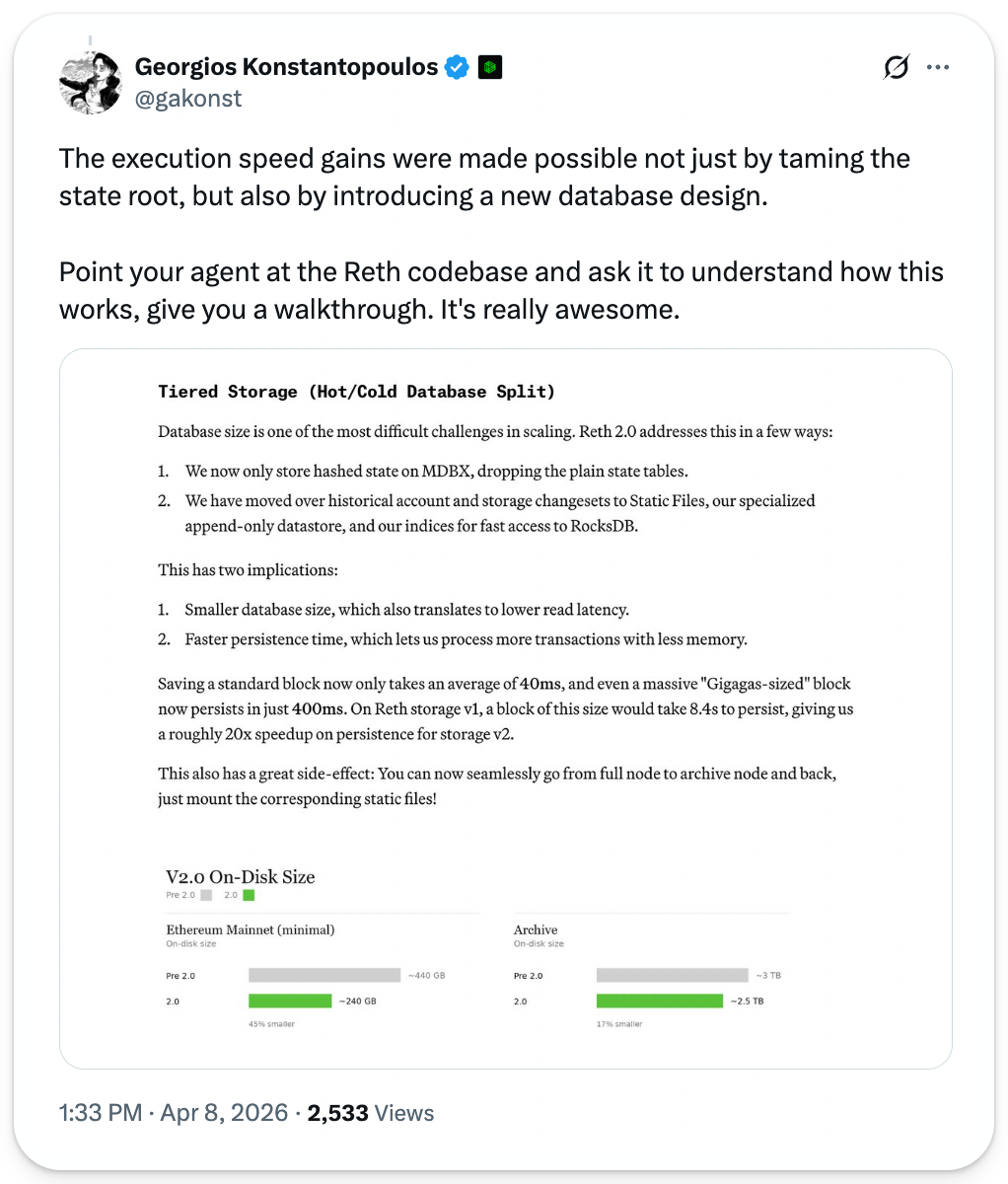
Moreover, Reth 2.0 also overhauls how data is stored. A new "tiered storage" system separates commonly used data from historical records, so that a full Ethereum mainnet node can now fit in less than 300GB, with snapshot downloads as low as 170GB supported.
Instead of taking days, spinning up a Reth node from scratch is streamlined to a couple of terminal commands plus waiting ~10 minutes.
A Tale of Two Nodes
Paradigm was long seen as an indomitable resource for the Ethereum community, and seeing their leadership and research shift much of their time and energy (while also hiring away key open-source talent) to pushing out Stripe's vision of a more corporate-aligned ecosystem has been a bummer.
For their part, the  Tempo team has repeatedly maintained that their work will continue to benefit the broader crypto ecosystem, including Ethereum. Reth 2.0 is at least one concrete data point in favor of Paradigm's position. Tempo node operators can run it just as Ethereum node operators can run it, and this is undoubtedly a significant net benefit to the Ethereum ecosystem in its own right.

Emerging markets provide some of the best yield on Earth. Opportunities shouldn't be constrained by geography or capital. Brix provides access to real yield, not made-up onchain mechanisms. Let the Yield Flow.

Michael Saylor thinks Bitcoin is headed to $21 million, but the real story in this conversation is how he believes it gets there.
In his first appearance on Bankless, Saylor breaks down Strategy’s evolving capital machine, why STRC may be the most ambitious instrument the company has built yet, how he thinks about quantum risk without panic, why his view on Ethereum has become more constructive, and what he means when he says the endgame is giving the world an 8% bank account forever.
Watch the full episode on YouTube 👇

Bankless
It’s time to break up with your bank, and join the movement for a better world.