Prediction Markets Face a Full-Court Press
Kalshi and Polymarket may have a wild road ahead as states wage war on sports markets and the public reckons with insider bets.


Prediction markets have been facing an awfully tough moment in recent weeks.
- The platforms continue to face headlines that underscore the complexity of preventing insider trading from breaking trust in its markets. The U.S. Senate just banned Senators from trading on the platforms at all. Meanwhile, governors from Illinois, New York, and Maryland banned state employees from trading on these platforms. This all comes after the DOJ indicted a sergeant who allegedly used classified intelligence to win over $400K on a
 Polymarket bet.
 - Meanwhile, states are continuing to challenge their most profitable venue: sports wagers. Wisconsin’s attorney general sued five platforms on unlicensed gambling grounds. New York’s AG sued two more on the same theory and joined with 38 other state AGs to back Massachusetts in its case against Kalshi.
While platforms like Kalshi and Polymarket are fighting back with mixed success, critics argue that the platforms are practically indistinguishable from sports gambling and are exploiting gaps between federal regulation and state gambling laws. The massive upside potential for these platforms will require winning the legal battles ahead while also challenging negative sentiment around prediction market integrity.
Sports Supremacy
The 2024 Presidential election may have sold the world on prediction markets' promise, but betting on sports has increasingly become the top entry point for users.
Kalshi cleared over $23 billion in trading volume in 2025. Roughly 86% of that activity was tied to sports. Polymarket reportedly cleared $10 billion in sports trading volume in Q1 of this year alone – its most popular category by far.
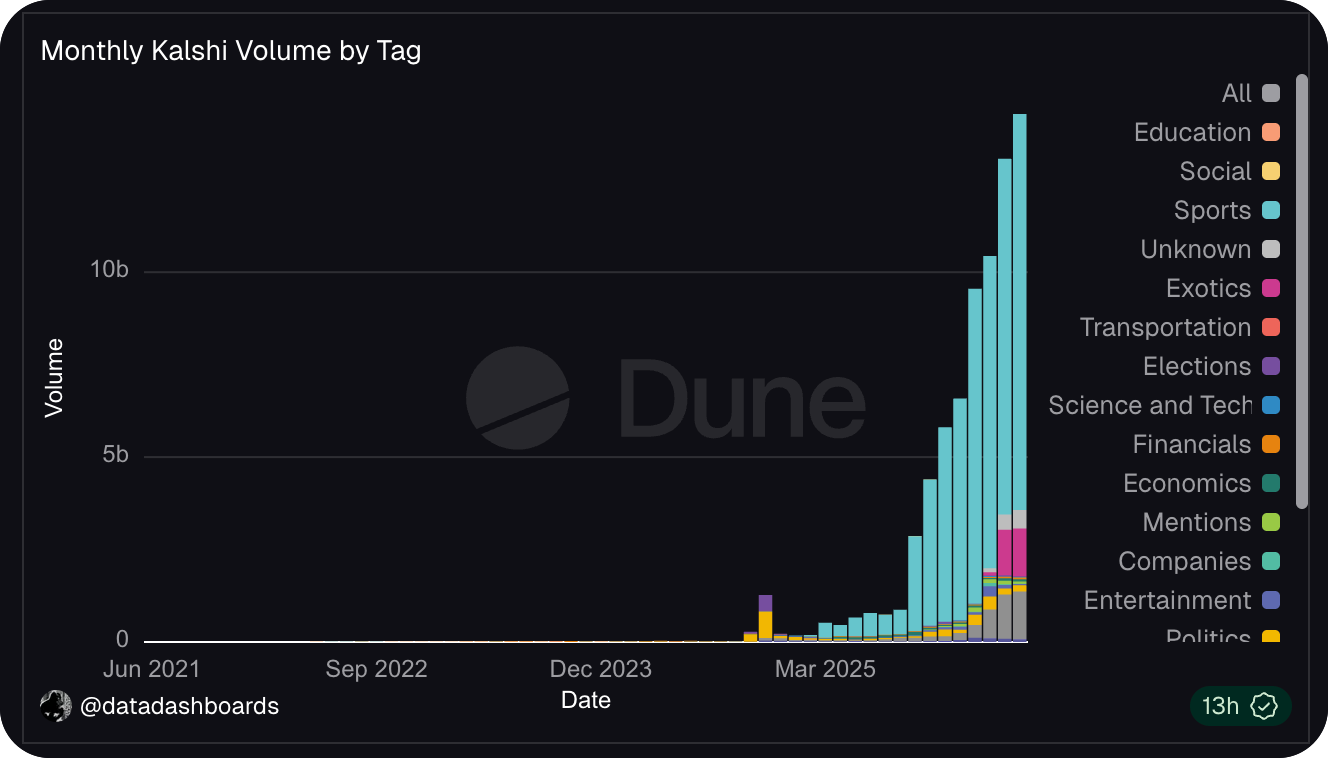
 Dune | @datadashboards
The platforms are seeing huge volumes and are getting key institutional buy-in too.
The growth potential of sports-related prediction markets has been a key area of investor excitement; Kalshi and Polymarket have already raised billions of dollars in venture capital funding.
The NHL signed multi-year deals with both Kalshi and Polymarket last October. Then came the UFC the following month. In January, MLS partnered with Polymarket and in March MLB signed an exclusive deal with them, reportedly worth up to $300 million over three years. The NBA is reportedly in active talks with both platforms, too.
An Inevitable Legal Showdown
Prediction markets are reckoning with a battle between federal regulators and state officials over jurisdiction. While sports gambling is regulated at the state level, financial swaps are regulated federally, and the entire dispute comes down to which bucket Kalshi and Polymarket's sports contracts fall into. The platforms say they are swaps. A number of states say these platforms are simply a new venue for sports gambling.
Complicating the position is the fact that Kalshi has argued both sides of this question. Back in 2023, while fighting the CFTC's attempt to block election markets, Kalshi argued that elections weren't "gaming" because elections aren't games. Football games, the company conceded at the time, were. They're now arguing the opposite, and states have been quoting that contradiction back at them in court.
Enjoying this article?
Subscribe to Bankless or sign in
The legal substance hinges on a single phrase in Dodd-Frank, which requires a swap to track a real financial, economic, or commercial outcome. Kalshi argues events like Super Bowl outcomes qualify because billions in advertising, travel, and merchandise depend on them. States argue that logic stretches the statute past its breaking point, and that if the Super Bowl counts, almost any event does.
 David Christopher
For now, the courts haven't agreed on which reading wins. The Third Circuit appellate court, the highest level court that has tried cases involving prediction markets, sided with Kalshi in early April. The Ninth Circuit, a court at the same level, heard arguments soon after and it appears likely things could go the other way. A circuit split usually pulls the Supreme Court in, but even SCOTUS isn't the final word here, because the dispute is over how to read a law that Congress wrote and Congress can rewrite the law at any point, a process already in motion.
The recently introduced Prediction Markets Are Gambling Act would tighten the swap definition so sports and event contracts fall outside of it, mooting the current legal fight entirely. Whether a bill like this has the votes with an industry-friendly administration in place is an open question. But the Polymarket for "Law banning sports prediction markets enacted in 2026?" currently only gives an 11% chance of passage.
Prediction markets are offering sports bets — just with a different name.
— Adam Schiff (@SenAdamSchiff) March 23, 2026
They are being offered in states where sports betting is illegal, like California, while federal regulators are greenlighting them rather than enforcing the law.
My bipartisan legislation with… pic.twitter.com/oNvI2vw9IP
If Congress doesn't move, the case could very well head to the Supreme Court. A win for the platforms undermines most state lawsuits while a loss forces them into navigating gaming systems state-by-state. But, the reality is that even a SCOTUS win wouldn't settle things permanently. A more prediction market-hostile Congress could rewrite the swap definition later, and the only move left at that point would be a constitutional challenge, arguing the law itself violates the Constitution or goes beyond what Congress is allowed to regulate – a much harder path.
It's far from a straightforward road ahead, even with an administration whose officials continue to publicly advocate for the platforms.
Winning Public Opinion
What gets lost in all this is what prediction markets actually do better than the alternative.
State gaming laws largely exist to protect customers from operators running platforms engineered to beat the customer over time. With Prediction markets, price emerges from peer-to-peer trades and the platform's only job is matching them. It banks plenty of profits off of these trading volumes, but the underlying market design means that a retail user on Kalshi or Polymarket isn't fundamentally competing against a counterparty designed to extract from them.
This isn't the easiest message to sell to an audience that seems to largely take issue with prediction markets tacitly encouraging a behavior that they believe should be more greatly controlled. Add in broad distrust with the underlying fairness of Wall Street (and Crypto!) and those insider trading scandals could transform regulating these platforms into an irresistibly populist pursuit for more lawmakers.
Prediction markets aren’t built like traditional sportsbooks, but that nuance may matter less than how they’re perceived. Their long-term trajectory will likely depend on whether they can clearly communicate that difference to the public and regulators.
David Hoffman

David Christopher
David is a writer/analyst at Bankless. Prior to joining Bankless, he worked for a series of early-stage crypto startups and on grants from the Ethereum, Solana, and Urbit Foundations. He graduated from Skidmore College in New York. He currently lives in the Midwest and enjoys NFTs, but no longer participates in them.