Buterin Proposes 'Extremely Lean' Ethereum Overhaul
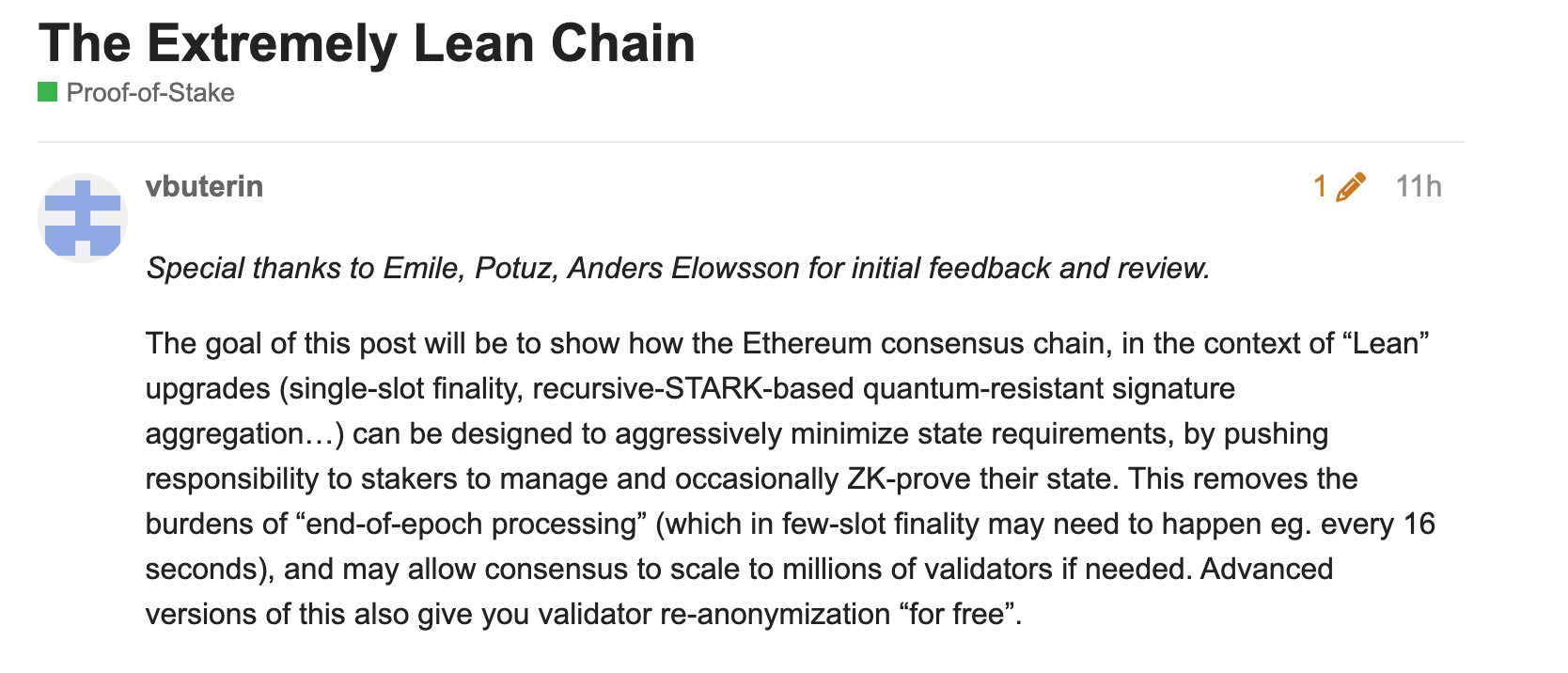
Buterin's new proposal would shrink Ethereum's validator state sharply using daily ZK proofs, part of the multi-year "Lean Ethereum" redesign.


 Vitalik Buterin published a technical proposal to radically shrink Ethereum’s consensus layer, as part of the long-term “Lean Ethereum” overhaul aimed at making
  Ethereum more scalable, private, and quantum-resistant.
What's the Scoop?
- The Proposal: In a forum post titled “The Extremely Lean Chain,” Buterin outlined a two-phase plan to make Ethereum store far less validator data directly onchain. Rather than the network carrying every validator’s full state record, validators would keep more of their own records and use ZK to prove to the chain that those records are correct. The goal is to shrink validator state to roughly 6 bytes while preserving Ethereum’s security guarantees.
- How It Works: Phase 1 removes most validator data from the chain and replaces frequent balance accounting with ZK proofs that show a validator’s rewards, penalties, and participation history are accurate. Phase 2 adds privacy by giving validators fresh anonymous identities each day, making it harder to track the same validator over time.
- The Scale Argument: The basic idea behind the change is to is to make nodes easier to run by reducing the amount of validator-specific data every node must store and process, with the end goal of having Ethereum run more validators.

David Christopher
David is a writer/analyst at Bankless. Prior to joining Bankless, he worked for a series of early-stage crypto startups and on grants from the Ethereum, Solana, and Urbit Foundations. He graduated from Skidmore College in New York. He currently lives in the Midwest and enjoys NFTs, but no longer participates in them.