How Google’s UCP Fits Into the Agent Economy
Google’s Universal Commerce Protocol gives AI agents a shared language for shopping.


On Monday, Google announced their Universal Commerce Protocol (UCP) — an open standard that gives agents a shared language for commerce.
What this means is that agents, like Gemini, can discover and purchase products across common marketplaces like Shopify, Etsy, Wayfair, Target, and Walmart — with your permission.
As you know, when buying physical goods from these platforms, there’s more than a money transfer. There's shipping addresses, tax calculations, return policies, and fraud protection, etc. UCP standardizes all these commercial capabilities — catalogs, carts, checkout sessions, fulfillment logic — so an agent can navigate them. It makes the entire shopping cycle machine-readable.
We’ve launched the Universal Commerce Protocol (UCP), a new open standard for agentic commerce that works across the shopping journey!
— Google Cloud Tech (@GoogleCloudTech) January 12, 2026
UCP is compatible with A2A, AP2, and MCP, and was co-developed with partners like Etsy, Shopify, Wayfair, and Target → https://t.co/0kpbdUyKj0 pic.twitter.com/shuBlZho83
Initially, some wondered whether this pits Google against x402. It doesn't. They're different kinds of protocols.
UCP is a commerce language for regulated marketplaces. It devises the semantics of this process for agents, letting them understand what products exist, what they cost, how they ship, and what happens if something goes wrong. x402 is permissionless payment settlement rails — instant, autonomous, non-reversible. One defines what "shopping" means; the other moves money between machines.
How They Work Together
The most realistic near-term interplay is x402 handling “upstream” micro-transactions while UCP handles “downstream” regulated commerce. Here’s what I mean.
Consider agent-to-agent scenarios. If an agent needs a $0.05 research paper or $10 of cloud compute, it doesn't want to fill out a checkout form. It queries a resource provider with an x402 endpoint, pays instantly, and receives access. No cart, no shipping address, no human approval — so no UCP.
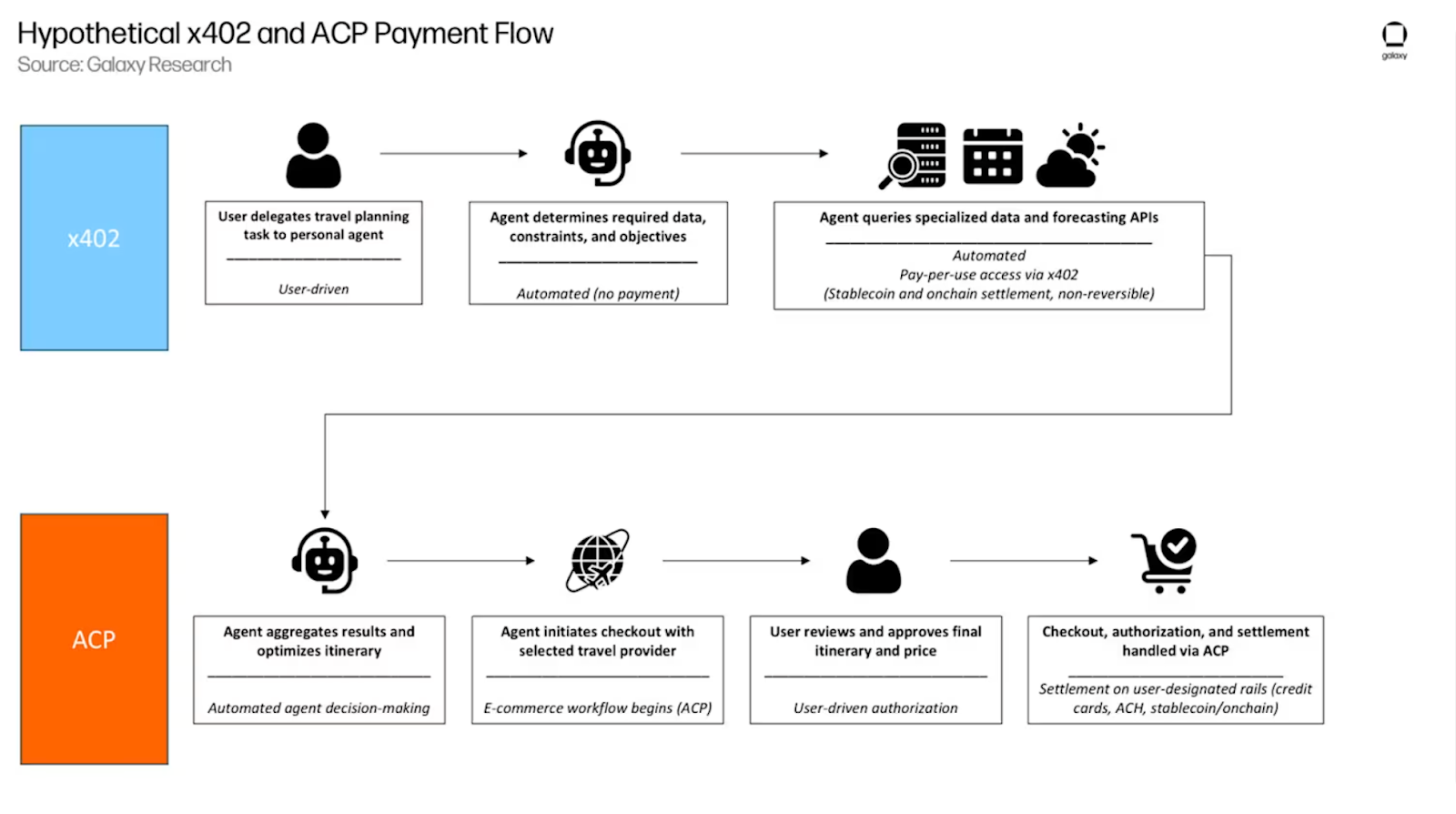
But, imagine an AI agent tasked with planning a vacation on your behalf (as Galaxy Research does). First, the agent may need intelligence: optimal travel dates, weather patterns, airfare volatility. To get this, it could query specialized data providers — a premium forecasting service, a demand-prediction API — that have integrated x402. Via the protocol, the agent programmatically discovers pricing, pays for access, and retrieves data.
Then, armed with this information, the agent determines when to travel and moves to book flights and hotels. As such, the transaction shifts to regulated commerce, switching from x402 to UCP. The agent uses UCP here to navigate the airline or travel platform: surfacing options, building a cart, initiating checkout. Payment flows through traditional rails — fraud protection, refunds, chargebacks, compliance. You review and approve the purchase.
Enjoying this article?
Subscribe to Bankless or sign in
Understanding the Boundaries
To be clear, while two protocols can be complementary, they don’t overlap yet.
Platforms integrated with UCP — Shopify, Walmart, the regulated marketplaces — aren't exposing x402 endpoints. They speak UCP for discovery and checkout, but payment settles through traditional processors. So an agent can find products, build a cart, and surface options via UCP, but it can't autonomously complete the transaction via x402.
Take a homemade jam shop on Shopify. An agent may discover the shop through UCP, understand the catalog, and prepare a checkout. But unless that merchant independently creates an x402 endpoint — which requires deploying middleware and configuring a wallet — the agent can't settle the purchase without human approval and traditional payment rails.
In the short term, it's unlikely that platforms standardizing commerce with UCP will also expose x402 endpoints. The interplay, for now, is complementary rather than integrated: x402 for autonomous resource access, UCP for regulated commerce that still routes through existing infrastructure.
Not quite. UCP is more about representing e-commerce checkout flows. x402 can cleanly sit below UCP, and they’re actually complementary rather than competing.
— kevin (@kleffew94) January 12, 2026
You can try x402 with UCP via the x402 a2a package here: https://t.co/rgYgVY3bSR
UCP and Google's A2A Standard
UCP isn't Google's first open standard for agents. Last year, they released A2A (Agent-to-Agent) — a protocol enabling AI agents built on different frameworks to discover, communicate, and collaborate.
A2A is a coordination layer. It standardizes how agents call each other and structure messages — regardless of who those agents were built by and what framework or toolkit they were built with. Without it, every agent-to-agent interaction requires custom integration.
UCP, by contrast, is a commerce vocabulary that A2A can carry. UCP makes "shopping" understandable to agents; A2A gives them a way to exchange that information. Yet, UCP is transport-agnostic, meaning it isn’t only able to be communicated via A2A. Messages can also be delivered via REST (the standard web API protocol), or MCP (Anthropic's protocol for connecting models to tools).
The Stack So Far
UCP's arrival adds another layer to what's becoming a recognizable agentic commerce stack:
- A2A handles agent coordination — discovery, messaging, and collaboration across frameworks.
- UCP handles commerce orchestration — product discovery, cart management, checkout, fulfillment.
- x402 handles autonomous settlement — instant payments between machines.
- ERC-8004 will handle identity and reputation — onchain registries proving who agents are and how they've performed.
What's worth noting is that UCP represents a specific kind of contribution: a language packet for commerce. It teaches agents what "shopping" means. We can imagine similar open protocols emerging for other domains — financial analysis, education, healthcare — each providing agents with a shared vocabulary for a particular subset of action.
The key is that these protocols remain open and interoperable rather than locked to specific ecosystems. Google, to its credit, has built A2A and UCP as public standards. Others should follow that lead. The more these domain languages proliferate as open infrastructure, the faster agents become genuinely useful — and the harder it becomes for any single platform to centralize or monopolize the stack.

David Christopher
David is a writer/analyst at Bankless. Prior to joining Bankless, he worked for a series of early-stage crypto startups and on grants from the Ethereum, Solana, and Urbit Foundations. He graduated from Skidmore College in New York. He currently lives in the Midwest and enjoys NFTs, but no longer participates in them.