Ethereum's Final Form
Nearly every major piece of Ethereum is slated for a big transformation.

| 24h Majors & Movers | ||||||

|
BTC $63.5k | ↗ 2% |

|
HYPE $70 | ↗ 1% | |

|
ETH $1.7k | ↗ 1% |

|
AAVE $95 | ↗ 8% | |

|
SOL $81 | ↗ 1% |

|
JTO $0.76 | ↗ 7% | |
Sponsor: MetaMask – Earn up to ~4% APY automatically with the new Money Account.

Enjoying this article?
Subscribe to Bankless or sign in
- 💠 Vitalik dropped "The Extremely Lean Chain," a proposal to shrink consensus state to ~6 bytes per validator by making stakers ZK-prove their own balances daily, a design he says could let
 Ethereum support millions of validators.
 - 🎢 Strategy disclosed the sale of another 2,225 BTC, pushing its two-week selling total to ~$215M as it funds preferred dividends and tops up its USD reserve. Notably, these sales don't eat into the BTC Monetization Program's separate $1.25B selling capacity.
- 💸 USDC drove ~70% of adjusted stablecoin volume in H1 2026 vs. ~25% for USDT per Visa's onchain data. The dominance comes as banks like Standard Chartered and BNY have chosen to plug into Circle's rails rather than build their own.

Ethereum's research scene has been on a tear. Between July 4th and today,  Vitalik Buterin gave a fresh overview of Ethereum's long-term direction, dropped a new "Extremely Lean Chain" research post, and highlighted a proposal to bring Bitcoin-style UTXOs to Ethereum.
All of these intrigues are compelling in their own right, but together, they offer us a clear preview of what Ethereum is shaping up to be.

The backdrop here is the strawmap, i.e. the Ethereum Foundation's self-described "strawman roadmap" of L1 upgrades stretching through the end of the decade, which received fresh updates in late June. Then on July 4th, Vitalik posted his own takeaways on the changes:
"'Lean Ethereum' is not a single one-shot upgrade, it is a collection of improvements that will come online to the Ethereum network over the course of three or four years. But make no mistake, this IS the third major iteration of Ethereum in the same way that the Merge was the second."
He went on to say, nearly every major component of the network will be supplanted across this arc, from how blocks are verified to how consensus is reached to what "state" even means. So what's coming?
Of course, the strawmap isn't singular, yet from its handful of currents and from Vitalik's comments there are a few broad themes to take stock of. For instance:
- Verification is succeeding re-execution — As things stand, every Ethereum node reruns every transaction to check the chain's math. In the Lean era, nodes will instead check cryptographic proofs, i.e. recursive STARKs. This change will make proving correctness cheap, which in turn will allow for scaling execution further, shrinking hardware requirements, and beyond.
- Ethereum state diet incoming — Before us a multi-tier state system is taking shape. Today's flexible but heavier "dynamic" state will stick around, but it'll only be granted a modest amount of room for further growth. In contrast, new classes of cheaper, albeit less flexible, state will be much more aggressively scaled (Vitalik's hypothetical was a 2030 Ethereum with ~2TB of the former and ~100 TB of the latter). Migrations to these new kinds of state won't be mandatory, though the economics will do the persuading since they'll offer projects and users drastically lower fees.
- Privacy and quantum are design pillars — At a time when most chains are still 1) totally transparent and 2) dragging their feet on quantum resistance plans, Ethereum's researchers have promoted privacy UX and quantum defense to central design pillars that must be considered and built toward and around. For example, as Vitalik noted: "When designing Frames, the mempool, additions to the state tree, we explicitly [asked] the question 'okay, how do quantum-safe, intermediary-free privacy protocol transactions go through this, and what is the overhead?'"
These advances won't materialize over a single update, as happened with the Merge, but rather across 6-7 forks between now and 2029. That said, the "strawmap" label exists for a reason, and the Ethereum Foundation has been clear that this map and timeline are loose guides for coordinating and not set-in-stone plans.
What's promising, though, is that proposals for new relevant mechanisms here are basically landing every day now.
Case in point? This morning Vitalik published "The Extremely Lean Chain," a design proposal for shrinking Ethereum's consensus layer down to almost nothing.
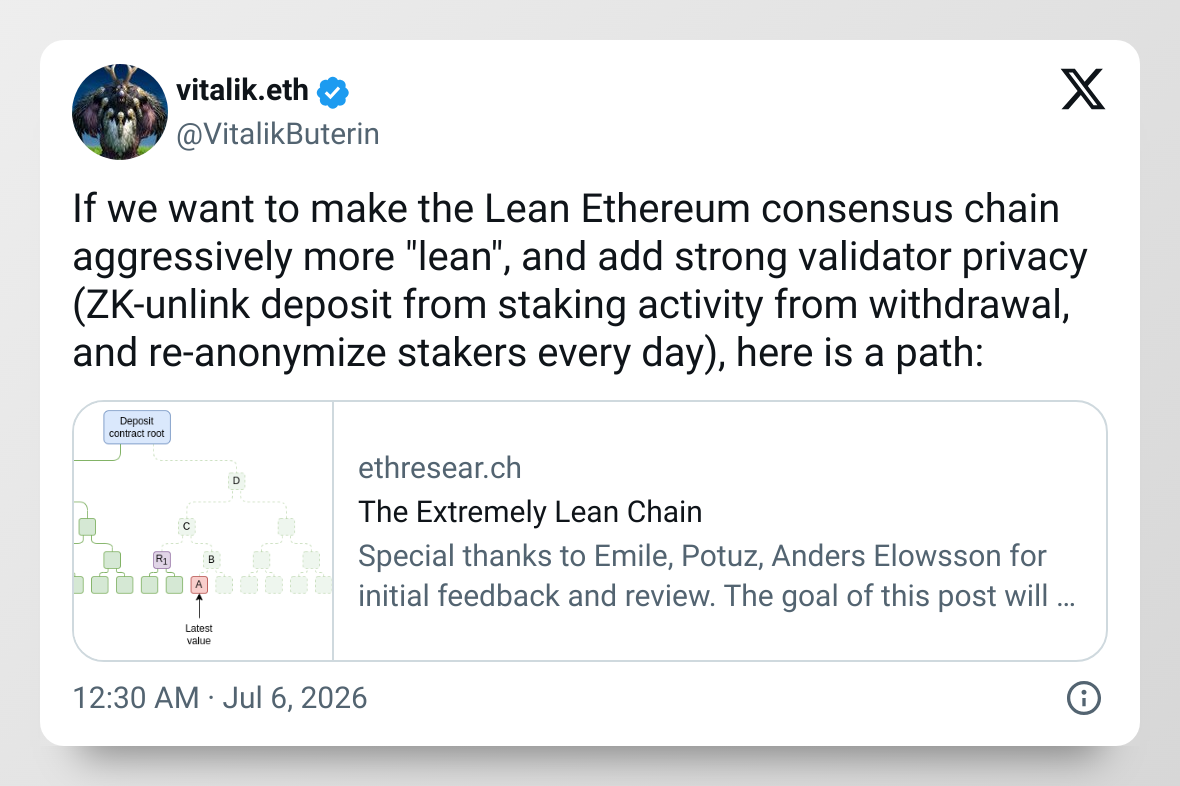
In Ethereum's current paradigm, the Beacon Chain keeps a chunky record for every validator and grinds through balance updates for all of them, every epoch. In Vitalik's proposed evolution, the chain would store roughly 6 bytes per validator, a 95% drop from today's status quo of ~121 bytes.
How this would work is that once a day, each ETH staker would generate a ZK proof attesting to their updated balance and then submit it onchain. In this way, Ethereum would essentially start checking receipts rather than doing bookkeeping directly. If a staker misses a daily proof, they simply can't attest until they catch up, but no slashing would occur.
The big benefit of this approach, as Vitalik noted, is that it "may allow consensus to scale to millions of validators if needed." Could this be the groundwork for eventually lowering the 32 ETH staking floor? We'll see. But there are other advantages to consider from this design route, too, like how in its fullest form, the design would even have validators reregister with new public keys daily, i.e. paving the way for anonymized staking.
But Vitalik's "Extremely Lean" proposal is just one to have on your radar right now. Another mechanism outline that could have huge implications for Ethereum was just published by EF researcher Toni Wahrstätter, namely "Native UTXOs on Ethereum."
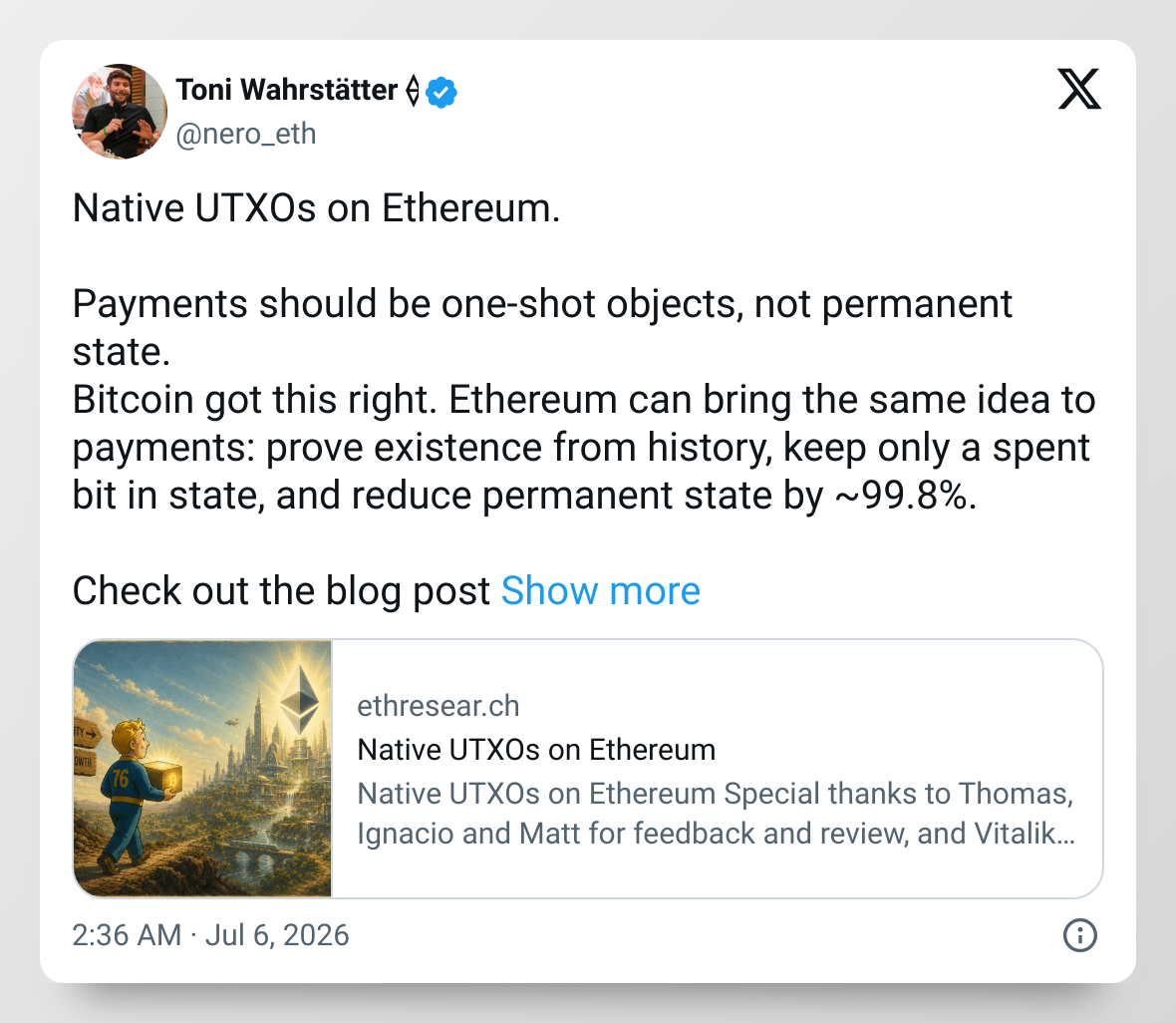
What if we just borrowed Bitcoin's approach to transactions? That's the thrust here. On Ethereum today, receiving a payment leaves a permanent record. The first time an address holds ETH or a token, every node must store that entry forever, even if the address is used just once. Multiply that dynamic by billions of payments and you've got a bona fide state bloat crisis.
Wahrstätter's idea is to turn to Bitcoin-style UTXOs, or unspent transaction outputs, which are basically one-time value packets that get consumed when spent. Going further, though, Ethereum's version wouldn't even have to store the UTXOs themselves. Their details would live in the chain's history, provable on demand, while the chain's permanent state would keep only a single bit per UTXO, marking whether it's been spent.
According to Wahrstätter's math, this shift would account for a ~99.8% reduction in permanent state for payment flows! In combination with the innovations of frame transactions, this new transaction style would also let freshly generated addresses receive and later spend funds without ever holding ETH for gas, which would pave the way for streamlined stealth addresses on the L1.
Zooming out, if these sorts of concepts ship on Ethereum, the network will be healthier and more durable and more flexible and, yes, closer to that north star of future-proofness. Personally, I'm most interested in the new state types and what they bode for the app layer and fungible token and NFT experiments. But whatever comes next and whenever it comes, Ethereum's direction of travel is as clear as ever. That's bullish.

Turn your money on with the new  MetaMask Money Account, and earn up to ~4% APY automatically. No lockups, no extra steps, no hidden fees. Your balance starts growing as soon as funds are deposited (mUSD), and keeps earning while you trade, send, and spend. Finally, money that works for you.

Bankless
It’s time to break up with your bank, and join the movement for a better world.