CLARITY Advances as Its Political Path Narrows
The CLARITY Act cleared Senate Banking, but an unresolved ethics fight, a departing White House negotiator, and a shrinking calendar threaten its passage.


The crypto market structure bill cleared its first major Senate hurdle, but its unresolved ethics fight has only grown as Congress runs out of time and the White House prepares to lose its chief negotiator.
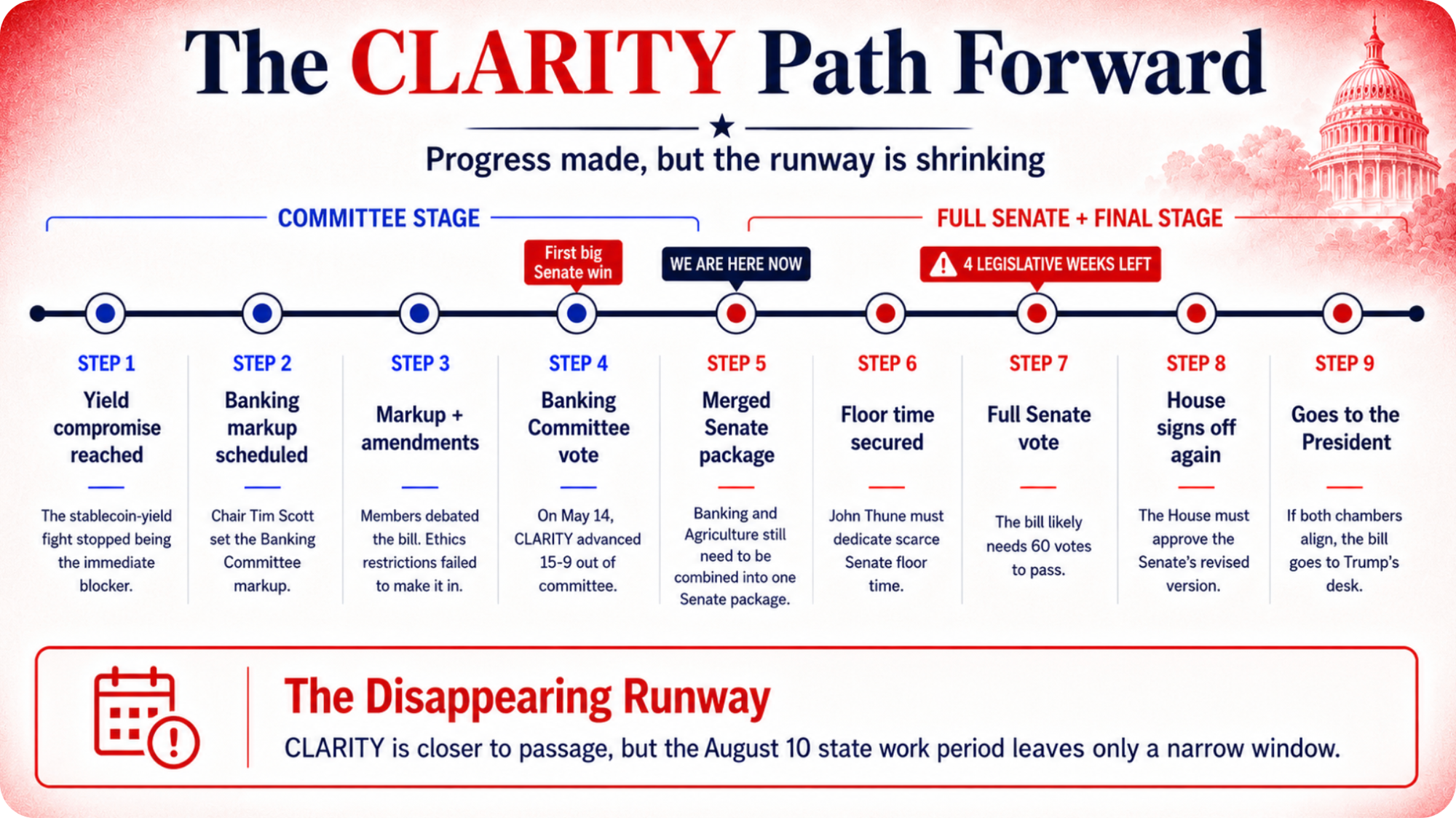
When we last checked on CLARITY two months ago, Senators Thom Tillis and Angela Alsobrooks had just reached a compromise on stablecoin rewards, seemingly removing the largest procedural blocker standing between the bill and a Senate Banking Committee vote.
Eight days later, Senate Banking held its markup, where senators debate amendments and vote on whether to advance a bill, and on May 14, CLARITY advanced 15-9, with Democrats Alsobrooks and Ruben Gallego joining all 13 Republicans.
But the committee vote did not resolve CLARITY’s largest remaining problems. It resolved one, preserved another, and pushed the hardest fight further down the road.
Since then, that fight has only become more difficult.
What Made It Through
The good news from markup was that CLARITY’s core developer protections came through in relatively good shape.
The bill retained the Blockchain Regulatory Certainty Act, or BRCA, which protects blockchain developers and service providers that do not control users’ assets from being treated as money transmitters. An amendment that would have gutted those protections was never taken up, preserving BRCA’s core distinction: publishing neutral software is not the same as operating a financial intermediary.
Those protections remain vulnerable (likely why we’ve seen the launch of the Defend Developers PAC). Only two Democrats supported the committee bill, and neither committed to backing it on the floor. Still, they survived the first serious amendment fight.
 David Christopher
Stablecoin rewards also stopped being the immediate procedural blocker.
The Tillis-Alsobrooks compromise bans passive yield on idle stablecoin balances while preserving rewards tied to transactions and other activity. Banks remain unhappy and could try to tighten the language on the Senate floor, but the compromise cleared the way for committee passage.
The issue that did not make it through was ethics.
 David Christopher
The Fight That Didn’t
During that May 14 markup, an ethics amendment from Sen. Chris Van Hollen (D-Md.), a senior member of Senate Banking, failed 11-13. It would have restricted presidents, vice presidents, members of Congress, senior officials, and their families from owning or affiliating with digital asset issuers and platforms.
That vote came six weeks before Trump’s June 30 annual financial disclosure showed that he reported more than $1.4 billion in crypto-related income through family ventures during 2025.
The filing emboldened ethics advocates, a cohort consisting almost completely of Democrats, who can now point to a president already profiting heavily from crypto while personally pressing Congress to pass the industry’s most important bill.
And, as such, their push has intensified. Elizabeth Warren has echoed Van Hollen’s call for restrictions covering officials and their families, while Chris Murphy and other Democrats are building a broader case against the bill. As of Monday, the text reportedly still contains no ethics provision.
Enjoying this article?
Subscribe to Bankless or sign in
— Elizabeth Warren (@SenWarren) July 2, 2026
Donald Trump is using the Trump family crypto businesses to make himself richer.
Any crypto bill must ban Trump and his family from profiting off crypto.
Otherwise, Congress is turbocharging corruption. pic.twitter.com/MybZurXpqJ
Trump and the White House are pushing in the opposite direction. Trump called on the Senate to pass CLARITY, while White House crypto adviser Patrick Witt warned that Congress could not afford further delay.
Now, the White House is about to lose the official leading that push.
Crypto in America reported Tuesday that Witt will finish his White House work on July 24 before reporting for months-long Judge Advocate General training with the Georgia Army National Guard on July 27. As the administration’s top CLARITY liaison, Witt helped broker the stablecoin-rewards compromise and navigate the ethics fight. He had already postponed the training from April to remain through negotiations, but could not defer it again.
Deputy crypto council director Harry Jung is expected to take over, and Witt reportedly intends to remain involved where possible. But the White House will still be without the official who spent months personally navigating the bill’s hardest disputes.
CLARITY is now caught in a worsening bind: Trump’s pressure makes the bill more urgent to the White House and more objectionable to Democrats, while the official charged with bridging that divide is stepping away.
🚨SCOOP: Top White House Crypto Adviser to Take Military Leave as Clarity Act Enters Critical Stretch
— Eleanor Terrett (@EleanorTerrett) July 14, 2026
Crypto Council Executive Director @patrickjwitt will embark on a months-long leave later this month to begin Army National Guard JAG training.https://t.co/EqjgUaLS0O
The Disappearing Runway
Our original best-case timeline had CLARITY reaching the full Senate before July 4: a deadline which came and went.
The Senate now has less than four weeks before its August 10 state work period, widely viewed as the bill’s best remaining window this Congress. Missing it would push CLARITY into the midterm campaign and fall spending fights, making scarce floor time and difficult bipartisan votes far harder to find.
Before then:
- Negotiators must finalize the merged Banking-Agriculture package.
- Majority Leader John Thune must dedicate scarce Senate floor time.
- Supporters must assemble the 60 votes needed to overcome a likely filibuster and clear the Senate.
- The House must approve the Senate’s revised version.
- If both chambers align, the bill goes to Trump’s desk.
None of those steps is impossible but together, with almost no slack left, they are a steep ask.
At the time of writing,  Polymarket gives CLARITY a 38% chance of becoming law by the end of 2026, down from a May peak of 73%. That market still includes potential September and lame-duck paths, not merely passage before August.
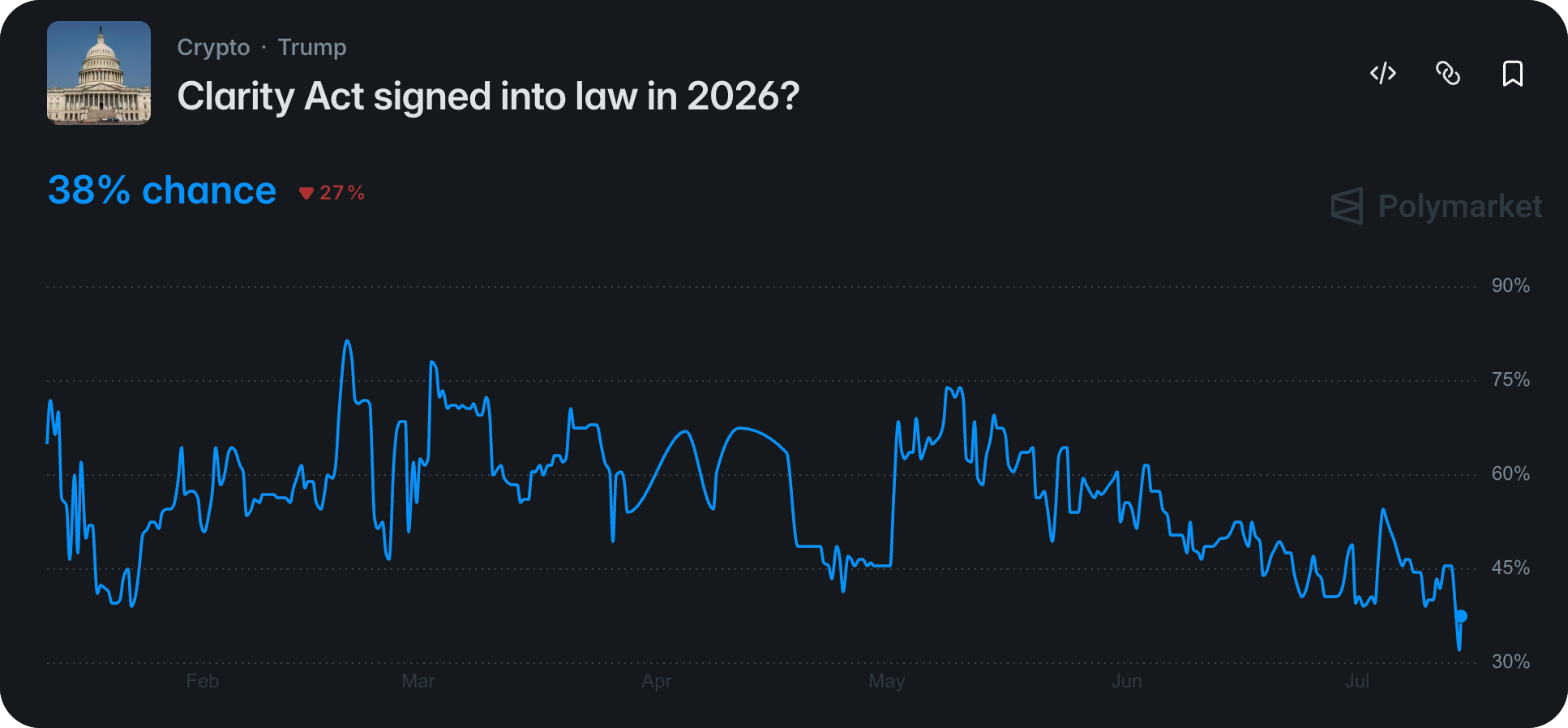
So, while CLARITY is procedurally closer to passage than it was two months ago, politically, its path is narrower. There is no public ethics agreement, no demonstrated 60-vote coalition, and another House vote is still required.
The bill escaped committee by resolving its technical blocker and postponing its hardest political fight. That fight has grown larger, its chief White House negotiator is stepping away, and the runway to solve either problem has nearly disappeared.
Hopefully this article marks the bottom on the odds we want it to be. Fingers crossed.

David Christopher
David is a writer/analyst at Bankless. Prior to joining Bankless, he worked for a series of early-stage crypto startups and on grants from the Ethereum, Solana, and Urbit Foundations. He graduated from Skidmore College in New York. He currently lives in the Midwest and enjoys NFTs, but no longer participates in them.