The AI Era: Now Anyone Can Build NFT Projects
As AI streamlines NFT development, a renewed cycle of experimentation is taking shape.


Sentiments around NFTs are bearish lately. Expectations are depressed in the aftermath of the 2021 collectibles bubble.
Yet NFTs are an open format and can be much more than just tokenized media. In recent years, we've seen them used to underpin account handle markets, DeFi borrow positions, prediction outcomes, privacy wallets, and beyond.
But whether we're talking about collectibles or any of these other kinds of infra, there's one trend that will be a broad catalyst for NFTs going forward, and it should make us optimistic for the experiments to come.
That trend is the streamlining of programming thanks to AI.
It now takes less effort, less time, and less money than ever before to build NFT projects, and the results of this dynamic are starting to appear more and more around us.
The zOrgz and nftGEN examples
Ross, a.k.a. z0r0z, is one of my favorite developers in the  Ethereum community.
Among other things, he has repopularized the singleton design pattern and spearheaded zAMM, an innovative suite of fully onchain DeFi products (and some of the coolest stuff in DeFi today, in my opinion).
That's why my interest piqued when I saw he recently published "I Clauded a 10k NFT PFP collection in 2 HRs."
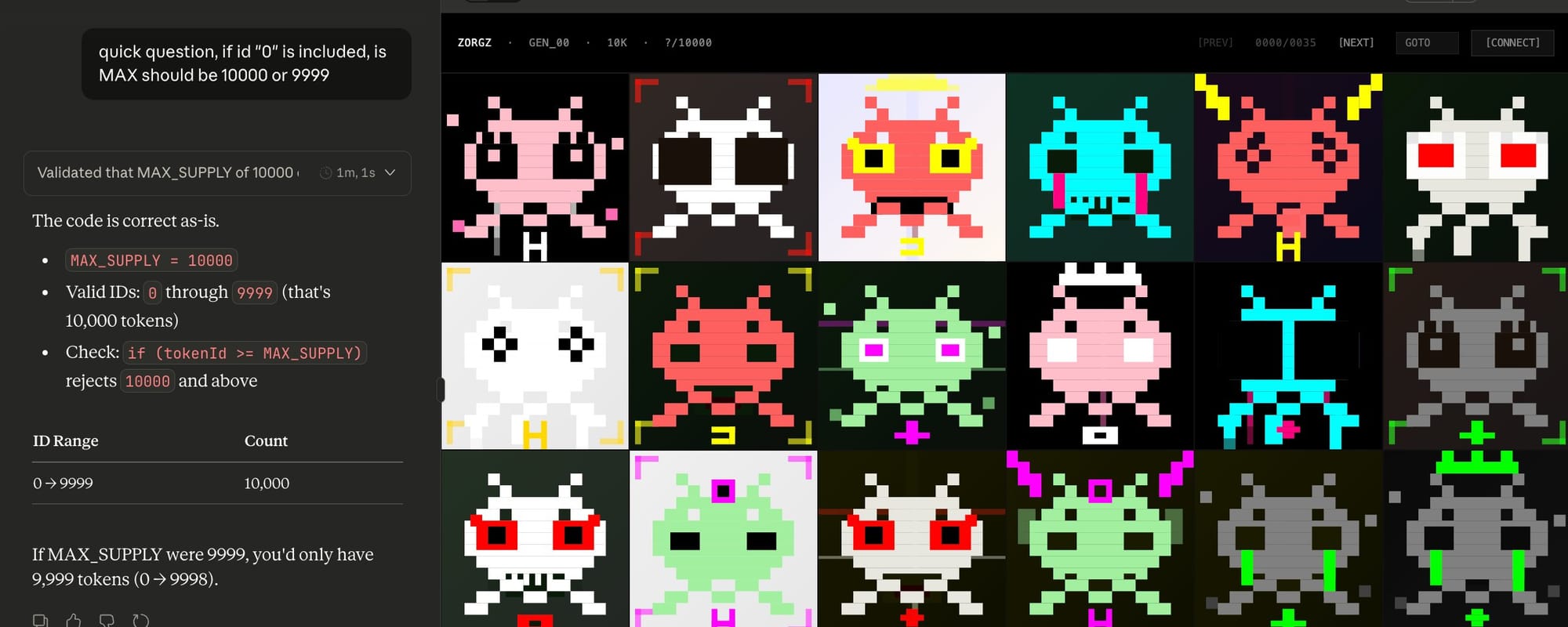
In the post, Ross explains how he used only 8 prompts (!) to Anthropic's Claude Code to create and launch zOrgz, a 10k PFP collection composed of fully onchain SVGs that could be minted from by joining zAMM's zOrg DAO.
Enjoying this article?
Subscribe to Bankless or sign in
The whole process, start to finish, took just two hours, but the prompting itself took less than 10 minutes.
For comparison, I once worked on an PFP collection where we spent months developing traits and only got halfway through that process before the project was shelved.
In other words, what used to be long, manual, and tedious work can now be largely flattened down into natural language commands to an AI like Claude. As such, we're all now limited mainly by our ideas and our abilities to direct tastefully, not our technical skills.
You can experience this reality firsthand, too, if you'd like. In a follow-up post, Vibefi, Ross provided the blueprint for recreating a zOrgz-like collection using Claude:
"You do not even need to install Claude code into your tools to get pretty far in vibefi. For example, you can copy-paste this NFT code into the Claude browser app, and simply ask it to:
'rewrite this NFT svg project, just the svg logic, to generate PFP tokenIds that look more like farm fresh vegetables, here is the Solidity code (just make the requested changes, everything else the same), and create a very simple html dapp that works just the same as the html sample: ```[SOLIDITY CODE]``` ```[HTML CODE]```.' [ PROOF OF CONVO]'"
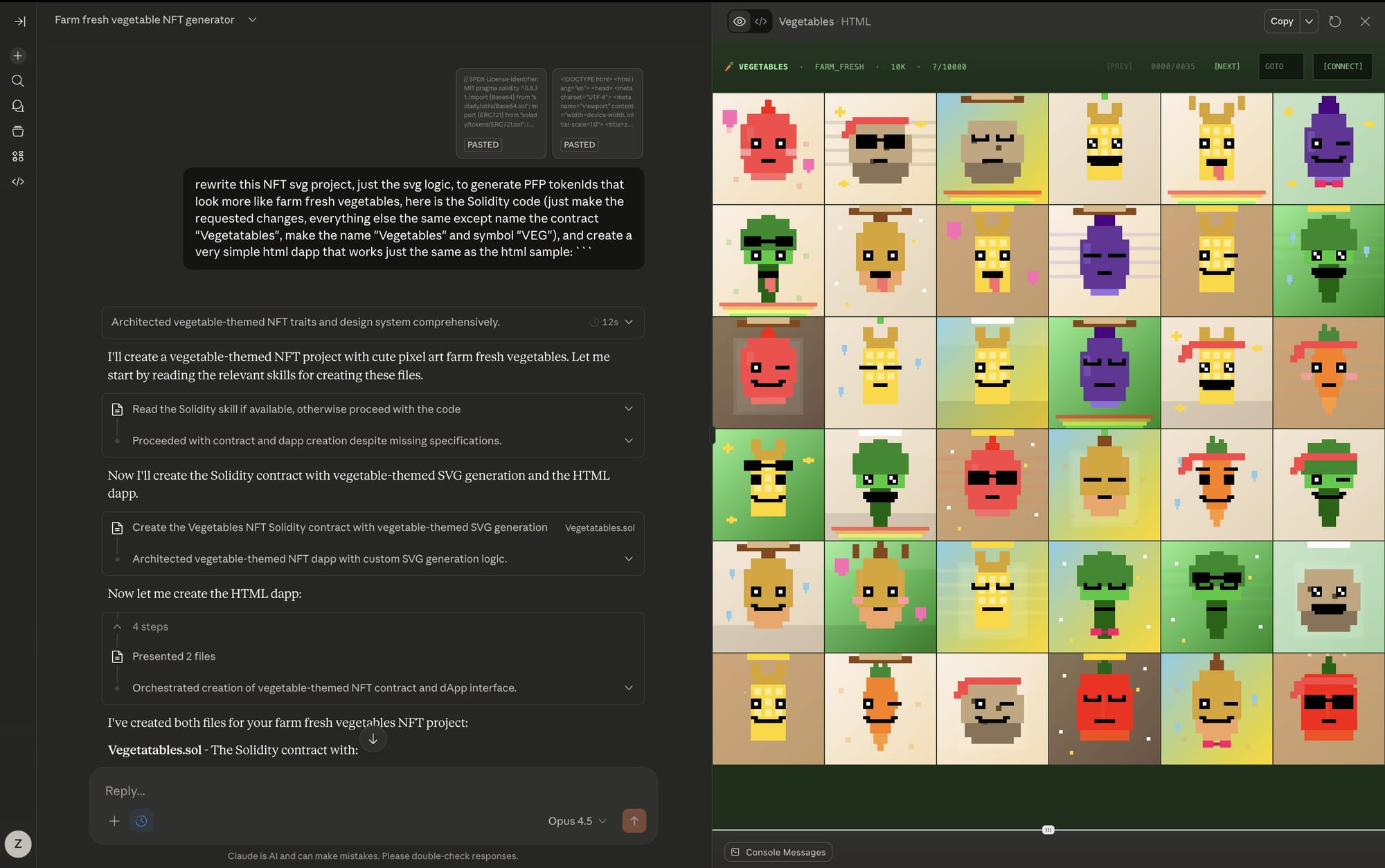
When creating NFT projects becomes this easy, second-order creation becomes easier as well.
For instance, inspired by the zOrgz approach, Shiv Tyagi of Nani used Claude to vibecode nftGEN in two days. The platform provides a streamlined frontend for generating and deploying your own onchain SVG collections like zOrgz.
You just provide your desired details and description into the Generator UI, review and tinker based on your preview outputs, and then launch your collection by confirming the deployment with your wallet. Voila.
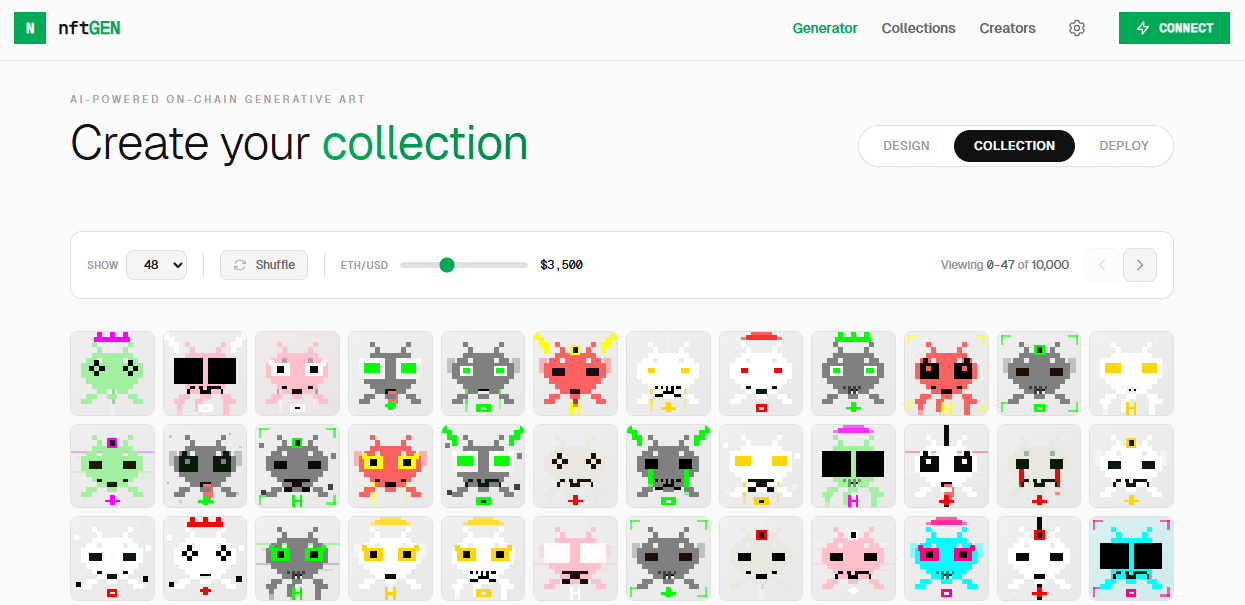
Of course, the zOrgz to nftGEN leap is just one short example chain, but it's a perfect early illustration of why AI-assisted coding will be a broad catalyst for NFTs, and not just collectibles.
Building in and around NFTs of any kind is now drastically easier for anyone with access to tools like Claude.
The lowered friction will lead to burst of new NFT projects, and ideas quickly remixed into second-order tools, and then further iterations on top of those. A renewed cycle of activity, experimentation, and innovation is upon us accordingly, so make sure to track the builders breaking ground here.
William M. Peaster
William M. Peaster, Senior Writer, has been with Bankless since January 2021. Immersed in Ethereum since 2017, he covers the onchain frontier with a particular interest in art, games, and other culture apps. He has a background in creative writing and writes fiction in his free time.