A New Kind of Stablecoin Is Brewing on Ethereum
What if stablecoins didn't use dollars or liquidations?


The majority of DeFi today centers around the same pillars, namely collateral, debt, and liquidations.
For example, the flow of depositing ETH to borrow stablecoins against that ETH. If the ETH price dips enough while your borrow is live, your position gets force-sold with a liquidation penalty.
This debt-based approach underpins the vast majority of stablecoin activity right now, but this type of arrangement hinges on price oracles being correct every second. When they're wrong, you get bad debt and cascading liquidations.
But what if we could build stablecoins that sidestep debt and liquidations altogether? That's the question at the heart of one of the more interesting design conversations happening in  Ethereum currently.
Things started picking up here after Vitalik proposed in a June 1st ethresear.ch post the creation of index-tracking synthetics, like non-USD stablecoins, on top of options rather than debt.
 vbuterin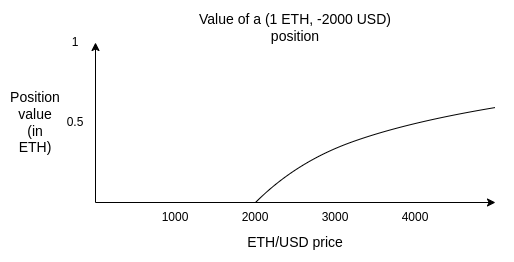
Then on June 2nd, Vitalik tweeted out a repost of an idea he'd first floated in a February Firefly post, which was related to his proposal from the day before. If not the U.S. dollar, what might a new kind of synthetic stable be stable against?
Here, Vitalik suggested the possibility of building prediction markets on price indices for all major spending categories, then having people's local AI assemble personalized baskets of shares for them representing "N days of expected expenses."
Re-posting the idea from the second half of this post a few months ago https://t.co/Y2jOdoltdT:
— vitalik.eth (@VitalikButerin) June 2, 2026
(This is very relevant to the options ideas from yesterday)
Question: if we're making a synthetic stable, what should it really be stable WITH RESPECT TO? USD is actually far from…
It's a big brain idea, sure, but it's not hard to imagine it could eventually become incredibly popular, even if it takes many years to happen. Instead of everyone always seeking refuge in USD, maybe eventually we'll use synths as havens, each tailored to our own, respective future costs.
How the options model works
We'll have to wait and see if such a sophisticated stablecoin system in this exact predictions style ever comes to pass. In any case, though, the theory for the foundations is already there as Vitalik outlined in his June 1st research post.
Enjoying this article?
Subscribe to Bankless or sign in
For instance, you could take 1 ETH and split it into two tokens, P and N, defined by a price index (e.g. USD/ETH), a strike price, and a maturity date. At maturity, an oracle reads the index once, P gets paid out up to the strike, and N gets everything above it. The crucial identity is that P + N always equals 1 ETH.
Option product never works on Ethereum because its complexity.
— 曾嘉俊 Zeng Jiajun (@zengjiajun_eth) June 11, 2026
It’s gonna work this time.
What more significant is that it not only gonna unlock decentralized stablecoin, but also various of index tracking product (s&p 500???) safely with much better capital efficiency.
P +…
If the two halves can never add up to more than the underlying collateral, nobody can go bankrupt, and with no loans or margin accounts anywhere in the design, there's no target for liquidation. P holders get a "cash-like" claim (think ETH with the upside sold off), while N holders get leveraged upside (effectively a call option, i.e. a bet that pays off above the strike). Each token is the natural counterparty to the other.
As opposed to liquidation-based systems, which need always-on price feeds, an options-based system like this only needs to consult its oracle a single time, at maturity, so it can lean on so-called slow oracles, e.g. TWAPs (time-weighted average prices) or prediction-market-style resolutions, that are far more tamper-resistant.
In other words, even deep drawdowns are survivable here, as settlement cares only about where the price lands at maturity. However, there would be consistent price drifting with a stable built this way; Vitalik guesstimated as much as 1-4% drift per year. Though he argued this movement could be worth it for anyone keen on maintaining non-USD price stability.
Who's building here
As it turns out, some teams have already been experimenting in this arena, while new ones have started building in the wake of Vitalik's new posts. In a June 11th followup, Vitalik noted "the options thing is happening already!"
Looks like the options thing is happening already!
— vitalik.eth (@VitalikButerin) June 11, 2026
See also: various people thinking through and building different versions of the idea in the thread: https://t.co/isSkr3901W
Though I do strongly urge that if any of these get on mainnet quickly, we formally verify it first. I…
Indeed, after scanning around it took me only a few minutes to come across a handful of relevant projects that are advancing here, or, in the case of Gnosis, could play a big infra role going forward. For your radar:
- Sir Trading, a leverage trading platform, has been working this options angle for a while. It uses 30-min TWAPs in place of instant oracles and a constant-leverage formula to avoid manual rebalancing.
- Split just went live on
 Base and Arbitrum with tradable P/N claims on WETH. Its pitch is "capped downside, uncapped upside."
 - Cleave, currently on testnet, splits ETH into a "cash half" and an "upside half" with one-click Earn and Boost products, settling on a median of three
 Uniswap TWAPs. Mainnet Ethereum is next on the slate.
 - Martin Koppelmann has also pointed out that Gnosis's proven Conditional Token Framework (which
 Polymarket runs on) can already produce these sorts of options splits today.
So it seems a new category is forming, and we'll likely be seeing many more related experiments arriving in the months ahead. For his part, Vitalik said projects innovating here should go for the two-for-one and adopt formal verification before deploying on Ethereum.
We've already seen what's possible here with TamaSwap, but much more work needs to be done to progress formal verification as the status quo. This technique can make crypto infra fit for the real world, and non-USD synthetic stables are a product fit for real people. These innovations can pair well together in the years ahead, so let's see what happens.
 David Christopher

William M. Peaster
William M. Peaster, Senior Writer, has been with Bankless since January 2021. Immersed in Ethereum since 2017, he covers the onchain frontier with a particular interest in art, games, and other culture apps. He has a background in creative writing and writes fiction in his free time.