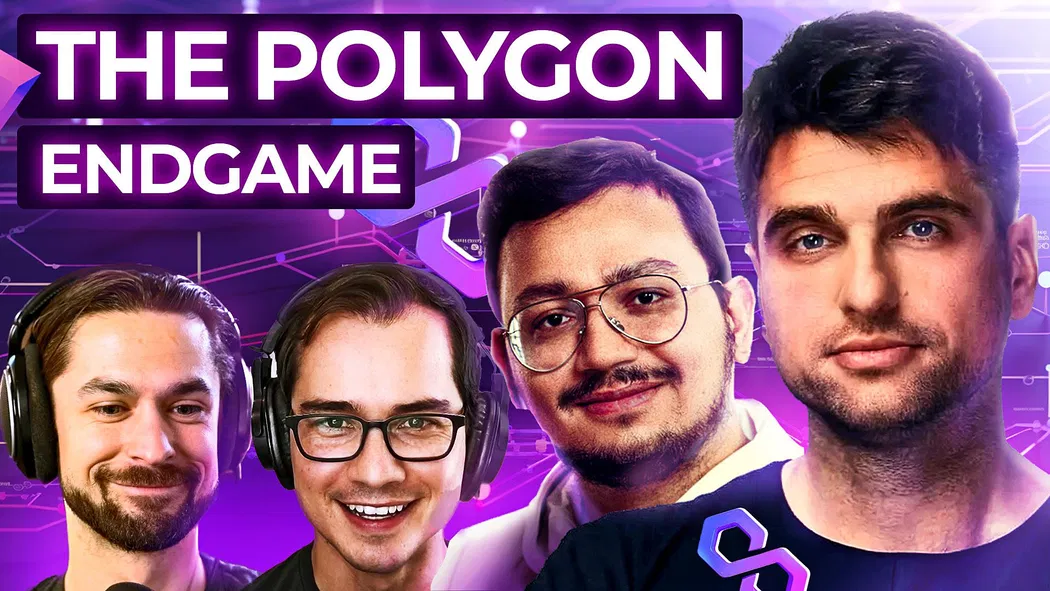
Polygon’s Endgame: Polygon 2.0 with Sandeep Nailwal & Mihailo Bjelic
Today on the show we welcome back Sandeep and Mihalo, the Co-Founders of Polygon to talk about Polygon 2.0
Up next
All episodes 00:27:27
Podcast Premium
00:27:27
Podcast Premium
DEBRIEF - Worldcoin’s Sam Altman & Alex Blania on Crypto's Most Ambitious Project
 01:00:04
Podcast
01:00:04
Podcast
Worldcoin’s Sam Altman & Alex Blania on Crypto's Most Ambitious Project
 01:32:41
Podcast
01:32:41
Podcast
ROLLUP: Celsius CEO Arrested & ETH CC Conference Recap
 Podcast
UniswapX Revealed: A Game-Changer for DeFi
 01:34:48
Investing
01:34:48
Investing
180 - Top 5 Bear Market Bets with Avichal Garg & Sanjay Shah of Electric Capital
 01:00:15
Podcast
01:00:15
Podcast
How Ripple's Win Reshapes Crypto with Paul Grewal & Mike Selig
 01:34:45
Bitcoin
01:34:45
Bitcoin
Expert's Take: Is a Bitcoin ETF Really Possible? with James Seyffart
 01:10:29
Podcast
01:10:29
Podcast
179 - The Bankless Origin Story - Raoul Pal
Inside the episode
Polygon is one of the most used chains in crypto. That in itself is a massive accomplishment. However, there’s been criticism of Polygon in the past, that it’s “just a sidechain.” That it’s not “Ethereum aligned.” The release of Polygon 2.0 will silence these critics. Tune in to understand why.
TIMESTAMPS
0:00 Intro
6:35 EthCC
11:35 Polygon 2.0
20:00 PoS to zkEVM
33:50 What Will Users Have To Do?
37:10 Validiums & Wen Upgrade?
43:00 How $MATIC is Evolving?
47:00 The Evolution of Crypto Networks
48:50 $MATIC to $POL
50:27 Work Token
53:14 Why $POL Naming?
54:20 The Governance Framework
59:50 Is This Polygon’s Endgame?
1:08:48 zkSupernets
Closing & Disclaimers
RESOURCES
Polygon Roadmap
https://polygon.technology/roadmap
Polygon PoS to a zkEVM - https://twitter.com/0xPolygonLabs/status/1671208777784209441
The Stack
https://twitter.com/0xPolygonLabs/status/1668312616459030528
The Token
https://twitter.com/0xPolygonLabs/status/1679427540790681600
Transcript
Thankless Nation, today we've got an episode for you with the founders of Polygon. We are talking about the Polygon Endgame. This release, this software release, this upgrade that Polygon is doing. They call it Polygon 2.0. Why is this important? Well, Polygon is one of the most used chains in crypto. And I think that in itself is a massive accomplishment. There's also been some criticism of Polygon in the past, some critiques that it's just a sidechain, that maybe it doesn't have the Ethereum alignment that the marketing says it does. I think the release of Polygon 2.0 will silence the critics. There's a lot of decentralization going on in today's conversation, including a path forward for the Polygon proof of stake chain. A few things we talk about. Number one, how Polygon is scaling Ethereum using ZK technology. Number two, a promise Polygon made to the community to upgrade the Polygon proof of stake chain and change it to a roll-up, more specifically, a validium. We'll talk about what they're doing there. Number three, we'll talk about Polygon's big token upgrade, what they're doing with a Matic token. They're converting it to even more of a work token. Interesting discussion follows there. They don't see Matic being a money token. And number four, we conclude with what is going on with layer twos, the infrastructure wars, as they were called in today's episode. David, what were your takes on this episode?
Well, we all know that we are in the middle of the layer two wars. So the the layer two wars are definitely heating up, especially here at ETH CC. And Polygon's transition to Polygon Two also enters into the game their strategy for going from a single chain to many, many, many chains. Uh we have, of course, have the OP stack, the ZK stack. Arbitrum recently has now uh orbits, and now Polygon has their fully fledged ecosystem to have what they call super nets to also fit into the world of all of these layer two platforms that want to turn into standards for horizontal scaling. So we could all have infinite block space, especially by the time this next bull market comes around, which uh lately seems to be coming a little bit closer than uh and a little bit sooner than I than I think we all anticipated. So I think listeners are going to learn a ton in this episode about Polygon, about one of the most used networks that we have on Ethereum. Before we get into the episode, quick disclosures. Polygon is a sponsor to Bankless. Ryan here is also an advisor to Polygon. I also have some small amount of PolyTokens as well. Um, Polygon's been around for a while and we're big fans. And so those are our disclosures. You can see all of our disclosures at bankless.com slash disclosures. All right, let's go ahead and hear from Sandeep and Mehalo, the two co-founders of Polygon. But first, a moment to talk about some of these fantastic sponsors that make this show possible, especially.
Bankless Nation, we are super excited to introduce you once again to Sandeep and Mahalo. They are the co-founders of Polygon. They are beaming in from ETHCC, the conference. So we're all in hotel rooms. Well, except for me, of course. I'm always at home, never on the conference scene. Sandeep, Mahalo, how are you guys doing?
Great, doing great
Doing great, doing great.
taking note of the Sandeep statue.
What are you showing us? Wait, what's that?
You got a polygon tattoo? Oh, it's temporary.
But we might get one
Uh and yeah, like just uh hustling through the each C C is like uh arguably the best uh event in that sense. Like very high quality.
great event.
Less
I'm glad it's been good for you guys. Um, David's been filling me in and we've got a whole bunch of uh conversations coming out of that. But that tattoo, I'm a little concerned, saying deep, that it's temporary because you know we're all about immutability in crypto here. So I'm I'm waiting for the immutable polygon tattoo that is inked and cannot be removed.
It's a s
method. It's a test net.
So in this episode, we're going to get into all of Polygon 2.0 because there's a big update. We're getting some changes to the Polygon token. We're going to talk about the technology trans uh transition from the proof of stake to the ZK EVM. But before I just a little bit more on ECC, I've had a fantastic ECC, uh, but I want to get your guys' perceptions as to who is asking you guys about what about Polygon? What's been the the response? Because this announcement went out you know earlier than ECC. So when people come up to talk to you guys and ask you guys questions, what are they what are they poking around about? Like what's the hype about Polygon when they come to talk to you?
I think generally, like the Polygon 2.0 has been received very, very well in the industry, like much beyond the expectations that we were thinking. And everybody's like, you know, this is like I actually met like some of the researchers, which, you know, including like, you know, I mean, a lot of researchers from the from from Ethereum Foundation to Cosmos to various different uh ecosystems. And you know, many of them said that, you know, the Polygon 2.0 architecture that this they see, it's it feels like the most,
you know, kind of practical.
And probable architecture. Like whether Polygon builds that or somebody else builds that, that's a separate thing. But point being that using the power of ZK, this looks to be the architecture which can actually provide this infinitely scaling Web3, uh, you know, trustless computation. And, you know, also while even though you are scaling infinitely, while providing a level of like you know proven composability or uh cross-chain uh as we say, unified liquidity across this value layer of internet that we say. So I think that that has been that has been the highlight uh for us, and definitely a lot, uh a lot of discussion around ZK because you know, arguably now our uh you know Polygon ZK stuff is like absolutely state of the art. So uh Jordy is like a rock star, you know, here. So uh yeah, a lot of ZK related discussions and uh developers coming up to us.
Yeah, yeah, I I can just echo what what Sandeep said. I think in in addition to that, I think it's kind of becoming obvious. We we at some point became
not not really irritated, but we felt a little bit sad that uh we were not really able to communicate all the great development that's happening on the ZK front uh within Polygon now. And I think now finally the community understands how how strong Polygon ZK team is and how
uh exciting everything that we're working on uh uh uh is so so that was my maybe second biggest kind of impression that that people are starting to to kind of realize that
and with yeah with polygon 2.0 the the the um
um
the the feedback has been really really great and we're very excited to to move forward with the whole
um with the whole concept
One of my favorite memories of uh Ecc Mahalo was uh in twenty twenty one. It was you, me, and Mariano Conti. And it was the last day of ECC. A lot of people had already left, and and it was just us three left, it felt like
exactly there that was
Yeah, and we were just grabbing some beers, and I remember you get a phone call,
and you jump up from the table and go take this phone call for five to ten minutes, and just me and Mariano just like chatting, just chatting, drinking our beers, and then you come back and you sit down and go s
Oh, really good news, guys. Really good news. And me and Mariano are like, oh, great. What what what is it? Tell us. And you go, I I can't say. I can't say. I'm like, Mahalo, come on, bro. What? You gotta say. It's like, no, I can't say, guys. I can't say. And then like six weeks, eight weeks later, Polygon announces the acquisition of Hermes, which later turned into Polygon Hermes, which is of course Geordi's project. And then next EC, a year later, was the announcement of Polygon ZK EVM. And then now here we are at the ZK EVM Polygon 2.0 stack. So it's just a nice little like quick story about like ECC and the progression of uh these systems over the years and you know the players that stick around through the years and uh relentlessly build forward.
Totally, totally. And then at that point I I as you know, and as you understood later, I had that kind of oath of uh NDA type of oath where because uh Hermes had a token, right? And we could not have publicly said anything in order to avoid any sort of speculation and whatnot. That was the only reason, otherwise, of course, I would have shared with you with pleasure. But uh yeah, Paris is very significant kind of for development of Polygon and this short but very exciting history. And yeah, we also announced ZKVM here in Paris. Uh and now we're kind of wrapping up the whole Polygon 2.0 thing here as well.
Yeah, and I think for Jordi, it's uh even more historical. Like, you know, he actually presented the the first time the idea of a ZK based rollup. Like he's the many people don't know that he's the one who came up with this idea. Originally presented it here. Next year, presented like the uh the Hermes 1.0, which was only a payment thing, launched that. Then next year we announced the Polygon uh, you know, working together. And they announced last year they had announced Testnet.
Um I think, right, in the l in the E C C and this
Last year was the completion of the code. It was feature complete. Here we released the whole the code base completely.
And uh yeah, now the mainnet.
It's incredible how um crypto has has kind of grown. I remember a time where I could keep track of all of the major projects. Even all of the major projects that we're building on Ethereum, right? It's just like I had them in my brain. And now it's getting difficult to even keep up with all of the major projects on top of Polygon, right? Like the Polygon ecosystem is probably bigger than the entire uh Ethereum ecosystem uh circa 2019-2020, right? That that's how fast it's grown. And so we're where I think we want to start this conversation because this is a conversation to really unpack this thing called Polygon 2.0. And I want to make sure that listeners understand what Polygon 2.0 is and what it contains, because there's a lot going on here, right? It just inside of the Polygon ecosystem. And I think the way um I understand this is maybe divided into three parts that we want to touch on today. The first part is Polygon proof of stake moving to a ZK EVM and what that means. So that's the first thread we'll pull on. Uh, secondly, I think we want to talk about the holistic stack here, the tech stack, you know, the layers and what you're doing here, because this will give uh people a sense for what the capabilities of the polygon ecosystem and architecture are. And then thirdly, I think we want to talk about uh token economics, the uh token economics of Matic and where this is moving uh moving forward. So those are the three kind of pillars we're gonna touch. Does that sound good?
And there's a fourth one, which is the the governance, the the release of the new governance framework that you're proposing for the whole ecosystem, for governing three important or three pillars as we define them of uh uh polygon ecosystem and polygon governance.
Lovely. Okay, so we got three pillars and then we got this governance wrapper around those three pillars that we're gonna talk about. So um
So I mean the Polygon 2.0, like I'll first take a stab at it like at a high level. Yeah, yeah.
Give us the high level.
Uh and then Mihilo can you know go more deeper into technical stuff. But basically the whole design of Polygon 2.0.
Is the philosophy is exactly how uh or is derived from the current web 2 internet, right? Like you know, this is Web3, and we want to say that if Web3
is going to achieve or is is uh you know, we want Web3 to achieve that level of scale of Web 2, then it needs to have two key characteristics that Web 2 has.
The first key characteristics has Web2 Web 2 has is practically
Infinitely scalable. More websites, more apps, more uh you know softwares are going to uh you know need to be created. You you create more and more servers, and you know, it keeps on growing. Like, you know, every year we have like millions of millions of uh apps join the system. So it needs to be infinitely scalable. Second, the second part is even more important is that this is this web too is basically this internet of information, internet of data, where the information can seamlessly flow from like it doesn't matter whether I am you know sitting in Paris and you guys are in the US and the the website that we are accessing in between is from some other part of the of the world. And uh, you know, we can seamlessly you know use this uh or share and create and exchange that information with each other, right? Whether it's video content, this content, that content, it's seamless basically. It it wasn't like that uh, you know, 30, 40 years back when the internet actually came, it was named internet because it was a network of networks. Previous to that, there was a lot of networks, but they were like DARPA net and things like that. They were disseparate networks. And previously, you know, if you wanted to have some information or data moving from one kind of network to another network, it almost felt like that, like it feels today when you have to bridge your USDT into other chain and things like that, right? So the information also was not seamless, but today it's seamless. So these two should be the characteristics, like infinitely scalable and unified liquidity that we say. We because it's an internet of value, we say unified liquidity means value can move from one layer to another layer seamlessly. And how we achieve that is basically uh, you know, we have a very nice diagram also, very simply, which says that, which shows that you know, Polygon is a is is basically going to become this multi-chain network of layer twos secured by ZK. So everything needs to be secured by ZK. And we will discuss about like our Polygon POS converting into ZK and all that, all that combines and aligns into this vision. That all the chains here, whether it's super nets, super nets previously used to be like individual side chains, and eventually they were going to have ZK proofs. So that moment has arrived now. That where all we can have like polygon POS chain, like chain, public chains, ZK VM chain, or these super nets, everything.
uh you know acts as a layer two
uh you know proven on Ethereum on top of Ethereum using the power of ZK.
And then we have an aggregator layer, which actually combines the ZK proofs in one recursively and puts one single proof on Ethereum. What happens with these recursive combinations in this aggregator layer is that one chain, like let's say you are on a chain number 100 and you are you want to swap some value from chain number 10 to chain number 100, right? What you do essentially there is simply the moment the chain number 10 has put some put the ZK proof on the aggregator layer, the chain number 100 can easily see that uh that ZK proof and knows that the XYZ transaction that is coming on chain number 100 is a part of this ZK proof that has been submitted. That means you can allow that cross chain transaction to happen. So, and imagine like how big big this concept is that you don't care whether that chain has one validator, two validator, hundred validator, doesn't matter. It's a private chain, doesn't matter for you. As far as the transaction can be proven that this transaction is a part of this ZK proof.
the other chains in the ecosystem will be able to simply uh you know take that, right? So
Essentially, what is being solved here? First, you can have as much block space if you want, like as many chains can be seen. So it's infinitely scalable. Second, because of the power of these ZK proofs, all the in all the value is seamlessly able to move across these chains, right? So unified liquidity. And this is the architecture using this power of ZK and recursion, what we have figured out in last two years uh with these multiple ZK teams. This brings us to this culmination of this polygon 2.0, which is like infinitely scalable and uh you know unified uh liquidity. And uh
And yeah, like, you know, that's why uh, you know, some of these interoperability features and and these features, like this all aligns into whatever next things we said, like Polygon POS becoming ZK and things like that. Mehalo, want to add?
Not much to add, I guess. Maybe I can just add that we are very, very kind of uh um
uh happy and confident about this tech that we are proposing now, and it is
uh the result
of this
uh practically two years long period of I I would say divergence that we have had in Polygon. We um so we understood that we shouldn't really try to predict the future, to to from the get go propose one single approach, one single tech stack, and and uh that has played out pretty badly for for some of the projects projects out there in the in the past, right? And and
Um
Proposing or creating the architecture that is indeed that can support mainstream adoption, that can support practically unlimited scalability and seamless interoperability is not an easy task, obviously. And we have intentionally encouraged this period of experimentation. And as I said, it has lasted for almost two years. And we have had multiple client development efforts, multiple ZK projects, experimenting even with data availability and whatnot. And we have really learned a lot during that period. And we slowly, some time ago, started converging, so to say, towards a more concrete architecture. And now we are, I would say, very confident uh uh that this is the way to go. And yeah, uh by leveraging, as Sandeep said, the the power of ZK and advanced advanced implementations like ZKVM that we have been able to ship.
uh uh and this advanced and in my uh um

Ryan Sean Adams
Crypto investor going bankless.
.png-a616dc52961c1edd72b0c1fdf5f47e7a.png)