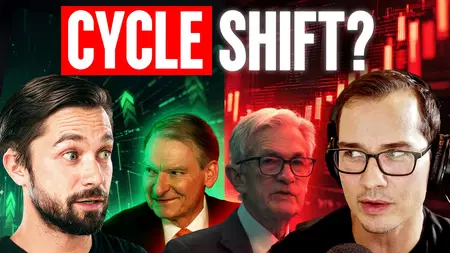
The DeFi Report Podcast | Was the Fed Rate Cut a False Signal for Crypto?
The DeFi Report gets its own dedicated podcast feed

Up next
All episodes 01:15:48
Podcast
01:15:48
Podcast
10 Crypto Predictions for 2026: $1M BTC, Wall Street Onchain & ETF Takeover | Matt Hougan & Ryan Rasmussen from Bitwise
 01:50:27
Podcast
01:50:27
Podcast
Is Privacy A Winnable Battle? | Andy Yen, Founder of Proton
 01:10:08
Podcast
01:10:08
Podcast
ROLLUP: Rate Cuts! | ZK Breakthroughs | Farcaster’s Pivot | SEC Onchain | NYT’s Stablecoin FUD
 01:09:21
Podcast
01:09:21
Podcast
The Return of the ICO | Ryan & David
 01:48:08
Podcast
01:48:08
Podcast
Inside Gary Gensler’s SEC: A Conversation with Former Crypto Policy Advisor Corey Frayer
 01:28:01
Podcast
01:28:01
Podcast
Crypto’s Agentic Future: AI, ZK and Money Networks at Bankless Summit
 00:28:00
Podcast Premium
00:28:00
Podcast Premium
DEBRIEF - Inside Gary Gensler’s SEC: A Conversation with Former Crypto Policy Advisor Corey Frayer
 00:59:51
Podcast
00:59:51
Podcast
ROLLUP: Buy Signal? | Fusaka Launch | Polymarket Mainstream | Trump’s Fed Chair | SEC Crypto Shift
Inside the episode
Subscribe & Follow the DeFi Report


TRANSCRIPT
Ryan Sean Adams:
[0:04] Welcome to the DeFi Report. Was the Fed rate cut the signal to buy back in to crypto? That's what we're going to explore on today's episode. So last week, the Fed cut rates by 20.25%. They also injected $40 billion in Fed Treasury bill purchases. Some people are calling this QE light. I got to know if that was the signal to buy back in. And if not, what signals does Mike from the DeFi Report need in order to switch back to RiskOn and buy back some of his Bitcoin. I'm going to introduce this episode for you. We are doing these episodes on a weekly basis. They're going to be 20 to 30 minutes or so. Access is on the DeFi Report, YouTube, Spotify, wherever you consume podcasts. What I want you to do right now is go subscribe to those feeds so you get this in your podcast listener every week.
Ryan Sean Adams:
[0:57] The first episode is now. We will be resuming these episodes again after the holidays in January. And really what we're going to do is we're going to put the reports that Mike publishes every Wednesday. We're going to put it in podcast format so you can consume it right here. You can access those reports at the defireport.io. So expect these weekly on a go forward basis. And the goal for these episodes is education. I am doing these episodes. We are forking this podcast from Bankless because honestly, I want to get inside Mike's head. He is a long-term crypto investor. He focuses on on-chain fundamental metrics,
Ryan Sean Adams:
[1:38] Cyclamentals, and we get to see on an ongoing basis his investor journal, basically, and what he's doing in his journey of a long-term crypto-oriented investor. So it's the assets with the strongest fundamentals, the things to buy during cycle dips or the things he's buying, the things on his watch list. This is almost as if Buffett invested in crypto. That's what I think Mike's style is. Of course, none of this is financial advice, entertainment use only. But what you do see is skin in the game because Mike shows us his portfolio in these episodes. That was a long way to introduce you to the DeFi Report podcast. Mike, are you ready to do this?
Michael Nadeau:
[2:21] I'm ready. Thanks for having me, Ryan.
Ryan Sean Adams:
[2:23] And we're going to be doing this every week. So, you know, strap in, folks. Let's level set, though. Your positioning right now is you are risk-off. You're risk-off for crypto. So you're generally bullish long-term for crypto, but right now you're arresting 80% cash, and you have been risk-off since October, right before the 10-10 October event. 80% cash, 20% crypto. So does that about cover it, your position right now?
Michael Nadeau:
[2:50] That about covers it. Yeah, I think, you know, we've covered this in a few prior episodes, kind of the kind of the journey that got us there. And I think now it's really doing a ton of research and kind of like exercising patience is kind of like the message, I think. And we're going to go through kind of why we're trying to be patient, I think, a little bit in this episode here today. Yeah, patience.
Ryan Sean Adams:
[3:12] That's the hard one. Let's talk about the headline. So last week, the Fed cut rates to 3.5% to 3.75%. There was also this surprise announcement from the Fed, a $40 billion per month in treasury bill purchase. So some were quick to label this as QE light. What did the Fed do? And what was the real objective here? And how are market participants perceiving it right now? Thank you.
Michael Nadeau:
[3:41] It's been a week since last week's FOMC meeting, which was a pretty interesting meeting. I watched the full press conference and I watched a lot of the commentary on CNBC right after that.
Michael Nadeau:
[3:54] And then I kind of went to Twitter and it's always interesting to go check out Crypto Twitter or FinTech Twitter on Fed Day because there's generally quite a bit of noise and a lot of interesting reactions to what the policy message was. And the Fed cut rates, which was expected, that was already priced into the markets. What was not priced in was the $40 billion of reserve management purchases, RMP is what we're calling this. This was surprising to people and it was perceived as dovish. You know, I was watching CNBC and all of the sort of analysts that were on there were almost drooling over themselves with how dovish they thought this was. And then I went on to Twitter and most of the discussion was about how this is QE and it's money printing and all of this. So I thought that was interesting. My take on this was that this is, to me, it's more of a sign of just how much tightness there is. In the banking sector in terms of liquidity right now. And that's really what the Fed's reaction is here. So they're going to essentially try to plug these holes in sort of tightening liquidity by purchasing $40 billion of T-bills from the Treasury.
Michael Nadeau:
[5:20] And so, you know, the question I think on everyone's mind is like, is this QE, is this money printing? I think you can say it's money printing because the Fed has to print the money to buy those T-bills from the treasury. But the key thing for me is...
Michael Nadeau:
[5:37] Is this actually going to suppress long-end yields? And to me, that is really the key thing that drives risk assets and this more sort of monetary repression that I would be looking for. And this policy does not do that, in my opinion. So buying T-bills does not reduce the long end. We've actually seen the long end rise a little bit. We've had six rate cuts and 175 basis points of cuts. since September of last year and the 30-year is higher than it was at the start of that and also the 10-year. So the long end of the curve is really the thing to pay attention to. And so I just don't see this as bullish for risk assets. And I think we've sort of had confirmation of that by what we've seen with NASDAQ and Bitcoin since last Wednesday. So that's kind of the key takeaway to me is like we're not, reducing duration. And when you reduce duration, that is what causes investors to sort of rebalance portfolios, move out of bonds, go into riskier assets. And we're just not seeing that right now.
Ryan Sean Adams:
[6:48] Okay, let's talk about that a bit more because as you said, that's not necessarily intuitive for investors. They see money printing and they assume, okay, this is QE light. They assume this is a dovish, easy monetary policy, and they assume this means a switch towards a risk on atmosphere. This is Lynn Alden, who's confirming that this is balance sheet expansion, at least, she says, about the $40 billion per month, I should say, injection. It's balance sheet expansion via T-bills. It's money printing because it lets the government spend into the system without drawing from the system. It also helps banks continue to buy T-bills on the fractional reserve. And so people look at that and they say, OK, whatever they call it, they're not calling it QE, but it's kind of a QE light. And that's the average market participants view on this. So talk about how your view is different a little bit. So you say T-bills purchases do not remove duration from the markets. There's no suppression of long end yields. And therefore, the financial conditions are not broadly eased. What is this idea behind long-end yields and duration from the market? So what's different between this type of balance sheet expansion and others that we've seen?
Michael Nadeau:
[8:09] Yeah, I think that's the key distinction is, you know, just because we're going to expand the balance sheet now, we were doing QT for a long period of time. The plan was to end QT, you know, at the beginning of December. And we're sort of expecting this type of move at some point. It came earlier. than expected. And so now we are not only not reducing the balance sheet, we're going to start expanding it again. But to me, the key distinction is that, is the duration of the assets that the Fed is actually purchasing and going on to its balance sheet. And right now, it's just T-bills. If we saw a move towards, hey, we're actually going to suppress long-end rates, and that was clearly signaled to the market, to me, that's much closer to QE. And that would spark lowering of long-end yields. I would expect lower yields on the 30-year, 10-year, things like that. That's what brings down corporate borrowing costs. That's what brings down mortgage rates. That's what lowers the discount rate, changes the calculation in terms of coming into risk assets. So those things are not happening. Mortgage rates have not come down since that policy was put in last week.
Michael Nadeau:
[9:26] So these are all the things that sort of.
Michael Nadeau:
[9:29] Would prompt more of a risk-on environment to me. And so I've kind of just been watching the NASDAQ, watching Bitcoin's price action. And to me, it's kind of been confirming that, you know, these things are not happening right now. The market is not perceiving that these things are happening either.
Ryan Sean Adams:
[9:45] So from your perspective, this is not the type of QE that would switch you to risk-on mode, but that moment will come. You say in the report that you published today, we believe Bitcoin and risk assets more broadly will have their moment in the sun, But that will come after QE or whatever the Fed calls their next phase of financial repression, which is not this, but you're expecting to see that soon. And you've got some signals to watch for. I think you named a few of them. The Fed artificially suppressing the long end of the yield curve. OK, so I guess we'll see that. Tell us what that looks like. And then real rates falling, corporate borrowing costs declining, term premium compressing, equity discount rates falling and mortgage rates falling. We haven't seen those signals, but you say we will see those signals when we get the big, the real QE print?
Michael Nadeau:
[10:35] That's what I'm expecting. And I think, you know, seeing the size of sort of this RMP program tells me that things are on pretty shaky footing right now. And so it sort of feels like we're maybe getting closer. When this policy came out, it was like, OK, this is probably not what we want to see for Bitcoin just yet. But it's telling me we're getting closer to that because I think the reason that they have to do this policy right now is, you know, people seem to forget that tariffs continue to pull money out of the economy. This has been happening now for since since April. So a lot of this is like catching up to the economy that we just saw the labor market data came out this week and unemployment's at its highest level since since over the last four years or so. So it's at 4.6%.
Michael Nadeau:
[11:24] I actually think it's closer to like 8% when you factor in all the part-time workers and the people that have actually rolled off unemployment that are still looking for work, but they're not included in those numbers. And then when you look at sort of unemployment at the youth stage, so I think teenage unemployment is over 16% right now in this country. The unemployment rate between 16 and 24-year-olds is over 10%. Wow. And we've got a few charts here just showing kind of this is labor market data and the gray bars are recession. And you can you can see that on the chart on the right there that's showing unemployment flows. Like when you start to rise up like we are right now on the right side of that chart in the pink there, like that every gray bar starts in the past when you start to see that moving up like that. So to me, like the labor market looks pretty shaky to me right now. And I think that these programs that the Fed is putting in place is in response to an economy that is slowing. Liquidity is tightening. And so this is giving me sort of, it's making me feel like we're getting closer to this point where the sort of QE and kind of what we think the actual answer to all this will be is getting a little bit closer.
Ryan Sean Adams:
[12:48] So when you look at the broader economy, we've got the K-shaped economy, of course, we've seen since 2021 and after COVID, right, which is just kind of the wealthy, they have a fantastic recovery, but middle class and down do not. It's kind of K-shaped. and inflation not doing so well.
Ryan Sean Adams:
[13:08] In fact, Trump's approval rating on inflation is just like not great right now. Retail sales also slumping. And I guess this is a question of you think the Fed and the U.S. government and Trump policy overall is trying to accomplish, even with these Fed cuts right now. What's the big picture? You talk about a global trade war. It's almost like Michael Howell's framework of these capital wars that are going on. What do you think really the big picture for these moves look like? And what can we see in 2026 start to develop?
Michael Nadeau:
[13:43] Yeah. And this is really where I'm starting to spend a lot more of my time here because it does look like we're going into this place when you just kind of look at the sort of near term and what we're seeing with Fed policy. Things are not looking great, just more micro-epotomy, what we're seeing in the US. But the real story to me is what's happening with global trade and the approach that the Trump administration is taking to solve this problem. I think when you really kind of zoom out on this and we've spent some time, There's a paper that was written by the recent Fed governor last year about basically how you would restructure global trade.
Ryan Sean Adams:
[14:22] Was that Steve? Steve. That was Steve Moran.
Michael Nadeau:
[14:24] Yeah. And I recommend people check this out because it's essentially the playbook that we've seen implemented over the last year. And you can kind of go through that and see what was expected of these policies that were put into place and what is playing out. Are these things working or not? And what is the sort of solution? Tariffs are the first phase of this plan, and tariffs are not designed to solve the problem. Tariffs cannot solve the problem. The only way the problem can be solved is through currency adjustments.
Ryan Sean Adams:
[14:55] What are they trying to solve, big picture? Is it reshoring manufacturing? Is it like rebalancing global trade? Is it that type of thing that they're actually trying to solve? Like there is a method to this madness that we're seeing?
Michael Nadeau:
[15:06] Yeah. So he starts the paper out explaining sort of the impact that the reserve currency has and the role that America plays in securing the rest of the world and how this impacts, you know, basically that the dollar is artificially inflated essentially because of it being a reserve currency. And so we're essentially exporting dollars to the rest of the world. And as we've done that, we've sort of gutted the manufacturing base of the country. And this is really what has stoked populism and I think led to Trump and everything over the last 30, 40 years or so. And basically what he's saying is this is not a choice. Like this has to, this has to.
Ryan Sean Adams:
[15:49] It's not sustainable. This is completely unsustainable.
Michael Nadeau:
[15:52] This has to be reversed. and there's basically been a silent depression that's been happening in the middle of America for a long period of time. This has to change for that reason, also for security purposes. We have to produce our own goods in this country for pharmaceuticals.
Michael Nadeau:
[16:11] Potentially for military and things like that. So we have to be able to produce our own things. This has to be solved. And tariffs are really just the beginning. It's sort of like a negotiating tool that has been put into place, And when they rolled this out, the expectation was that when they rolled out tariffs, the dollar would actually rise relative to the Chinese currency. And that's why Trump is coming out and saying China is going to pay for the tariffs because they're going to pay through a currency adjustment.
Michael Nadeau:
[16:46] That did not happen. The dollar dropped when they rolled out the tariffs. And therefore, this is why basically U.S. consumers are paying the tariffs through CPI because that did not happen as planned. This is causing inflation now. We just showed the chart. This is the most important topic for voters is inflation. So now this is causing a problem on that front. But I think the big takeaway for me here is that tariffs are phase one of this. They're not really going to plan. It's kind of just hurting the US economy. It's not really... Changing China's practices. If you look at charts of China exports, they're actually going up. And so this really hasn't been solved. And the only way to solve it is through, you know, currency adjustments. And that is really getting the dollar down so that our exports can become cheaper, we can start to produce again. I think the only way to do this is through a massive, you know, devaluation of the dollar at some point. I don't know when that's going to happen. But to me, this is the big picture. for people that people should be paying attention to.
Ryan Sean Adams:
[17:54] So the big picture for political reasons to restore the middle class and also, you know, to restore U.S. Security and manufacturing in this country is you have to somewhat abandon reserve currency status. You have to weaken the dollar relative to other fiat currencies. And tariffs are just one step in that planned process, but further steps will come in the future. This is very similar to Luke Grumman. He came on Bankless and talked about this. And this was his kind of quote unquote way out is you have to devalue the dollar and it has to be less of a reserve currency and less powerful relative to other
Ryan Sean Adams:
[18:32] fiat currencies than it is currently. Is that your take?
Michael Nadeau:
[18:35] I think so. They obviously don't want that to happen. I think they would prefer to keep the reserve currency, keep the US treasury as a global reserve asset. I just think it's going to be really hard to do it because those two charts that you're showing there, it's sort of like they're a mirror image of each other. So the US has a huge trade deficit. We send dollars to the rest of the world and then they use, you know, and we get goods in return. They use those dollars and they're coming back into US capital markets. And so I think what Luke Groman is saying is that you can't solve this problem, and have everybody still using the U.S. Treasury as that reserve asset, there's probably going to be something else. I don't think the dollar, I don't think we're going to be using a different currency or anything like that. I think the dollar is not going anywhere. But the U.S. Treasury as the reserve asset, as the thing that everybody invests their surplus from selling goods to the U.S. Into, that could change if we're devaluing the dollar. And then where is it going? And, you know, that's what we like to set up for Bitcoin and other hard assets.
Ryan Sean Adams:
[19:43] Yeah. So this is the big picture setup, I guess. So it's not happened yet. We haven't seen that big real QE injection, but you're still forecasting that on the horizon and there will be signs and you think that is the inevitable destination. So even if the dollar does retain some reserve currency status relative to other fiat, it It doesn't mean it won't lose market share to, you know, non-sovereign reserve assets like, say, cryptocurrencies like a Bitcoin or like a gold. And that, I think, is what you're forecasting. But not yet. This is where the word that you talked about early in the episode, patience, comes in again. So let's talk about the cycle itself and what we see on-chain right now. So what does Bitcoin look like on-chain? And remind us why these cyclometrics are so important for you and why you look at the on-chain holding patterns of Bitcoin in order to forecast what's going to happen in the future.
Michael Nadeau:
[20:41] Yeah, so this is super important. And what I think is interesting and probably something that we do a little bit more so than maybe some other research shops out there is we really deeply, deeply want to understand Bitcoin market structure. So we're studying macro, we're studying liquidity and all the things that we believe impact Bitcoin, but also important to understand actual market structure. And so like one example of that is just looking at things like long-term holders and short-term holders and flows and different things like this. The long-term holder supply continues to drop for Bitcoin, even at these levels that we've been, you know, upper 80s, lower 90s or so.
Ryan Sean Adams:
[21:22] That means long-term holders are selling.
Michael Nadeau:
[21:24] They're still selling. We're seeing a supply drop. So it looks like they're still kind of exiting the market somewhat, not, I wouldn't say in a chaotic fashion. And there seems to be you know some new money coming in some short-term holders coming in um but for me the takeaway you know with this chart is that you know bitcoin doesn't bottom until long-term holders have you know kind of exited the market and they typically are the the foundation and the base that's gonna you know set the bottom so so it's, You know, we'll see, you know, it's possible we just sort of set a bottom somewhere in the 80s here. And this doesn't play out the way it has in the past. But my base case is that, you know, the bottom will come when we see sort of an exhaustion from some of these long term holders that are selling currently. Okay.
Ryan Sean Adams:
[22:20] Can you give us some numbers of cost basis numbers? I think you say 41% of the Bitcoin supply has a cost basis above $78K. That's interesting. 28% of the Bitcoin supply has a cost basis above $92K. You think these types of numbers are important and you say that the takeaway is the conviction of many new entrants over the last year is likely to be tested in the coming months as prices potentially move below their cost basis. So you've got all these different cost basis numbers. And you also talk about a large cluster of Bitcoin holders in this 84 to 85k range. There's about 5% of all Bitcoin supply in that range. And there might be some dip buyers in that range. So use all of this data and help us understand what you think could play out, you know, in the coming weeks as we're still, according to you, in this risk off mode.
Michael Nadeau:
[23:13] Yeah. So this is the great data that we get from Glassnode. And it's really useful in the analysis because it gives me a pretty clear view of, again, the market structure and how sort of lopsided it is, you know, right now. It reminds me of sort of, you know, early 2022 is kind of what it sort of looks like to me, where you've had a period of over a year or so where there's been new money that's come into Bitcoin. The average price of the last year is over 100K or so. So most of the new money that's come in has come in at those levels. And that is sort of a, you know, we're going to find out if those are diamond handed holders as the price starts to dip below their cost basis. And what we're trying to do is understand just how large the base of coins is within these sort of what we think might not be diamond-handed holders. And then we want to essentially study what's happening as price starts to go into these clusters where we think we could see more selling. What was interesting is that the largest cluster, and this is looking at just over the last six months of buying, the largest cluster was in the $84,000 to $85,000 range. About 4.5% of the Bitcoin supply actually has a cost there was last moved on chain at those levels.
Michael Nadeau:
[24:42] That looks to me like a lot of dip buying when we had the first initial crunch down to like 80K or so. So we're seeing people come in and buy that.
Ryan Sean Adams:
[24:53] So there's some strength in the 80s, in the low 80s then to mid 80s.
Michael Nadeau:
[24:55] We're seeing plenty of people come in and buy in that zone. This is similar. Again, early 2022, people were doing this as well. Like after you dropped the initial 30%. People are still in risk on mode. We've sort of been conditioned to buy the dip, and that's been the right move since early 2023. And I tend to worry that people haven't sort of turned their psychology into a more defensive stance. They're still kind of in that buy the dip mode. We'll see. And if you're buying the dip at 84 now, if the price starts going down into the upper 70s or so, are you still buying? or now you're like a tapped out and potentially selling. We'll see. But this is the setup that we're paying attention to.
Ryan Sean Adams:
[25:41] And I'm looking at this graph here, which I think is instructive. There's kind of two lines on this graph that seem important. There's of course the Bitcoin price line in purple, but then there's the 50 week simple moving average. And of course we breached that. And that's like confirmation to you of a bear market, of risk off stance. But there's this other white line that's kind of in the distance here and slowly ebbing up, which is the 200-week simple moving average. And you said it's still possible that we get a jump back up above 100K Bitcoin. So that would be above or close to the 50-week moving average. But the longer-term trend is that white line, the 200-week average. Simple moving average. And you think that might be where we're ultimately heading, which is currently at a scary number. That's about 56k. So by the time it hits that, you think it could get in the 60s to the 65k range, something like that. Is that what you're waiting for in combination with the QE signals that we've talked about earlier in this episode?
Michael Nadeau:
[26:50] That is kind of where I think the convergence is potentially coming, where we're sort of forecasting this out and historically bitcoin does um you know get down to that the white line there's the longer term 200 week moving average and you know historically in every bear market we've gone down and touched that so um that's the base case is that we would hit that the blue line there's the 50 week moving average that's the really more the bull market support band line that we broke uh in october historically in past cycles when we've broken that 50 week moving average for the first time, like heading into the bear market, we, we usually see a retrace back to it, um, within, you know, two to three months or so. So we're in that zone where I, you know, my base case has been that we would sort of see a pretty good move back up. It really hasn't.
Ryan Sean Adams:
[27:39] That's a fake out.
Michael Nadeau:
[27:40] I think it's a fake out. Um, I do think that will be a fake out, but, uh, we haven't even seen that move just yet. So it's possibly we will, we will, maybe that's the Santa rally or potentially coming. But that's kind of the base case. And that's what I'm looking for. If we did go back up there, I would be looking for, can we flip that into support? That would be the key thing to pay attention to.
Ryan Sean Adams:
[28:03] But you're going to be patient even up there. You're not going to immediately call for, okay, now we're back to risk on. You're still going to maintain your patient posture because you sort of expect that. And so we've even dipped below the white line, the 200-week simple moving average in previous bears as well. Do you think that could happen?
Michael Nadeau:
[28:22] It could. It definitely could. It happened for the first time it happened last cycle. So it could definitely happen. And that's a moving target. So it could be, you know, like you said, into the 60s or so by the time, you know, we see the convergence there.
Ryan Sean Adams:
[28:36] Okay. So we got what you're waiting for in terms of price. Do you have a sense of, and QE indicators, do you have a sense of how long this will take to play out?
Michael Nadeau:
[28:45] Hard to say. I think it's, like I said earlier, just seeing the Fed kind of make this move to $40 billion, nobody was really projecting that they would kind of be printing $40 billion a month at this stage. Yes, it's just the T-bills, and we don't think that that's necessarily great for risk assets right now, but it shows that there's some concerns out there. And the deeper I go into the economic data right now, the more concerned, you know, I'm becoming about just the health of the economy. So if it continues to deteriorate, like it could be Q1, you know, we start to see, you know, the markets can be pretty reflexive. And what I think could happen, everyone is still very much locked into the AI trade and everything. But when psychology shifts, it tends to shift pretty fast and things can be reflexive on the way up and also, you know, on the way down. So something to pay attention to. These things are hard, really hard to forecast, but I like to just sort of anchor to something that I have strong conviction in and then just look for the signals as we go.
Michael Nadeau:
[29:54] The timing is probably less important for me.
Ryan Sean Adams:
[29:57] So they answer the question, was the Fed rate cut the signal to buy back in? Mike is saying, no, it was not the signal. Patience right now to wait for the bigger QE indicators and for prices to drop still further. So you got to look for the risk on. You are right now positioned in risk off with 20% crypto holdings and 80% cash. In the meanwhile, it seems like you're doing some research on your portfolio watch list, basically, of assets that you would buy at bottoms. And that continues on the DeFi report. What's the best way to follow your strategy here? Aside from, of course, listeners, go subscribe to the DeFi report. We're publishing this on a non-bankless feed, so it's a separate feed. So go do that. Spotify, wherever you consume podcasts, also YouTube. What else can folks do to plug into your strategy and what you're watching?
Michael Nadeau:
[30:54] Yeah, so we write weekly reports, sometimes twice weekly. And all of the research is geared towards cycle awareness, cycle metrics, deeply understanding fair value for Bitcoin and patience right now. So doing a lot of research and kind of patiently waiting for our price targets to hit. People can follow the research at the defireport.io is the best place to follow the written reports. And yeah, excited to do these episodes with you on a weekly basis moving forward to get into a little more nuance, I think, which is helpful for people that maybe we can't get into in some of the written stuff.
Ryan Sean Adams:
[31:32] So I am a paid member of this service, the DeFi Report Pro that comes with two weekly reports. It also comes with access to all of Mike's portfolio holdings and something that's come in handy, which is an alert when things change. So that was very helpful just before the 1010 episode also includes these watch list assets. These are the tokens that you have that you might be purchasing at some point in the bear market cycle. What's on the watch list right now, Mike?
Michael Nadeau:
[31:59] Yeah, we just did a report last week on Robinhood. So Robinhood is on the watch list. I encourage people to check that out. I think it was one of our best reports that we've done. And, you know, Robinhood is a really interesting company. We think that's potentially a financial institution of the future. So it's an asset that we were in, you know, early back in 2022. We rode it all the way up this cycle. We're out of it now, but we'd like to buy it back at lower prices. Because we've got a report on Hype coming. Hype is on the watch list. We covered PumpFun recently. That's on the watch list. And we've got a lot more coming. We're going to be covering the Bitcoin mining sector. We've got Galaxy coming as well. So lots more coming. And the goal of all this is like, hey, we're in a bear market. This is what I get sort of excited for. I know that's a little odd to say, but it's just so much easier to do the deep research, build the conviction. There's less noise at this stage, I think. And this is when we want to be doing all that research. And so in preparing ourselves for when the opportunity comes to buy our favorite assets at the prices we want to pay for them.
Ryan Sean Adams:
[33:11] Go subscribe if you want to follow along with the journey. I certainly am. Mike, thanks so much. I got to let you know, of course, none of this has been financial advice. Thanks for following the DeFi report on our Crypto Fundamentals journey. We will see you guys after the holidays.
Transcript
You're about to hear the first episode of a new podcast format I'm working on with Michael Nato from the DeFi Report. And the idea behind these episodes is to really get inside Michael's head, his portfolio, his positioning. He's a long-term crypto investor. He's someone I respect. I think these episodes will help you on your crypto journey. And we'll be doing these weekly next year in 2026, just not on the Bankless Podcast feed. So if you want access to these episodes, we're coming out with them every Wednesday next year in 2026. Subscribe to the DeFi Report podcast. There'll be a link in the show notes. Go do that now.
Welcome to the DeFi report. Was the Fed rate cut the signal to buy back into crypto? That's what we're going to explore on today's episode. So last week the Fed cut rates by 20.25%. They also injected $40 billion in Fed Treasury bill purchases. Some people are calling this QE light. I gotta know if that was the signal to buy back in. And if not, what signals does Mike from the DeFi Report need in order to switch back to Risk On and buy back some of his Bitcoin? I'm gonna introduce this episode for you. We are doing these episodes on a weekly basis. They're gonna be 20 to 30 minutes or so. Access is on the DeFi Report, YouTube, Spotify, wherever you consume podcasts. What I want you to do right now is go subscribe to those feeds so you get this uh in your podcast listener every week.
The first episode is now. We will be resuming these episodes again after the holidays in January. And really, what we're going to do is we're going to put the reports that Mike publishes every Wednesday. We're going to put it in podcast format so you can consume it right here. You can access those reports at thedefyreport.io. So expect these weekly on a go forward basis. And the goal for these episodes is education. I am doing these episodes. We are forking this podcast from Bankless because honestly, I want to get inside Mike's head. He is a long-term crypto investor. He focuses on on-chain fundamental metrics, uh, cyclementals, and we get to see on an ongoing basis his investor journal, basically, and what he's doing in his journey of a long-term crypto-oriented investor. So it's the assets with the strongest fundamentals, the things to buy during cycle dips, or the things he's buying, the things on his watch list. This is almost as if uh Buffett invested in crypto. That's what I think Mike's style is. Of course, none of this is financial advice, entertainment use only, but what you do see is skin in the game because Mike shows us his portfolio in these episodes. That was a long way to introduce you to the DeFi Report podcast. Mike, are you ready to do this?
I'm ready. Thanks for having me, Ryan.
Uh, and we're gonna be doing this every week. So uh, you know, strap in, folks. Level let's level set though. Your positioning right now is you are risk-off.
Your risk off for crypto. So
you're generally bullish long term for crypto, but right now you're arresting 80% cash and you have been risk off since October, right before the 1010 October event. 80% cash, 20% crypto. Does that about cover it, your position right now?
That about covers it. Yeah, I think, you know, we've covered this in in a few prior episodes, kind of the kind of the journey that got us there. And I think now it's it's really doing a ton of research and and kind of like exercising patience is kind of like the message, uh, I think. And we're gonna go through kind of why we're trying to be patient, I think, a little bit in this episode here today.
Patience. That's the hard one. Let's talk about the headline. So last week the Fed cut rates to 3.5 to 3.75%. There was also this surprise announcement from the Fed a $40 billion per month in treasury bill purchase. So some were quick to label this as QE light. What did the Fed do? And what was the real objective here? And what how is how are market participants perceiving it right now?
Yeah, it's been it's been a week since uh since last week's FOMC meeting, which uh was a pretty interesting, interesting meeting. I I watched the full press conference and I watched kind of a lot of the commentary on on CNBC right after that.
Uh and then I kind of went to Twitter, and it's always interesting to go uh check out Crypto Twitter or or FinTech Twitter uh on Fed Day because there's there's generally quite a bit of noise and a lot of a lot of interesting reactions to what what the what the policy message was.
And you know, the Fed cut rates, which which was expected, that was already priced into the markets. Um what was not priced in was
The the 40 billion of reserve management purchases, RMP is what we're calling this. Um, this was surprising uh to people and it was perceived as
as dovish. You know, I was watching uh CNBC
and all of the sort of analysts that were that were on there were were were almost drooling over themselves how dovish uh they thought this was. And then I went on to you know Twitter and
Most of the discussion was about how this is QE and it's it's money printing and all of this. So
um thought that was interesting. Uh my take on this was that um this is
to me, it's more of a sign of
of just how much tightness there is in the banking sector in terms of liquidity right now.
And and that's really what the Fed's reaction uh is here. So they're going to
uh essentially try to plug these holes in sort of tightening liquidity
by purchasing $40 billion of T bills.
From the Treasury. And so, you know, the question I think on everyone's mind is like, is this QE? Is this money printing? I think you can say it's money printing because the Fed has to print the money to buy those T bills from the Treasury.
But the key thing for me is
is this actually going to suppress long end yields? And to me, that is really the key thing that drives risk assets and this more sort of monetary repression.
That I would be looking for. And this policy does not do that, in my opinion. So buying T bills does not reduce the long end. We've actually seen the long end rise a little bit. We've had six rate cuts
and 175 basis points of cuts
since September of last year. And the 30 year is higher than it was at the start of that,
and also the 10 year.
So the long end of the curve is really the thing to pay attention to. And
so I just don't see this as bullish for risk assets. And I think we've sort of had confirmation of that
by what we've seen with NASDAQ and Bitcoin since last Wednesday. So that's kind of the key takeaway to me is like we're not
reducing duration. And when you reduce duration, that is what causes investors to sort of rebalance portfolios, you know, move out of bonds, go into riskier assets. And we're just not, we're not seeing that right now.
Okay, let's talk about that a bit more because as you said, it's not that's not necessarily intuitive for investors. They see money printing and they assume, okay, this is QE light. They assume this is uh dovish, easy monetary policy, and they assume this means a switch towards a risk-on atmosphere. This is Lynn Alden who's confirming that this is balance sheet um expansion, at least. She says about the $40 billion per month, I should say, injection. It's balance sheet expansion via T-bills. It's money printing because it lets the government spend into the system without drawing from the system and also helps banks continue to buy T-bills on the fractional reserve. And so people look at that and they say, okay, whatever they call it, they're not calling it QE, but it's kind of a QE light. And that's the average market participant's view on this. So talk about how your view is different a little bit. So you you say T-bill purchases do not remove duration from the markets, there's no suppression of long end yields, and the the therefore the financial conditions are not broadly eased. What is this idea behind long end yields and duration from the market? So, what's different between this type of balance sheet uh expansion and others that we've seen?
Yeah, I think that's the key distinction is you know, just because we're gonna expand the balance sheet now, we were doing Q QT for a long period of time. The plan was to end QT, you know, at the beginning of December. And we're sort of expecting this type of move at some point. It came earlier
than expected. And so now we are not only not reducing the balance sheet, we're going to start expanding it again.
But the to me, the key distinction is that.
Is is the duration of the assets that the Fed is actually purchasing and going onto its balance sheet.
And right now it's just T-bills. Um, if if we saw a move towards, hey, we're actually going to
um suppress long end rates, and that was clearly signaled to the market, to me, that is like that's much closer to QE. And that would spark uh you know lowering of long end yields. I would expect lower yields to uh on the 30 year, 10 year, things like that.
That's what start, that's what uh brings down corporate borrowing costs. That's what brings down mortgage rates. Um, that's what lowers the discount rate, changes the calculation in terms of you know, you know, coming into risk assets.
Um, so those things are not happening. Mortgage rates uh have not come down since since that policy was put in uh last week.
Um so these are all the things that sort of
Would prompt more of a risk on environment to me. And so I've kind of just been watching the NASDAQ, watching Bitcoin's price action. And to me, it's kind of been confirming that these things are not happening right now. The market is not perceiving that these things are happening either.
So, from your perspective, this is not the type of QE that would switch you to risk on mode, but that moment will come. You say in the report that you published today, we believe Bitcoin and risk assets more broadly will have their moment in the sun, but that will come after QE or whatever the Fed calls their next phase of financial repression, which is not this, but you're expecting to see that soon. And you've got some signals to watch for. I think you named a few of them. Um, the Fed artificially suppressing the long end of the yield curve. Okay, so I guess we'll see that. Tell us what that looks like. And then real rates fall falling, corporate borrowing costs declining, term premium uh compressing, equity discount rates falling, and mortgage rates falling. We haven't seen those signals, but you say we will see those signals when we get the big, the real QE print.
That's what I'm expecting. And I think, you know, seeing the size of sort of this RMP program tells me that things are on a pretty shaky footing right now. And so it sort of feels like we're maybe getting closer when I when this policy came out, it was like, okay, this is probably not what we want to see for Bitcoin just yet, but it's telling me we're getting closer to that because I think the reason that they have to do this policy right now is.
Um, you know, people seem to forget that tariffs continue to pull you know money out of the economy.
This has been happening now for since since April. So a lot of this is like catching up to the economy. We just saw the the labor market data uh came out this week, and unemployment's at its highest level um since since uh over the last four years or so. It's at 4.6%.
I actually think it's closer to like 8% when you factor in all the part-time workers and the people that have actually rolled off unemployment that are still looking for work, but they're not on included in those numbers.
So, and then when you look at um sort of unemployment uh at the at at the youth stage, so I think
uh teenage unemployment is over 16% right now in this country. Uh the unemployment rate between 16 and 24 year olds is over 10%.
Wow.
And we've got a few charts here just showing kind of uh this is labor market data.
And the gray bars are recession. And you can you can see that uh on the chart on the right there, that's showing um unemployment flows.
Like when you start to rise up, like we are right now on the right side of that chart in the in the pink there,
like that every gray bar starts in the past when you start to see that moving up like that. So to me, like the labor market looks
Pretty shaky to me right now.
And I think that these programs that the Fed is putting in place is in response to an economy that is slowing, liquidity is tightening. And so this is giving me sort of
it's it's making me feel like we're getting closer to this point where the sort of QE and kind of what we what we think the actual answer to all this will be is getting a little bit closer.
So when you look at the broader economy, we've got the the K-shaped economy. Of course, we've seen uh, you know, since um 2021 and after COVID, right? Which is just kind of the the wealthy, they they have a fantastic recovery, but middle class and and down do not. It's kind of K-shaped and uh inflation uh not doing so well. In fact, Trump's approval rating on inflation is uh just like not great right now. Retail sales also slumping. And I guess this is a question question of what you think the Fed and the US government and Trump policy overall is trying to accomplish, even with these Fed cuts right now. What's the big picture? You talk about a global trade war, it's almost like Michael Howell's framework of these capital wars that are going on. What do you think really the big picture for these moves look like? And what can we see in 2026 start to develop?

Ryan Sean Adams
Crypto investor going bankless.