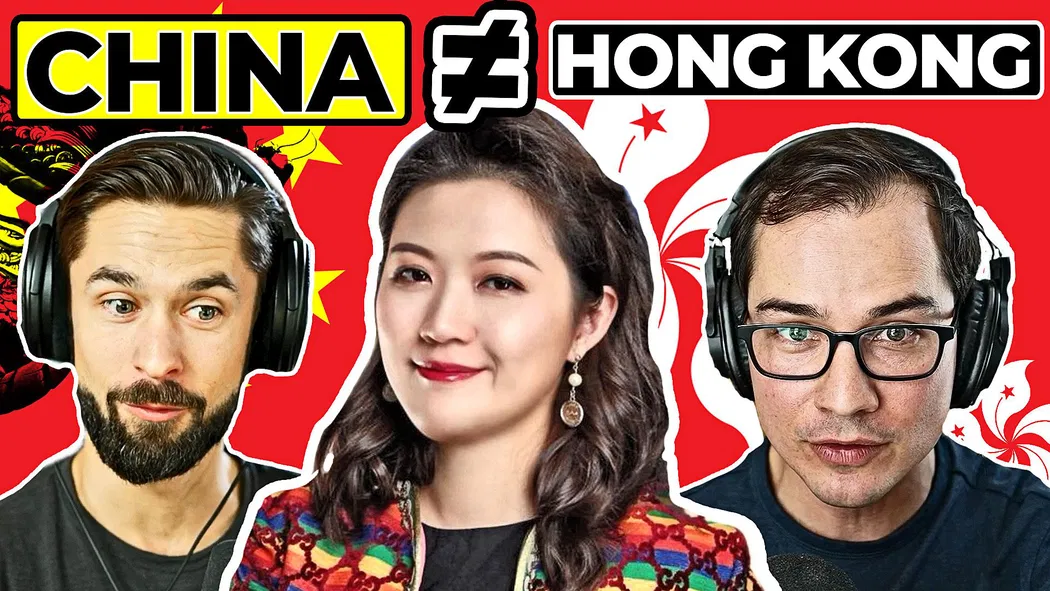
Crypto in Hong Kong with Sandy Peng
Joining us today from Hong Kong is Sandy Peng. Sandy is here to tell us what crypto is like on the other side of the world, walking us through regulations, adoptions and bringing us fully up to speed on the landscape in Hong Kong.
Up next
All episodes 00:52:38
Ethereum
00:52:38
Ethereum
Scroll zkEVM Mainnet Launch with Sandy & Toghrul
 01:21:54
News
01:21:54
News
ROLLUP: SBF vs Caroline Ellison | Sam Altman on Joe Rogan | ETH Predictions
 00:22:27
Podcast Premium
00:22:27
Podcast Premium
DEBRIEF - Bull Case For Stablecoins
 Podcast Premium
EARLY ACCESS - Nic Carters' Bull Case For Stablecoins
 00:42:18
Podcast
00:42:18
Podcast
Introducing Rainbow Wallet Browser Extension With Mike Demarais
 00:58:02
Ethereum
00:58:02
Ethereum
What the ETH Futures Approvals Mean for Crypto with Eric Balchunas
 00:23:40
Podcast Premium
00:23:40
Podcast Premium
DEBRIEF: Danny Ryan's Case Against Lido
 01:33:40
Ethereum
01:33:40
Ethereum
191 - Danny Ryan's Case Against Lido
Inside the episode
Joining us today from Hong Kong is Sandy Peng. Sandy is here to tell us what crypto is like on the other side of the world, walking us through regulations, adoptions and bringing us fully up to speed on the landscape in Hong Kong.
For many of us this episode is a 0 to 1 moment in understanding around crypto in Hong Kong and more broadly China.
CHAPTERS
0:00 Intro
5:53 Hong Kong History
10:08 What is Hong Kong Like
12:27 Why Hong Kong is Successful
15:28 Innovators and Regulators
19:11 HK & China Relationship
26:35 Why is HK opening its Doors to Crypto
28:52 Crypto in HK
37:21 Has HK Put Its Foot on The Gas?
40:42 The Silicon Valley Of China
43:08 Stablecoin Legislation
45:08 How Crypto Friendly is HK?
46:54 Why Move To HK?
50:50 DeFi
54:46 Crypto Projects in HK
56:33 Watch The Debrief
RESOURCES
Sandy
https://twitter.com/SandyPeng1
Transcript
I think really what we're trying to get at is understanding that Hong Kong has meaningfully opened its doors to crypto. The c the question I have is that is Hong Kong opening its doors to crypto in spite of China or because of it?
Bankless Nation, the question for today is Hong Kong warming up to crypto? What would that mean for China, for the rest of Asia, for the world? And how about for crypto? A few things we discuss on today's episode. Number one, what's the deal with Hong Kong? How about its history? How about its relationship with China? Number two, is Hong Kong turning crypto friendly? What's the evidence of this? What do things look like on the ground? Number three, is Hong Kong trying to position itself as the epicenter of crypto in Asia? Do other city states like Singapore have something to say about this? And number four, if Hong Kong goes crypto, will China follow? These are the big questions in today's episode. Why was this significant to you, David?
There's a growing movement out there of just focus on city-states as bastions of innovation and entrepreneurship. And this is, I would say, definitely the story of Hong Kong and also Singapore and other examples as well. People have certainly learned that just good regulation and good rulemaking can produce and generate wealth. We've seen that in Singapore. We've seen that in Hong Kong because of good relations between entrepreneurs, innovators, and regulators, massive amounts of opportunity and wealth has been created. And Hong Kong is one of those few city-states out in the world that is really leaning into this. And crypto, of course, is one of the few frontiers of the world that is producing a ton of wealth. And Hong Kong, like Singapore, like others, are really leaning into this. So what lessons can we learn from Hong Kong? I'm really jealous about the way that Hong Kong is treating crypto. What can the United States learn from Hong Kong? And really, how will this kind of position the physical world as crypto in the metaverse world grows? How does this impact the atoms that are floating around in the physical world? I think understanding that dynamic is always something worth worth paying attention to. And really the case being made here is that Hong Kong, from the crypto perspective, is also worth paying attention to. So we dive into trying to get a grip and understanding around what's going on in Hong Kong here today on this episode.
Good time to escape your Western bubble if you live in Europe or the US and see what's going on in Asia. So we do that in today's episode. Guys, we're gonna get right to the conversation with Sandy. But before we do, we want to thank the sponsors that made this episode possible. Bankless Nation, we are very excited to introduce you to Sandy Pang. She is one of the co-founders of Scroll, which is a ZK scaling solution that's working on scaling Ethereum. Some very noble work there. Sandy's also a longtime Hong Kong resident. She's been in Hong Kong for over 10 years. She's seen the rise of Hong Kong and its influence in the crypto sphere as an economic center as well. And more recently, crypto seems to be back on the menu in Hong Kong. Sandy, welcome to Bankless. How are you?
Thanks for having me, Ryan and David. Very happy to be here.
Yeah, this is a really interesting subject that of course David and myself are not equipped to help answer. So we're hoping you can help us uh today. And we've we've seen a lot of headlines here recently over the past few months. Uh headlines such as as the US cracks down on crypto, Hong Kong extends a warm welcome. So bullish Hong Kong for crypto, you know, another one. Hong Kong government pressures banking giants to accept crypto clients. It seems very much the story of 2023 has been US regulatory hostility to crypto and Hong Kong maybe opening up. So that is really the question that um we'd love to have you help us answer today. Is Hong Kong warming up to crypto? What would that mean for China? What would that mean for the rest of Asia? What would that mean for the world? So uh we thought we'd go through a three-part maybe uh agenda in this episode, um, because I think we need, firstly, to get some grounding on the history of Hong Kong. Educate us Western listeners on how Hong Kong came to be, how it's grown in prominence and economic power. Then uh give us some sense of the relationship between China and Hong Kong, if we could spend a few minutes there. And then lastly, I think we'll be equipped to talk about Hong Kong and China. Does that sound good, Sandy?
Yeah, sounds great. Looking forward to it.
Okay.
History. Give us a little history lesson here, Sandy. Hong Kong is a very unique place. It's kind of a maybe a quirky place. It's at the margins of some very uh dominant societies and empires, maybe. It has US dollars as the pegged local currency, has the highest concentration of ultra net worth individuals. It's the fourth largest financial center in the world. Give us a sense of how Hong Kong has come to dominate in these ways. Why is it doing so well? Give us some of the history here, Sandy.
Um, I think in a nutshell, Hong Kong originally was a fishing village of no particular significance. Um, it was ceded to the British during the first Opium War. So the Opium Wars where the Brits tried to sell opium in exchange for goods and services, uh, well, mostly goods, and um, and then during the second opium war, Kowloon was also ceded to the British. So after about a hundred years or so of British colonization, um, in 1997, Hong Kong was returned to China officially under the one country two system mechanism, and where Hong Kong gained an independent kind of judiciary and independent kind of legislative process and um and and the bureaucratic kind of um um the part of the government is set up in a sense that's still very similar to the way that um that's typical to a British colony. So the reason so Hong Kong has been a major financial center um over the last couple of decades now. And um the reason it's been so popular, it's it's kind of historically a popular place for um Chinese companies to be listed overseas. And it has um, you know, huge liquidity pool. And when when when when large companies think about listing, they typically think about
US or Hong Kong.
So it it's very interesting when an important jurisdiction such as Hong Kong starts to become more crypto friendly.
So, how how did we get here from fishing village to bustling economic center for the world? So the Opian Wars, um, it was back in the kind of the 1800s, of course. And then I it must be the case that Hong Kong had a booming 20th century, a booming 1900s, in order to transform it from a fishing village to economic hub and economic zone. Uh how did that happen?
Um, so I think the the the economic miracle um of Hong Kong is relatively similar to that of Singapore and um South Korea and to some extent Japan. So after the um, so so so so after the Second World War, um a lot of the um so so Hong Kong very quickly became the bridge between China and the rest of the world. There was a period of time, uh, well there there still is capital control in China, and um Hong Kong is the place where um Chinese companies get listed, and it's where US capital and and international capital for that matter use Hong Kong as a jumping board before investing into China. And um being part of the kind of the major kind of economic miracles over the last couple of decades, about you know, where you know hundreds of millions of people were lifted out of poverty, part of that economic miracle also brought with it an uh a kind of emergence of Hong Kong as a financial center that that that enabled it.
Getting the ingredients as to what contributed to that economic miracle, I think, is definitely one of the big conversations that we want to pull out here. But just to really put an image in listeners' minds about what it's like, what Hong Kong is like, what the city is like. Sandy, uh the last I saw you was in Austin at Permissionless. I've met you in New York. Uh, we've hung out in Paris at EccC. You've you've been over the world. You've uh trotted your number of cities. Can you kind of compare and contrast the cities of the world to Hong Kong, just so people can kind of uh get an image of what Hong Kong is like? Like literally the geography, topology, kind of culture of it all.
Um, in terms of vibe, I think it probably max m maps blosely to New York. Um everything is very closely packed together and um except there's fantastic public transport and um
Yeah, our public transport had a flood last weekend.
Um, and people are very friendly, it's very cosmopolitan, and there's a huge international community. So I think of it as the um
New York of Asia.
I think that that um comparison really makes sense to me, right? And even as I was looking up uh Hong Kong's population, it's about eight million people. That's about the population of New York City. And that this portrait of Hong Kong as kind of a financial center uh for Asia, I mean, that starts to be very much what what kind of New York is uh for the US in the West.
B both are islands. Well, Manhattan's islandy, kind of.
Sure.
It's got bridges.
Yeah. So there's that too. And um so it is that really where Hong Kong specializes? Like, so in addition to be being called kind of the New York of Asia, could we also call it the Wall Street of Asia? I mean, how much um kind of trading activity and economic hack t activity is sort of Wall Street like? Is that where um many of Asia's banks are are situated and and hang out and stock markets kind of are are represented there? Tell us about that.
Yeah, I think a very large proportion of the population here uh works in the financial services sector. And um a lot of the major banks have a huge presence here, and there's a constant inflow of you know trainees in in law firms and investment banks and consulting firms that passes through Hong Kong. Um, in that sense, it's very similar to New York. It was also, you know, traded to the Brits once upon a time. That's also a
Similar tie in history.
So the topic of the the network state people, for example, use both Hong Kong and Singapore and a few other example cities as just like exemplar cities of wealth, gr growth, wealth generation, uh cool new rules that allows for entrepreneurship. Uh so starting to get into the topic of like why Hong Kong has been so successful over the decades, can you can you get into that story?
So I think partially it's a it's a location where there's a large number of um talent who are financial savvy and who are relatively tech savvy. And um and it's this understanding of the financial system that enables a lot of the first generation of crypto trading shops, entrepreneurs, um centralized exchanges to emerge from Hong Kong.
And as a part of that narrative, there's also a lot of kind of family offices here. And also, I think the the the clearer the regulatory regime in a particular place, the more it enables and empowers entrepreneurs to step into the arena, which is what makes Hong Kong and Singapore and probably a few other crypto friendly jurisdictions very interesting at this particular point in time.
Sandy, is there like a rivalry between these these jurisdictions like like Hong Kong? Like so is there like a Hong Kong versus uh Singapore type of um rivalry almost? Like you know, maybe fun competition. I'm sure they're they're trading partners and such, but um who who does Hong Kong see as a rival?
Um, I I think you're definitely right there, Ryan. There's a bit of a Hong Kong-Singapore rivalry. And um, and I think that's all um that that's very healthy and it's good for the ecosystem as a whole. And um, so I think the fact that Singapore became a very crypto-friendly jurisdiction um was a major catalyst for for for Hong Kong speeding up its crypto lawmaking process. And so um in 2022, that was the first time I think the Hong Kong government announced its ambition to become a Web3 hub of the world. And since then, there's been a huge kind of coordinated effort amongst the various government agencies to work together to support uh crypto businesses in Hong Kong. And fast forward to today, there is um, you know, I think in a um, you know, direct engagement with Invest Hong Kong, Cyberport Hong Kong, Hong Kong Science Park, uh, Hong Kong MA, SFC, all of these um kind of uh government agencies are very easily accessible to relevant builders in the space. And um and there are there's a number of public consultation and crypto laws which are in place or very quickly becoming um or or or or you know reaching a stage of public consultation that is proposed by the community. And and that's very encouraging.
Yeah, so that is something that we are not familiar with. Uh having accessible regulators is definitely something I would say that's foreign to us uh in at least in the United States. Uh it w to what degree would you say that that's been an important part of Hong Kong's history, just like the relationship between entrepreneurs, innovators, and regulators?
Um, so I think with financial innovation in particular, this has been um a thing that Hong Kong government as a whole have been trying to spearhead for a very long time. And um there's been a kind of consistent push towards fintech in general, and the push for crypto in particular started really in the last two years. Um but I think that the the commun the business community in Hong Kong in particular is very adaptable and very resilient. Um I think the first time I came to Hong Kong and
1998. I don't think anybody spoke Mandarin. And now almost everybody speaks Mandarin in Hong Kong. And um, I would say two or three years ago, hardly anyone spoke crypto. And now the level of crypto knowledge amongst the various agencies and um, you know, senior government officials is um uh is very, very quickly ramped up over the last two to three years.
One one advantage of um smaller, almost like city states, uh we'll call them like uh Singapore or a Hong Kong is that they can move so much faster with respect to regulation and governance than a big um aircraft carrier-sized, you know, uh nation like the United States or or even China. And so I think that's what maybe you know we're seeing a little bit is when there is the desire and when there is the economic uh impetus to move forward, then a um a a place like Singapore, a place like Hong Kong can really get it done and put sensible laws on the books that that promote a certain industry or sector um or you know um like advantage it in some way. And so that seems to be a uh a superpower of um you know uh countries like or places, jurisdictions like Hong Kong and Singapore. There there's also a difference though between Hong Kong and Singapore, and this is where maybe the um conversation of China uh gets into it, which is so how is how is Hong Kong related to China versus say, you know, Singapore, right? So Singapore does not have any sort of special designation with with China, um, I believe, but but Hong Kong does. So compare and kind contrast that. What is Hong Kong's current relationship with China?
Um, well, I think first of all, geographically, there's a very big difference, even though the two are both city-states of very uh highly affluent population. Uh, Hong Kong is much closer to mainland China than Singapore. Singapore is a four or five hour flight away, and Hong Kong is literally 30 minutes away from the city center of Xinjiang. And second of all, um, Hong Kong operates under a one country two system mechanism, where um it is officially a part of mainland China, uh, but it has its own laws, which makes it very interesting. So it's a common law system jurisdiction, just like many of the kind of the ex-British colonies. And and in that sense, it's also similar to Singapore, and um, and and that oversees most uh all of the financial regulation and rules. And so the major financial regulators, um, the SFC and the MA, they both um fall under a common law system.
Mm-hmm. And so this produces some degree of autonomy, the Hong Kong system from mainland China. But what is the actual, like the actual like, you know, technical levels of uh, you know, the alignment between Hong Kong and China? Like, does Hong Kong pay taxes to China? Like, what degree of control and influence does China actually have over Hong Kong?
In terms of finances and taxes, it's completely independent. So taxation and Hong Kong has its own law-making powers. So when it comes to taxation and how the money is used and how resources are allocated, there is an elected kind of legislative council and the chief executive and the bureau and so there's a completely independent system where resource allocation within Hong Kong is decided.
So the um the one country two systems that you mentioned, um that that that was put in place in 1997, is is that correct?
Correct, yes.
Okay. Um and then so Singapore, in contrast, does not have that sort of uh relationship, this uh similar type of relationship with with with China. Maybe you could contrast that a bit. So Singapore would be a completely independent city state, unlike China, or sorry, unlike Hong Kong, correct?
Uh yes, so Singapore is a city state for sure, and it is um, you know,
it it is not related to China, and um yeah.
So that that would be correct.
There's something interesting here in that it it seems like um China has the potential to use Hong Kong or leverage Hong Kong as kind of a um a alpha site or like a beta site where it can sort of test innovative ideas and then if they work kind of bring them back to mainland China. I mean, what one famous uh Supreme Court justice in the US once said that um the US is essentially 50 different uh experiments, uh, you know, talking about all of the different states around the US with with kind of separate uh from the federal uh governance apparatus and the best experiments can kind of win and maybe reflect in in the federal law. I I'm wondering if that perception is accurate that that Hong Kong is kind of a um bleeding edge area for innovation where where China can kind of leverage that, see what works in Hong Kong, and if mainland China likes it, kind of uh bring it back, export it from Hong Kong back to mainland China. Is is that a relationship and perception that that that is correct?
Um, that's definitely a plausible thesis. And um, in terms of financial innovation, um, it's happened um a few times when it comes to banking regulation and also um insurance laws, um, the success of which is variable and uh very sector and initiative dependent. But um historically this has happened a few times when successful initiatives in Hong Kong have been implemented elsewhere, but it doesn't happen all the time.
I think trying to really drill down and measure the degree of freedom that Hong Kong has from China is probably a very like academic thing where lots of experts go back and forth and really try and define it. And it's not really something that I feel very equipped to do. But Sandy, I want to kind of throw my just perception at you and see what sticks. Like my my kind of because the the Hong Kong-China relationships is like contentious. Like we we don't know how much control there is. Like Hong Kong is China's. That is that is the rule. That's the law. And Hong Kong, the citizens of Hong Kong, are like okay with China having that perception. And the reality of how much Hong Kong is actually China is something less than what China wants the world to perceive. It's some gray area, some ambiguous gray area, and like Hong Kong as a city state just like is happy to live in that ambiguity, and there's no really clear answer here. That's kind of my my gist.
That's a very long question. I'm trying to think of
There's no question actually. I'm wondering if that's just like resonates with you.
um.
I mean, I think my role first and foremost is a row-up builder and then also just kind of like someone who enjoys living in Hong Kong because it's a great place to live. I'm probably not the best position to comment on kind of political issues. I think in terms of perception, um, that is something that neither the Hong Kong government or anybody can particularly control. And um in terms of like um, you know, in terms of um alignment, um, I think every city has its vibe and um and it is um, you know, I think that the I think Paul Graham has an essay called Cities and Ambition. And um, if I had to kind of summarize Hong Kong's ambition as a city, it is to be um a successful financial center, it is to be a facilitator and a um and a broker, and increasingly kind of like a fintech and and and technical innovator, uh kind of house of innovation. So with that ambition in mind, it makes a lot of sense to um instill um kind of regulatory stability, regulatory clarity, particularly comes when it comes to opportunities such as crypto, where there is uh opportunity for like regulatory arbitrage. Um but in terms of the political perception, um, I don't think that's something that anyone can control.
Um
I think I think what's interesting here is we're we're all just trying to to figure out to to move this into kind of crypto uh roll-up metaphors, right? Well, so is is Hong Kong kind of a layer two of China or or is it is it a is it a side chain or is it uh something in between? Is it like a validium or maybe it's a volition? So sometimes it's like a layer two and sometimes it's not, right? And you know, as crypto people, that's uh interesting for us to to sort of consider and understand. But yeah, as David said, maybe maybe it's so like fine to live in kind of the the ambiguity of it's somewhere between a side chain and a layer two. Does that does that resonate with you crypto geeks here? I'm not sure.
yeah, I'm not sure um if that analogy applies on such a grand scale.
But um
but I think in a in a more uh more in in more of a microcosm, um whatever um whatever crypto
rules are proposed by the ecosystem and enshrined in the common law infrastructure in Hong Kong um will stick for a very, very long time. And it's kind of um I wouldn't want to say semi permanent, but it takes an equal amount of effort to overturn. And um and and and and there's no uh retroactive.
like enforcement, which is super important. There's only retroactive public good. And
I think really what we're trying to get at is understanding that Hong Kong has meaningfully opened its doors to crypto.
The c the question I have is that is Hong Kong opening its doors to crypto in spite of China or because of it? Sorry,
Ryan Sean Adams
Crypto investor going bankless.


.png-a616dc52961c1edd72b0c1fdf5f47e7a.png)
.png-cde5b9c0aa4838d09c634abbd1136ff2.png)