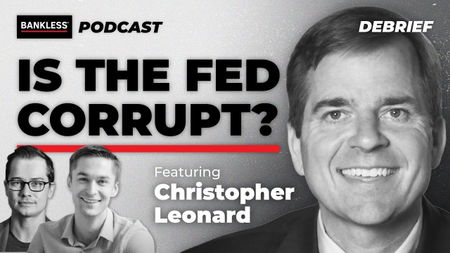
145 - Is The Fed Corrupt? with Christopher Leonard
How is money created? Why? Whose job is it? We often discuss the Federal Reserve, and in this episode, we’re doing a deep dive into what the Fed is—its origins, its purpose, and ultimately, its concerning behavior.
Up next
All episodes 00:26:22
Podcast Premium
00:26:22
Podcast Premium
Debrief - Is the Fed Corrupt?
 01:18:57
Bitcoin
01:18:57
Bitcoin
The Bull Case for zkBTC
 01:29:00
News
01:29:00
News
ROLLUP: FTX Contagion | SBF Tweet Thread | Genesis Trading | Gemini Earn | StarkNet Token | Cosmos ATOM 2.0
 00:51:27
News
00:51:27
News
How We Rebuild with Jesse Powell of Kraken Exchange
 01:05:05
DeFi
01:05:05
DeFi
How the FTX Meltdown Happened—explained by Castle Island's Matt Walsh
 01:03:56
News
01:03:56
News
The Path Forward | Livestream
 00:27:06
Podcast Premium
00:27:06
Podcast Premium
Debrief - Web3 Is Going Great!!
 01:29:41
Regulation
01:29:41
Regulation
144 - Web3 Is Going Great!! with Molly White
Inside the episode
What do we do about this institution? Something has to change, but what is the path forward?
Joining us to answer these questions is Christopher Leonard, investigative journalist and author of The Lords of Easy Money.
TIMESTAMPS
0:00 Intro
5:30 Should We Be Worried?
8:35 This is Insane
15:30 Origins of the Fed
23:50 A Young Fed
30:40 From Gold to Fiat
35:50 A Tool of the State
43:25 Incentives and Structure
47:25 Against Ben Bernanke
55:20 Institutional Pressure
59:30 Jay Powell
1:05:20 Banking Pressure
1:12:30 Political Actors
1:16:30 The Terminal Point
1:20:40 What Comes Next?
1:24:00 What to do about the Fed
1:29:15 The Legacy of the Fed
RESOURCES
Transcript
Welcome to Bankless, where we explore the frontier of internet money and internet finance. This is how to get started, how to get better, how to front run the opportunity. This is Ryan Sean Adams. I'm here with David Hoffman, and we're here to help you become more bankless. Guys, how is money created? Why is it created? Who actually does the job of money creation? And how come everyone is always talking about the Fed?
This episode is going to unpack everything you need to know about this odd little institution that governs our lives. A few takeaways for you. Number one, we talk about the origins of the Fed. Starting this little place called Jekyll Island. Did we even need it in the first place? Number two, has the Fed strayed from its original purpose? Has it become corrupted? We talk about the massive damage that the Fed has done. And number three, what do we do with this institution? If it is corrupt, if there is no path forward, what do we do with it? Do we reform? Something has to change. What is the path forward? David, this is a really fun episode. Like I learned a lot about the Fed, but why are we talking about the Fed? I mean, is this just kind of a wonkish detour, or how is it core to the crypto journey? And why do we need to unpack it on Bankless today?
Yeah, certainly. Well, the Fed is at the very bottom of the global financial system. So why are we talking about the Fed? Well, it supports everything. And so it's important to understand how it works. And it's actually crazy that so few people understand how the Fed works. And this was just a really good learning lesson for me, is like to go and unpack the construction of the Fed.
You don't teach this in school, right?
No, no, not at all. And I think it's also like emblematic that the Fed is a Federal Reserve or a central bank, you're not supposed to think about it. If it's working, it's invisible. If something is breaking, a symptom of that is that we talk about the Fed. Yeah. And so the Fed is supposed to be in the background. So the fact that it is on top of investors' minds, that is something that is already off to a bad start. And so there's some things I think that listeners should consider while they listen to Chris here. The Fed, it's not a monolith. It's got a number of different people, 12 different board members. And if it's got different board members, some board members come and go over time. So how does the composition of the Fed change? How has it changed since it was created in 1913? How was the Fed originally formulated? And how did time and external influence change what the Fed is? And also perhaps consider what parts of the Federal Reserve story or the character development of the Fed are emblematic of what our goals and aspirations are in the crypto industry? What part of this story really shows us why we are here in crypto? I think those are questions to consider while we listen to Chris in this episode.
Yeah, definitely. And if you're a premium subscriber, stick around after the episode for an episode we call the debrief. Premium subscribers get it in the RSS feed where David and I unpack our thoughts after the episode. Guys, we will be right back with our episode with Christopher Leonard, Bankless Nation. We are super excited to introduce you to our next guest. Chris Leonard is going to help us get into the minds of the Fed.
He's an American investigative journalist. He's an author. Christopher's newest book is called The Lords of Easy Money. And that's an investigation into this institution we call the Federal Reserve. The subtitle of that book is How the Federal Reserve Broke the American Economy. Man, it sure feels broke right now. And of course, this is a crypto podcast, primarily, but uh the Fed impacts everything. Chris, welcome to Bankless.
Thanks for having me.
So we want to get into the story of the Fed. I guess, you know, a high level question though. Is what the Fed is doing right now, is that a new thing? Like, should we be worried?
Yeah, we should totally be worried. I mean, that's the undertone.
Alright, cool.
Yeah.
Just checking.
Yeah.
I'm pretty worried about a lot of stuff. And what the Fed is doing right now is not normal in any respect. And,
you know, I don't want to just launch into a soliloquy about it, but I think to answer your question,
the core point that people need to know
is that between 2010 and 2020,
The Fed just broke into an entirely new graph. Like they started doing these experiments with easy money
that changed their role in the economy, that changed the financial system in really, really deep ways. And
again, it just broke the graph of what they've been doing. So they really broke the charts starting in 2010.
They've changed the entire landscape of monetary policy.
And that's the backdrop for everything they're trying to do right now.
So, you know, we're sitting here in late 2022, and the Fed is trying to so-called tighten, you know, they're trying to hike interest rates and do all this stuff we'll talk about, like quantitative tightening,
to fight inflation.
And that sounds pretty normal. That sounds like the job of what the central bank does, it hikes rates to fight inflation.
But the backdrop is that they're doing it in this wildly distorted environment that they themselves have created,
which means that they don't really know.
What's going to happen? They really are like a person feeling their way through a dark room right now. And there's a tremendous amount of volatility and risk sort of underpinning what they're doing. So my my headline is things are the opposite of normal right now. And
if there's one party that really has no clue how this is all gonna play out, it is the Federal Reserve itself.
This is something that I think a lot of people in the crypto industry are learning. We are all kind of learning for the first time, especially because the crypto industry kind of skews younger, the role and importance of the Fed. While also what the Fed is actually doing is also becoming very significant and new. And like as I kind of zoom out and like come to terms with what the Fed is, Chris, it kind of just seems absolutely insane. And I think that what I mostly mean by that is they're making very big choices that there's no one else checking on them. And like there's no other entity that's like, hey, Fed, that is that's lunatic. That's crazy. And everyone is also, oh, the Fed is uh 0% interest rates for this long and now jacking them up this fast in this way. And like sometimes I just zoom out and was like, this is insane. Is that your reaction too?
Yeah, and the insanity exists on two levels that you just kind of nodded toward, okay?
You know, first of all, I think a lot of young people don't know about the Fed because it seems really boring. It seems like it's way over on the margins, like it's not very involved in our daily lives.
The Fed is really practiced at talking about everything they do in an extremely boring way and presenting themselves as just sort of like bureaucrats that are just are solving math equations.
But
again, the insanity is happening in two key ways. The first is the one you kind of mentioned, which is that
this institution.
Is undemocratic. Like it was built to be insulated from voters because it has a really hard job to do to manage the currency. And that means it has to do the hard thing sometimes of hiking interest rates, pushing the economy into a recession.
But for that reason, the Fed was created
to be run by this committee of 12 voting members in Washington, D.C. And these people meet every six weeks.
They make these hugely consequential decisions like whether or not they're going to plunge the economy into a recession. And like you're saying,
This committee never faces voters. They're never up for election. There's no sort of outside entity that can kind of veto what they're doing. It is entirely up to them.
So that's kind of insane to think about a committee of 12 people making these decisions. But then
the second level is that
what they've done over the last decade has been so experimental and unprecedented that it's raising the stakes of everything. So let me just quickly, if I can, like lay the groundwork for what I'm talking about. When I keep talking about, oh my God, they've like changed the graph of history.
The Federal Reserve
is the only institution in the world that can create new US dollars out of thin air. That's the Fed's superpower. They make money. They literally create new dollars out of thin air. Okay.
So
when the Fed creates new dollars, it's like putting
water into a swimming pool.
And that swimming pool is called the monetary base. It's like how many original new dollars the Fed has created. So when the Fed creates more dollars, that monetary base grows. And when the Fed
basically sucks dollars out of circulation, the monetary base shrinks.
Okay.
For the first 95 years of its existence,
the Fed kind of gradually and steadily created more dollars. It expanded the monetary base to be about $900 billion. That was like the core
foundation of US money. $900 billion.
And then between 08 and 14, okay, in about five and a half years,
the Fed created three and a half trillion new dollars.
Okay.
So that's 300 and yeah, more than 3x. The way I put it is more than three centuries of money printing in about four and a half years.

Ryan Sean Adams
Crypto investor going bankless.



.png-cde5b9c0aa4838d09c634abbd1136ff2.png)