26 - Investing in DeFi Paradigms | Charlie Noyes
A chat with one of the most thoughtful investors in crypto




Up next
All episodes 01:30:28
DeFi
01:30:28
DeFi
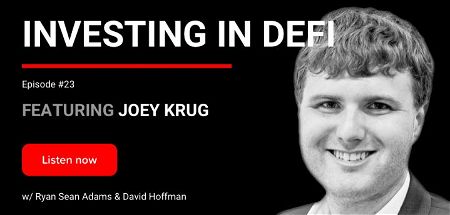
23 - Investing in DeFi | Joey Krug
 01:46:55
Podcast
01:46:55
Podcast
22 - The People's Narrative | Ben Hunt
 01:44:18
Ethereum
01:44:18
Ethereum
21 - Ethereum: Past, Present, Future | Vitalik Buterin
 01:51:18
Ethereum
01:51:18
Ethereum
20 - Ethereum Opportunity | Chris Burniske
 01:26:48
DeFi
01:26:48
DeFi
19 - DeFi vs. Banks | Hasu
 01:28:01
DeFi
01:28:01
DeFi
18 - COMP Growth Hacking DeFi
 01:04:58
Podcast
01:04:58
Podcast
17 - A Bankless Nation (Part 1)
 01:40:16
Ethereum
01:40:16
Ethereum
16 - What's an Etherean | Nic Carter
Inside the episode
What are the paradigms for investing in DeFi?
Charlie is an exceptionally bright & thoughtful investor in crypto assets at Paradigm...one of the leading investment firms in the crypto space. We talk institutions, yield farming, and DeFi protocols...and then we get into one of our favorite subjects.
Is ETH money?
Or rather, does ETH need to be money in order to secure itself?
What is dirty little secret many Ethereans and Bitcoiners don't admit? Why is moneyness and security two sides of the same coin? Why won't transaction fees secure Bitcoin?
This episode goes from great...to amazing. You won't find this depth of discussion anywhere else. Stay tuned to the very end to catch the conversation on economic security.
TOPICS
- Starting in crypto at age 11
- Gen Z and crypto
- How Institutions see crypto
- Futility tokens are futile
- Is Uniswap the last word on AMMs?
- RAI vs DAI
- Money gams & accounting tricks
- Yield farming for yield farming sake
- Why we're not in a bubble yet
- Why Ether has to be money (or bust)
- Cosmos and Ethereum alternatives
- Not bullish on Eth2 timeline
RESOURCES
- Here's the episode with Joey Krug we mentioned
- Bitcoin for the Open Minded Skeptic article by Paradigm
- Is the Map of America the way institutions see crypto?
- We mentioned YAMS - here's our explainer
- We mentioned EIP-1559 (listen here | read article)
Transcript
Welcome to Bankless, where we explore the frontier of internet money and internet finance. This is how to get started, how to get better, how to front run the opportunity. This is Ryan Sean Adams. I'm here with David Hoffman, and we are here to help you become more bankless. David, how are you doing today?
Oh, you know, just tending to my fields. Um, it's there's uh been a new craze in liquidity mining and yield farming, and so that's kind of captured my attention lately.
It has been attention grabbing, uh, and we get into that a little bit with our guest. Uh yeah, what was your take on this?
Yeah, Charlie Noyce, really smart guy, and I was constantly reminded during our conversation with him is is how young he is. And that's kind of what gets me like so excited about the future of crypto. And is it it's a part uh it's a is a part of the future of crypto that's not coming in like one year, not coming in two or three or four years, but it's really the whole generational shift is that these young, young individuals, and I consider myself young, and Charlie is even way, way more young than I am.
Are going to come in as crypto natives and be thinking in crypto native terms and are going to really get familiar with economics, with finance, with complicated crypto economic systems, and they're going to be that's going to be their first monetary system.
And I think Charlie is a good representation of somebody who's coming of age as uh as these crypto platforms like Bitcoin and Ethereum, Ethereum are being understood by the greater world. And so I'm very bullish on this younger generation of people that's coming up.
being crypto native and being able to speak crypto before they're able to speak traditional finance.
So, do you know how old Alexander Hamilton was when he joined the revolution?
I have no idea.
21.
Sounds like Charlie.
Right? I mean
Charlie.
we we think of uh many of the founding fathers as you know people like George Washington and Ben Franklin and we see them in wigs and that sort of thing. We forget that so much of the revolution was fought and won by the very young Alexander Hamilton, 21, Lafayette, 19 years old. These are the uh vanguard of the revolution. And why are they doing it? Because they think differently.
Because they're exploring new opportunities and uh exploring the infinite white space of what could be. Uh, and you know, Charlie is in the revolution for those reasons. Um, so his story is fantastic. We also talk about some pretty in-depth subjects. So it starts off kind of higher level, but then we get into something that is super important and rarely discussed. In fact, I've never heard it discussed on a podcast before, and that is the economic security of Bitcoin and Ether and whether those assets, Ether and Bitcoin, need to become money in order to succeed. I won't spoil it for you, but that is a fantastic section near the end that you absolutely have to check out. It's not 101 level or uh 200 level. This is 400 level material. I think you're really going to enjoy this important stuff uh to back up the thesis, your thesis for this space.
Yeah, and and what Ryan's talking about, what we were talking about in the podcast with Charlie, the minor extractable value component of these systems, is really an unsolved problem in the crypto space, largely being spearheaded by Ethereum researchers. And so I I've I always keep my keep an eye on what they're doing with the whole MEV world. We'll go into it in the podcast and make sure that we can explain it. But I think it's going to become a regular topic in the Bankless podcast because of just how important it is. And so I'm looking forward to future content that we in future guests that we bring on to discuss minor extract extractable value because it's a it's a crucial topic.
Yeah, and I think you will be most equipped to uh think about this if you've listened to a bunch of the other podcast episodes. This is episode 26, uh, but people forget we sort of started this sequentially. Um, for folks that are new to Bankless, go ahead and go all the way back to episode one if you need to and start listening because it's sort of each each of these episodes builds on the last, and I think you'll get a great grounding just by starting with one and moving forward all the way to episode 26, which is where we are today.
David, before we go any further, we should talk a little bit about our sponsors.
The first sponsor I want to tell you about is Ave. Ave is a DeFi protocol that you absolutely have to check out. What can you do with it? You can lend, you can borrow banklessly all on Ethereum. So you could do things like lend dye to the protocol. It will magically transform that DAI into an interest-bearing DAI account. Not just DAI, all sorts of crypto assets on Ethereum. You can also borrow against it. Ave has been climbing up the leaderboard as well, and they've recently released Avenomics, which is their token economics upgrade. You can read more about it. We will include a link in the show notes. So Avenomics grants key decision making to Aave token holders. It creates more safety and economic incentives to reward protocol growth. One of the coolest things is it actually introduces a safety module. So there is staked Ave becomes a collateral of last resort. You can find out about Ave, Avenomics, start using the protocol at Aave.com. That's A V E.com.
For those of you that have been transacting on Ethereum, you've noticed that the gas prices have just been insanely high. You know, 60 GUE on a good day and sometimes all the way up to 100 GUE, which is really reducing the amount of activities that is really feasible to be able to do on Ethereum. This is where our newest sponsor, LoopRing, comes in. LoopRing is a ZK rollup scaling protocol for Ethereum for both trading and for payments. ZK rollups that stands for zero knowledge rollups. It's basically cryptographic magic. It allows you to combine activity and transactions into one single bit of information, which means that massive amounts of transactions can be bundled into a very small chunk of information, which reduces the gas per transaction. At loop ring.io, you can find a ZK rollups based exchange and also a payment mechanism, all with the same security guarantees of the Ethereum L1 blockchain, which is really important. So Loop Ring and ZK rollups allows you to scale up transactions, tradings, payments into thousands and thousands of transactions per second, but with the same security guarantees of the main Ethereum blockchain, which is just incredible. In September, Loop Ring is releasing the Loop Ring wallet. This will be a mobile smart contract wallet with ZK rollups tucked in natively. I'm really excited for how this is going to impact the adoption of Ethereum. The rest of the world will be able to experience Venmo type transactions, but with the same amount of trustlessness and security of the decentralized future ahead of us. So if you're a trader that's being eaten alive by gas fees, visit loopering.io to get on boarded into Ethereum's cheapest and fastest exchange. All it requires is an Ethereum address and you can trade on a high performance order book completely gas free. And transferring Ether and ERC20 tokens on the platform is completely free. If you visit loopering.io, enter the code BANCLIS in order to get the highest VIP tier for six months. So check that out. There's a link in the show notes. Visit loopering.io, enter code BANCLIS.
Alright guys, let's go ahead and get right into the interview with Charlie Noyes of Paradigm.
Bankless Nation, we are super excited to introduce you to Charlie Noise as part of our venture capitalist series. Charlie is a partner at Paradigm. He is a former Pantera. He's an incredible thinker in the space. We've had many back and forths on Twitter in the past. He's just a smart investor. Um, want to emphasize before getting into this, of course, these are his personal views. He's not speaking on behalf of Paradigm the Fund, but he has offered to share his personal views, and I think those will be very helpful as we think about the space. Charlie, how are you doing?
Doing pretty well. Thank you guys for having me. I know we can debate pretty frequently on Twitter, but
I do think uh
you know this is a really high quality resource for the community. Um I'm excited to be on here.
Yeah, the advantage of a podcast, of course, is we can carry those things into conversation format and everyone gets to kind of hear about it. Um, you know, Charlie, what I think would be super helpful for our listeners is just to set the context uh and set the context in two places. You know, maybe first your background, and then second, uh, some of the background behind.
Because both both backgrounds, I think, are fairly unique in this space, right? So I was looking through uh your LinkedIn profile, Charlie, and um you've got a very interesting like background. And you you started as a research scientist at USC, and I think you were doing that during high school. Uh, then there's a there's a point where you went to MITB, you dropped out. Uh, then there's this gap of three years, which I'm going to assume, but hopefully you tell us that three year period is where you maybe discovered uh crypto. And then the resume sort of continues where you're a principal at Pantera Capital. Of course, we had Joey Krug on a few episodes ago. We'll include that in the show notes.
And then in I believe 2018 or so, you became a partner at Paradigm, which for folks that don't know is I think one of one of the most interesting crypto funds that are out there. It was co-founded by uh the co-founder of Coinbase, Fred Ayrisom. It's got some other notable names, great research coming out of it. And one notable thing, one of many, is that Paradigm was actually one of the first funds, I believe, to raise from a major endowment. So in 2008, the Yale Endowment, that's a $29 billion fund, an institutional fund. You've heard the institutions are coming. Well, they came in 2018 and they invested in Paradigm. So that's a little bit of background from my perspective. But I want you, Charlie, to help uh fill in the blanks. Maybe, maybe starting at the top, uh, how did you go from research scientist at USC in high school to uh partner at Paradigm?
So I might need to update the LinkedIn uh and I might have taken a little liberty with Research Scientist on the title there. But I think at the time I was I was like 13 um and I was I was in high school at that point um working in
Uh a lab at USC that was doing some interesting cryptography research related to some of the earlier SMPC protocols and first run them like SPDZ. But
um I actually was into crypto at that point. So when I was like 11, a few a few years before
I was you know selling software on the internet um and made a PayPal account uh in my mom's name, and then at some point they requested her social security number.
And she was like, there's absolutely no way that I'm giving this to you to go use on the internet. And so I started using Bitcoin.
Um, and for a couple of years, I just thought it was kind of incredible. Um, I mean,
like at that point in my life, you know, it was like the only payment reel that I could actually use on the internet. Um
and eventually, um, I think in around like 2013, um
went from
Kind of a user casually interested, um, you know, mining on my own hardware kind of before the ASIC era, um, to getting really into the more theoretical and research side of it,
um, and wanting to understand sort of like the basis of these systems, um, and then got further into that
um,
you know, through some early opportunities to do research, both related and unrelated to crypto,
uh cryptocurrency cryptography.
Um, and then once Ethereum came out, uh I
Wanted actually to dive in full time um but decided to leave high school to go to MIT instead.
Spent a year there, realized I was gonna miss the boat if um if I didn't leave and decided to leave MIT to join um Pantera along with Joey, who you guys had on. Um
that's a friend of mine.
Um
so yeah, that's kind of the the early origin story
All right. So
here.
we talk a lot about um the unbanked, right, in in crypto in general. But uh I've gotta I've gotta be honest, Charlie, I've never thought about the unbanked preteens, right? Like the kids that are like between, I don't know, um, I guess eight or so when they start to get semi financially literate and uh 18, who actually are kind of locked out of the financial system.
And you came at this um because you were you were locked out of of PayPal, essentially, and crypto was like the only
the only bank, I guess, the only finance, the only the only money you could really use at any level of scale. That's crazy to me.
Yeah, I mean it it's kind of a wild series of coincidences, and I think like um you know many of the people in the space at this point, it is still so early that you kind of have to have a reason to be here. And I think um most people have these kinds of backgrounds where it's just a really strange sequence of coincidences that led you to being.
You know, deeply interested in internet money and programmable internet money
and want to spend all your time on it. Um
but I got super lucky with that. And then I ended up at Pantera. I spent an awesome year there um with Joey and
uh and then in early 2018, um I met Matt, who uh I got inch introduced to also did MIT undergrad.
Um and Fred at the time. Um Fred had left Coinbase the year before, um, spent a year thinking about what he wanted to do next. Um, him
and Matt got together um and then pulled me in um in early 2018, and I decided to
Ryan Sean Adams
Crypto investor going bankless.
.png-a616dc52961c1edd72b0c1fdf5f47e7a.png)
.jpg-48bb3b8a9a7a83dee5836f716023f733.jpg)
.png-336efc5e35995e6b184e7e830baa688b.png)