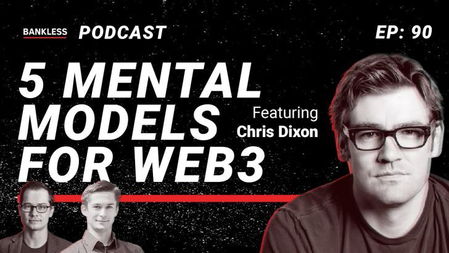
🎙 90 - 5 Mental Models for Web3 | Chris Dixon
The Key to Understanding Why Web3 Matters
Up next
All episodes 01:50:34
Podcast Premium
01:50:34
Podcast Premium
5 Mental Models for Web3 | Chris Dixon
 01:59:18
News
01:59:18
News
📺 ROLLUP: SHIB | WorldCoin | Twitter, Reddit, Disney NFT Platform | Facebook Meta
 01:57:36
Ethereum
01:57:36
Ethereum
DEBATE: BTC vs ETH | Justin Drake, Dennis Porter, & Muneeb Ali
 01:49:08
Podcast Premium
01:49:08
Podcast Premium
Institutions are Bullish | Eric Peters
 00:21:52
Podcast Premium
00:21:52
Podcast Premium
EXCLUSIVE DEBRIEF: Forward with Crypto | Andrew Yang
 01:30:55
Podcast Premium
01:30:55
Podcast Premium
Forward With Crypto | Andrew Yang
 01:10:11
DeFi
01:10:11
DeFi
The Rise of Rari Capital | Jai Bhavnani
 01:36:46
Ethereum
01:36:46
Ethereum
Pet3r Pan | Layer Zero
Inside the episode
Dharma just rolled out trading on Polygon. From Dollars to Tokens with Zero Network Fee 👀
Chris Dixon is a general partner at a16z, and gives Bankless listeners a masterclass in understanding the Web3 Metaverse in this episode.
There are five essential mental models to understanding why Web3 matters, and they overlap often throughout the course of the conversation. Web3 has begun to impact all corners of digital culture – from media to finance, art and gaming, and even identity.
Mental models allow for digestible thinking patterns to understand and predict the world, and Chris lays out how these new digital primitives are changing everything.
🚀 Get this episode's exclusive debrief to hear Ryan & David’s unfiltered takes on the podcast.
🎙️ NEW PODCAST EPISODE
Listen to podcast episode | iTunes | Spotify | YouTube | RSS Feed
Bankless Sponsor Tools:
💰 GEMINI | FIAT & CRYPTO EXCHANGE
https://bankless.cc/go-gemini
💧LIDO | DECENTRALIZED STAKING
https://bankless.cc/Lido
👻 AAVE | LEND & BORROW ASSETS
https://bankless.cc/aave
🦄 UNISWAP | DECENTRALIZED FUNDING
https://bankless.cc/UniGrants
RESOURCES
🏴 JOIN THE NATION 🏴
Subscribe: Newsletter | iTunes | Spotify | YouTube | RSS Feed
Follow: Twitter | Instagram | Reddit | TikTok | Facebook
Not financial or tax advice. This newsletter is strictly educational and is not investment advice or a solicitation to buy or sell any assets or to make any financial decisions. This newsletter is not tax advice. Talk to your accountant. Do your own research.
Disclosure. From time-to-time I may add links in this newsletter to products I use. I may receive commission if you make a purchase through one of these links. Additionally, the Bankless writers hold crypto assets. See our investment disclosures here.
Transcript
welcome to bankless where we explore the frontier of internet money and internet finance this is how to get started how to get better and how to front run the opportunity this is ryan sean adams i'm here with david hoffman and we're here to help you become more bankless david i felt like this was a master class a master class in web 3 a master class in crypto we had chris dixon on the podcast we went through five mental models that are essential listening material essential
understanding i think if you're on the crypto journey and you're trying to understand everything that's going on in this new era of transformation what were some of your thoughts and takeaways uh from this episode i particularly enjoyed how all these mental models bled into one and you can definitely hear chris's just uh stream of consciousness his train of thought as to how he came about these mental models and each one of these mental models is both a tweet thread and also a post on chris's website so you can follow along on his website as well if you want to do that
uh and uh we we go through just the gamut of why web3 actually gets the designation of three the primitives behind the establishment of web 3 tokens as a digital primitive as a digital version of a new website also the difference between what chris calls the take rate or basically the fees that platforms charge and how the lowering of a take weight rate in web 3 turns from revenue into economies and extrapolation on that and then of
course his uh the famous um everything kind of starts out all innovations start out as a toy and how the early blockchain just mimics the same sort of early innovations that we've seen across other investment paradigms that we've seen in the past and so really just a comprehensive lesson on both what is web3 why is it why is it valuable and also how to invest as well yeah it really covered everything and chris is like um well let's see i mean he's
he knows what he's doing in this space like he knows what he's doing when it comes to venture and he's seen so many of these patterns play out before and now he's like applying these patterns to crypto i gotta say there are different lenses through which you can view crypto you know one popular lens is some people only see crypto as sort of a money solution right um kind of the money lens of crypto others uh think about like you know the bank list being like defy sort of movement others think that this is a web three big disruption to um to tech incumbents you know still
others think about the metaverse i think like we probably view it as all of those things simultaneously at once and i do think that the the term web 3 has um increasingly had validation over the past year or so i think some people were jaded myself included were a little bit jaded with the term coming out of 2017 2018 where it seemed like all of these nebulous ico concepts and startups that were going to create a new decentralized
internet were emerging but actually didn't really deliver much and so the money narrative i think at that time seemed strongest and firmest and that's why i think we we saw d5 sort of arise out of that and i was a proponent of that i mean if someone asked me in 2018 2019 what is web 3 and be like i don't really know what you mean by web 3 because it hasn't been developed i like the ideas of of self-sovereignty and um you know obviously that i think there's potential in disrupting some but
people were talking about like yeah let's create a decentralized social media platform on the 15 transactions per second ethereum instance and it's just like no that's not going to happen right now that's not going to happen first so all of this to say chris has a very web 3 centric lens but that lens on the world and how it's going to impact both tech music industries gaming industries all sorts of consumer product industries all of these different industries has received a massive amount of validation
over the past 12 months ago and even since we last spoke which is really cool we bring all of that into the conversation today at the tail end of the the bear market there was definitely that difference between like there's defy and then there's web 3 and these things are not the same and i think the way that chris frames what web 3 is really i think vindicate some of the early ideas of what defy was defy is really about lowering the costs of performing financial transactions with other people but chris would say this is it's it's
creating a platform a network with a lower take rate and so he's really just talking about the extrapolation from web 1 to web 2 to web 3 as who is providing the services and who gets to capture the wealth and chris's version of web 3 is much more in line with web one in that individuals and communities crop up make value and share value amongst themselves and then also the difference now is that these web 3 platforms can also provide services towards the rest of the whole entire world without having a central
operator take what chris says is upwards of larger than 50 percent of the value that's created instead we have something like zero to ten percent of the value that's created is collected by these web three protocols so guys we go through that we go through the five mental models it's just a toy web three tokens are the new websites your take rate is my opportunity networks become economies and then we conclude with what a16z is doing this in the space a look at regulatory and then chris gives us some fantastic parting wisdom so make sure you stay tuned to the end super cycle does he believe in
that or maybe something a little bit different maybe a riff on that and of course if you are a premium subscriber make sure you tune in to the debrief that david and i will do with our thoughts and reflections on this episode we record those after the episode for all of our bankless premium subscribers available on the premium feed so without further ado we want to thank the sponsors that made this episode possible bankless is proud to be supported by uniswap uniswap is a new paradigm in asset exchange infrastructure instead of
a cumbersome order book system where trades are matched with other humans uniswap is an autonomous piece of software on ethereum which is what ryan and i call a money robot no human counterparties or centralized intermediaries just autonomous code on ethereum input the token you want to sell and receive the token you want to buy something brand new in the uni-swap ecosystem is the uniswap grants program is now accepting applications for grants we have been saying this for a while and we'll say it again dows have money and they are in need of labor if you think
that you have something to contribute to the uni-swapped out apply for a grant to uni-swap just look at the size of the uniswap treasury it's almost 3 billion this mountain of capital is looking for labor do you have something of value to contribute to the uni swap dow no matter how big or small your idea is you can apply for a uni grant at unigrants.org and help steer uniswap in the direction that you think it should go that's exactly what we did to get uniswop to be a sponsor for bankless and you can do the same for your project
thank you uniswap for sponsoring bankless the era of proof-of-stake is upon us proof-of-stake systems like ethereum terra and solana allow the industry to move away from the hot loud and wasteful proof of work systems and return back to a cottage industry of individual stakers and individual validators and that is what we need to make this industry stay decentralized individuals must play their part in crypto network validation and that is what lido is here to do lido makes sticking accessible to everyone at the click of a button by delegating your
stake to lydo's network of nodes you can access the yield offered by proof of sake systems and claim your share of the network transaction rewards do you have 32 eth and want to stake it to ethereum but running a node sounds intimidating or maybe you have less than 32 eth and you need to pool your eth with others so you can access baking yields lido offers a solution for both simply go to lydo.fi choose which assets you want to stake and deposit them to the lido validating network lido is working to make sure proof of stake stays as decentralized as
possible and is committed to decentralizing its own validating network to eventually become a completely permissionless protocol so if you want to stake your eath tara or soul and get liquidity on your stake go to lydo.fi to get started bankless nation we are super excited to introduce you to our next guest he needs no introduction he's been on bank list before this is chris dixon he's a partner at a16z where he leads crypto investing last time we spoke to chris was january 2021 if i'm recalling correctly so
that's like roughly 10 years ago i think in crypto times how are you doing chris it's great to have you guys great thanks for having me thanks good to see you guys david yeah yeah it's been a while but you haven't aged a day even though it's been like a very long time in crypto years was that meme it's like the interstellar meme where it's like you know it's like four hours down here it's not the gravity or something yeah fantastic movie by the way all right so um i actually thought it was wasn't it defy summer i thought it was over a year ago anyway it was yeah it was twice just at
the end of defy summer i feel like i was here at defy summer but it was it was before nft mania let's see if we're doing charting this encrypted just after d5 summer things were in kind of a lull before eath went on a tear and bitcoin had just done okay nfts were barely a thing there was no such thing as crypto gaming right let's see what else happened so many other things it's been such an eventful year all right well let's talk about this because actually for for the listeners um we wanted to start this episode maybe a little bit differently than our others we wanted to make this
kind of a canonical bankless episode um i mean we're going to discuss a16z and what you're doing crypto because we can't not you guys just raised a casual you know 2.2 billion dollars i think back in june so we're definitely going to discuss that it's probably going to be near the end but really where we wanted to turn your brain at first is um for the listener chris is not only a brilliant investor he's a master of mental models dave and i love mental models on bank lists we think these are like shortcuts for understanding how to approach the space it's a way to connect
the dots it's the fastest way possible to connect the dots and like for for those of you who aren't familiar with mental models first of all i bet i bet you are familiar with mental models because you use them all the time your day life but it's just a framework that you can carry with you to help explain something help explain how the world works and in crypto we think this is the fastest way to get you from like 0 to 60 on a subject because it's like compressed information okay this is like a zk roll up for your mind so so we love mental models and we're
actually going to spend the first part of this going through a number of mental models that chris has helped develop for this industry to help individuals understand it david you look like you want to say something about mental bottles i know you love them too yeah absolutely just in time for thanksgiving and christmas for you to sharpen your sticks and take them home to your families to explain what the hell this whole crypto thing is yeah they're going to be asking you at the thanksgiving get together what what's going on in crypto these days you know that so we're going to dive into five mental models today i'm just gonna list them
off and then we're getting chris's brain on each of the um the first is a mental model that that i call it's just a toy okay why new technologies are dismissed so we'll touch on that the second is web three how do crypto people have the audacity to call this thing web three we just like created a whole new era of the internet we gotta talk about that as a mental model the third is tokens as the new websites um interesting the fourth is this is a bezos quote your take rate is my opportunity what do we mean about that in the context of the transition from
web 2 to web 3 the fifth is networks becoming economies that is a paradigm shift so those are the five models uh but before we get into the models chris you're a master of mental models why do you like them so much what's the value of a mental model yeah i think i think that um i think it's a little bit sort of like all all of what scientists do for example or anyone trying to anyone trying to predict the future right you need to the world is so complex you know eight billion people uh you know economics physics biology
it's way too complex for anyone to understand and so what you do i think when you try to predict the future and this this would apply if you were a scientist so it applies if you're an investor it implies applies if you're an entrepreneur or anyone who's sort of concerned with you know thinking about how do these really complex systems evolve um you need simplifications you need ways you need ways to kind of take very complex things and distill them and find patterns and so to me that's what these mental models are and they come from you know they come from as with anyone who works full-time and
working you know in the space for eight years and basically full-time in in crypto for five years um and my whole career in technology and this is sort of you know these are the models i've sort of i've developed to help to help my own thinking and my own investing and and also you know i think as part of kind of our philosophy of investing and working with entrepreneurs we'd like to also share these with the with the world um and look it's partly i think it's partly
to hopefully it's a resource for people but i also think you know it in the end our job is to be the place that entrepreneurs want to go to work with and i think a lot of entrepreneurs appreciate that if you kind of help them along in their entrepreneurial journey they think they think that's valuable yeah so i think it's fundamentally about about understanding and predicting the world and one of the things i find so fascinating about the the space that we work in web 3 crypto
is it's just sort of endlessly interesting like you know that meme where the the guy is lying in bed and he's like she's like what are you thinking about him this is the one topic in my life where i have never run out of interesting things to think about like i'm i'm never bored wait really like more so than like i mean you were here for the early days of the internet too or like the early days of web yeah i don't know i think it's more i think it's more interesting maybe because i'm in the middle of it more but i think that this this you know because
this like think about it you think about like for example like we have different practice areas in our in our in our crypto group right i think like at least three different areas so we have infrastructure defy and sort of nfts in gaming and then maybe a fourth area of sort of emerging areas and you know in the infrastructure one like you get all of computer science in there it's a fascinating area my partner ali kind of leads that effort but i i sort of you know moonlight doing that and it's just endlessly interesting like now we're getting deep into kind of zk stuff and cryptography and you know spent years on kind of the various kind
of scaling kind of concerns so that's just endlessly interesting it's computer science but you're also reasoning about you know what application what people use these things for and and then you have the whole community aspect right of like a blockchain is not just a computer it is a computer in the sense that it runs code and stores information but it's also a community and a network right so you have this human aspect to it you have economics you have game theory i don't think and then you go to nfts and you have all of that plus culture plus media plus gaming right and then you go to d5 and you have all
that plus finance and you know yield farming and degens and just all this like fascinating kind of cultural stuff so i i just think it like there's like 10 for me at least it's feel i feel like the 10 things i've been interested in my life like programming economics game theory culture you know it all kind of comes together and this is like the this is like the great big most fascinating thing ever yeah that's my view i mean that's that's why i'm so fired up about it i'm sure you i i expect them to be preaching to the choir here but but uh and so yeah so i spent a lot of time you
know i spend most of my time meeting with entrepreneurs and and learning from them and then i spend sort of the rest of my time beyond i mean i do have a personal life and everything else but like so i don't make sound like i only work but i do work a lot but but i spend the rest of my time kind of processing all that information and trying to come up with ways to understand it and that's i think that's where a lot of these mental models come from chris how has your relationship with mental models progressed throughout your time unpacking the internet you are an internet veteran you've kind of seen it blossoming from all of its forms how has you how have you used mental models and
how have your mental models developed uh from one web one to web two and then also how has web 3 really changed the game with like needing mental models yeah a great question i mean i think the la like the last time i was really excited about the internet was was 2009 to 11 i'd say which to me was the golden period of mobile um and that was a really exciting time i think one of the fascinating things about that there were a bunch of interesting things um it was a you know it's interesting first of all it was really underestimated it it seems like
today you know the iphone came out in 2007 the app store in 2008 and it's very easy to tell a story that it was just sort of okay mobile's the thing and that's it it wasn't the case so like a very important moment was facebook's mobile pivot in 2012. so 2012 was really in my mind 2012 was the year that the world real the tech world realized that mobile is not the secondary computing platform it's the primary computing platform so people knew it was a thing and it was important and it was growing but the to the extent to it
specifically touch-based smartphones like you know there were many many cell phones but there was a lot of controversy as to whether they were look they were really expensive go look at that steve but it's the infamous steve ballmer video about the iphone and no one's going to buy it it's so expensive the idea of people paying a thousand dollars for a phone just seemed kind of crazy of course what they weren't thinking through was i think what they underestimated is first it's not a phone it's a super computer internet connects a super computer right which is worth a thousand dollars and secondly this is this is the hardest this is the
most important thing with computing new computing waves is is there there was this exponential improvement curve that it went on okay and and it it was partly the phone itself if you take a phone today an iphone today and compare it to an iphone 2011 it's gotten much much better right just in terms of the performance and the camera but what's really gotten better are the applications right now you go on and you have just an endless stream of entertainment you have the smartest people in the world on twitter you have you know tick-tock dance videos you have ephemeral messaging you've got a million games it's a it's a you know it's a
giant rich ecosystem right and so it just got and those two things this is one of the things that happens in computing waves and by the way i'll get back to crypto i believe we might be in that golden period now that's one reason i'm so in in blockchain crypto web 3. um in the really good golden period you get this you get this feedback loop so you've got the application developers coming in and doing cool new stuff which in turn drives more users and money into the infrastructure layer meaning like the phone or the blockchain and that gets better and as that gets better that unlocks so we're you know that unlocks
new applications we're already seeing this i'm sure like for example in the l2 world right now that you've got real ethereum l2s you're now going to have a new class of applications now that you've got other l1 that are built for for like gaming use cases an example that's going to unlock a whole nother range of kind of games as an example or nft use cases anyways so that you know so going back that was a very exciting time and what was so fun about it is you had this new thing in your pocket is this gps connected smartphone with a
camera what are you going to do with it right that's the creative thing so you know travis says hey i think that the cool thing to do would be to build a worldwide network of you know uber network and ride sharing and you can click a button and this thing magically shows up right um instagram says you know i think that now this is going to change there were photo sharing sites before but they were like these snap fish like get your family photos printed kind of thing this is going to change kind of the way that people consume
create and consume photography media video and so forth right so new this very creative period of people thinking of new use cases um and so and the early web had this kind of thing too what the the internet i think is kind of had four important distinct phases there was web one where you know there's sort of this explosion of stuff in the 90s and and the key feature there it was governed by open protocols which meant that because sergey and larry and other entrepreneur you know that all the kind
of me you know pierre omidar ebay google amazon because they're open protocols they knew they could build internet services that they would truly own and control that no one could kind of rug pull them the way that you get rug pulled on the platform on on the iphone or on facebook or something but that first wave those applications were what i call skeuomorphic they were they took kind of things that were from the offline world like magazines and put them on the internet and so a lot of the websites were just kind of one way you were just
reading stuff and then there was this next period in the 2000s where a new wave of entrepreneurs came along and they said wait a second no these are computers and you can read and write and put code and do all sorts of other things and that's when you had first this kind of early phase where you had you have to you probably never heard of them but like things like flickr and delicious and the whole and six degrees early social networking and there was kind of people you know they were kind of the they were building kind of the early primitives and the early ideas and then you had mark zuckerberg and eva williams and jack dorsey and other people take
those and package them up really beautifully and boom that was web 2. and then web 2 got accelerated by mobile which was sort of another layer of interesting stuff that happened on top and then i think we had a period of just kind of incumbent domination between 2012 and 20 or something you know where apple and google is out of these companies get bigger and bigger and the internet is now at a precarious point where it could turn into kind of tv where you have like four channels like cbs and npc like tv in the 70s or something which i think we'd all agree with
well that's that's what the that's what the great the the great cause that we're all fighting for here is to keep the internet open and interesting and not like that right um but then yeah and then you had this as you you both well know you had this kind of counter trend that's began to develop obviously originally with with satoshi and then i think very importantly with vitalik and ethereum and then i think that's led to really kind of a explosion and these feedback loops that i've described before an explosion of innovation
and and now i think you know i think that i think we could be in that moment that golden period moment i remember very much in mobile like i was there we knew mobile was a big deal but it's very hard to know when you're in a process is it linear or exponential because you're sitting on one point and you don't really know how fast it's going have there been some things chris where like you thought they were exponential they turned out to be linear yeah that's a good point that's um i mean look i i started a machine learning company in 2008 and i was clearly too early on that it was called hunch it was acquired by ebay in 2011.
um and i and i if you'd asked me and i you know in 2008 i said this is going to be the thing it's going to change the world ai is finally at a point where it's going to it's going to it's really going to happen ai had like a 50-year period of kind of false start you know going back to alan turing who predicted that i forget exactly but someone would pass would you know pass a turing test would trick would be able to simulate act like a human i think he said within 30 years or something way overly optimistic the field was seen as kind of a disappointment and i believed that
people were underestimating and so i created this company and we had this recommendation technology ai stuff and i think i was right i just unfortunately was too early and you know that's as they say in venture too early is the same as being wrong so i guess i was wrong but um i think i think that look there's certainly technology kind of trends that people get excited about that don't fully pan out a lot of times though i think it's too early i think vr is a good example where i think you know we invested i led our investment in oculus
in 2013 and i thought it was three years away i think it's actually right around the corner right now i think it's about to really kind of get really big and it's finally there and people are underestimating it but it took longer so usually my this is my mistake like before i went and started a crypto fund i did a kind of full personal audit of all of the things i've believed and whether i've been right or wrong to really kind of see if i'm if i you know how highly convicted i am and i came to the conclusion that along the thread of software and computer science which is what i've
always been interested in like internet and software pretty much everything that a lot of smart people got excited about has happened it's only been a question of time um i have this blog post what the smartest people do on the weekend everyone else will do in 10 years and i think it's i think that's been universally true for the last 50 years in software that the things that you know the steve jobs and the wozniak going to the homebrew computer club and like all the all the smartest computer science nerds in 1970s
were right and the people at the big companies who bet against pcs were wrong um that's happened over and over um it happened with the internet it happened with open source software and i think it's going to happen here as well and chris i think that's that's one of the big mental models that you've communicated is this whole web one web two web three and all these uh denominations of the web are just mental models right each one is its own mental model and you talked about like well wouldn't that just be terrible if the internet just collapsed onto like four channels the youtube channel the
facebook channel the instagram channel and the twitter channel which is kind of where we're getting close to it absolutely right yeah and so as a veteran of the web one era how do you see web three re-instantiating some of the cool things and that we that we liked about web one yeah well i think a big part is having credibly neutral platforms upon which to build right so if you build an application on top of ethereum and whether it be a game or something nft experience or a d5
protocol you do not have to worry about the protocol deciding to kick you off later or charge you thirty percent of your date rate or whatever you know happens on these other kinds of platforms um and so you know that you can invest and spend your life as an entrepreneur betting on that platform and building around it in the same way in the web one you knew that you could do that around http and smtp it's very very different to i i think a very formative moment in my experience you i don't know if you were both in
tech then was the facebook twitter uh api uh massacre essentially which is there were all of these there was a huge wave of people that built startups on facebook and twitter and they were all just summarily kind of shut off um i had a lot of friends who had startups that were built on the twitter api twitter was a twitter was an ecos it was a developer platform for many years yes it had users using it directly but it actually didn't even have an app for a long time it was all third-party apps and those were all companies those were
people who spent their lives on it and twitter did by the way i don't blame i'm friends with some a lot of these people at these web 2 companies i don't think they have any ill intent i think i think the problem is the model right um the model importantly to put these into crypto terms the lack of immutability of the web 2 model and the lack of immunity meaning they can change the like i like to say in in web 3 it's can't be evil in web 2 it's don't be evil so web 2 you're depending on the kind of the the you know the good intentions of the of the founders and
part of it's architectural right you don't have a blockchain you don't have like a code that this locks them into it and if you build an ethereum the code is locking you into certain commitments if you build a smart contract it's there it's immutable everything else but it's also just the model of like if you're if you're yeah maybe if you're an ultra founder jack dorsey or something you can resist this but for almost everybody else you ultimately report to shareholders and those shareholders want you to maximize profits and that i believe is fundamentally inconsistent with maximizing the health
of the networks built on top i think the network i think that corporations and networks are fundamentally misaligned the corporation is going to want to grab more and more of the money and close off the network when the network what the what the network wants what the people on the network want is they want openness and low take rates and open permissionless access okay and those two things are fundamentally misaligned in the last 10 years we've seen how that misalignment plays out and i think a lot of the reason people are unhappy on these networks is they they
feel this viscerally a lot of these creators who are early to build youtube up are now you know at the whims of the algorithm at the whims of the company they get demonetized they get the take rates changed and they feel viscerally they were part of this network creation and they should have been part of the of now of the governance and economics of the network but they aren't and as you know web3 using tokens and all of these other kinds of new primitives that we have with web3 we can
now fix that and we can build networks where there isn't a corporation that needs to increase the take rate and shut down access where the network can flourish where the the users and the on the network and the developers on the network can participate in the value creation and the governance of those networks i my friend brad burnham he's the co-founder of unit square ventures has a phrase that we finally he finally discovered the native asset class of information networks tokens wow we were mismatching this other asset
class the you know delaware c corp with networks and that created all this endless strife and we now have a way to fix that this is super cool and i think this is basically what we've been getting into if listeners aren't aware is your first mental model which is the mental model of of web 3 and like the question of yeah how do these crypto people have the audacity to like label this new crypto thing that they're working on an entirely new era of the internet right like some people don't understand that
um how because it's so early in the journey right so but but you're saying web3 is basically it's this internet that's owned uh by the builder and users and it's orchestrated with with tokens and it's a less predatory relationship between the platform and users right because you know in the web 2 model the platform the users with with growth comes this extraction from the users of an individual platform or network and web3

David Hoffman
Co-owner at Bankless. Optimistic storyteller of frontier technology.
.png-a616dc52961c1edd72b0c1fdf5f47e7a.png)