Unlocking Privacy on Ethereum with Paul Brody
Paul Brody is the head of EY’s blockchain business.

Up next
All episodes 01:35:14
Ethereum
01:35:14
Ethereum
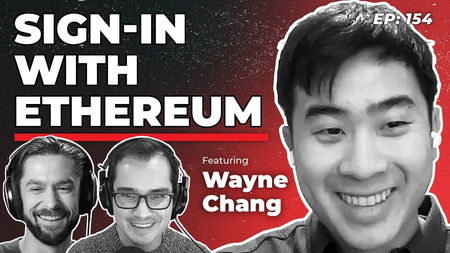
154 - Sign-in With Ethereum with Wayne Chang
 01:25:46
News
01:25:46
News
ROLLUP: Genesis Bankrupt | SEC vs Gemini | Bitzlato | New 3AC Exchange GTX | MetaMask Staking | ETH Denver
 00:32:40
Podcast Premium
00:32:40
Podcast Premium
DEBRIEF - Sign-in with Ethereum
 01:15:51
Podcast
01:15:51
Podcast
What's Hot in Arbitrum? | Arbitrum Ecosystem Guide
 01:03:47
Podcast
01:03:47
Podcast
153 - Why Crypto is Underrated with Tyler Cowen
 00:12:35
Ethereum
00:12:35
Ethereum
THE ETHEREUM MERGE! Everything You Need to Know
 00:03:01
Podcast
00:03:01
Podcast
Welcome to Bankless: New & Improved!
 00:19:18
Investing
00:19:18
Investing
Why is Crypto Full of Scams??
Inside the episode
Paul Brody is the head of EY’s blockchain business. EY is Ernst & Young, one of the “big 4” global professional services and accounting firms. He’s been at EY for nearly 8 years now and before that he was a VP at IBM where he started IBM’s first blockchain project.
Paul is deeply intertwined with the Ethereum community as well as enterprise use cases. If anyone is going to crack the nut of Enterprise use cases for public blockchains, it's going to be him.
TIMESTAMPS
0:00 Intro
7:00 Enterprise Blockchains
11:20 Public vs. Private Blockchains
15:00 Use Cases
18:36 Supply Chains vs. Digital Money
22:00 Disruption
23:55 Network Effects
26:40 EY's Nightfall
30:50 Low-Cost Transactions
37:30 Tokenizing the World
41:50 Real-World Assets
47:10 Transactions
50:44 Stablecoin Adoption
54:15 DeFi Integration
56:35 Operating Nightfall
59:40 Nightfall Roadmap
1:01:35 Why EY
1:05:15 Enterprise Blockchain Burn Leaderboard
1:08:40 Action Items & Disclaimers
RESOURCES
- Paul Brody
https://twitter.com/pbrody
Transcript
Fankless Nation, we're talking about privacy on Ethereum and enterprise blockchain. We have Paul Brody from EY, that's Ernst Young, on the episode today. Paul's been a longtime, I think, member of the Ethereum community, advocate for enterprise blockchain. Also has this project called Nightfall, David, that we want to get into, which is uh EY's um
Software.
Basically, it's a software suite. It's a layer two technology as well. I believe it's a roll-up that we can find out a little bit more. And it's privacy-centric. And uh so there's a lot to unpack here, David. What are we gonna cover today?
The concept of enterprise blockchain is a big one. There's, of course, IBM Hyperledger that has uh previously captured a bunch of mind share. There's the concept of putting supply chains on blockchains. But overall, just like enterprise blockchain is a big subject that has failed to start for so long now. And it's always been about like, why, why is that true? Uh and Paul Brody is, I think, the only person I think I really trust with actually being the correct visionary for this whole world of enterprise blockchain. He's been uh both straddling the deep core Ethereum community while also leading up EY's blockchain effort. Uh and I think that, and that's why I kind of only believe that it's really Paul Brody to really is the one that is building out this uh ecosystem, this universe of enterprise blockchain. So we're gonna lay the foundations of what is enterprise blockchain, what does it mean, and why hasn't it gotten started yet? And uh what the EY is coming to the crypto world today uh this last week with a recent uh nightfall release, hopefully is the key ingredient that really unlocks this vast, vast world of enterprise blockchain.
There we go. Help us, Paul Brody. You're our only hope here. Um before we get in, want to talk a little bit about our friends and sponsors. All right, um, we're gonna get right to the episode with Paul. And a last thing before we do, David, and um what what should people be looking out for in this episode? What are some of the questions, I guess, that uh uh we want answered?
Yeah, I think it it's pretty easy to make the claim that we are just at the very beginning of broad crypto use cases for the world. Like we are maybe one to five percent on, unlocked of all total crypto use cases. One of the big untapped fields out there is crypto use cases for enterprises, for large-scale uh entities that trans tra uh straddle the world of you know digital online payments, but real world physical goods. How can blockchains enable uh commerce? Uh, especially when there's there's real supply chains on one end and digital payments on the other. How do these two worlds map onto each other? And how can we use blockchains to help facilitate this world? That is one of the big untapped fields that crypto has yet to pioneer into. And asking why not, why haven't we gotten there yet, is a, I think, a question only Paul Brody can answer. Uh and so these are gonna be the start of the rabbit hole uh that maybe uh piques the interest of many, many banks listeners.
All right, guys, we're gonna get right to the episode with Paul, but before we do, we want to tell you about the sponsors that made this possible.
Bankless Nation, I want to introduce you to Paul Brody. He is the head of EY's blockchain business. EY is, of course, Ernstein and Young, one of the big four global professional services and accounting firms. He has been at EY for nearly eight years. But before that, he was VP at IBM where he started IBM's first blockchain project. So he has been around the block. And like I've said in the intro, I've heard very high praise for Paul. He has been straddling the world of Ethereum, deep core Ethereum, and enterprise blockchain use cases. And you know, most people who work on enterprise blockchain, you know, private blockchains, like intranetworks, in my mind, they don't really get it. But Paul has been deep into the weeds of the Ethereum community as well as enterprise use cases. And so if anyone's going to crack the nut of enterprise use cases for public blockchains, it's going to be Paul. At least that's my idea. Paul, welcome to Bankless.
Guys, thank you so much. I really appreciate it. And thank you also for for the kind words. Not just now, but in the past. I I know when you guys say like my name or or the EY name, because my my text messages start blowing up like you're like, hey Paul, I'm listening to the bank list. They're talking about like you guys. Uh so I I know, Emily and the people I respect respect you guys and listen to you. So thank you so much for having me on. I really appreciate it. It's great to be here.
Well, cheers, man. There's a there's so much to to unpack, and I know there's a great world out there that we want to uh bring forth onto Ethereum in that world is of course enterprise blockchain. But I think this could be this could use some definitions, because this is not really something that like the many or the the community is really used to. This is an interesting new uh topic field for them. What is enterprise blockchain? Like, why is it such a big thing?
So I I think enterprise blockchain is is is is and should be a big deal. Maybe I'll start with what is it? So
In my mind, enterprise blockchain is really just enterprises using blockchains in order to run their business transactions. Right. So, and and what I really mean is basically almost every
business transaction kind of boils into this. One party has money,
the other party has stuff,
and I can represent the money and the stuff as digital tokens, and I can represent the exchange under the terms of an agreement as a smart contract. And so when I think about enterprise blockchain, I think about all the things that can be done.
Under that message. What I don't think of as enterprise blockchain is just like some specific blockchain only for enterprises.
Right. And that and that's always been the thing that has always uh
raised a flag for me when it comes to these private blockchains that they haven't really been in conversation in a number of years now. But for a while, I remember in 2017, 2018, there was always this very big hype about public versus private blockchains. And a lot of the core uh you know the crypt crypto Bitcoin community was like private blockchains, the whole point about these things are that they are public, that they are they are cool. I'm wondering if you could uh just take us down memory lane about this like the progress of under how we've understood private versus public blockchains as it relates to enterprises.
So that whole history is a really fraught history because it goes to the heart of why blockchains haven't caught on very far inside the enterprise, which is a couple of things. Number one, private blockchains doesn't work. And all the people in the crypto community who are like, yeah, this is crazy, they're right. They were always right. Like this idea that you would want to have a centrally run decentralized ledger, it doesn't make sense if you spend even a couple minutes thinking about it. So, first of all, nobody wants to join these like private.
Fully private sort of ecosystems. They're just like a web 2.0 business model with a little bit of web 3 pixie dust sprinkled on top. That doesn't work, right? If we're gonna do this, if the value prop is decentralization, no centralized monopoly. And then the second issue has been very simply privacy. Public blockchains, the way that I always explain them is listen, the way they work, the way they work without central authority is I'm checking your work and you're checking my work.
And so, if we hide the work,
by default, public blockchains are designed for a lack of privacy. And so you have to think very, very carefully about how you would design something for privacy because enterprises care a lot about privacy. They don't want to share
all that information about what they're doing, how much they're paying. But they really do like the idea
of a system that doesn't have a potential
future predatory monopolist right in the middle.
So I want to make the distinction, Paul, between some of these words so that listeners aren't confused by this. So you're saying enterprises don't actually want pup private blockchains. They want pr public blockchains, the public infrastructure that they all use. An analogy here might be rather than kind of a local network, an intranet for your company, that really the value that enterprises unlocked was on the public network, the internet, right? And that's kind of the analog here. And you're saying yes to the internet, yes to the public chain, no to the private local blockchain. Like what is that? It's just a database. But when you say private blockchain,
um
uh that th organizations don't want a private blockchain. Uh they you're not referring to privacy because they absolutely do want privacy
On their chain. So they want a public blockchain that includes privacy. And that has been somewhat of a constraint, I think, thus far, because um, okay, now we have public blockchains that are out there, Ethereum being kind of the most notable and most credibly neutral and most uh adopted. But Ethereum still doesn't have privacy on the base layer, and that is a thing that seems to be a core requirement. Is that a distinction you would make? The difference between privacy versus a private chain?
Yes, you've perfectly captured it, right? Enterprises, and by the way, I think individuals too, but enterprises who are very strategic, right, in how they think about ecosystems and they don't want to be trapped or kind of face risk. They want privacy for their transactions, but they want to execute them on a neutral, distributed public infrastructure, just like the internet.
Okay, can we talk? Oh, go ahead, David.
Yeah and and li can we just like make it really obvious as to why enterprises need privacy? Like what happens if enterprises don't have privacy?
So, I mean, they would never use blockchain if they don't have privacy. Think about like uh, you know, your smartphone, what you buy in Walmart, right? They, these companies negotiate.
Deals with suppliers, right? And what they're buying, how much they're buying, where it is, how much they're paying, how many widgets they have, these are all like, first of all, they're among the most
secret information that companies have. Like it's super secret, it's top secret, they're carefully negotiated. Secondly, if you're a publicly traded company, this is all what gets called material non public information. If I could look
What you've got and where it is, I know how your quarter is turning out. I know how your business is doing. I know who your suppliers are. I would be exposing so much information that it would, it would out the damage of exposing that would far outweigh any benefits I got from using blockchain, which is why uh enterprises especially just can't deal with any form uh they they need some, they need a high level of privacy. It's not going to be perfect, by the way, right? We, you know, every time Apple or Samsung comes out with a new phone, people crack them open and look at who the suppliers are. We we can all acknowledge our enterprise privacy is not perfect in the same way that personal privacy isn't, but people enterprises need some core information to remain relatively private uh over time.
So like asking a a company to use a public blockchain without privacy would almost be like asking them to like release all of their emails to the public. It's showing their card.
It's showing everything, right? It's just like this is what makes you know that this is our uh competitive advantage. This this this collection of information. If we leak this, then we kind of lose our company.
Exactly. And so and and as a result,
Uh it's not easy for them to get on board. They do, enterprises do use public blockchains in a limited way today,
but they only disclose stuff that they're totally comfortable letting everybody know, which is frankly a very small amount of information, right? At the end of the day, uh, in order for them to consider other use cases, they need the privacy capability.
Well, let's talk about use cases then really quick. So the use cases
For an enterprise, for a company of a public blockchain, let's assume it has privacy. So it's a public blockchain, but it also has privacy, so all the transactions are fully private. What sorts of things would an enterprise, a company, want to do?
So enterprises want to do a bunch of things. First of all, they would really love to automate all of their transactions. Like if you think about any business contract, it's
if I have a set of a contract with you and I want to buy stuff.
Right. We're going to have some kind of agreement. And there's going to be terms and conditions attached to that agreement. And every time I send you a purchase order for another batch of widgets or some more video games, you're going to send me back those products. And then I'm going to, you're going to send me an invoice. I'm going to, I'm going to spend all this time like, okay,
Ryan said he was going to
give me, you know, this amount of money, but we agreed on this discount. And companies spend, it turns out, a lot of money, like on average, $100 of time and effort every time they approve a payment.
Like in the world of blockchain, people talk about, oh, payments are expensive, or we have a cheaper way of doing payments.
The cost of actually doing the payment is nothing compared to all the verification
that goes on in an enterprise where they think about matching
the terms of a business agreement with an invoice.
With a smart contract, you can literally make that happen instantly and for almost nothing. And we've done this on private blockchains. Like we do this from Microsoft. We took
the amount of time it takes them to process their monthly transactions for the Xbox video game network from 45 days down to like five minutes.
And we we cut the cost of doing that in half because it just automatically checks like this is a smart contract, I know exactly how many transactions. It makes it automated perfectly.
And
it also beautifully keeps track of everything because tokens on blockchains, the beauty of tokens on blockchains is that they sort of do, I always say
tokenization does for anything
what banks do for money, which is it applies real control. Like if I have to remember how many widgets I've sent you or how many things you bought.
Because of the way tokens work, if I want to give you one, I have to take it out of my inventory. And if I want to make it, I have special control over like which smart contract makes that token.

Ryan Sean Adams
Crypto investor going bankless.

.png-a616dc52961c1edd72b0c1fdf5f47e7a.png)
.png-cde5b9c0aa4838d09c634abbd1136ff2.png)