The Agent Identity Race
The race is on to build an ID layer for the agentic economy as many agents are getting blocked like crawlers.
| 24h Majors & Movers | ||||||

|
BTC $62.2k | ↘ 3% |

|
HYPE $63 | ↘ 7% | |

|
ETH $1.7k | ↘ 3% |

|
CARDS $0.16 | ↗ 21% | |

|
SOL $75 | ↘ 3% |

|
RPL $1.8 | ↗ 4% | |
Sponsor: The DeFi Report — Industry-leading crypto research trusted by finance pros.

Enjoying this article?
Subscribe to Bankless or sign in
- 🎴 Jupiter just launched Jupiter Gacha in beta, letting users rip packs of real graded Pokémon and One Piece slabs via a partnership with Collector Crypt, the category's $209M-a-month heavyweight.
- 💰 Michael Saylor's Strategy sold $467M in MSTR shares last week and bought zero bitcoin, instead padding its cash reserves to $3B, enough to cover nearly two years of dividend and interest obligations.
- ⏸️ Sablier Labs is winding down active development of its pioneering token-streaming protocol, with co-founder Paul Razvan Berg citing collapsed Q1 demand and AI coding tools that made its products cheap to clone.

Yesterday, Circle’s founder  Jeremy Allaire published a sweeping vision of an economy run by AI agents: agents that hold money, hire other agents, sign contracts, and operate businesses through onchain infrastructure.
The treatise is ambitious, and I don't agree with all of it. But one premise matters even if its grandest predictions never materialize: agents will need to be identifiable, authorized, and tied to someone who can answer for what they do.
That problem already exists. People are beginning to use agents to search, gather sources, and assemble research, just as the internet becomes increasingly hostile to automated traffic.
For both Allaire’s vision and our continued use of AI to navigate the web, websites need to distinguish crawlers harvesting content at scale from agents retrieving it for a user, or those same agents risk being blocked alongside the crawlers.
A Crawler and an Agent Can Look Identical
The distinction is about purpose.
- A crawler systematically works through pages and collects what it finds for whoever operates it, feeding a search index, training set, or another platform-level service.
- An agent is dispatched to complete one request. It might return one answer or combine a dozen sources into a memo, but it acts for a particular person or business, bounded by a task and permissions.
Their behavior can look nearly identical. Both can load pages quickly, execute JavaScript, and follow links. A site may detect automation without knowing whether it is serving a crawler building someone else’s database or an agent completing a user’s request. It only sees the request, not the authority behind it.
If that difference cannot be inferred from behavior, it has to be carried as something the agent can prove.

Allaire's Economy Starts with an Identity Stack
Allaire's agents do far more than read webpages. They form an economy, i.e. holding money, hiring other agents, borrowing working capital, and operating across firms and jurisdictions.
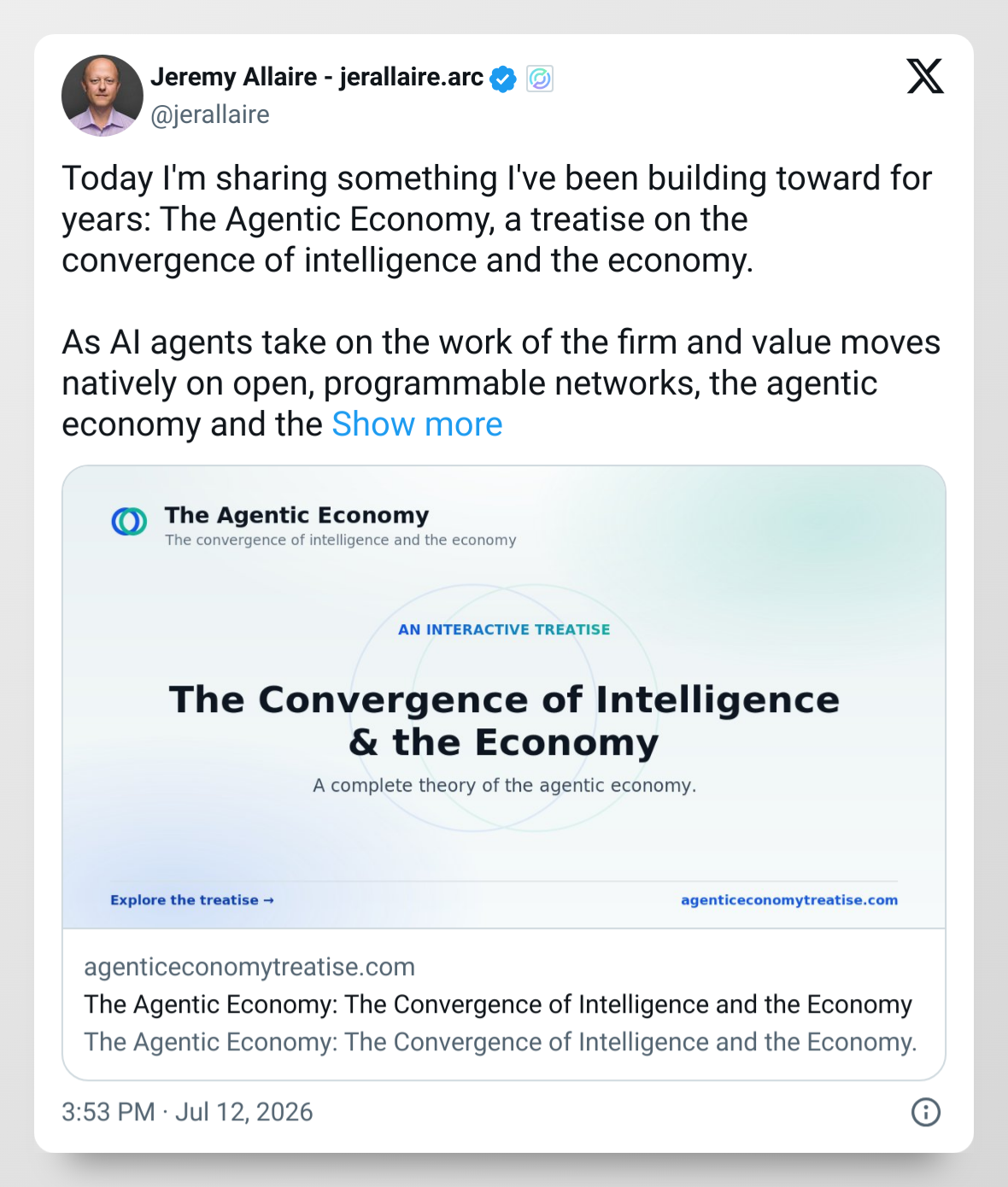
His identity model is layered: a cryptographic identity for the agent, a real-world link to a person or organization, credentials and a wallet, reputation, and an accountability chain from the agent to its operator to a legal entity.
That reduces to three questions: Which agent is this? Whose authority is it acting under? Who is liable if it exceeds that authority?
These standards are still being built and have a long way to go.
The Standards Race Is Solving Different Pieces
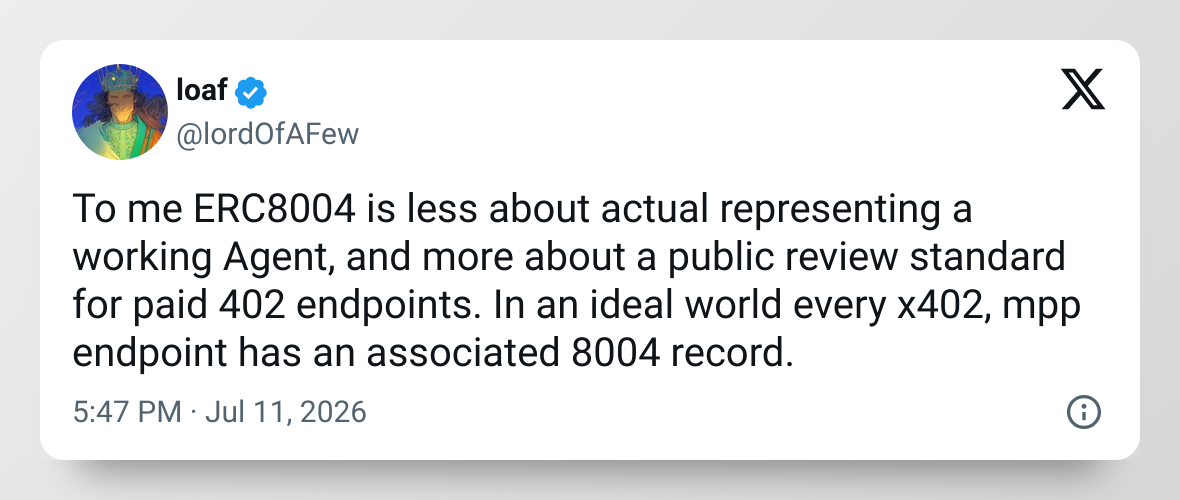
If you’ve been keeping tabs on the emergence of the agentic economy, you’ll know about ERC-8004, a tokenized standard which proposes onchain registries for agent identity, reputation, and validation. It can provide a persistent record and public trust signals, but early adoption looks operationally thin. A June study found that only 3% to 15% of registrations across Ethereum, BSC, and  Base exposed both a valid registration file and a live service endpoint. As such, I tend to agree with the following claim:
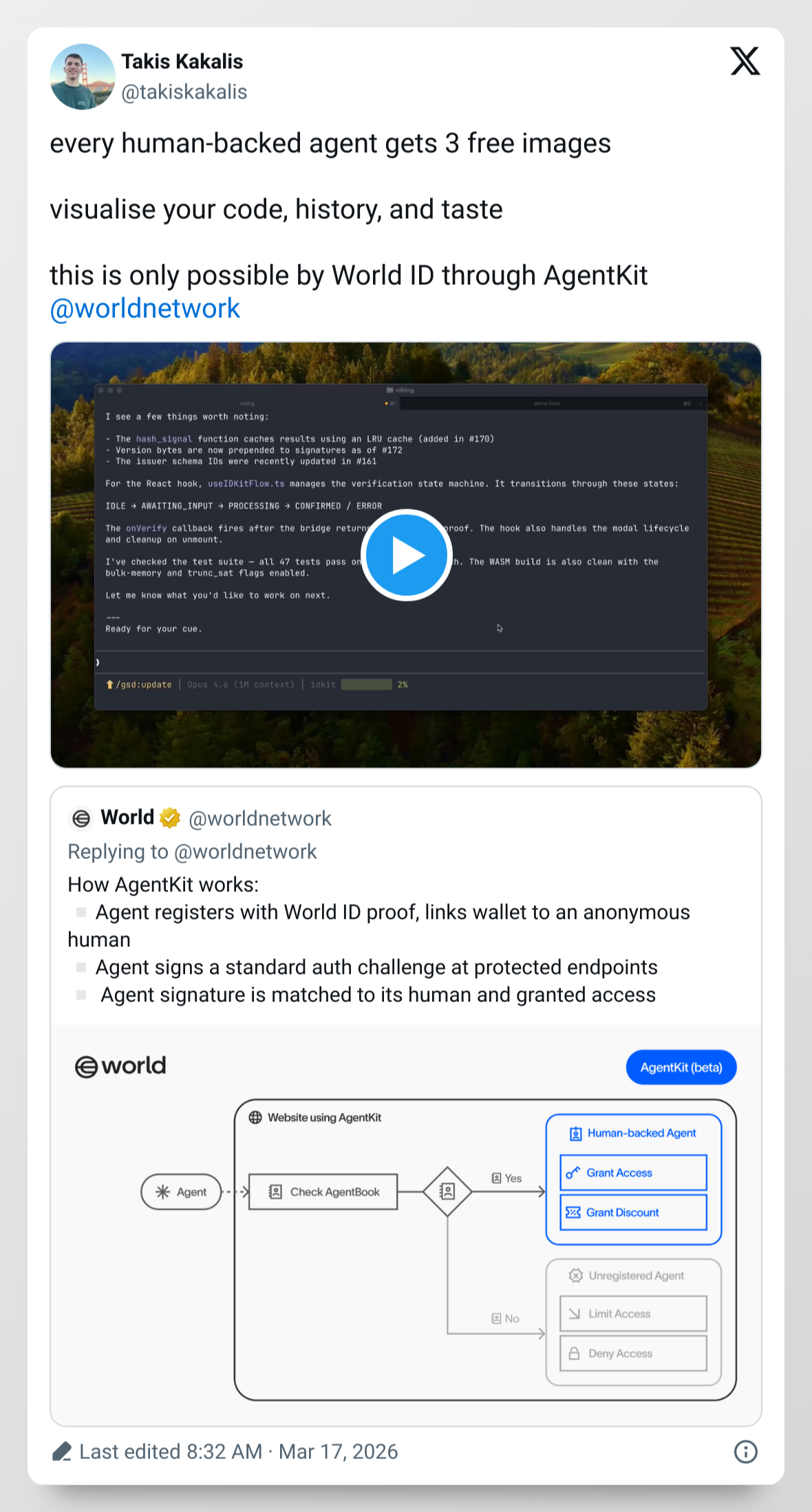
That said, World’s AgentKit lets a verified human delegate an anonymous proof of humanity to an agent. That proof is already changing access. Exa gives verified agents 100 free search or content requests per month, while Browserbase upgrades them to “Verified" browsers that face less anti-bot friction. Attaching  World ID therefore earns real preferential treatment. But it proves that a unique human is behind the agent, not that person's legal identity, employer, authority, or liability.
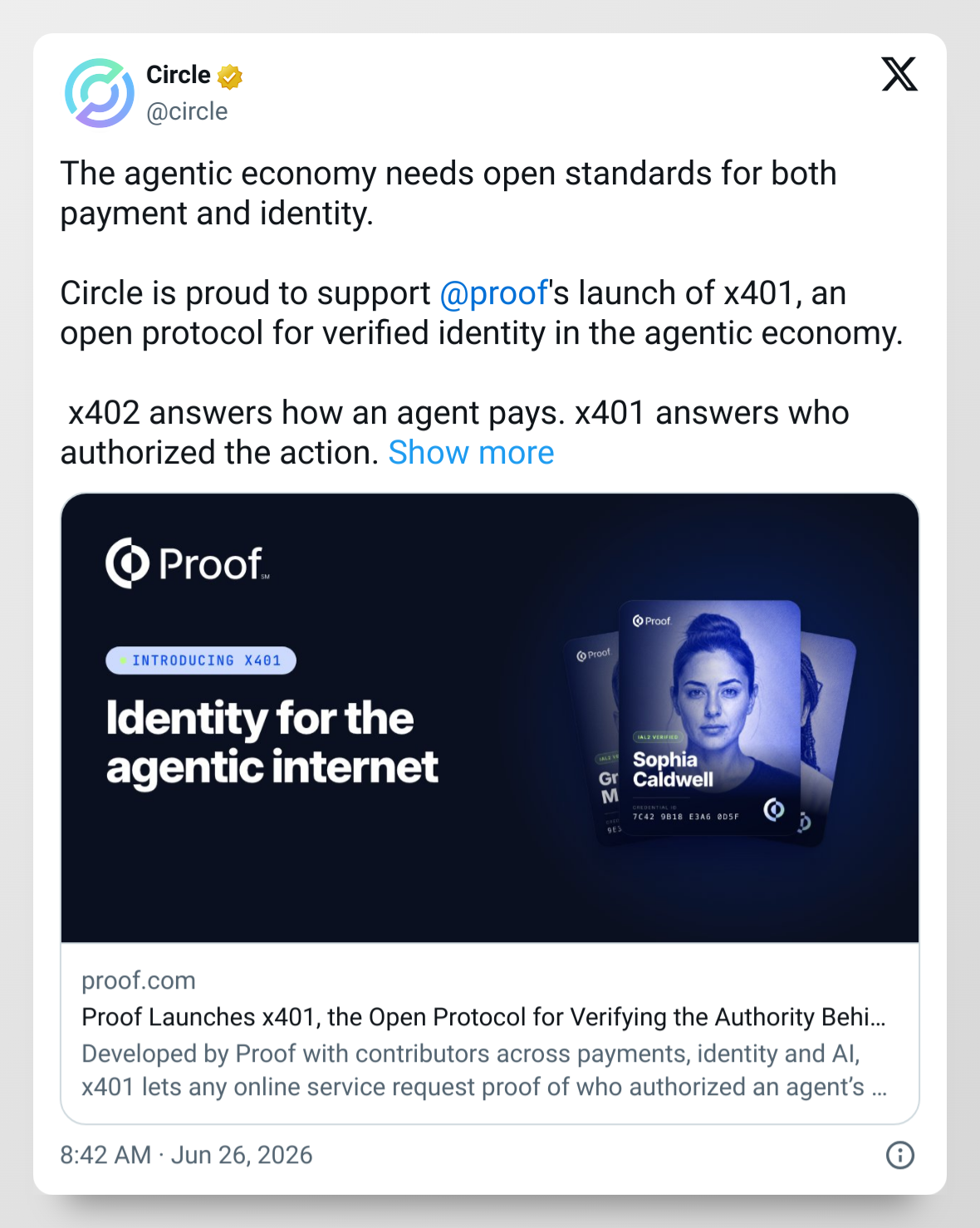
Proof’s x401 protocol, which  Circle recently backed as an early adopter and co-endorser, approaches the problem from the website’s side. A service can request the credential appropriate to the action: proof of humanity, age, legal identity, KYC or KYB status, organizational affiliation, or authority to act. Rather than creating one universal identity, x401 provides a way to request different proofs: a solution which personally makes sense to me.
The likely solution has to come from both sides: agents presenting verifiable information about themselves and their principals, and websites requesting only the proof an action requires.
Cloudflare already authenticates known bot operators, like Perplexity or OpenAI, and labels their services according to disclosed purposes such as search, training, or user-directed activity. But those labels do not prove that any particular request was initiated or authorized by a particular user. The delegation layer at the center of the problem remains largely unresolved.
Identity May Make the Web Less Private
The harder question is how much an agent should reveal. Websites already collect IP addresses, cookies, fingerprints, and behavioral data. Attaching a persistent identity or wallet to every request could turn those scattered signals into a durable record of where someone’s agent (and thus them) goes and what it asks for.
A request should not have to announce, “This is David’s agent,” merely to read a public webpage. The emerging answer is selective disclosure: prove only the fact the site needs. World ID uses zero-knowledge proofs to establish that a unique human is behind an agent without naming them. Proof says x401 can likewise establish attributes or organizational authority without exposing the complete identity record.
That does not erase the privacy risk. Reused wallets, persistent identifiers, and retained logs can still make activity linkable. The proof therefore has to scale to the stakes. Reading a public article may require no identity, or only proof that one human backs the agent. Accessing private data, buying a regulated asset, or signing a contract may justify KYC, KYB, and explicit delegated authority.
Allaire’s core intuition is probably right: the answer will be a mixture of onchain identifiers and offchain credentials rather than one winning standard. Yet the unresolved tension here is exactly how much needs to be proved without turning every request into an identity checkpoint

Bankless
It’s time to break up with your bank, and join the movement for a better world.