


Subscribe to Bankless or sign in
Etherealize, the firm acting as the go-between for  Ethereum and Wall Street, published Ethereum and the Era of Productive Money today and brought the primary author, Mike McGuiness, onto Bankless to walk Ryan and David through it.
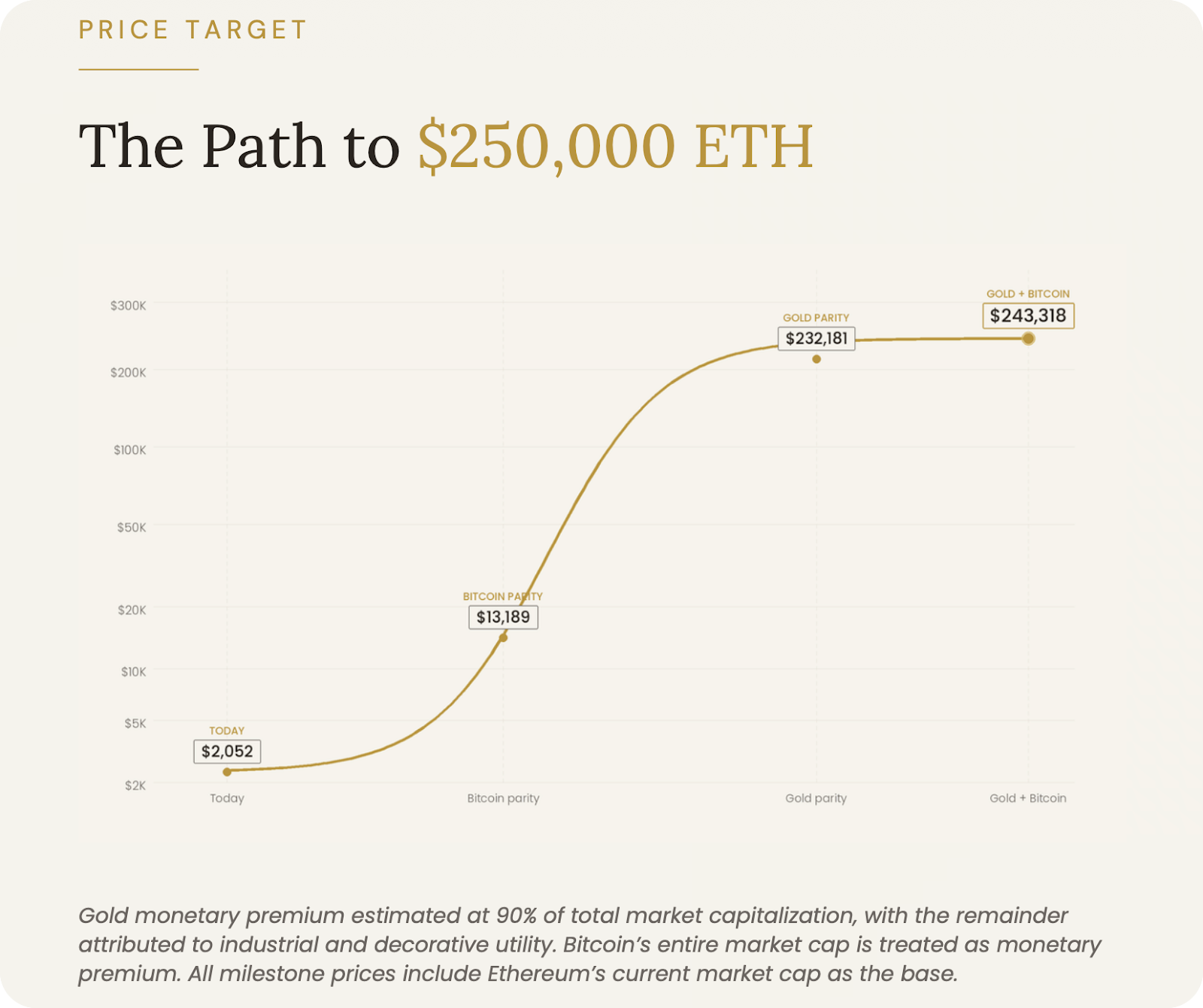
The headline number is the one that'll travel: the combined monetary premium of gold and  Bitcoin is roughly $31 trillion. Divide that by the ~121 million ETH in circulation, and you get about $250,000 per ETH. Today it trades at around $2,300.
But before you dismiss this as delusional Bankless bullishness, know it isn't a price target. The Report says so explicitly. It's what ETH would be worth, given its functionality and feature set, if the market agreed ETH is money.
If you've been reading Bankless for a while, you'll know it's a question we've been circling for years (six, to be precise).
Etherealize took the scattered arguments and assembled them into one coherent thesis, with a framework behind it and a number attached to it. The intended audience is Wall Street.
The Triple Point Asset, Finished
In 2019, Ryan coined the phrase Triple Point Asset.
The claim was that ETH is simultaneously a:
- Capital Asset — generates cash flow via staking
- Consumable Asset — burned as gas
- Store of Value — a bearer instrument with hard supply discipline
No other asset occupies all three corners of that triangle at once.
At the time it was a shape claim, helping size up ETH against BTC and the blue chips of that era. What Etherealize's Productive Money thesis does now is name the monetary argument that was always implied underneath. The three corners communicate mechanisms that make ETH better money than anything that came before it.
Compounding, scarcity, and bearer status, all fused in one asset.
McGuiness closed the pod by crediting Bankless directly. His conversion from Bitcoiner to ETH holder came from listening to the original Ultra Sound Money episode with Justin Drake. He went back through the arguments, couldn't answer them, and rotated his stack.
Menger and Buffett, Finally Agreeing
To pitch this claim to institutions, Etherealize’s Report leans on two gatekeepers whose standards money has had to satisfy for over a century.
The first is Carl Menger, the founder of the Austrian school of economics, who in 1892 wrote the most influential theory of money's origins ever put to paper. Money, Menger argued, emerges from goods that excel across a composite of attributes: scarcity, fungibility, divisibility, portability, durability, verifiability, and low carrying cost.
ETH matches or beats gold and Bitcoin on every one of those attributes.
Its net issuance runs around 0.8%, below gold's 1.5%. It settles globally in seconds. Counterfeit gold bars exist; counterfeit ETH doesn't. As the Report says, “a million dollars in ETH fits in a twelve-word seed phrase and crosses any border on earth.”
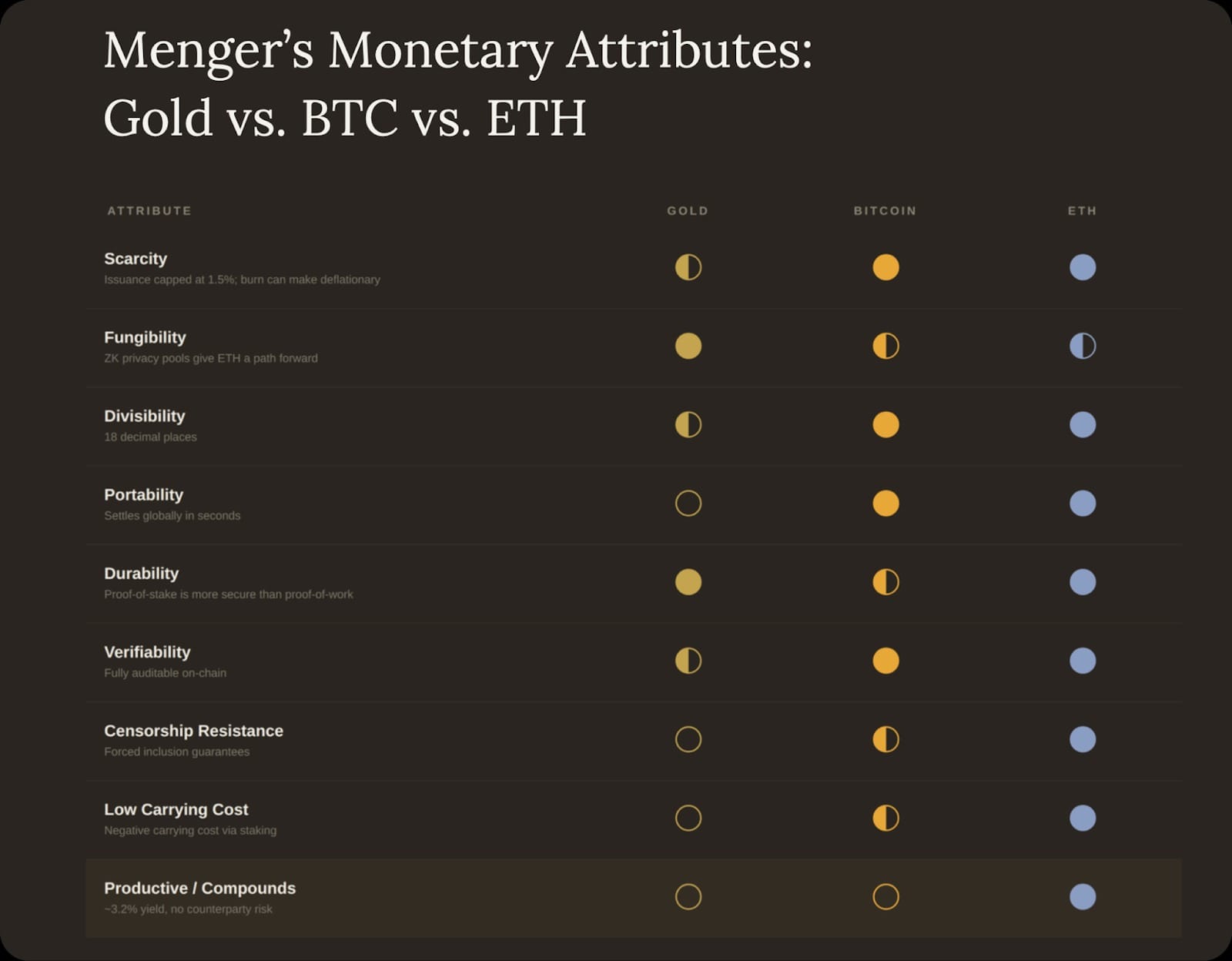
But, as David says on the pod, checking Menger's boxes simply gets ETH into the race. It doesn't win it.
The second gatekeeper is Warren Buffett, and passing his test is what distinguishes ETH from gold and Bitcoin as a superior form of money.
In a 2011 letter to Berkshire shareholders, Buffett cut gold down for size: "If you own one ounce of gold for an eternity, you will still own one ounce at its end." What he's saying is that scarcity without productivity is economically sterile. Why own gold when you could own farmland? Farmland compounds. Gold doesn't.
Enjoying this article?
Subscribe to Bankless or sign in
The same critique applies to Bitcoin, but not to ETH. Stake it and you earn 2-4% annually, paid by the protocol itself. No loan, no deposit, no bank, no borrower. It's the first monetary asset in history that compounds while it remains in your hands.
A Bitcoiner will object here that yield disqualifies ETH as money. Real money, the argument goes, doesn't do anything. That framing was always circular. It defined money as whatever doesn't compound and then used the definition to reject anything that does. Buffett would reject it on day one. Compounding is what gets ETH past Buffett's gate, and it's the feature Wall Street is looking for.
Menger and Buffett have pointed at different assets their whole lives. Yet ETH would be the first asset they agree on.
Ultra Sound Money Was Half the Story
Bankless has been running an adjacent argument for years, Ultra Sound Money.
The meme was simple: EIP-1559 burns ETH with every transaction, and at sufficient network usage, burn exceeds issuance and total supply contracts.
For years the critique from the utility camp, led by researchers like Dankrad Feist, was that scarcity without demand is cope. If no one wants something, why does it matter if it's scarce? The Report resolves the fight. Ultra Sound was always the supply side of the Productive Money argument. It was never the whole thing.
The ultrasound money meme gets way too much hate.
— RYAN SΞAN ADAMS - rsa.eth 🦄 (@RyanSAdams) October 28, 2024
The purpose of the meme was to showcase ETH's monetary policy as it moved from arbitrary block reductions to something algorithmic - not to imply that ETH would always and eternally be deflationary.
Drop the ultrasound if you…
The demand side shows up as three structural sinks:
- Staking locks ~29% of supply out of circulation
- ETH serves as the foundational collateral across DeFi, used on Aave, backing decentralized stablecoins, pairing against most DEX liquidity
- Gas consumption burns a slice of every transaction forever
Now a fourth sink, and arguably the largest, is the one BlackRock used in a Davos presentation: Ethereum as "the toll road to tokenization." The data backs the metaphor. Ethereum cleared $18.8 trillion in stablecoin volume last year, topping Visa's annual throughput. Over 65% of tokenized real-world assets live on Ethereum, because institutions put the assets that matter on the most secure rails.
Here the flywheel forms. Every real-world asset that tokenizes on Ethereum creates more demand for ETH. Tokenization drives settlement volume. Settlement burns ETH and pays stakers. More stakers lock up more supply. More DeFi activity locks up more collateral. The more that gets built on Ethereum, the less ETH is freely available to buy, and the more valuable what's left becomes.
And the flywheel is already turning. RWAs on Ethereum have grown roughly sevenfold since spot ETFs launched in 2024. Stablecoin supply on Ethereum has more than doubled. BlackRock's BUIDL and Franklin Templeton's FOBXX settle on Ethereum or its L2s. Banks are testing onchain settlement. So is SWIFT.
 David Christopher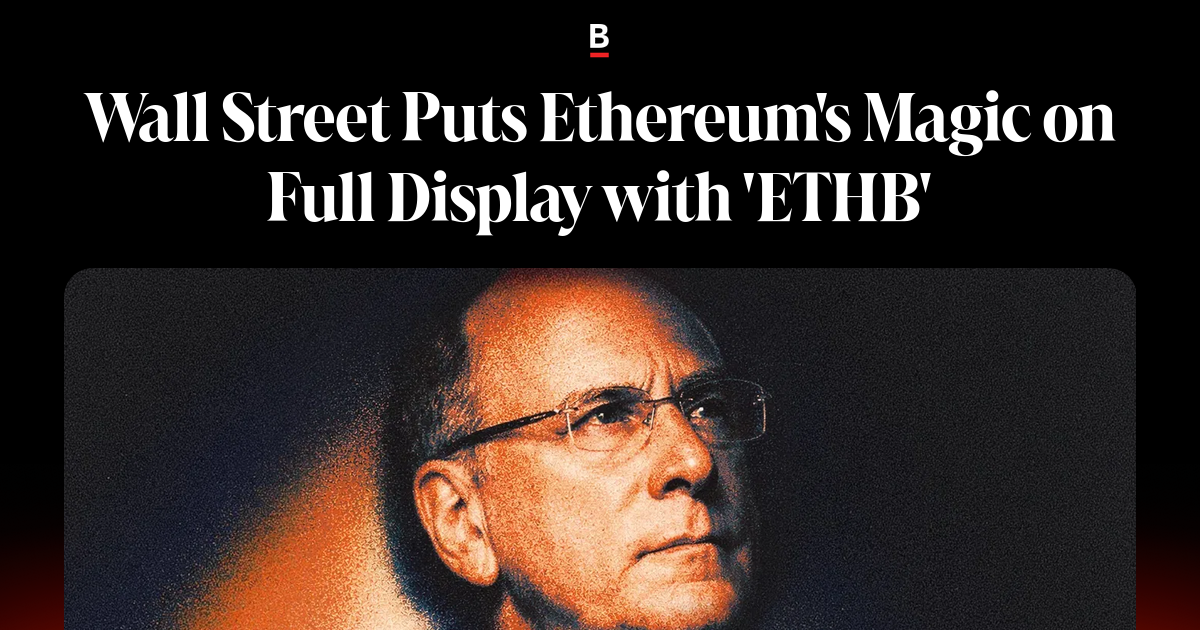
That's the floor Bitcoin doesn't have. Satoshi's own thought experiment framed Bitcoin as a teleportable scarce metal. The value proposition is pure monetary premium, with no economic activity underneath. If confidence wavers, there's nothing to catch it.
ETH has DeFi underneath, and that activity doesn't evaporate if the monetary narrative takes a decade longer than bulls expect.
What Could Break This
As the previous sections showed, the Bitcoiner objection about yield isn't the real threat to Ethereum’s success. The real risks live downstream:
- Technical: the ZKEVM migration and post-quantum upgrade are non-trivial
- Regulatory: governments restricting DeFi and smart contract platforms at large
- Competitive: though McGuiness considers this largely resolved, citing Ethereum's ~60% share of DeFi and significant market cap lead over the nearest competitor
And a fourth risk Etherealize can't solve from a report: adoption velocity. The structure is there and fits the thesis, but whether Wall Street moves this quarter, this year, or this cycle isn’t something a report can control.
The Synthesis
The Triple Point Asset framed the shape. Ultra Sound Money captured the supply side. Productive Money brings the full argument together.
Last month, BlackRock's iShares Staked Ethereum Trust (ETHB) began trading on Nasdaq as the firm's first staking ETF. For years, Wall Street was pitched ETH as productive money, though 2024's spot ETFs handed them price exposure without the yield. ETHB closes that gap on the product side. The Productive Money report closes it on the narrative side.
Gold sits. Bitcoin sits. ETH compounds. Wall Street now has a wrapper that lets them hold the best one.