Ethereum Foundation Cuts 20% of Staff in Restructuring
The Ethereum Foundation cut 54 staff and reorganized around five clusters, one day after former EF researchers launched the independent lab Ethlabs.


The  Ethereum Foundation announced a major reorganization today, cutting roughly 20% of its staff, 54 employees, and restructuring around five domain-focused clusters.
What's the Scoop?
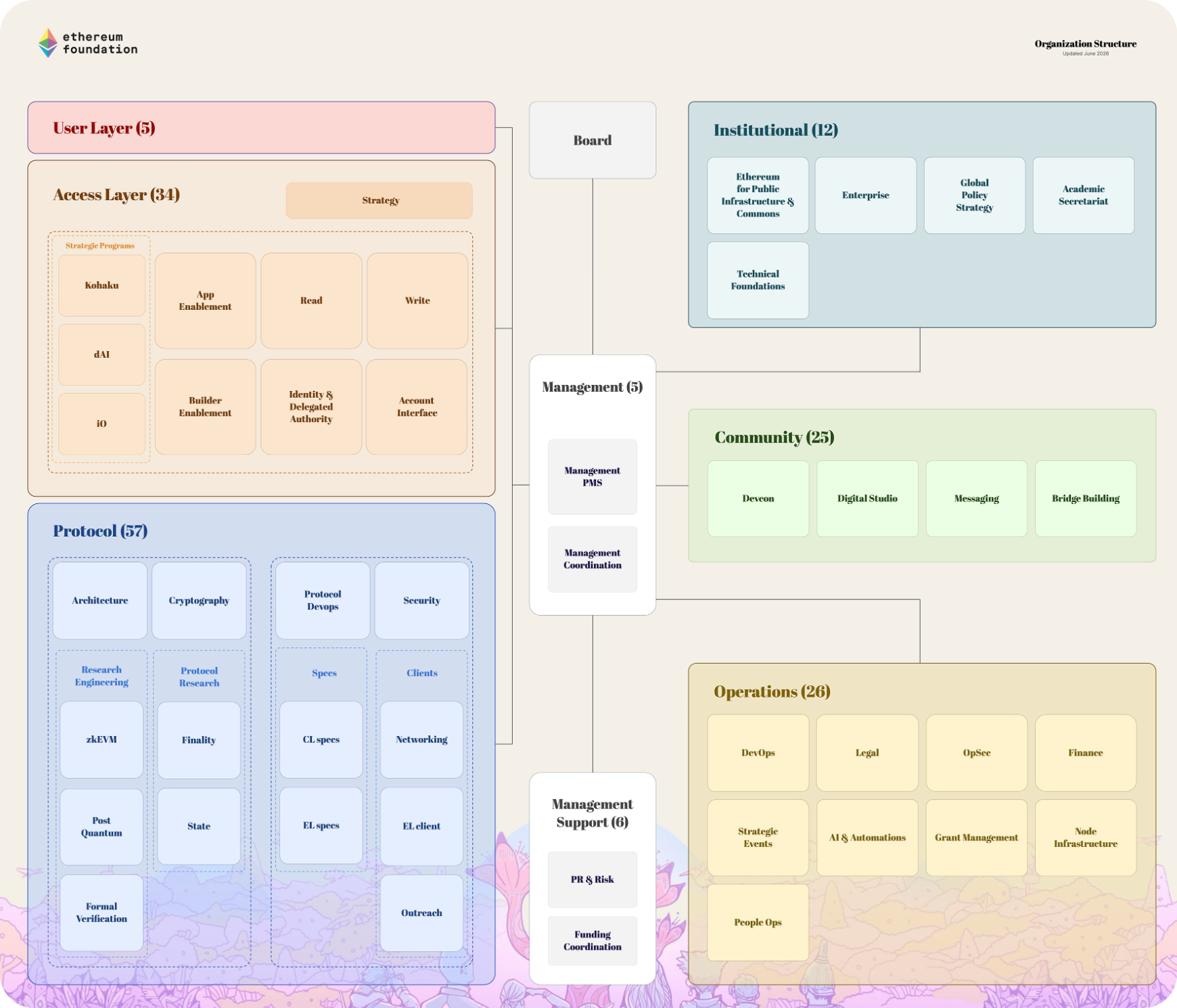
- The New Structure: Beyond operations and management, the EF now organizes around five work clusters:
- Protocol Layer: Hardens and scales the core protocol, including work on post-quantum security, zkEVM, and L1 privacy.
- Access Layer: Builds tools for users and their AI agents to read the chain, transact, prove, delegate, and exit without relying on third parties.
- User Layer: Researches who actually uses Ethereum and how, so protocol and access decisions are shaped by real user needs rather than assumptions.
- Community Layer: Manages how the EF presents itself and builds relationships inside crypto and in adjacent fields like open-source software, privacy, and cryptography research.
- Institutional Layer: Works with financial institutions, enterprises, governments, and academics on Ethereum integration and tracks policy developments affecting the network.
- The Framing: The restructuring leans heavily on self-sovereignty as the organizing principle, with repeated emphasis on censorship resistance, capture resistance, privacy, and open source. The Protocol cluster's mandate explicitly states it "does not exist to make Ethereum more marketable or focused on short-term interests, or to make it easier to turn into another financial rail controlled by intermediaries."

David Christopher
David is a writer/analyst at Bankless. Prior to joining Bankless, he worked for a series of early-stage crypto startups and on grants from the Ethereum, Solana, and Urbit Foundations. He graduated from Skidmore College in New York. He currently lives in the Midwest and enjoys NFTs, but no longer participates in them.