Eigen's Darkbloom Turns Idle Macs Into a Private AI Network
Eigen Labs just launched Darkbloom, which stitches idle Apple Macs into a private inference network.


There's a growing anxiety about token subsidization, seen across the timeline and in reporting. Companies keep launching promotional usage campaigns to win market share as they roll out agentic capabilities that drive inference costs up. These subscriptions are priced well below cost, and how long that lasts is anyone's guess.
Bracing for a future where people don't want to pay $500 a month for a max subscription, the market is seeing a surge in demand for open-weight models one can run locally at much lower costs. That's mirrored inside crypto too, with the rise of Inference Capital Markets: the repricing of platforms that crowdsource cheap inference from "consumer" hardware. Many of these projects I haven't looked at in over a year, and it's great to see demand for them emerge again.
The "consumer" label is generous, though. Much of that demand is for private inference, which these networks tend to serve through Trusted Execution Environments (TEEs), the established path for confidential computing but one that runs on specialized hardware and not on the machines most people own. So the compute is crowdsourced, just not from a truly consumer base, which caps how far supply can grow. To push past that, these networks need another way to deliver privacy.
This is why we need solutions like https://t.co/WwDxVWrmtq - use the compute that’s already there and open weights models https://t.co/CAYl7XOCT1
— chainyoda (@chainyoda) May 27, 2026
Eigen Labs is attempting exactly this through its new Darkbloom platform, which stitches together idle Apple Silicon Macs to serve private inference. It replicates Private Cloud Compute (PCC), the system Apple uses to handle Siri and Apple Intelligence queries privately, bringing those same guarantees to anyone on its network.
With the launch of its public alpha on Tuesday, now's a good time to examine how Darkbloom works, how it's able to piggyback on Apple's PCC, and how its potential squares with its reality.
Darkbloom just completed a major network upgrade!
— Gajesh (@gajesh) May 26, 2026
BIG UPDATE: We’re moving from Research Preview to Public Alpha.
In the last month:
- 1000s of provider signups, 250 live providers at peak
- 600M+ tokens served
With this upgrade, performance is up 30–200% across key metrics… pic.twitter.com/LB580NlNAQ
What's Live
At its base, Darkbloom's network consists of three parts: users, a coordinator, and providers.
- Users send inference requests through either a chat interface or an OpenAI-compatible API.
- The Coordinator, a matchmaker run by Eigen Labs, routes those requests to an eligible Mac on the network.
- Providers, i.e. people who own one of these eligible Macs (more on eligibility shortly), run the models and return the output without being able to see the request.
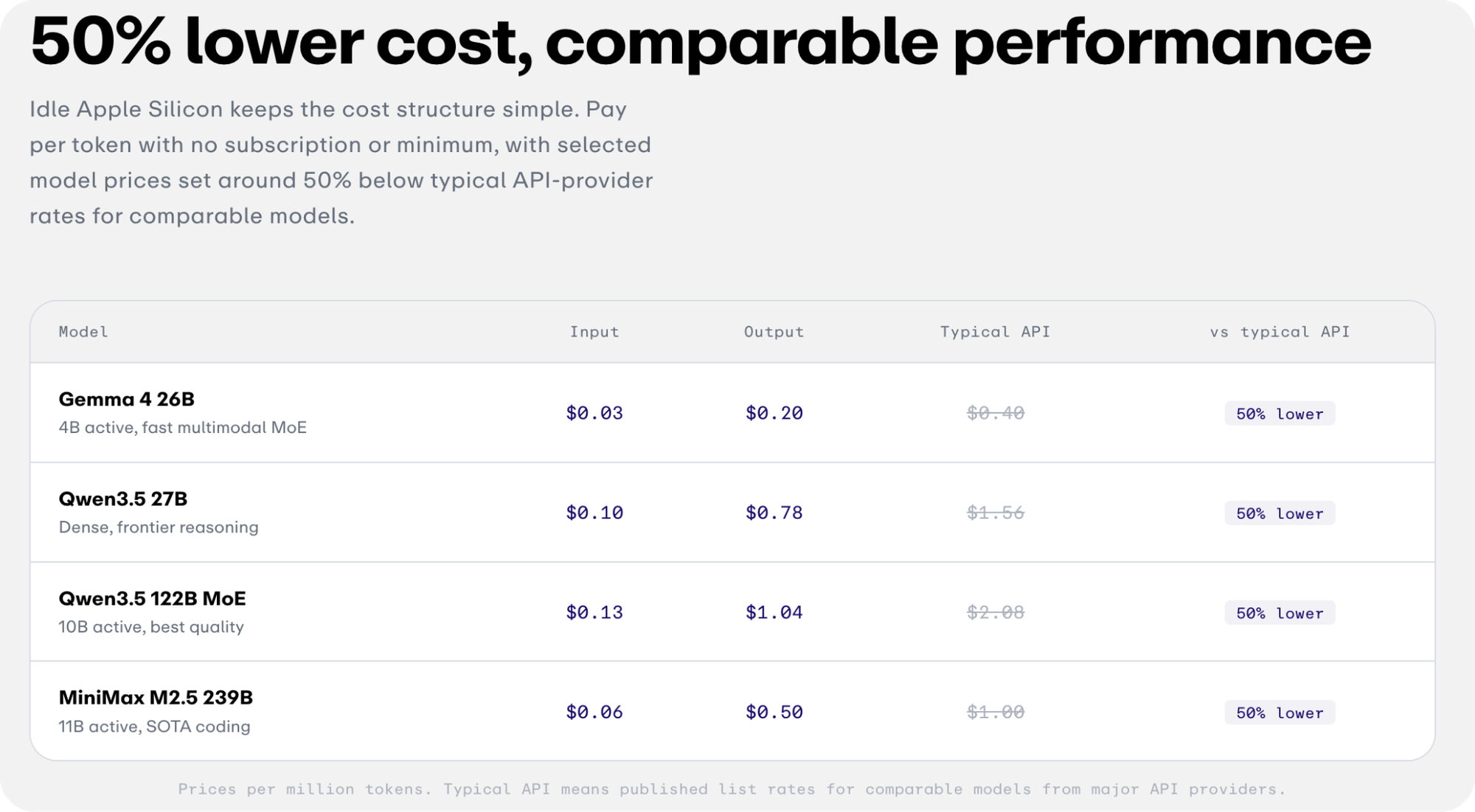
In the public alpha as the network gets tested, the available models are Google's Gemma 4 and OpenAI's GPT-OSS. The broader model catalog on Darkbloom's site lists larger models like Qwen and MiniMax variants, but treats those as where the network is headed, not what it's running today.
This all runs on Apple Silicon, too, the M-series chips in every Mac sold since 2020. Because each chip's CPU and GPU share a single pool of memory, the more memory a Mac has, the larger the model it can serve, which is why heavier models arrive as higher-memory machines join. Pricing on selected models comes in around 50% below typical API-provider rates, a real draw for consumers, with per-token billing and no subscription tier or minimum commitment.
As for providers, the main cost is the electricity to keep a Mac running. That stays marginal, which in theory gives the network room to undercut cloud providers and stay competitive.
Enjoying this article?
Subscribe to Bankless or sign in
Darkbloom Piggybacks on Apple for Privacy
Private Cloud Compute is the system Apple built to keep Siri and Apple Intelligence queries private. Inference runs inside a sealed process on Apple's servers that even Apple can't peek into.
These capabilities sit latent on idle Apple Silicon Macs, and Darkbloom repurposes them into a service consumers can access and providers can offer, provided they attest that they, like Apple, have no way of seeing the requests they handle. To enforce that, Darkbloom has all providers install software that checks the Mac is genuine Apple hardware, macOS security settings are intact, the software itself hasn't been modified, and none of it has changed since the Mac joined the network.
Accordingly, the software then signs that information with a hardware-bound key and sends it to the coordinator. If anything looks off, the coordinator stops routing work to that Mac.
ICYMI: Darkbloom is turning idle Macs into private, low-cost inference infra and now it’s moving into PUBLIC ALPHA!
— EigenCloud (@eigencloud) May 27, 2026
- 600M+ tokens served
- 250 live providers at peak
- 30-200% performance gains
Powered by @eigenlabs. https://t.co/HrBh642Ti3
The Earnings Question
The consumer value is clear: private model access at roughly half the cost of typical API providers. The supply-side pitch is shakier.
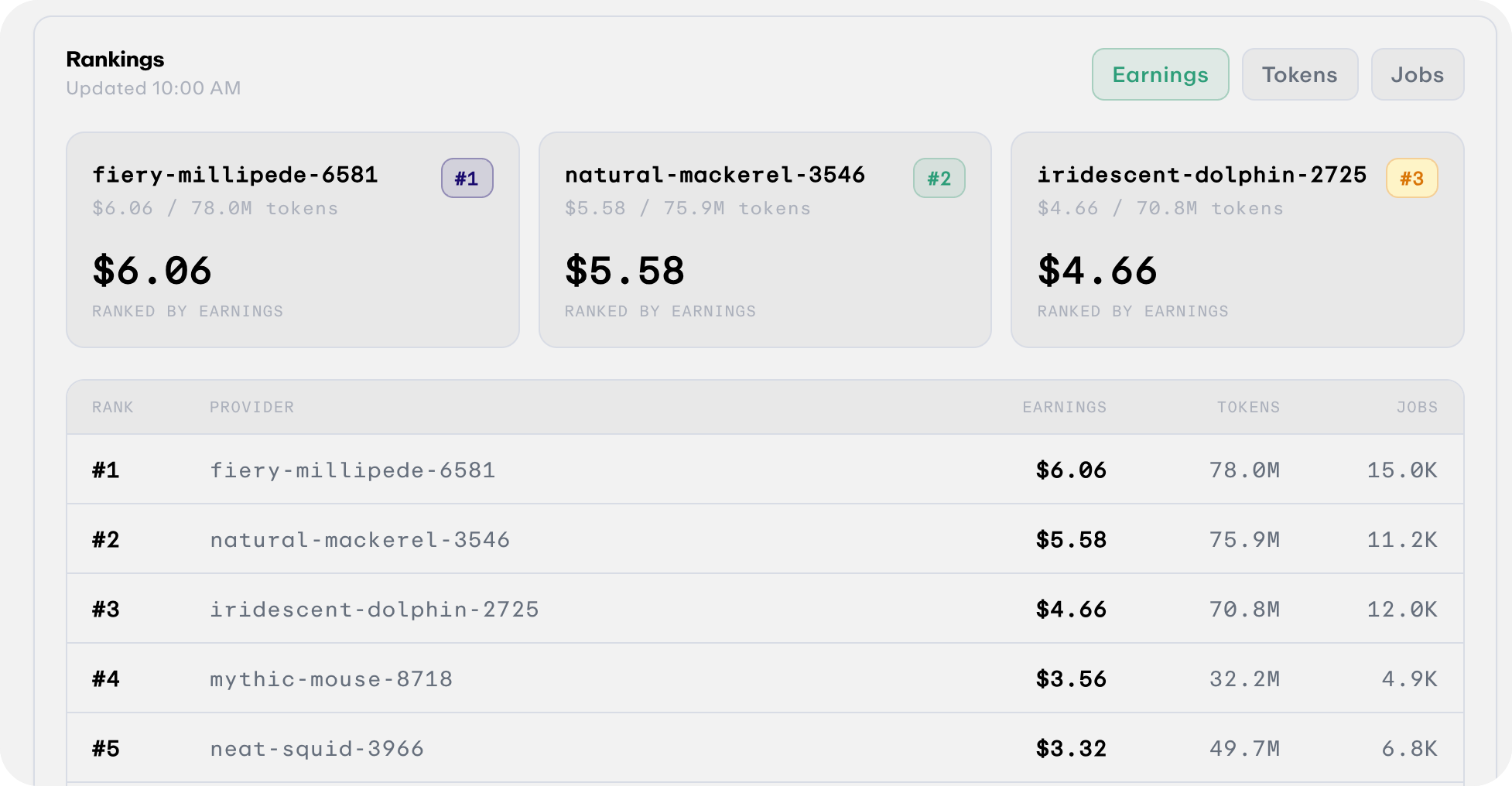
Darkbloom's earnings calculator estimates my own Mac could pull in between $280 and $600 a month offering idle inference, depending on the model I run. Yet the leaderboard ranking providers by earnings over the last 30 days shows the current top earner at around $6. Subtract roughly $2.50 in electricity and you're left with about $3.50, which hardly incentivizes participation. The service is brand new, of course, but this will be something to keep an eye on.
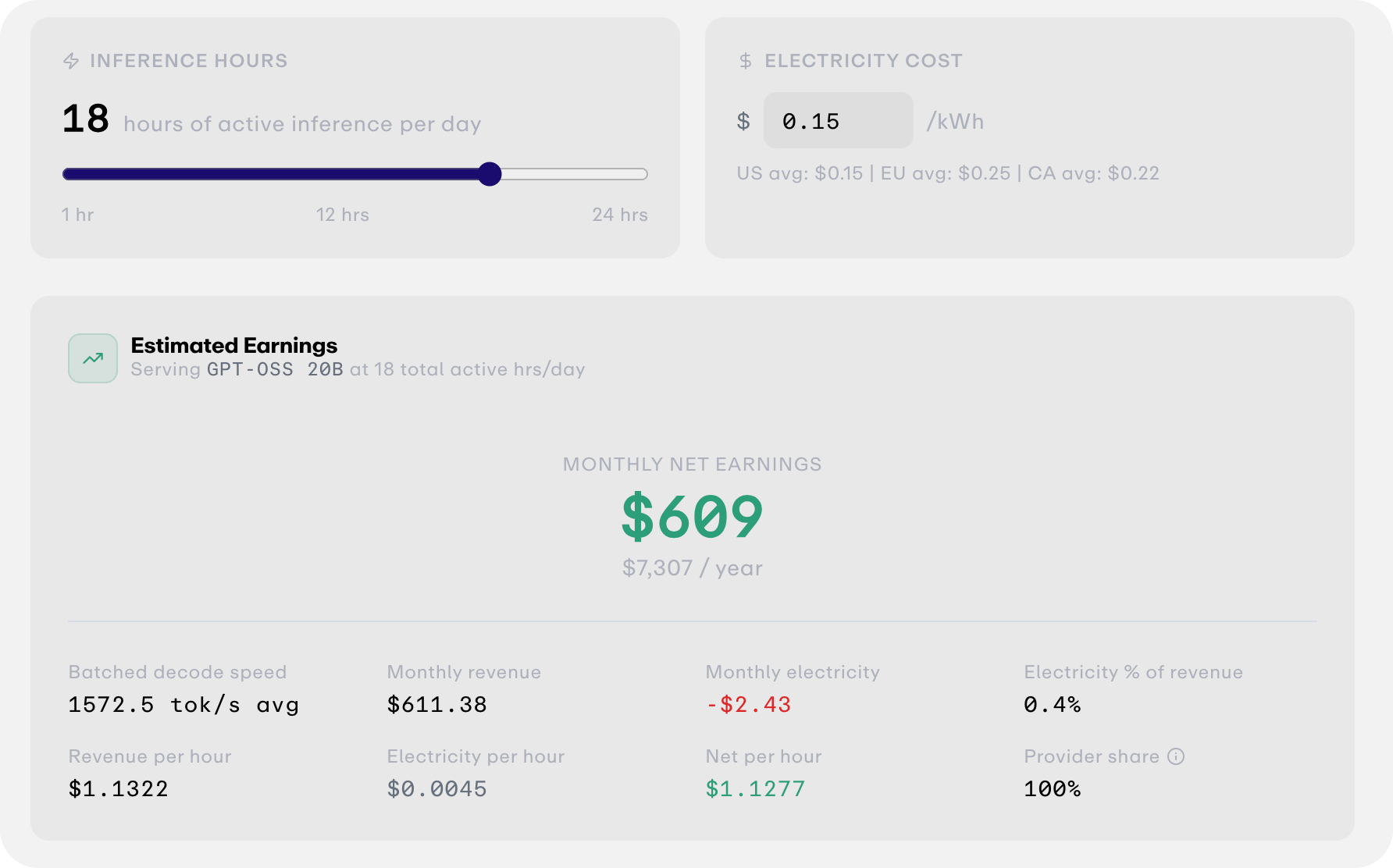
Providers do keep 95-100% of their revenue, and earnings should scale with demand, so prospects look better going forward. For now, though, too little revenue is flowing to make it worthwhile for providers. Consumers get the cost benefit either way, so as Darkbloom adds more models, activity may pick up and earnings with it. As always, there may be a factor I'm not seeing, but per the available data, the juice doesn't seem worth the squeeze for providers as things stand this early on.
This is what makes Darkbloom interesting to me, though. It's a DePIN network in all but name, but unlike most, it doesn't lean on token rewards to bootstrap its supply. Paying providers in tokens can manufacture early activity, but that activity rarely maps to a protocol's longevity. If anything, it's the opposite. Darkbloom's earnings come from real inference demand or they don't come at all, and paired with Eigen Labs' technical rigor, that's what sets it apart.
The risk is that thin provider earnings keep the network from reaching its potential, and that Eigen reaches for the token lever to compensate. I doubt they will. Darkbloom reads as a research project and proof of concept, a signal of where Eigen is heading in AI infrastructure, not a core product to inflate (yet).
The likelier path ahead is growing demand the hard way, by making the network something people actually want to use. Comments on the alpha announcements suggest the appetite is there. But for Darkbloom to really excel, it has to serve the most performant models, which are also the largest, and those need high-memory Macs to run. That loops back to the same problem: the models that would pull in users depend on hardware that thin earnings aren't yet bringing onto the network.
This will be a thorn to solve if this novel and accessible way to deliver privacy is to succeed. I hope it works, and given the team behind it, I think it will.

David Christopher
David is a writer/analyst at Bankless. Prior to joining Bankless, he worked for a series of early-stage crypto startups and on grants from the Ethereum, Solana, and Urbit Foundations. He graduated from Skidmore College in New York. He currently lives in the Midwest and enjoys NFTs, but no longer participates in them.