Crypto's M&A Logic
As some crypto firms file for bankruptcy, others are betting on acquisitions to thrive.

| 24h Majors & Movers | ||||||

|
BTC $64.9k | ↗ 1% |

|
HYPE $56 | ↘ 3% | |

|
ETH $1.9k | ↗ 2% |

|
PUMP $.002 | ↗ 15% | |

|
SOL $75 | ↗ 1% |

|
AERO $0.44 | ↗ 8% | |
Sponsor: WisdomTree Prime® – Tokenized RWAs, Built for Onchain Portfolios.
Enjoying this article?
Subscribe to Bankless or sign in
- 💸 The big crypto treasuries split paths last week, as Bitmine tacked on another 9,946 ETH, pushing its treasury past 5.78M tokens (~$11.3B), while Strategy left its 843,775 BTC stack untouched for the 5th straight week, opting instead to sell $544.5M in stock and build up cash.
- ⛓️ Ondo Finance unveiled the Ondo Network, a new execution layer that splits trade execution, verification, and settlement across secure enclaves, decentralized attestors, and onchain settlement, effectively shelving its original full L1 plan.
- 💎 Lido kicked off its biggest Core upgrade since V2, rolling out Curated Module v2 and CSMv3 while consolidating over 8 million ETH (~$16B) onto larger post-Pectra validators, a move set to cut Ethereum's validator count by roughly a third.

Three crypto companies filed for Chapter 11 this month. Two exchanges announced they were winding down. In the same stretch, MoonPay, Circle, and  Kraken each announced or completed deals for another piece of the infrastructure surrounding their core businesses.
The usual reading is that infrastructure gets commoditized and the money moves to integration. That happens in every maturing technology market. Crypto's version has a wrinkle: the dominant positions here are still open. Nobody knows which venue most people will end up trading in, which chain will settle the most value, or which dollar becomes the default.
That changes what an acquisition is for. In a settled market, you integrate to widen margins. Here, you integrate so you still have a business no matter how those three questions land. The deals differ mostly in how much each company needs a particular answer.
MoonPay Doesn't Need a Winner
MoonPay sits at the boundary where capital crosses between traditional finance and the onchain economy. Nearly every crypto application needs someone to turn a bank balance into an onchain asset, and eventually reverse it. That position doesn't depend on any chain or stablecoin winning.
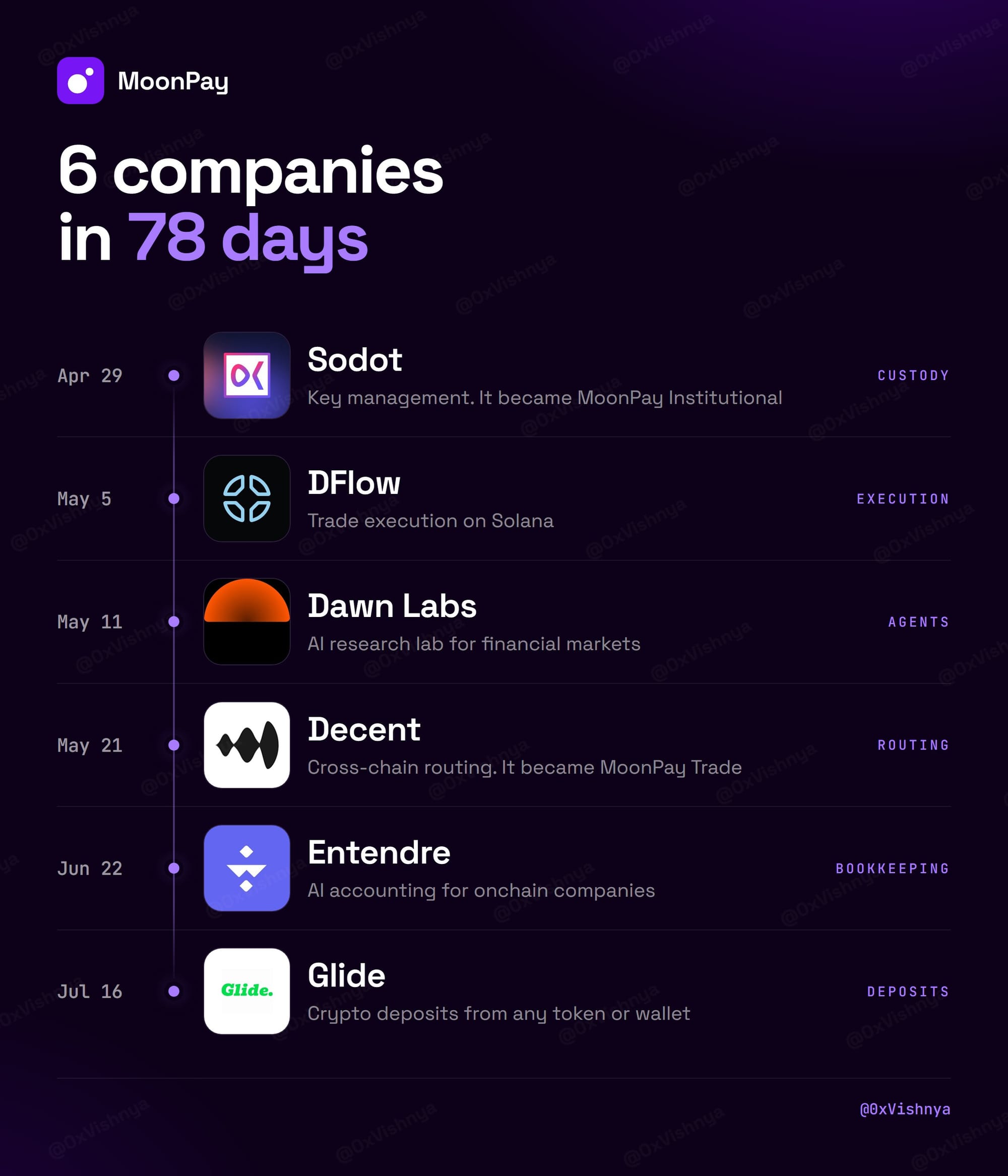
MoonPay’s acquisition of Glide on July 16th, the sixth of the year, extends the same logic. Glide lets applications accept deposits from almost any token, wallet, exchange, or card, handling the swaps and bridges needed to deliver the requested asset. Earlier deals of MoonPay’s added key management, trade execution, AI trading tools, and accounting operations. Where the company once handled entry and exit, it now stays involved as capital is moved, traded, reconciled, and withdrawn, regardless of the venue.
 Polygon is the useful contrast. It spent more than $250 million in January on Coinme and Sequence, adding licenses, wallets, and fiat connectivity to what it calls the Open Money Stack. The pieces are similar. Polygon's economics improve most when value settles on Polygon, while MoonPay's improve wherever the customer goes.
 Circle Needs USDC to Stay the Default
Circle's business runs through one asset, and Open USD made the cost of that clear.
The Open Standard consortium, composed of +140 companies including Visa, Mastercard, Stripe, BlackRock, and Coinbase, is designed to let distributors mint and redeem OUSD for free and retain most of the interest earned on its reserves after a management fee. On the day of the announcement, CRCL fell roughly 16%. That interest is where Circle makes most of its money. If it has to hand more of it to exchanges and wallets to keep them distributing USDC, its margins shrink even if USDC supply never drops.
 David Christopher
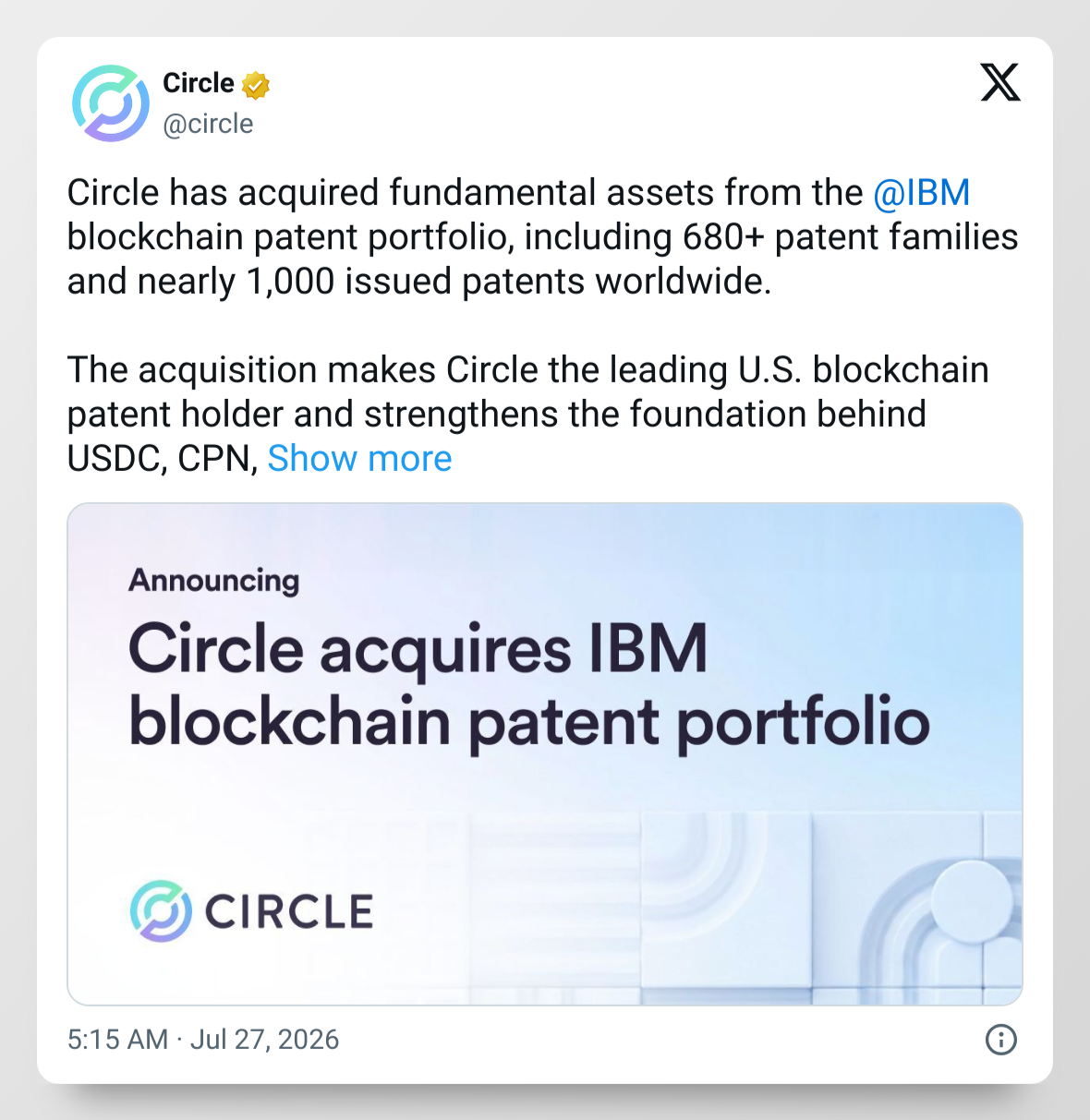
The patent deal announced today stems from that. Circle bought nearly 1,000 issued patents from IBM's blockchain portfolio, spanning banking, insurance, enterprise infrastructure, and secure cloud operations. The company says they'll support USDC, Circle Payments Network, Arc, and its agentic finance tools, and said little beyond that.
If revenue sharing becomes standard and stablecoin margins compress, the reason to pick one dollar over another becomes everything around the token: settlement paths through banks and corporate networks, treasury tooling for businesses holding balances, and traceability clean enough for auditors.
That infrastructure could prove a more durable place to compete than yield alone.
Kraken Needs to Be the Venue
Coinbase, Robinhood, and Kraken are all racing to become the account where a user can trade almost anything: spot crypto, onchain assets, stocks, derivatives, payments, and tokenized securities. At the same time, each is developing its own onchain trading environment through Base,  Robinhood Chain, and Ink. The goal is making onchain and offchain markets feel like one venue.
Today, Payward, Kraken's parent, announced an agreement to acquire Magic Labs' wallet-as-a-service business, the embedded wallet infrastructure behind apps like Polymarket. Kraken already lets users trade onchain tokens without opening a separate wallet, and its xStocks tokenized equities have cleared more than $35 billion in cumulative volume. It also runs Ink, an  Ethereum L2 that has yet to find breakthrough traction.
Magic would make those products behave like one trading environment. Instead of sending users into a separate wallet every time they move onchain, Kraken can embed that wallet in the experience and let people reach onchain markets from the app they already use.  Ink stands to benefit from the same plumbing, which would give it a shorter path to Kraken's existing distribution than it has today.
That matters because, as the events of the last few weeks have shown us, the market for exchange-owned trading environments remains open. Robinhood Chain launched July 1st and passed Base on daily active users three weeks later, initially on memecoin volume, though its tokenized stocks have also begun generating meaningful trading activity.  Base remains much larger on deeper measures such as liquidity and stablecoin supply, but the speed of Robinhood's rise shows how quickly an existing brokerage can turn distribution into a new onchain venue.
All that said, the bankruptcies and shutdowns this month don't share one explanation, but they belong to the same shifting landscape. At the other end of it, larger platforms are buying capabilities that strengthen their products today while positioning them for several possible versions of crypto's future.
As the underlying infrastructure becomes easier for everyone to access, the advantage moves toward whoever can assemble it into the smoothest product and the strongest network. Yes crypto is maturing, but there is still plenty of room for competition.
Limited Time Offer: Get an Instant $50 BTC Reward when you fund your WisdomTree Prime® account with $250 or more. Access tokenized real-world assets designed for yield, transparency, and programmability. Stay onchain: Fund via stablecoins, hold in-app or self-custody. Offer available to U.S. residents age 18+.

Bankless
It’s time to break up with your bank, and join the movement for a better world.