Prediction Market Tightrope
This week the CFTC defended prediction markets from state intervention while tightening oversight as the industry scales.

| 24h Majors & Movers | ||||||

|
BTC $63.1k | ↘ 1% |

|
HYPE $57 | ↗ 2% | |

|
ETH $1.8k | ↘ 1% |

|
CARDS $0.15 | ↗ 10% | |

|
SOL $75 | ↘ 0% |

|
RE $0.45 | ↗ 7% | |
Sponsor: NEAR — Your money is your business. Confidential swaps across 35+ chains. near.com.

Enjoying this article?
Subscribe to Bankless or sign in
- 🔀 Justin Drake says the EF is ditching Poseidon for the Ethereum L1 in favor of standard hashes like SHA-2, claiming new binary-field SNARK designs can now match Poseidon's performance without a specialized hash.
- 🏦 Ether.fi rolled out a major neobank upgrade today, adding tokenized stock trading, Aave-powered portfolio borrowing near 4%, and expanded fiat rails covering +30 currencies.
- 🏈 Polymarket has acquihired the team behind Turf, a real-time NFL prediction game, bringing them in to work on its US web platform and app as the predictions giant has ramped up hiring ahead of football season.

The CFTC spent this week showing both sides of its role as prediction markets’ federal regulator: defending its jurisdiction from state intervention while simultaneously telling the industry where it needs to tighten up.
On Wednesday, the CFTC warned contract markets that an increasing number of filings for market-maker, liquidity, trading, and other incentive programs, particularly those tied to event contracts, were arriving with procedural or substantive deficiencies.
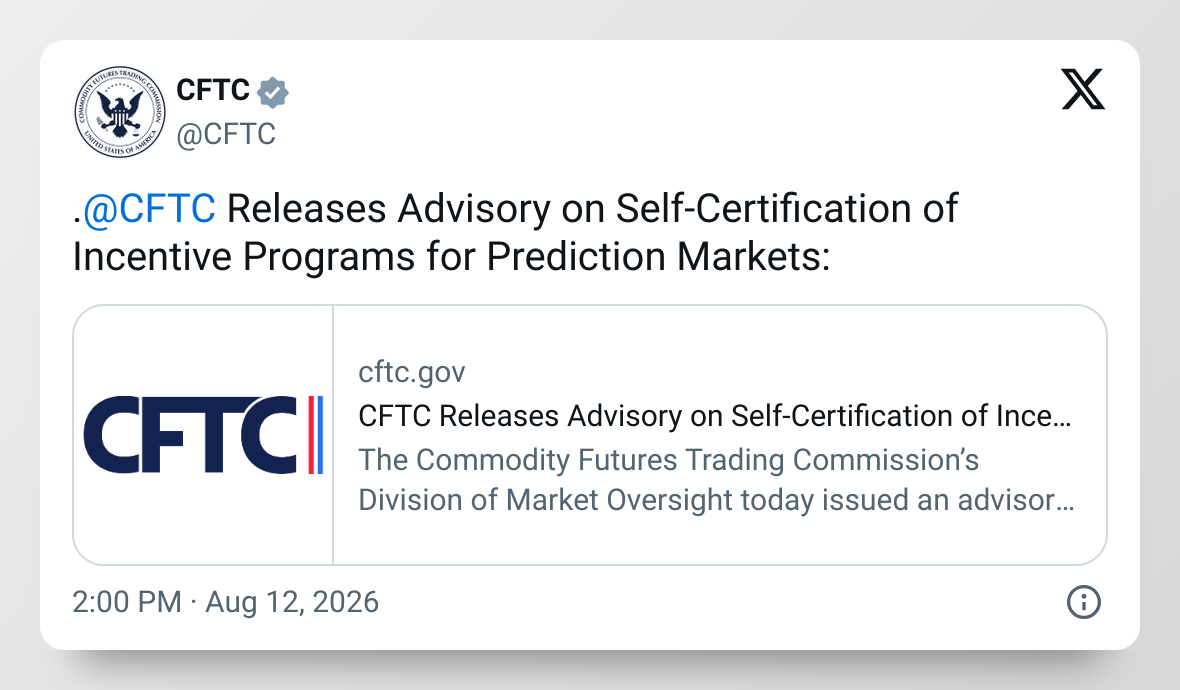
To generate liquidity and depth for markets, prediction markets sometimes incentivize trading with rebates or “yield.” Rather than cautioning against this system, which can be necessary to create “healthier” markets, the CFTC is cautioning against how quickly these programs are coming online and how little detail some exchanges are providing about how they work.
While headlines have overwhelmingly focused on the CFTC standing up to state-led intervention against prediction markets, Wednesday’s release was hardly the first time the CFTC has stepped in to rein prediction markets in.
- In February, its Enforcement Division issued an advisory after two Kalshi cases involving “improper” trading, one where a political candidate traded on his own candidacy and another about insider information about upcoming YouTube videos.
- Then, in March, the CFTC reminded prediction markets that they are “front-line regulators” responsible for ensuring the contracts they list aren’t readily susceptible to manipulation.
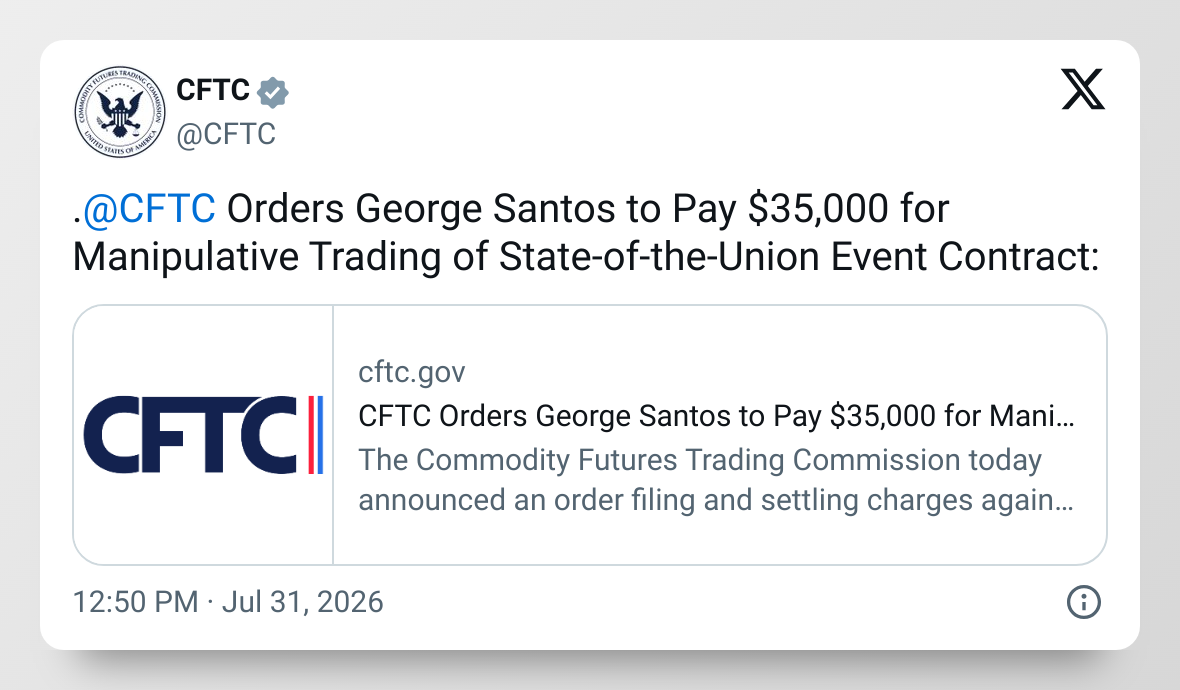
- And, most recently in July, the CFTC ordered George Santos to pay roughly $35,000 and banned him from trading for three years after finding he manipulated a Kalshi market on whether he would attend the State of the Union.
As prediction markets rapidly expand from consumer-facing products into markets institutions use, those controls become even more important. That does not make institutional users more valuable than retail traders. It simply means these markets need the surveillance, settlement integrity, and rule clarity expected of financial infrastructure if they want to be ready for prime time.
Much of this oversight ultimately falls into the broader effort to minimize insider activity and manipulation as prediction markets scale. To this end, Kalshi also partnered with Nasdaq Market Surveillance on Monday, giving it more firepower to identify manipulation, insider trading, and other abusive behavior if it pops up.
But, as mentioned, cautioning the industry was not the only parental responsibility the CFTC exercised this week. It also defended it, invoking emergency authority for the second time this summer on Kalshi’s behalf.
The latest New York fight began July 31, when Attorney General Letitia James sued Kalshi, alleging it was operating an illegal, unlicensed gambling business. New York also sought a temporary restraining order that would prohibit Kalshi from offering event contracts nationwide, a potentially existential threat to a company headquartered in the state.
 David Christopher
Kalshi notified the CFTC that the requested relief constituted a market emergency and, on Tuesday, the regulator agreed, invoking emergency authority and ordering Kalshi to continue operating. The move effectively prevented the state lawsuit from disrupting the federally regulated exchange while the larger fight over who gets to regulate prediction markets continues.
Again, this is the second time emergency authority has come into play this summer alone. Amid an ongoing battle between Kalshi and the State of Michigan, the CFTC similarly intervened in July after a state-court order threatened to halt trades.
But back to New York, where the state-level suit this week was joined by a separate New York City Council probe into prediction markets’ advertising practices.
Announced Wednesday, the probe builds in part on a June Wall Street Journal investigation that found more than 70% of the roughly 1,100 Polymarket promotional videos it reviewed featured trades conducted on fake versions of the platform. The Council is now broadening that scrutiny to Kalshi, Coinbase, and Gemini Titan as well, seeking information about allegedly deceptive advertising, influencer promotions, and marketing directed toward young users.
Polymarket responded to the original reporting by saying it would audit its promotional content and has said only that it looks forward to engaging with the Council. The four platforms have 14 business days to respond.
All events taken together show the multi-dimensional nature of the CFTC's role in stewarding prediction markets. They’re simultaneously fighting to retain regulatory jurisdiction, while also invoking that jurisdiction to keep these platforms “on the rails” as they scale at lightning fast speed.
And prediction markets already have a trust problem, from widely publicized insider-trading cases to enormous deceptive marketing campaigns. Protecting the industry’s room to grow while making sure its markets remain worthy of that trust is the CFTC’s increasingly important balancing act.

Swap, send, deposit, and withdraw across 35+ chains, confidentially, all from one near.com account. Powered by NEAR Intents, the same infrastructure that has moved over $23 billion in cross-chain volume. Your money is your business.

Bankless
It’s time to break up with your bank, and join the movement for a better world.