CLARITY's Senate Sprint
Senators have resolved one key CLARITY dispute, but fights over developer protections and ethics rules could threaten the crypto bill’s buzzer beater passage.
🔒 FREE PREVIEW: Upgrade to unlock full access. Join Bankless Premium.

Sponsor: MetaMask - Spend crypto anywhere online and AFK with  MetaMask Card.

- 🏦 Morgan Stanley's E*TRADE Commences Crypto Trading Pilot. Its fee structure undercuts that of rival brokerage Charles Schwab, with broader access for all clients expected later this year.
- 💰 Saylor's Strategy Contemplates BTC Sales to Fund Swelling Dividend Obligations. After famously advising acolytes to sell their kidneys before their BTC, Saylor's Strategy may go against his own advice.
- 🥷 Ekubo DEX Users Drained for $1.4M in Token Approval Exploit. April was riddled by a series of high-profile DeFi exploits; early May seems to be continuing the trend.
| Prices as of 5pm ET | 24hr | 7d |

|
Crypto $2.70T | ↗ 0.1% | ↗ 7.3% |

|
BTC $81,458 | ↗ 0.1% | ↗ 7.4% |

|
ETH $2,353 | ↘ 0.8% | ↗ 4.6% |
Enjoying this article?
Subscribe to Bankless or sign in

Crypto's long-awaited market structure bill has had a dramatic path through Congress. Now, after months of delays and political infighting, CLARITY may finally be nearing its most consequential test yet in the Senate.
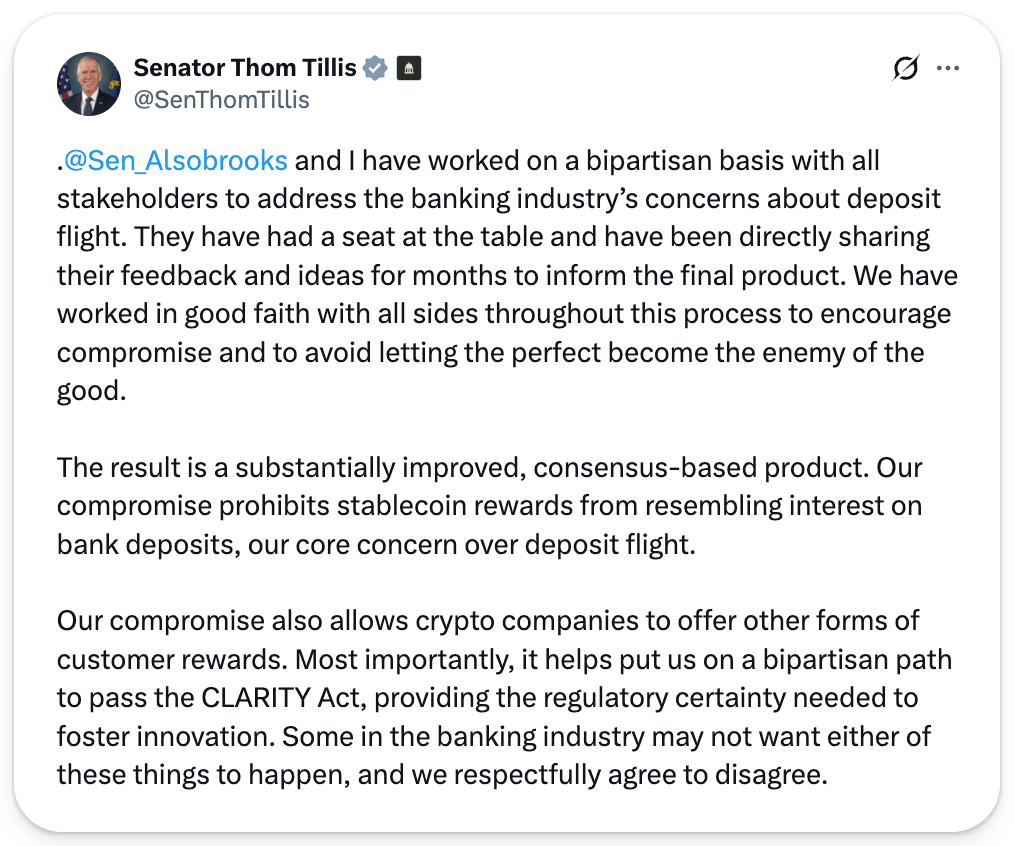
Last Friday, Senators Tillis (R) and Alsobrooks (D) released the stablecoin-yield compromise text, the missing piece holding up the Senate Banking Committee's CLARITY markup since January.
CLARITY is the most comprehensive crypto bill we've seen yet. It centers around ending the SEC vs. CFTC jurisdictional fight by classifying digital assets into three categories: securities regulated by the SEC, payment stablecoins governed by the GENIUS framework, and digital commodities (tokens tied to mature, decentralized networks) overseen by the CFTC. Finalizing these classifications clears up other downstream rules: registration, custody, disclosures, exchange oversight, AML. CLARITY passed the House last July, but it's been stuck in the Senate ever since.
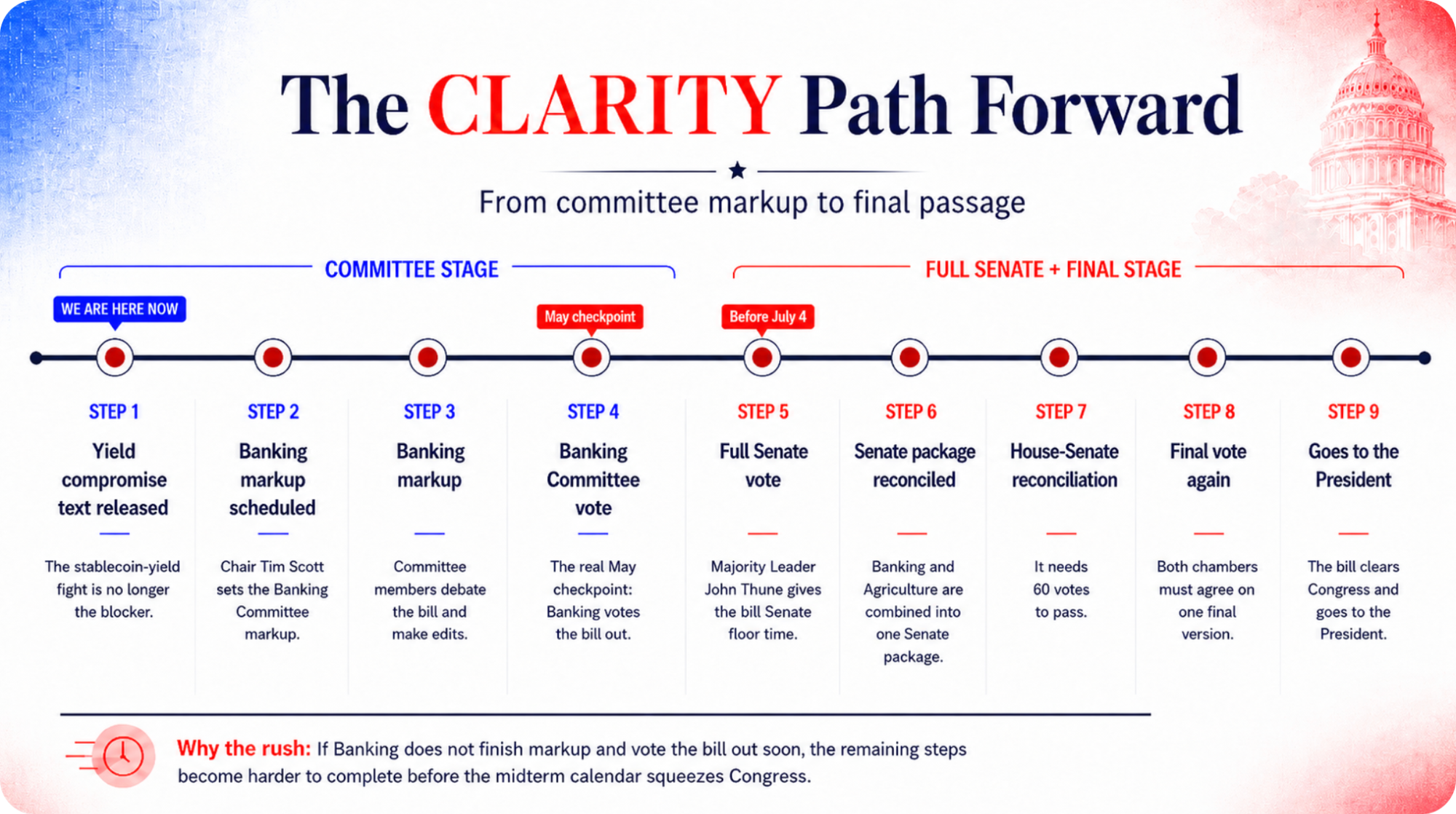
The bill now has a path to move forward, but only to the next chokepoint: Senate Banking Committee markup. Senate Banking is not the full Senate. It's a committee inside the Senate which handles the SEC, stablecoin, custody, and developer-protection pieces. During the markup, this committee will revise its draft and vote on whether to send it forward. If it clears the committee, the next major step would be a full Senate vote.
Stablecoin yield may be solved, but developer protections, ethics language, and the pressure of the rest of the year's congressional calendar are not.
The Yield Compromise
Until now, stablecoin yield has been the biggest procedural blocker.
The question has been whether crypto firms could pay users for simply holding stablecoins on-platform. Banks framed that as a deposit-flight threat: if exchanges can pay bank-like yield on dollar tokens without being banks, deposits could leave the banking system.
The new Tillis-Alsobrooks text makes sure they don’t have to worry about that, killing anything "economically or functionally equivalent" to interest or yield on a bank deposit. What remains are activity-based rewards: cashback on stablecoin payments, transaction incentives, loyalty programs, transfer rewards, and perks tied to platform usage.
That means banks won the larger concession.  Coinbase had pushed against restrictions that would kill stablecoin rewards. Yet crypto appears at least willing to proceed.
  Circle stock jumped 16%. Coinbase rallied more than 7%.
  Brian Armstrong tweeted, "mark it up.”
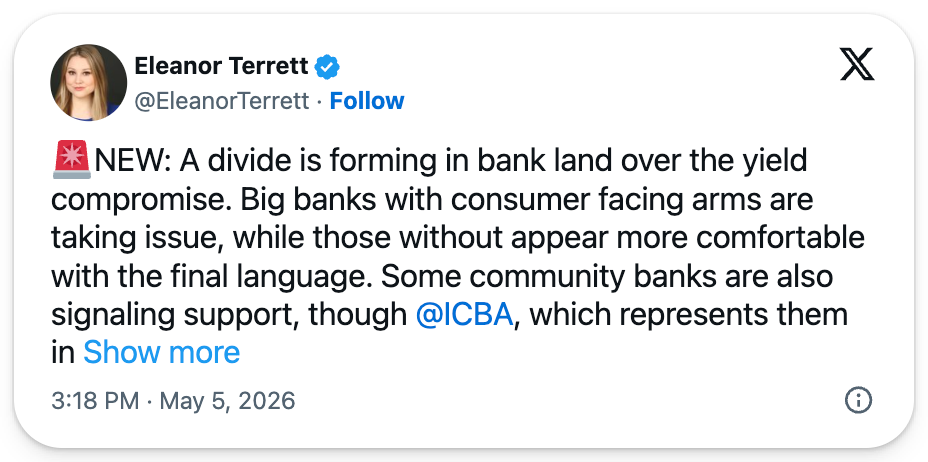
But the banking lobby is still (reportedly) not entirely satisfied. This morning, reporter Eleanor Terret reported that major banking trade groups believe the text has loopholes that crypto companies could exploit, and plan to lobby committee members before markup.
We’ll see what happens here but with midterms approaching, the window of opportunity to pass the bill is closing. Beyond the jurisdictional "clarity", the bill also creates a $50M fundraising pathway for projects trying to decentralize, protects self-custody, carves out room for developers, and includes anti-CBDC language. The yield concession is the entry fee for all this, one which legislates stablecoins away from savings and toward payments.
 Jean-Paul Faraj
The Two Fights Left
Two disputes still decide whether CLARITY can survive the Senate: developer protections and ethics safeguards.
Developer and DeFi Protections
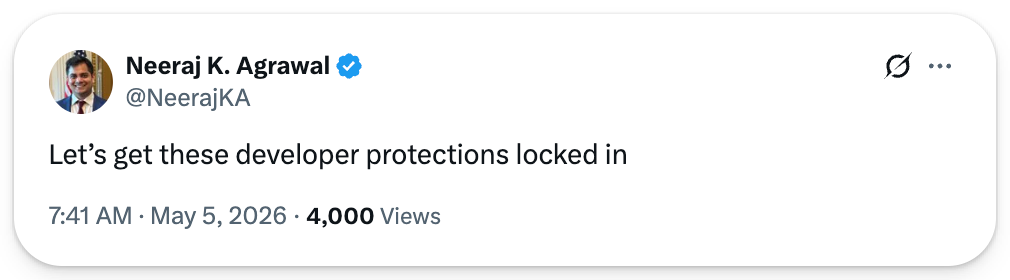
Inside CLARITY sits the Blockchain Regulatory Certainty Act (BRCA), which hopes to draw the line between writing code and operating a financial business, ensuring developers don't get targeted for activity that happens on their platforms. The friction point is how much legal protection they should get. Section 1960, the federal money-transmission statute, will be where that line gets drawn: can a developer safe harbor protect neutral software without accidentally protecting people who knowingly help launder money? On Monday, Terrett reported that these questions are expected to be finalized this week.
Ethical Safeguards
The House-passed version of CLARITY already prohibits members of Congress and senior executive branch officials from issuing a digital commodity during service. But, given the Trump family's footprint in crypto — one the industry itself continues to sour on — some lawmakers want that scope broadened. So far, opposition here has come from Democrats, though Sen. Tillis himself voiced concerns last week, reportedly threatening to oppose the bill unless ethics language is included before it leaves the Senate. Whether or not the recent progress he's made with the yield compromise changes that stance is unclear. Ethical safeguards are still being negotiated in discussions which are expected to continue after CLARITY moves out of the Senate Banking Committee.

The Meandering Path Ahead
While Friday cleared the biggest holdup so far, it did not put CLARITY on the Senate floor.
Senate Banking Chair Tim Scott still has to schedule the markup. The committee then has to debate the Tillis-Alsobrooks yield text, process amendments, settle developer and ethics language, and vote the bill out. That vote will be telling. A comfortably bipartisan committee vote would signal that CLARITY may have enough support for the full Senate. A party-line vote would signal trouble. All this must happen in May, says Galaxy’s Alex Thorn, who notes that if markup slips past the middle of the month, the probability of 2026 enactment drops sharply.
After all of this comes the full Senate vote. Most Senate legislation effectively needs 60 votes to overcome cloture. Republicans currently hold 53 Senate seats, with Democrats holding 45 and independents holding 2, so CLARITY needs at least seven votes from Democrats or independents if all Republicans support it.
If the Senate passes Banking’s version, that bill still has to be reconciled with the Senate Agriculture Committee's separate CFTC-focused Digital Commodity Intermediaries Act, the companion market-structure draft that handles the CFTC side of the bill: digital commodities, spot markets, and digital-commodity intermediaries. The two tracks then get merged into one Senate market-structure package.
That merged Senate package then has to be reconciled with the House-passed CLARITY Act and voted on again before it can go to the president.
It’s a tight squeeze with an unforgiving calendar. After July, clean legislative weeks disappear as senators shift to campaigning, and politically exposed votes get postponed. What happens this month may decide whether the rest of the road stays open, or whether delay foreshadows defeat.
Jack Inabinet

Spend crypto online or IRL directly from your crypto wallet at over 150 million merchants worldwide—anywhere Mastercard is accepted. This is how you offramp: 3% cashback, zero foreign transaction fees, and exclusive benefits. Keep full custody of your funds until the moment you pay. Get the MetaMask Virtual Card now, free.

Bankless
It’s time to break up with your bank, and join the movement for a better world.