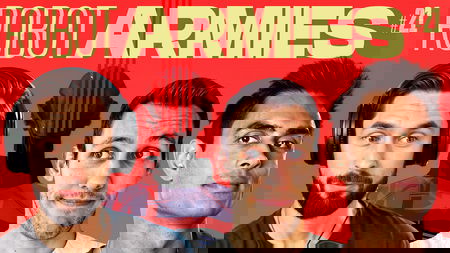
LIMITLESS: This Is Far Bigger Than The Internet Boom | Shaun Maguire
From AI and silicon photonics to humanoid robots and space infrastructure.

Up next
All episodes 01:07:28
Podcast
01:07:28
Podcast
ROLLUP: ETH’s Pectra Upgrade | $2T Stablecoin Push | Apple’s Crypto Breakthrough | Coinbase Buys Deribit!
 01:20:56
Podcast
01:20:56
Podcast
AI Rollup: AI Robots and The $10T Arms Race
 01:20:40
Podcast
01:20:40
Podcast
Can PumpFun be Dethroned? ETH's Pectra Upgrade | Future of Bitcoin L2s | Jon, Bread, & Andy8052
 01:27:34
Podcast
01:27:34
Podcast
A New Chapter for Ethereum | EFs Co-EDs Tomasz & Hsiao-Wei
 01:02:56
Podcast
01:02:56
Podcast
Crypto's Big Test: Ethereum’s Pivot, Tariff Storms, and Bitcoin’s Political Rise
 01:28:21
Podcast
01:28:21
Podcast
AI ROLLUP: The AI Experiment That's Been Secretly Manipulating You
 01:05:20
Podcast
01:05:20
Podcast
Ethereum’s Survival Strategy: Scaling L1, Killing L2s, and Betting on Memecoins?
 00:52:22
Podcast
00:52:22
Podcast
Can Story Protocol Tokenize the $70 Trillion IP Market? | Jason Zhao
Inside the episode
On today’s episode of the Limitless Podcast, we sit down with Shaun Maguire, partner at Sequoia Capital, whose journey spans quantum physics, DARPA, startups, and now frontier tech investing. His thesis? We’re entering a new technological era — one that will outpace the dot-com boom in scope, depth, and significance.
🚀 The Dual Renaissance: Hardware + AI
Shaun argues that we’re living through a rare convergence — the simultaneous rise of artificial intelligence and a renaissance in hardware manufacturing. Historically, every software revolution (e.g., mobile apps, cloud computing) was preceded by a hardware breakthrough (e.g., iPhone, GPUs). Today, we're witnessing both at once: bleeding-edge AI models that are limited not by code, but by the physical constraints of compute, bandwidth, and energy.
And it’s not just Nvidia and ChatGPT. Shaun points to a return to hardware roots at Sequoia and a new era of hardware-first innovation catalyzed by SpaceX, Tesla, and rising stars in robotics and silicon photonics.
🏭 Manufacturing & National Resilience
Shaun dives deep into America's lost manufacturing capabilities — and what it would take to bring them back. The decline of domestic production, especially in critical sectors like semiconductors and drones, has left the U.S. vulnerable. The solution? A new wave of vertically integrated companies with tight control over their supply chains, modeled after Tesla and SpaceX.
He believes it would take just 10 such companies — SpaceX-style juggernauts — to catalyze a full-scale manufacturing revival in the West.
⚡ Energy Is Destiny
Energy is the limiting reagent of progress, Shaun argues. Without abundant power, all the robots, data centers, and factories of the future are a pipe dream. While long-term solutions like nuclear and solar must be scaled, he also makes the pragmatic (and controversial) case for a short-term fossil fuel renaissance to bridge the gap.
In his words: “There’s a wartime mindset required now — Cold War 2.0 — and our energy policy needs to reflect that.”
🌌 Space, Mars & Real Estate in Orbit
Shaun shares why space is the new real estate. Companies like Reflect Orbital — which plans to beam sunlight to solar farms at night — represent the earliest signs of a trillion-dollar orbital economy. He compares investing in these frontier firms to “buying land next to the railroad stops before the railroads were built.”
He’s confident that by 2035, we’ll see a functioning Mars base. And while the utility of space colonization may seem distant, the tech developed to make it happen — autonomous fabs, closed-loop agriculture, next-gen power systems — will revolutionize life back on Earth.
🤖 On Robots, Neuralink & Superintelligence
The rise of humanoid robots, led by Optimus at Tesla, isn’t just aesthetic. The world is built for humans — stairs, doors, tools. Shaun explains why matching human form makes practical sense, and why Elon’s companies are uniquely positioned to lead.
He also touches on brain-machine interfaces like Neuralink — not as gimmicks, but as humanity’s hedge against runaway AI. As we barrel toward AGI, Shaun advocates for multiple superintelligences to ensure mutual oversight. “We don’t want just one god,” he says.
🌍 Final Takeaway
Shaun Maguire doesn’t just see exponential growth — he sees compounding leverage across space, AI, hardware, and energy. His optimism is rooted in first principles, his realism in geopolitical context. If he’s right, the next 20 years won’t just be a tech boom. They’ll be the dawn of a new civilization arc.
“Humans are resilient — we’re going to figure it all out.”
Transcript
If America can stay at the cutting edge of space, get to the cutting edge of silicon photonics, if Tesla and then others can basically get to the cutting edge of humanoid robotics, which is something that like I strongly believe is,
why fundamentally cheap space travel will unlock so many things that will actually turn into quality of life improvements for the average person who's left on planet Earth.
you know, people have this mental model that space is very
Picture a guy who treats the frontier like his backyard. That's Sean Maguire. And he was gracious enough to join us on the show today to discuss energy breakthroughs, factory floors humming with humanoid robots, brain machine computers, and space exploration. In fact, Sean's even invested in a company who shoots satellites into outer space to beam light rays back at Earth and turn night into day. This is it's crazy stuff. And he walks us through exactly which of these sci fi visions are already sneakily here today, which will upend entire industries in months, and which have the opportunity to reshape entire civilizations over the next couple of years. Some of the timelines even left me speechless.
And that is what the Limitless Podcast is all about. So, Bankless Nation, welcome to Limitless, where we explore the frontier technologies that are poised to reshape our world. I'm David Hoffman and joined by my co-host Josh Cale, and our very first guest is Sequoia Capital Frontier Tech investor Sean McGuire. Now, if you are hearing this on the Bankless feed, don't worry, bankless isn't going anywhere. And if you found us on the Limitless feed, congrats, you're ahead of the curve. Limitless is a brand new podcast out of Bankless, focusing on frontier technologies and getting ahead of a rapidly accelerating future. Bankless will return to focusing on crypto and Marcus with Ryan and me at the helm. And Limitless is where Josh, Jaws, and I, and also sometimes Ryan, will chase the future. How AI and other frontier technologies are going to impact our lives and what we need to know and do about it.
If you're familiar with the bankless cadence, you'll find yourself right at home with Limitless. On Monday, we're going to do deep dive interviews with founders and investors that are building the future. And then on Thursdays, we have the weekly AI roll-up, our fast-moving recap of the week's biggest AI headlines. Now, I'm pretty biased here, but I think the AI roll-up is truly the most accessible, informative, and engaging AI news show out there. So if all of this sounds like your jam, hit subscribe on your favorite podcast app or YouTube. There's a link in the show notes to go find Limitless. And if you don't mind, we would definitely appreciate a quick five-star review and also sharing it with your friends to help more curious minds stay ahead of the curve. Your support, of course, powers everything we do. And so thank you for coming on the ride with us as we push into brand new frontiers. Now, with that, let's get right into the debut episode on the Limitless Podcast with Sean Maguire from Sequoia Capital. Bakeless Nation, today on the podcast, we have Sean McGuire. He's a partner at Sequoia Capital. Sean's got one of the more interesting backgrounds that I've ever seen. Starting out working as a physicist, uh, working on quantum gravity, then spent time working at DARPA, where he was deployed to Afghanistan, then shifted gears into startups and investing. He co founded a cybersecurity company called Expanse, which was later acquired by Palo Alto Networks. And then he's also been an early backer of companies like Visa, Watershed, SpaceX. At Sequoia, he's focusing on early stage investments, especially in hard and frontier technologies, which is why we wanted to bring him on the show today. Sean, welcome to Bankless.
what's up, guys? Thrilled to be here.
First of all, did not start with quantum gravity, started probably with an F in algebra two. So I've had a a lot of failures before the successes. And unfortunately, I was on early background Visa, I think you meant Vise. And I
Ah, it's excuse.
And just all all good.
Visa would have been pretty legendary, and hopefully Vise becomes even bigger.
Yeah, I guess I guess Visa is just the wrong generation. It's a little bit a little bit earlier than all of us here. So maybe maybe with that, since I need a little bit more help kind of understanding your background, just expand on your perch a little bit for listeners who just might need more context about what your deal is, who you are, and especially as we get into more modern times with all of the crazy technologies that we have today, just explaining a little bit of your context and what interests you and where how your arc has been, I think would be pretty helpful.
I'm thrilled to be here. I've been a big fan of the pod for a long time.
So I'll try to keep this pretty brief, but I would say
kind of my
childhood
was characterized by just like not listening to what I was told to do instead of.
Paying attention in school or like even going to class a lot of the time. I just stayed home or would do, or would even in school would focus on my own learning.
And I've I've basically been obsessed with computers, the internet,
like then physics,
then math.
Basically my entire life. Like computers really started at the age of seven.
And so I kind of sacrificed
not learning English very well for learning a lot about computers at a young age.
And, you know, I took it pretty seriously. I was really into building computers, really into
Like honestly,
understanding like how computers are made, understanding silicon at a pretty
young age, and
understanding a lot of industries. I've just kind of been
driven by curiosity my whole life. I was really obsessed with the chemical industry as a kid. I'm happy to talk about the chemical industry today. To me, it's honestly one of the most fascinating industry in industries in the world. It's five trillion a year in sales. No one knows anything about it. It's bigger than oil and gas, it's where everything comes from.
But it's just like I'm I'm giving that as an example. That's I have a hundred anecdotes like that. It's just kind of being really interested in
different things and spending time going pretty deep
at a young age. And,
you know, now as an investor,
I get to kind of
invest in those things. Invest in things, basically, I get to invest in things that were childhood passions. And so I can make chemicals instance. I'm an investor in a chemicals marketplace called Node, K N O W D E. And almost every investment I've made at Sequoia can be traced to some deep childhood obsession. Like with SpaceX, I was completely obsessed with space from a very young age. Like I started off at the age of nine being obsessed with the solar system, but then
Like starting to learn about rockets and
you know, like
taking that all the way to having a failed space launch company in my early 20s.
But
kind of I think that's what people need to understand about me is that the investments I make now, like it's not
coming from two years of thinking about something, it's coming from you know 20 to 30 years.
I think that that background is really helpful because the reason why we want to get you on today is just really just to talk about all the frontier technologies that really seem to be maturing seemingly all at once. People often joke that the world uh has not been the same ever since Harambe was killed in 2016. But I think I want to actually take that a little bit more seriously and fast forward to the world has not been the same ever since ChatGPT 3.5 came out in 2022. Because now, just a few years later, Elon is catching rockets flying out of the air. We have actual robots walking among us. I just saw a video today of a robot boxing league coming out of China. So that's pretty crazy. Driverless cars are actually in production, driving people around. And then now, also, of course, we have people talking about actual AGI coming in in two years or less. So it just feels like this current moment of time seems especially unique and seems like you've been thinking about a lot of these things as they have been maturing. From your vantage point as an investor in Sequoia, how does this just period of history feel for you right now?
Well articulated.
I mean, uh, this period feels insanely exciting. I feel I I truly feel
like unbelievably privileged and lucky to be an investor in this time.
I have been very passionate about the history of venture capital,
you know, for
honestly for over 20 years. And
I think that if you look in VC, there were
kind of like
depends how you define it, but like two to four really great periods before today. And I think we're, you know, and some examples were the early computing era.
It depends how broad your interests are, but you know, early internet era,
then like the dot-com era.
I would say, in my in my opinion, like the early mobile era was incredible with giant companies being created very quickly.
And now we're in this kind of new era where you have both AI and research of hardware happening simultaneously.
And so I I truly feel incredibly lucky to be an investor right now.
And I think that like to build on that,
I think the AI stuff is more obvious to the public. Like it's
talked about all the time. Like you're, you know,

David Hoffman
Co-owner at Bankless. Optimistic storyteller of frontier technology.