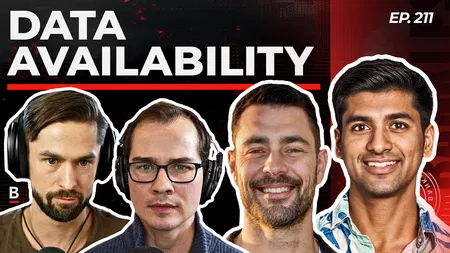
Justin Drake & Ben Fisch: The United Rollups of Ethereum
Everything you need to know about shared sequencing

Up next
All episodes 01:10:15
Bitcoin
01:10:15
Bitcoin
Nic Carter: The Second Bitcoin Civil War
 01:33:25
Podcast
01:33:25
Podcast
211 - Is DA a Good Business Model? - Neel Somani & Jon Charbonneau
 01:10:22
Podcast
01:10:22
Podcast
ROLLUP: $ETH 3k! | TradFi Stonks ATHs | $STRK Now Live | Yuga Acquires PROOF
 01:35:24
DeFi
01:35:24
DeFi
The LRT Episode
 01:04:39
Bitcoin
01:04:39
Bitcoin
Are Bitcoin L2s Real? with David Seroy (Bitcoin Dave)
 01:03:13
Podcast
01:03:13
Podcast
The Starknet Culture with Abdel Bakhta
 01:16:46
Podcast
01:16:46
Podcast
A Conversation with Michael Ippolito
 00:19:39
Podcast Premium
00:19:39
Podcast Premium
DEBRIEF - Endgame 2.0: A Guide to Vitalik’s Ethereum Roadmap
Inside the episode
In today’s episode, we do a shared sequencing deep dive with repeat guest, Mr. Moonmath himself, the Blockchain Brainiac, and the Ethereum Evangelist– Justin "The Juggernaut" Drake. Justin is joined by The Sultan of Sequencing, the Espresso Emperor, the Cross-Rollup Connoisseur himself, Ben, the Blockchain Barista Fisch.
Where the fragments of Ethereum threaten to turn the digital ecosystem into a maze of confusion, these two men stand tall, illuminating the way, to come and save us from the labyrinth of Ethereum’s rollup-centric roadmap.
TIMESTAMPS
0:00 Intro
6:09 Goals For the Episode
8:32 Sequencing / Sharing Explained
15:13 Ethereum’s Arc
18:20 Shared Sequencing Obstacles
23:52 Network Effects & the Cold Start Problem
32:54 MEV Redistribution
45:25 Reserve Price
46:45 Loss of Sovereignty
54:34 Espresso Announcement!
1:03:52 Fast L2 Finality
1:09:52 Real-Time, Recursive Proving, & Hardware
1:13:32 Flash Loans & Snark Proving
1:15:38 Low Latency Finality
1:17:08 Censorship Solutions
1:21:50 Discussing the Downsides
1:35:38 Known Unknowns of the Future
1:39:46 Closing & Disclaimers
RESOURCES
Justin Drake
https://twitter.com/drakefjustin
Ben Fisch
https://twitter.com/benafisch
Transcript
Welcome to Banklist, where we explore the frontier of internet money and internet finance. And today on Banklist, we explore the frontier of composability of Ethereum's roll-up-centric roadmap. Today on the show, we have Justin Drake as my technical co-moderator as we both interview Ben Fish, the CEO of Espresso Systems. Espresso is building a shared sequencer that operates at a higher plane than the Ethereum layer one that allows for shared execution amongst the Ethereum rollup landscape. The frontier that Espresso is building in is becoming more and more relevant as the fragmentation of Ethereum's roll-ups become more and more obvious. Yet there are a bunch of solutions being built in parallel, and Espresso unlocks a lot of them. A lot of innovation is allowed to come into the world of composability across Ethereum's roll-ups. At the beginning of this episode, I really make sure that we drill down into the foundations of this conversation, the 100 level, 200 level basics, before I kind of let Justin Drake take the reins and get into some of the deeper ends, the more uh technical nuances of shared sequencing. So I think this episode is accessible to all skill levels. If you are at the beginning of your arc of understanding Ethereum, you're gonna catch a vibe. And then if you are deep into the weeds, I think you're going to really enjoy the second half of this episode. I think the exploration of composability off across Ethereum's roll-ups are is just beginning on Bankless. And this is our second step into the world of composability here, our second episode with Justin. We will get into further conversations with other players in this arena as well in the future. But before we get into this conversation with Justin and Ben, uh first a moment to talk about some of these fantastic sponsors that make the show possible. Bankless Nation, ladies and gentlemen, in my left corner, we have Mr. Moonmath himself, the blockchain brainiac, the Ethereum evangelist, Justin, the juggernaut, Drake. Justin, welcome to the show.
David, thanks for having me again.
And coming in for his first time on Bankless, we got Ben Fish, the Sultan of Sequencing, the Espresso Emperor, the Cross Rollup Connoisseur, the blockchain barista. Ben, welcome to Bankless.
Pleasure to be here, David. Thank you for having me.
So, where the fragments of Ethereum threaten to turn this digital landscape into a maze of confusion, two men stand tall, illuminating the way to come save us from the labyrinth of Ethereum's roll-up-centric roadmap. Today on the show, we're going to be talking about shared sequencing and what this means for Ethereum's roll-ups, what it means for composability across Ethereum's rollups, and trying to get down into the deep end of some of the nuances that are going to ultimately turn into engineering questions and then ultimately turn into production products for the Ethereum ecosystem. And so we got Justin Drake, not as a guest, but as my technical co-moderator for this episode. And I think I'm going to just make sure that we kind of touch on some of the easy things, uh the easy subjects before we get into the deep end here. But Justin, maybe I could just ask you before we really get started here, what would you say are your goals for this episode? What knowledge do you want to get out of Ben? What should listeners be prepped for or be thinking about as we progress further into this conversation?
Right. Um, I mean, I'd like to push forward the discussion around shared sequencing and base sequencing specifically. I think we're in this interesting phase shift moment where people are starting to pay attention to this the problems of fragmentation, and also the solutions are starting to pop up. There's a bunch of misconceptions, or maybe I should say preconceptions, uh, that would be good to clarify. And I also feel that there's this wave of momentum.
uh of you know teams like like Ben's team uh that are potentially you know making a big pivot. And I think Ben might have a big announcement to make here during the podcast.
Interesting. Yeah, Ben, maybe share some of your your similar thoughts or goals or just interests in uh the knowledge and content and conversations that you wouldn't broadcast. What goals do you have for this episode?
Yeah, similar to Justin, I would like to address head-on, you know, shared sequencing and what it is and why I'm very bullish on it, why I think that it's very important for the evolution of the roll up space and the and and for the scalability of Ethereum while preserving its unity and defragmenting what has happened to Ethereum with the current.
Scaling of Ethereum through many different fragment, you know, fragmented rollups that are not united. I also want to talk about um, as Justin alluded to, uh, we've got very excited about based
sequencing, the idea of using involving the L1 itself, Ethereum L1, um, in in as much a way as possible in shared sequencing. And we've actually found a way to merge.
The um you know the narrative of espresso with that of base sequencing. And that's been a very exciting and new development for us that I've been talking a little bit about, but haven't talked about publicly yet until this podcast. Um
and so I could get into a bit of how we've made those adjustments at Espresso and how roll-ups running on Espresso can actually be based rollups.
Okay. I love that. That and I want to put a pin in that because I want to work towards that point. But I think we need to establish a foundation, some knowledge before we get into what the significance of that is. So let's see how fast we can kind of speed run through the 100 level and 200 level aspects of this conversation before we get into the deep end. So this looks like just start at the 101 level. Sequencing, what is it? And then what does it mean to share it? So what's what's sequencing at all? And then what does it mean to add sharing onto that? Ben, we want to take this one.
Yes.
Uh so sequencing today uh for a rollup
is the
act of determining the transactions that will actually go into the rollup. Um and currently most roll ups today have a server that collects these transactions.
Um and uh you know orders them,
um gives confirmations to users that these are the transactions that are going to be included, and then every
ever so often it settles them on Ethereum by posting them to a smart contract. And the smart contracts today
um will can only be updated by this sequencer. So they they give
The in total authority to this
central server to uh to determine which transactions are going to update
uh the rollup, with the exception of transactions that can be forced included, and there are other other details we don't need to get into right now. Um
the maybe the first thing to talk about then with sequencing is well, what is decentralized sequencing? It's simply taking that and making it not one server that's in charge of sequencing, but many different servers. So having a decentralized, some kind of decentralized protocol whereby um it's not just one party that can determine the transactions that get included. Maybe it's a rotating set of parties, maybe it's a um a Byzantine fault tolerant protocol.
And shared sequencing
is the idea that multiple roll-ups can share
a common mechanism
for determining this ordering.
Um
and I'll I'll give
one slightly
Zoomed out take though on shared sequencing that I don't think is a common way of describing it, but it's definitely the way that I think about it. I think of shared sequencing as
not quite not necessarily sharing
a
common uh you know party or protocol for determining the ordering, but it's more about sharing a mechanism, um, sharing a marketplace whereby roll ups can effectively sell
their block space to
Third parties who are bidding on the joint block space and may value it more and can create a surplus value.
But rollups really can determine by the slot whether to sell that block space or not.
And, you know, if there is value to be had in parties jointly sequencing for multiple roll ups at once, then the outcome will be that there are these third parties that will be simultaneously purchasing the block space from multiple rollups and producing.
um these blocks simultaneously and creating a surplus value that gets redistributed to roll-ups. I think that last point gets a little bit deeper and I'm gonna put a pin in that because I know we're trying to go over basics one-on-one of what shared sequencing is, but I'll stop there.
Maybe one way to articulate um the uh purpose or advantage of shared sequencing, and this is just my understanding, so check me on this, Ben, is that um when you have one rollup, you have the economics of that one roll-up. Uh, and then when you have a sequencer that is spanning multiple roll-ups, aka a shared sequencer, we one rollup can have more opportunities for double coincidence of wants with the transactions in one rollup as it relates to another set of transactions in another rollup. And so a shared sequencer is kind of like a matchmaker between the double coincidence of wants of the economies of two roll ups and when it behooves both roll ups, a shared sequencer can kind of make those connections happen. Is that like a simplified way to understand this?
Absolutely. Yeah. The um
It it enables faster bridging between roll-ups. There are certain things that you can't do today, like let maybe it's good to I I this isn't even what you said is entirely correct, but I think just giving a few quick examples might help make it concrete. Let's say that I want to buy an NFT on one roll up, but I want to pay for it with cash on a different roll up. I might want to make these two transactions atomic without even bridging assets over.
Could I buy an NFT on Zora with, you know, uh, I don't know, cash that I have on CK Sync, right?
Um
What about what if I want to uh you know take advantage of arbitrage between AMMs on two different roll-ups? Um what if I want to fund a transaction on one rollup using uh funds that I have on the other? Maybe they say I want to take a loan on one on one rollup and use it to fund a transaction that I have on another, and then even repay the loan. So do some kind of flash loan, for example. All of these things are not
um you know possible with the status quo, and shared sequencing
um
is not the same as being in the same execution environment like Ethereum, but it can get us under sort of certain kinds of economic guarantees very, very close to that.
Yeah I like the the marketplace analogy because it's all about creating value that otherwise couldn't have been created.
So there is there are certain instances where we want this really low friction form of interaction, which we call synchronous composability. And that provides more value than the counterpart which would be asynchronous composability.
And um it turns out that on L1, every rollup benefits from synchronous composability. So this is the luxury that we've gotten used to. And once you don't have uh shared sequencing, when you have this siloed sequencing, then suddenly you fall back to this lower form of composability. And I think what Ben is trying to do is kind of bubble up this value creation. And when there are opportunities to have synchronous composability, try and capture this additional value creation and potentially even give it back to the rollups.
So it's a net positive for everyone. Not only are we creating value, but this value to goes back to the back to the rollups, and there's no loss of the perspective of an individual rollup.
Maybe the uh the Ethereum layer one, the common settlement layer for all rollups, maybe one way to perceive it is like a minimum viable composability for all rollups. Uh at the very least, rollups are composable, albeit slowly, albeit extremely asynchronously, through the layer one. And that is our threshold. That's our floor, that's our foundation of level of composability. And with additional levels of innovation, uh shared sequencing being one of them, maybe an intense is also relevant here. We can actually kind of raise the floor of what composability looks like. And maybe that's kind of like where we are in Ethereum's arc right now is like we've got this minimum level of composability, and now the webbing between some of the roll ups are starting to get fleshed out, which is like what this conversation is here. Ben, what would you like to add to this?
I'll say it like this. Ethereum is a shared sequencer.
Right.
Ethereum, we already have a shared sequencer, right? Ethereum is a shared sequencer, not only for all applications that run on Ethereum, it is a shared sequencer
for rollups.

David Hoffman
Co-owner at Bankless. Optimistic storyteller of frontier technology.
.png-a616dc52961c1edd72b0c1fdf5f47e7a.png)

.png-336efc5e35995e6b184e7e830baa688b.png)
.jpg-48bb3b8a9a7a83dee5836f716023f733.jpg)