

| 24h Majors & Movers | ||||||

|
BTC $64.7k | ↘ 2% |

|
HYPE $58 | ↘ 1% | |

|
ETH $1.8k | ↘ 3% |

|
ZAMA $0.05 | ↗ 32% | |

|
SOL $75 | ↘ 3% |

|
RE $0.52 | ↗ 9% | |
Sponsor: WisdomTree Prime® – Tokenized RWAs designed for Yield, Transparency, & Programmability.
 Coinbase Boosts Agents
Enjoying this article?
Subscribe to Bankless or sign in
- 🤖 Coinbase advanced toward the agentic economy today, shipping updates that let businesses accept USDC from AI agents, users set plain-English conditional trades via agents, and devs bolt x402 payments onto any API.
- 💸 BitMEX, the exchange that invented the 100x perpetual swap back in the day, is shutting down for good on September 23rd after +11 years and zero funds lost to hacks. New signups are frozen now, and new positions end August 26th.
- 🔥 Vlad Tenev's X account was seemingly hacked this morning to promote a fake Vladhood memecoin, complete with a contract address that
 Robinhood Chain's own explorer has now flagged as a "potential scam."

For going on two years now, the SEC has been thawing toward crypto in ways that would've seemed fantastical not long ago.
In January 2025, the agency stood up its Crypto Task Force under Commissioner Hester Peirce, with a mandate to draw lines between securities and non-securities instead of litigating the question one enforcement action at a time. By mid-2025, Chairman Paul Atkins was pushing Project Crypto, a broader initiative to make the U.S. a hub for onchain builders.
The capstone landed this March, when the Commission published its big crypto interpretive release, i.e. formal Commission-level guidance (not a new rule, but a framework the agency will administer the law through). Among its moves:
- A five-part token taxonomy comprising 1) digital commodities, 2) digital collectibles, 3) digital tools, 4) stablecoins, and 5) digital securities, with the first three categorically not securities in themselves, and majors like BTC, ETH, SOL, and XRP named outright as digital commodities.
- An off-ramp from the Howey Test such that a token may not be a security but the transaction around it can be. The agency also spelled out how an investment contract ends once an issuer's promised managerial efforts are fulfilled or abandoned. In other words, "once a security, always a security" is dead.
- Plus, they outlined safe harbors for infra activities, elevating earlier staff positions on mining, staking, 1-for-1 wrapped tokens, and free airdrops to Commission-level interpretation.
However, this thawing hasn't made for an anything-goes amnesty, and nobody has held that line more consistently than Peirce herself, crypto's most sympathetic voice inside the SEC. Last summer, she issued her now-famous reminder that "tokenized securities are still securities."
That said, the latest entry in that throughline arrived yesterday, when Peirce published a new statement on crypto vaults and onchain lending. In it, she reasserted "if you do headstands, backflips, and other gymnastics" to read securities laws as not applying to certain crypto activities, "you will have a painful fall."
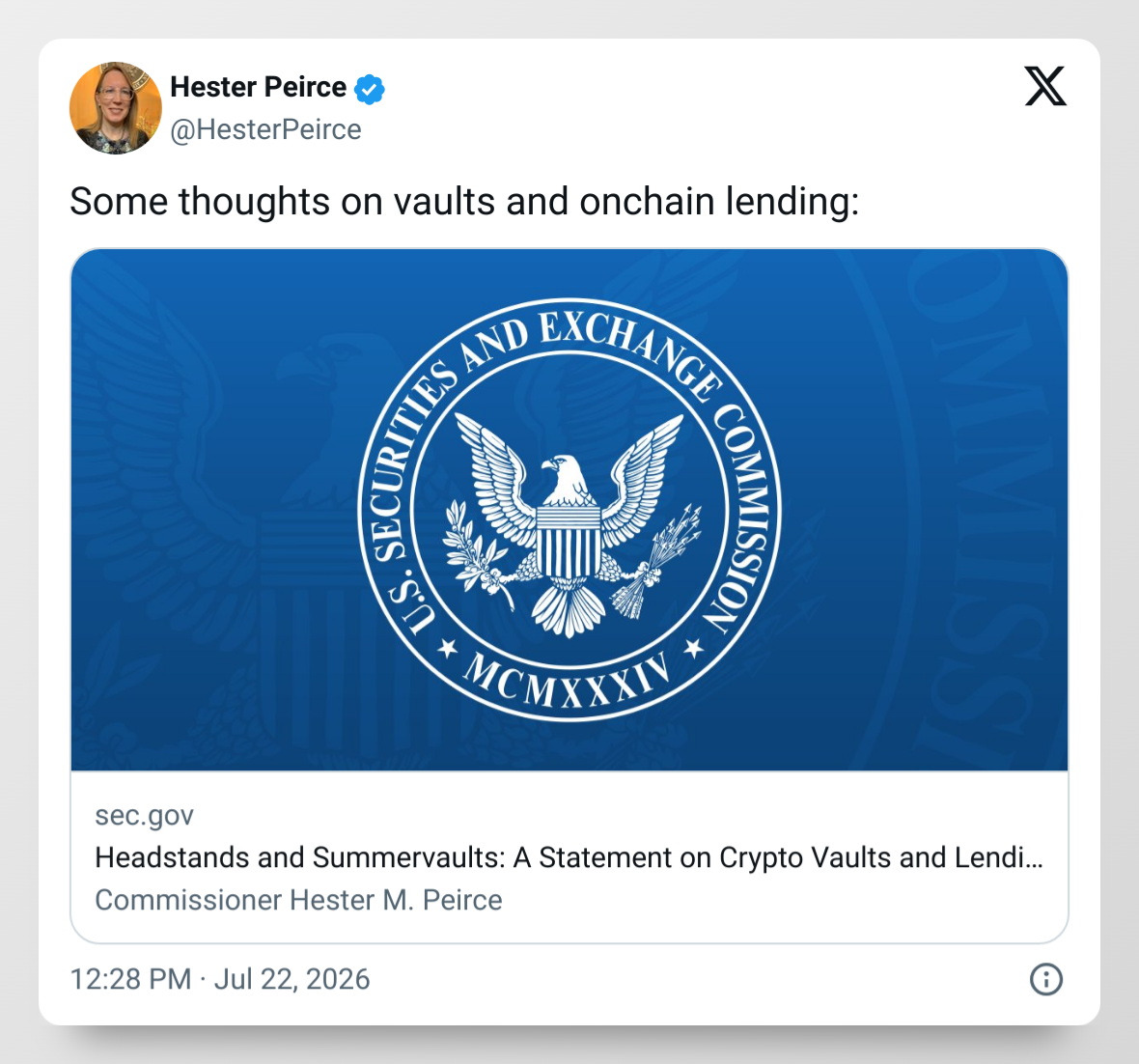
Fair enough, right. And Peirce's framing here overall was notable for its acceptance of vaults as a general technology. She acknowledged they hold great promise and can generate income for asset holders efficiently, so the question's not whether vaults should exist. It's who is doing what inside them.
Specifically, Peirce noted that vaults sit on a spectrum, from allocations determined solely by immutable smart contracts on one end, to allocations at the sole discretion of a person or group on the other. The further you drift toward human discretion, the more U.S. securities laws loom.
So for example, if you're selecting a vault's yield strategies and enacting them, or, on the lending side, if you're determining liquidation limits and so forth. If this is your work, Peirce said you "may want to analyze" whether you're on the wrong side of securities laws.
Indeed, as she pointed out, a vault holding securities (think tokenized treasuries and other RWAs, i.e. real-world assets) could face the same regulatory implications as a traditional investment company does, while onchain loans can function as securities depending on their circumstances (and with both avenues raising the matter of investment adviser registrations to boot).
There's still room for evolution, too, as evidenced by the overture Peirce gave to DeFi projects at the end of her latest statement:
"You may not fall within our regulatory scope, but, if you do, we welcome the opportunity to talk with you about how to serve your customers in compliance with the federal securities laws. Those laws are flexible because Congress recognized that technologies would change. Sometimes, even with that flexibility, our regulations block innovation and entrench the status quo. We welcome your thoughts on whether we need to modify our rules to accommodate vaults, onchain lending, or other innovations and how we can do so while still ensuring that investors are protected [...]."
On the curator question
In the newest Bankless episode, David Hoffman chatted with Herd founder Andrew Hong. During the convo, and among other things, Hong mapped out how modern vaults wrap human risk managers (i.e. curators) in smart contract cover (and sometimes lots of cover, e.g. dozens of interlinked contracts).
At one point David even asked outright: can't a vault just be a hedge fund?
In response, Hong suggested "what is a curator?" is a more interesting question than "what is a vault," noting that curators steering assets with securities exposure would, at least as he's been told (and as Commissioner Peirce hinted at in her new statement), need to acquire registered investment adviser status, which most curators presumably don't currently have.
To be sure, I'm no securities lawyer, but purely programmatic, immutable vaults appear in the clear under this paradigm. On the other hand, teams and operators of vaults that serve as curated, discretionary products probably want to ring up the SEC's Crypto Task Force if they haven't already.
And yes, for those that do decide to come to the SEC and register as needed, Hong noted there will be "more of a duty around reporting and regulation and accounting, all the standards that we should have to actually have," and this will have downstream benefits:
"Then, hey, every team has to produce a view kind of like what we produce [at Herd] with a full transparent view of the backing and analysis and various stress tests to be able to prove what they're managing. And [that will] force everyone down the chain to be more transparent."
 William M. Peaster
Zooming out
A commissioner's statement isn't a rule or an enforcement action.
Yet it's also true that Peirce has been a reliable weathervane for where this SEC is headed on crypto, and she's now put DeFi's vault scene on notice rather politely. Her call for preemptive dialogue with the friendliest SEC crypto has ever had is certainly far from the iciness we faced during the Gensler era.
We'll have to see how things shape up from here, though more clarity brings with it more reasons for optimism. In the meantime, if you want a great rundown on DeFi's contemporary vaults landscape, don't miss David's conversation with Hong, as it covers the basics and lots of deeper intricacies.
Become a Bankless Citizen to hear the full episode today!
 Bankless

Put idle stablecoins to work onchain, without giving up self-custody. WisdomTree Prime® is live. Fund with stablecoins and get access to regulated tokenized real-world assets: Equity Funds, Fixed Income Funds, Treasury Funds & more. Hold in-app or in your own wallet. Off-ramp anytime. You keep your keys.
New accounts get $50 in BTC instantly for funding with $250 or more. US residents 18+.