What Crypto Built in this Bear Market



Crypto is buzzing again. All the signs of a bull market are here. Tokens are pumping 2x overnight. CT timelines are full of "I gave you x at $69 dollars before it did a 1000x" posts. First-cyclers are being forced to forget logic, dive into the thrill of Soros’ theory of reflexivity, and watch crypto as an asset class gets repriced in real-time.
However, before such excitement, there's usually a quiet time. It's when the real work happens. And it's been no different this time around.
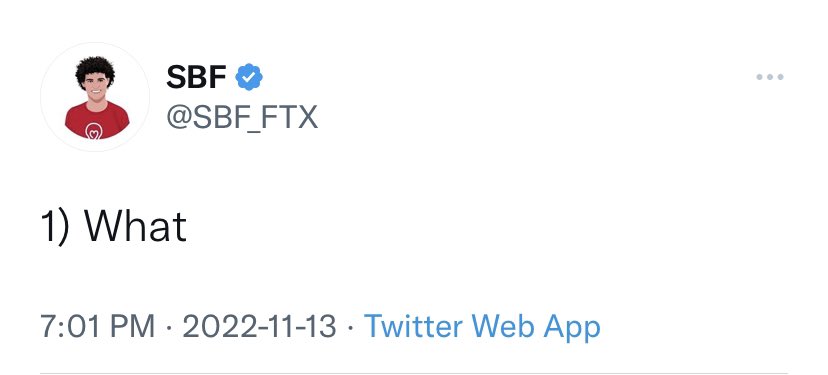
Back in November 2021, Bitcoin hit $69,000 (poetic) and  Ethereum reached $4,800. The total value of crypto crossed $3 trillion. Everyone thought crypto was the future of finance, and the growth seemed unstoppable. Sadly, though, that was the pico-top of the last bull run. For the next two years, the market only went down. We entered a bear market which hit rock bottom in November 2022, marked by the collapse of FTX.
A bear market might seem gloomy, but it's not all bad news. Yes, prices are down bad, cries of "crypto is dead" are still echo, and many go back to living off of cup of noodles. But what's that saying again?
Bear markets attract chad builders, chad builders create projects with product-market fit, products with PMF attract new users and investors, adoption leads to speculation that crypto is the future of finance, and a new bull market begins.

There's a strong feeling that we're at a point right now where we're juuuust before a real bull market takes off. If you listen to anons with penguin PFPs on X, they'll tell you the past few months were just a preview, and we’re in for a wild ride.
Yet, this post isn't about the incoming bull market and how you should prepare for it. It’s about celebrating the chad builders who stayed during the crypto winter and built solid projects. Today, we’ll spotlight some key sectors developed during the bear market.
Let’s dive in! 👇
 Solana the Monolith
There are often many paths to achieving a goal. Solana's comeback story serves as a powerful reminder that there are different approaches for scaling toward mass adoption.
Remember when we mentioned the bear market's bottom was marked by the FTX collapse? It seems fitting to kick off our chad builder shoutouts with the ecosystem that many feared would go down with it.
Solana’s comeback story has been nothing short of a miracle and one celebrated by the entire industry (okay, maybe it’s just the manlets all over everyone’s feeds).
The Solana Virtual Machine (SVM) is turning heads, and for good reason. With its local fee market mechanism keeping gas prices low, the ‘only possible on Solana’ tag isn’t just a meme. The SVM's influence is spreading beyond Solana. Modular rollups like  Eclipse are adopting it, Ethereum heavyweights like MakerDAO are considering it for their own native chain, and innovative projects like Rome Protocol are using it to tackle Ethereum's scaling challenges.
On the app front, Solana boasts feature-rich platforms like Jupiter and Tensor, which are redefining user experience in DeFi. The standout user experience on Solana apps remain the network's low fees and fast transaction execution.
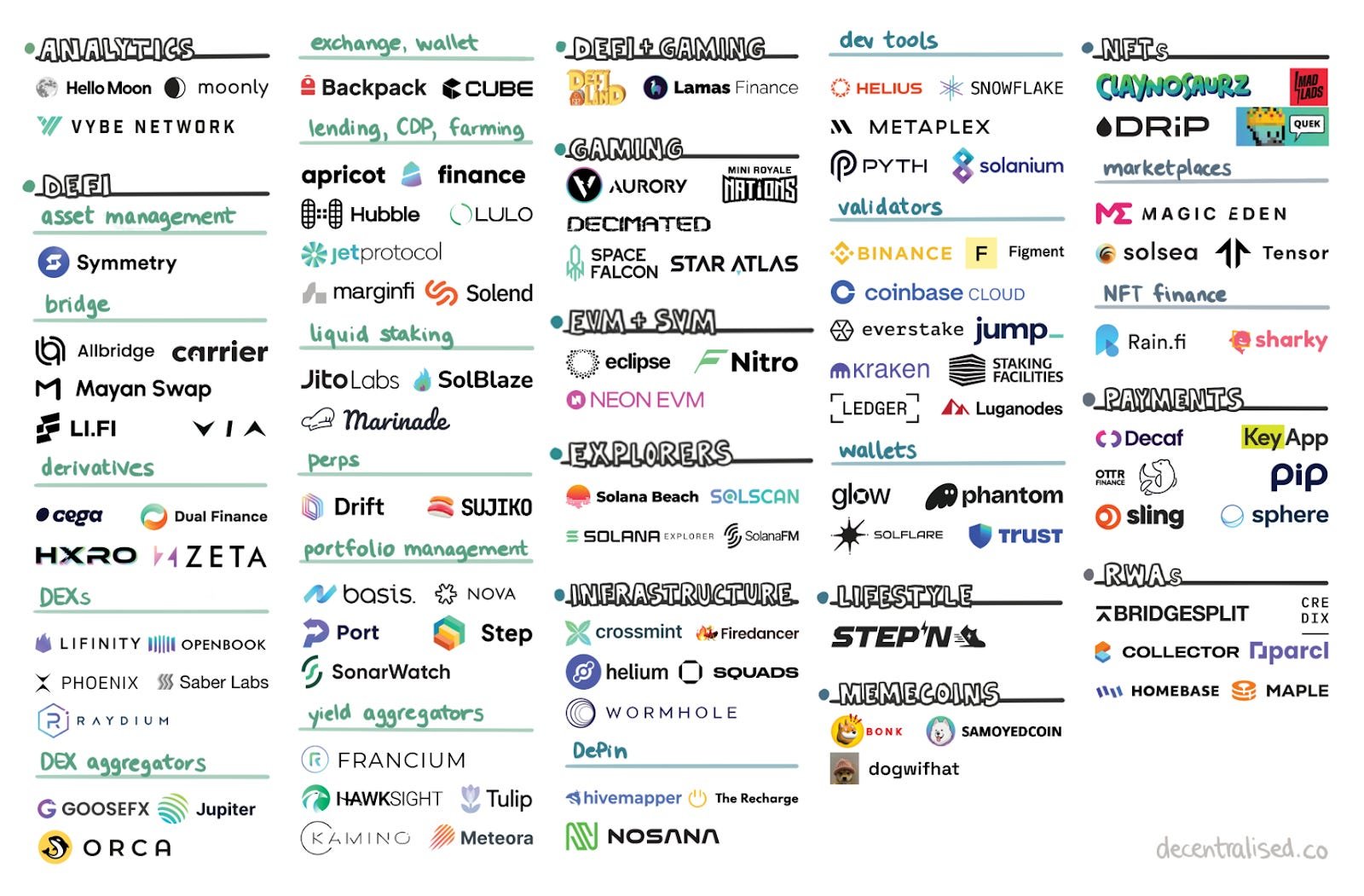
In addition to its diverse app ecosystem, Solana has fostered a loyal community with a unique culture. From NFTs like Mad Lads and Tensorians to meme coins such as  BONK and
  dogwifhat turning the ecosystem into a live casino – not to forget airdrops like JTO and JUP creating instant wealth for users – Solana has all the makings of a standout player in the bull market.
L2 Proliferation
The Ethereum community had a dream, a dream to scale via L2s so that users could have cheap transactions. Now, that dream is becoming a reality as L2s are scaling Ethereum by ~5x.
L2s are key to Ethereum’s success and scalability. Many launched in 2021, and some would speculate that their launch is what fueled rallies in ETH and several ETH ecosystem tokens as Ethereum's rollup-centric roadmap came to life, showing a clear path to scaling. Since then, L2s have seen impressive growth. Here are some stats that show L2s as a major success story of the bear market:
- As of January 2024, L2s are handling 5x the daily transactions of Ethereum.
- On Feb 21, 2023,
 Arbitrum became the first rollup to surpass Ethereum Mainnet in daily activity, later reaching 2.5x Ethereum’s transactions after the $ARB airdrop.
 - In December 2023, zkSync Era became the first rollup to process more transactions than Ethereum over a 30-day time period.
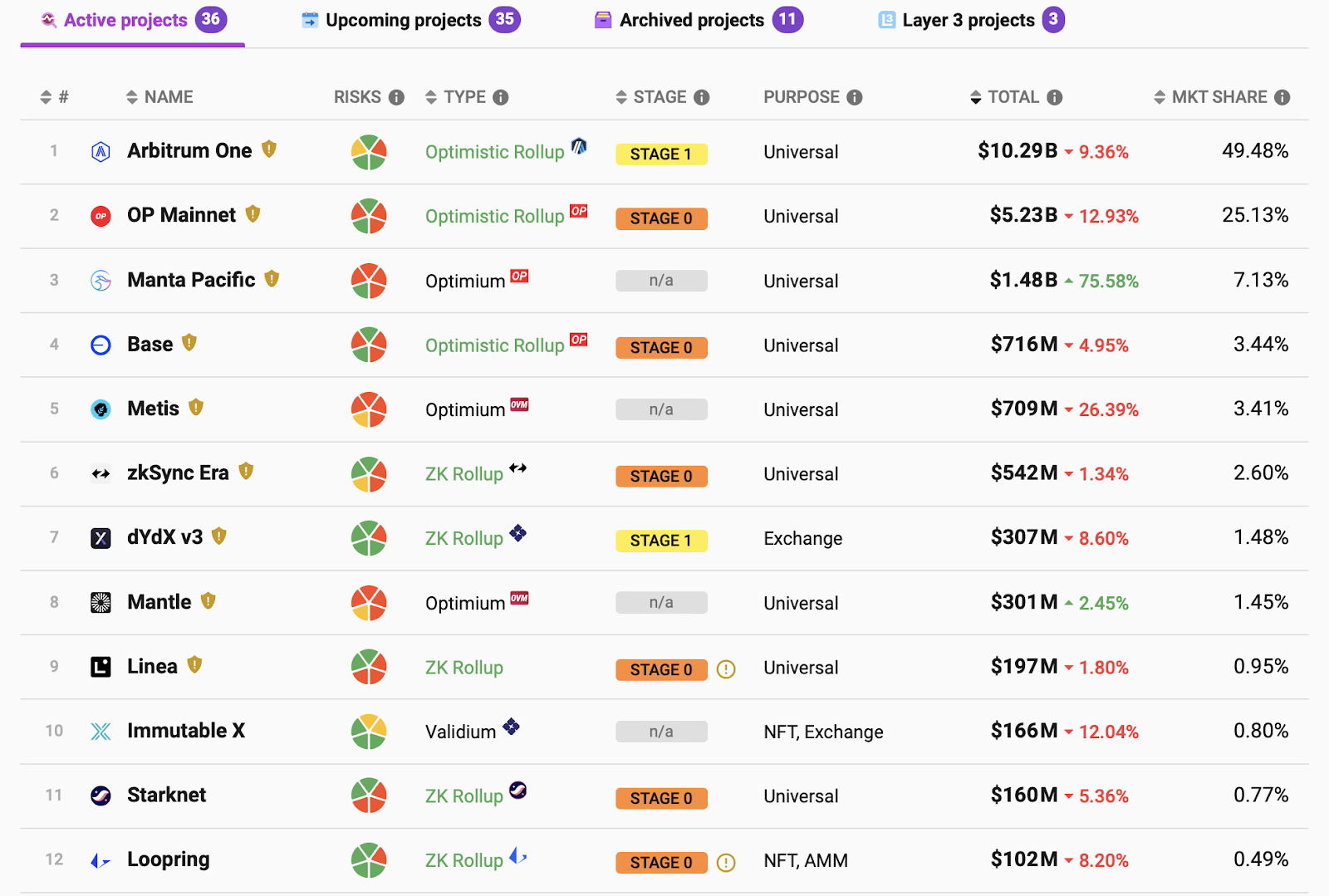
- By April 2023, the combined TVL of all L2s surpassed $10B for the first time, doubling to $20B by Jan 2024.
- Currently, four L2s boast over $1B in TVL, with one (Blast) not even live yet. There are 12 rollups in production, each with over $100M in TVL. Arbitrum is at the helm, leading with over $10B in TVL (50% market share), and
 Optimism is at #2 with over $5B (25%) market share.
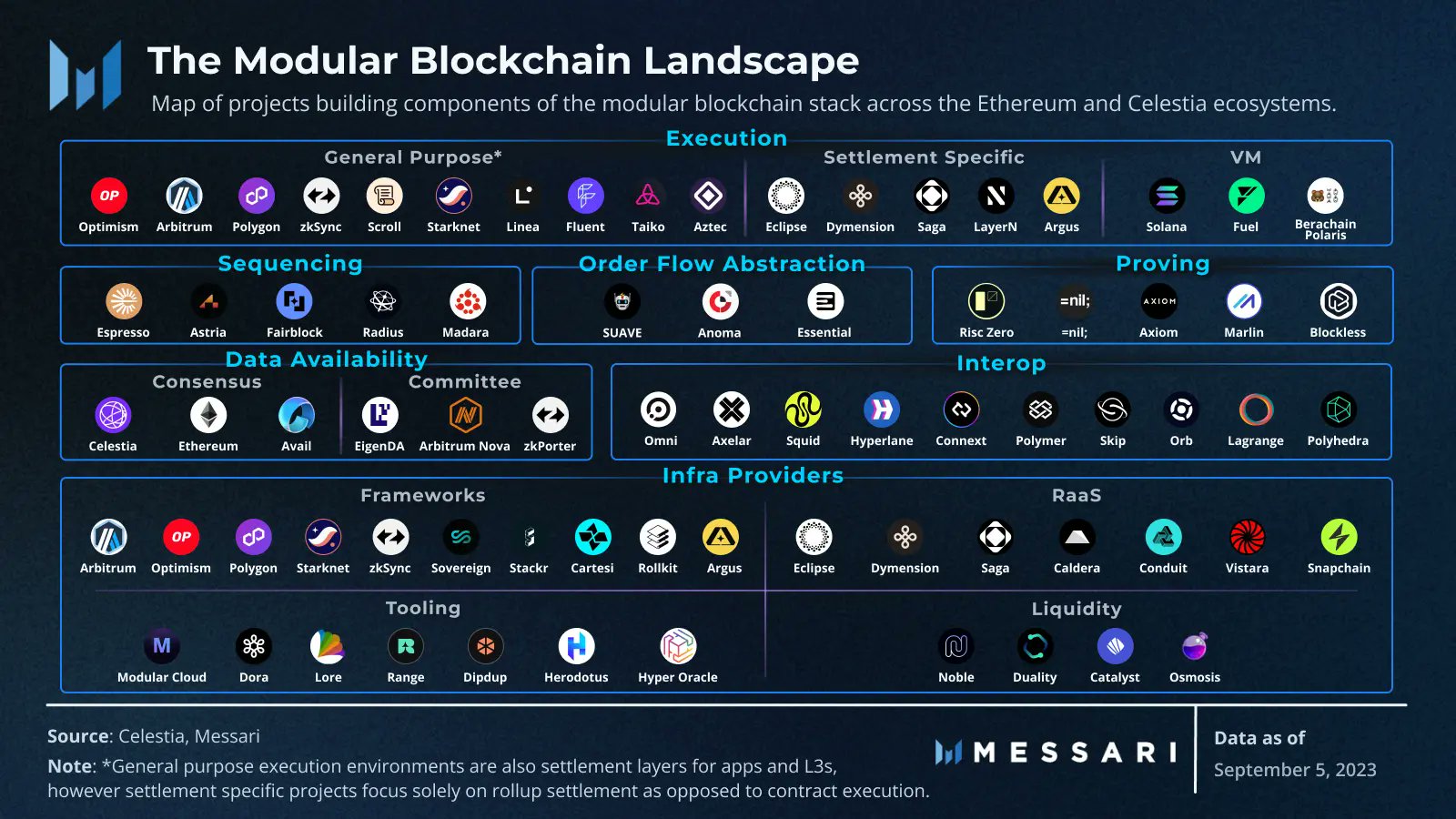
With advancements like danksharding (EIP-4844), data availability solutions (Celestia, EigenDA, Avail), rollup frameworks (OP Stack, Arbitrum Orbit, ZK Stack,  Polygon CDK), and rollup-as-a-service providers (Caldera, Conduit, AltLayer) we could see thousands of rollups deployed in 2024.
The ease of rollup deployment means teams will experiment to stand out. We're already seeing this with rollups like  Blast and Manta Pacific, which offer native yields for holding funds on their chain.
Modularism, not Maximalism
In the modular blockchain era, high gas costs are no longer a barrier to building cool things on rollups. Rollups can now scale by storing data on different layers outside of Ethereum.
The modular blockchain thesis, which deconstructs a blockchain's layers – execution, settlement, and data availability – into specialized chains, has seen significant progress during the bear market and is now seeing early adoption.
Enjoying this article?
Subscribe to Bankless or sign in
There's been innovation across all layers. For instance, in the execution layer, teams like  Monad and
  Sei are working on parallelizing the EVM to boost throughput. Meanwhile, new programming languages for blockchain and smart contract development, such as Move, are being advanced by teams like Aptos, Sui, and
  Movement Labs.
The data availability (DA) layer is particularly interesting these days. Celestia’s mainnet launch in October 2023 officially kicked off the DA wars. Major ecosystems like Starknet, Eclipse, and Manta, as well as L3s like Lyra and Aevo, have started integrating  Celestia for DA, signaling a trend that could shape the future as more chains launch with Celestia underneath.
The anticipated 2024 launches of other DA solutions like EigenDA and Avail will offer chains a variety of DA options. Coupled with Ethereum's own proto-danksharding (EIP-4844), expected to go live in 2024, which aims to lower DA costs for L2s, it will be fascinating to see whether chains stick with Ethereum for DA or pivot to specialized DA layers.
The Future is Multi-Chain and also Cross-Chain
Bridges in crypto: a love-hate saga of connecting different chains. We might prefer a world without them, but the truth is they're indispensable to the multi-chain ecosystem.
In 2022, Vitalik Buterin shared his views that the future would be multi-chain but not necessarily cross-chain, citing security concerns with bridges. However, as we’ve seen time and time again, users and capital move towards the most lucrative opportunities. As the adoption of different chains increased, there was an inherent demand for users and capital to flow across these ecosystems, leading to significant development around interoperability solutions like messaging protocols and liquidity networks that enable the movement of data and assets.
Key innovations developed during the bear market to support this cross-chain functionality include:
- Messaging Protocols – These protocols enable smart contracts on one chain to receive data from others. Key players in this space include LayerZero, Axelar, Wormhole,
 Chainlink CCIP, and
  Circle CCTP.
 - Liquidity Networks – Also known as intent-based bridges these days, these networks facilitate the transfer of assets between chains. Leading solutions include Across, Stargate, and THORChain, with aggregators like LI.FI and interfaces like Jumper helping users find the best route for their cross-chain swaps. [⚠️Disclosure: I work in research at LI.FI]
- Cross-Chain Applications – These are blockchain-agnostic applications that are built on top of messaging protocols. Popular examples include liquidity networks like Squid with Axelar, Stargate with LayerZero, and diverse applications like Radiant Capital’s money market on
 LayerZero or Prime protocol’s lending platform on Axelar.
 - Cross-Chain Token Standards – These standards ensure token fungibility across blockchains, enabling seamless cross-chain transfers through a burn-and-mint mechanism supported by messaging protocols. Notable standards include LayerZero’s OFT, xERC20, Wormhole’s xAssets, and Axelar’s ITS.
- Multi-Chain Compatible Tooling – The multi-chain reality has necessitated the evolution of ecosystem tooling. This includes apps and wallets with built-in cross-chain swaps, as well as dashboards, analytics platforms, and blockchain explorers that support multiple chains, enhancing the DeFi user experience in a multi-chain environment.
The need for cross-chain governance by platforms like Uniswap, Lido's expansion of wstETH across chains, and the billions in volume processed by liquidity networks underscore the importance of messaging protocols and liquidity networks within the multi-chain ecosystem. As concepts like the Superchain utilizing the OP Stack and Polygon's aggregated blockchain thesis with Polygon CDK evolve, the role of these interoperability solutions will be intriguing to watch. Additionally, with the ease in deploying rollups, we are moving toward a future with thousands of chains. Observing how these solutions adapt and perform at scale will be a key area of interest as the ecosystem continues to expand.
Intents to Illuminate the DeFi Dark Forest
Intents are here. Today's intent systems, with their limit orders, aggregation, batch auctions, and solvers, have laid the groundwork. They've set the stage for advanced intents protocols of tomorrow, promising MEV protection, advanced aggregation, intent standards, and privacy, which will simplify using DeFi for everyone.
The concept of "intents" was introduced to the mainstream by a presentation at Research Day, becoming a buzzword in 2023.
In simple terms, an intent is the outcome a user aims to achieve by interacting with an application. This isn't a novel concept; intents have always been part of the user experience, albeit in a more rudimentary form. For example:
 Uniswap facilitates the intent of exchanging asset X for asset Y.
- Opensea caters to the intent of purchasing NFTs.
- 1inch addresses the intent to swap assets at best rates.
These examples represent the basic level of intents, focusing on fulfilling user desires but still requiring users to navigate the complexities of transaction execution.
In an intent-based paradigm, users communicate their desired outcomes without detailing the execution process or setting limits on potential gains. Third-party agents, known as solvers, then execute these intents, competing in an intent protocol. They are motivated by auctions and game-theoretic incentives to deliver the best possible results to win the user-generated order flow.
This approach significantly enhances the DeFi user experience, offering greater flexibility and customization while abstracting the intricacies of execution. The importance of this becomes even more pronounced in a landscape with thousands of chains, where such user-centric flexibility can make life drastically easier for users.
Although the concept of intents gained popularity in 2023, foundational work has been laid by projects like CoWSwap, 1inch Fusion, and Across. As intent-based applications gain traction, the role of solvers is set to become crucial. They are the architects behind fulfilling user intents.
Additionally, intent-focused protocols such as SUAVE, Anoma, and Essential have been under development for several years and are on the cusp of launching. These protocols are exploring intents on a grander scale, diving into order flow, solvers, MEV, domain-specific languages, block building, decentralization, and value extraction, pushing the boundaries by engaging with these concepts on a deeper level down the blockchain stack.
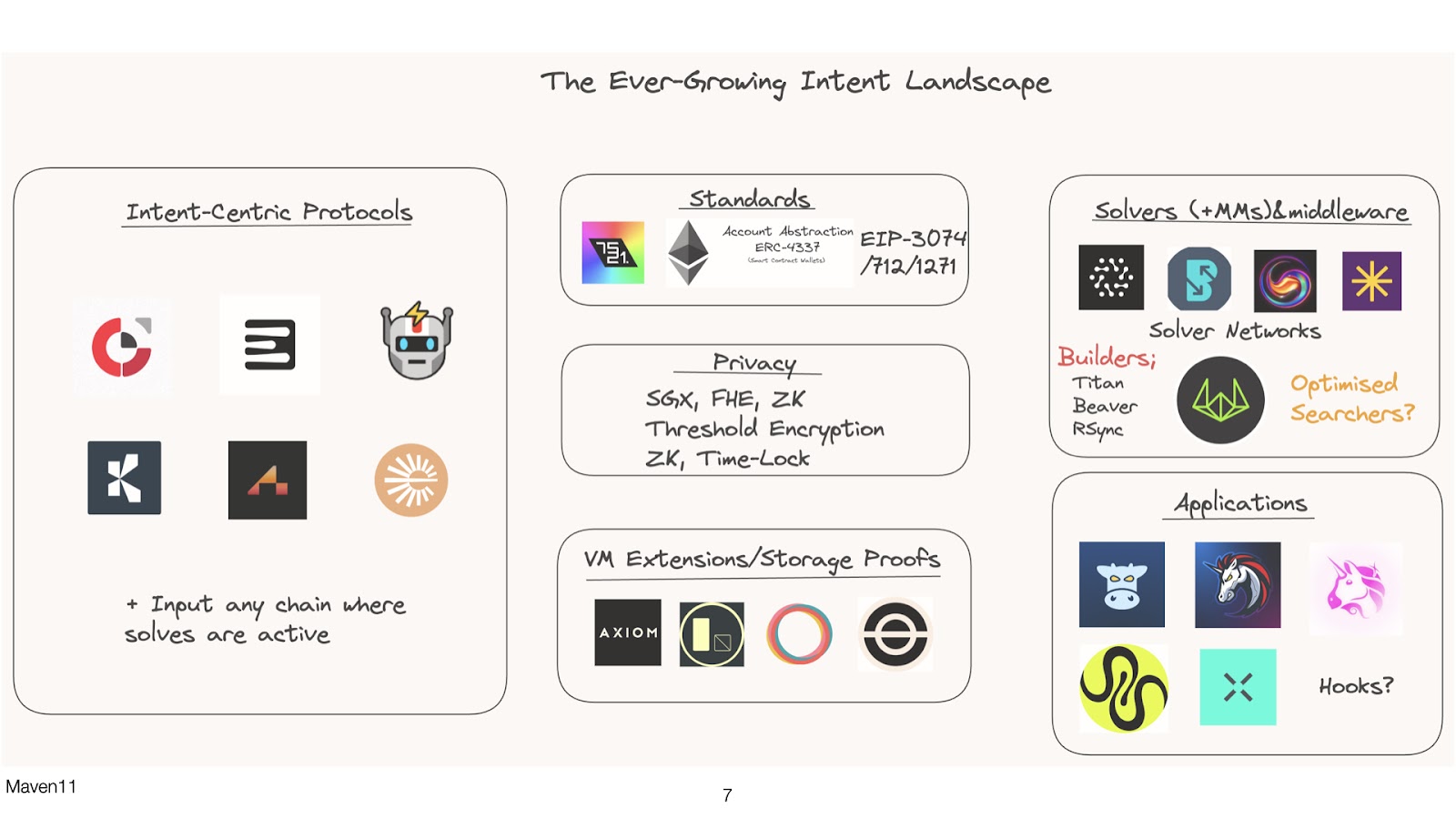
The evolution of the intent landscape is a development worth monitoring closely in the coming years. For those interested in a deeper exploration of intents, the Flashbots team has created a comprehensive dashboard at orderflow.art, which provides valuable insights into this emerging field.
Other Key Developments in Emerging Verticals
As we conclude this article, it's important to recognize several other sectors that have undergone substantial growth over the past two years and are poised to significantly influence the future landscape:
- Restaking – Following the Ethereum Merge in 2022, the liquid staking of assets such as ETH has become a cornerstone of DeFi. Projects like
 Lido (stETH) and
  Rocket Pool (rETH) for ETH, as well as
  Jito for SOL, have secured billions in value. Liquid staking was the trend until 2023, but now restaking has emerged as the new frontier in DeFi. An ecosystem is evolving around restaking, spearheaded by Eigenlayer, with projects like Ether.fi, KelpDAO, and Swell. These initiatives enable users to earn extra rewards by restaking their tokens with protocols like Eigenlayer, which leverage these assets to secure various DeFi infrastructure segments, such as the DA layer with EigenDA.
 - Real World Assets (RWA) – The idea of tokenizing everything to bring it onchain may be a meme, but there's been significant progress in this area. Efforts to tokenize tangible assets like real estate and yield-bearing instruments like US treasury bills are underway. Projects such as Ondo, Parcel, and LandX are at the forefront here.
- Blockchain Gaming – The onchain gaming sector is experimenting with novel concepts like play-to-earn and ownership of in-game assets. Early successes like Axie Infinity suggest a bright future, with the potential for a breakout game to attract a wave of new users after years of development and investment. Ecosystems like
 Avalanche and Polygon are strategically positioning themselves as preferred platforms for game deployment. Keep an eye on projects like
  Immutable and
  Beam within this vertical.
 - Artificial Intelligence (AI) – This sector aims to merge two of the most radical innovations of recent decades: crypto and AI. While still in its infancy, we can anticipate a surge of activity as projects begin to enter the market. Initiatives like
 Bittensor and Olas are pioneering efforts to infuse AI with the decentralized ethos of crypto.
 - Decentralized Physical Infrastructure (DePIN) – This sector has the potential to draw mainstream attention to crypto. By applying decentralized principles such as transparency and community governance, DePIN projects aim to create fairer systems for physical infrastructure use cases. For instance, envision a community-owned and operated alternative to Google Maps. DePIN protocols like Hivemapper are turning this concept into reality by connecting real-world drivers to a crypto-based mapping infrastructure that compensates them for mapping roads globally.
That’s a wrap for today!
The bear market has been a hotbed of innovation, and while we've covered a lot, there's undoubtedly more to discover. If there's a particular development you're curious about or would like us to delve into further, please share your thoughts in the comments!