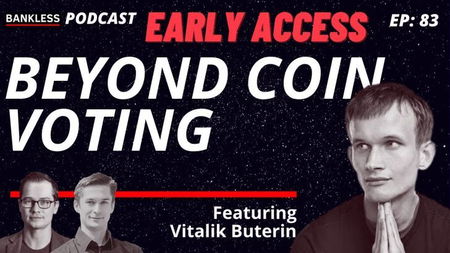
Beyond Coin Voting | Vitalik Buterin
Discussing Vitalik's Recent Article on Decentralized Governance
Up next
All episodes 01:04:46
NFTs
01:04:46
NFTs
LOOT Panel | Jackson Dame, Will Papper, and Anish Agnihotri
 01:46:03
Vitalik Premium
01:46:03
Vitalik Premium
Beyond Coin Voting | Vitalik Buterin
 01:28:53
News
01:28:53
News
📺 ROLLUP: Solana & Arbitrum Outages | OpenSea Front-Running | Elizabeth Warren Crypto
 01:43:25
Investing
01:43:25
Investing
🎙 82 - Investing in the Future | Cathie Wood, Chris Burniske, Yassine Elmandjra
 00:23:01
Investing Premium
00:23:01
Investing Premium
EXCLUSIVE DEBRIEF: Investing in the Future | Cathie Wood, Chris Burniske, Yassine Elmandjra
 01:43:25
Investing Premium
01:43:25
Investing Premium
EARLY ACCESS - Investing in the Future | Cathie Wood, Chris Burniske, Yassine Elmandjra
 01:41:09
News
01:41:09
News
📺 ROLLUP: Steph Curry & Tom Brady FTX | Crypto Regulation & SEC | Solana & Arbitrum
 01:35:29
Ethereum
01:35:29
Ethereum
🎙 Layer Zero | Justin Drake
Inside the episode
Perpetual Pools are now Live on Aribtrum! Check out TracerDAO on Layer 2 >.<
Vitalik Buterin returns to the Podcast to discuss his recent article 'Moving Beyond Coin Voting Governance.' As always, Vitalik comes with a birds-eye view of high level challenges facing the crypto space with a moral & philosophical slant.
Building sufficiently decentralized governance mechanisms is a hugely challenging endeavor. Tackling elegant solutions to coin voting, we also cover the benefits of running your own node, the metaverse, and Vitalik gives an update on the Ethereum ecosystem.
When Vitalik comes on Bankless, it's time to listen closely.
🎙️ NEW PODCAST EPISODE
Listen to podcast episode | iTunes | Spotify | YouTube | RSS Feed
Bankless Sponsor Tools:
⚖️ ARBITRUM | SCALING ETHEREUM
https://bankless.cc/Arbitrum
🍵 MATCHA | DEX AGGREGATOR
https://bankless.cc/Matcha
🔐 LEDGER | SECURE YOUR ASSETS
https://bankless.cc/Ledger
🦄 UNISWAP | DECENTRALIZED FUNDING
https://bankless.cc/UniGrants
RESOURCES
🏴 JOIN THE NATION 🏴
Subscribe: Newsletter | iTunes | Spotify | YouTube | RSS Feed
Follow: Twitter | Instagram | Reddit | TikTok | Facebook
Not financial or tax advice. This newsletter is strictly educational and is not investment advice or a solicitation to buy or sell any assets or to make any financial decisions. This newsletter is not tax advice. Talk to your accountant. Do your own research.
Disclosure. From time-to-time I may add links in this newsletter to products I use. I may receive commission if you make a purchase through one of these links. Additionally, the Bankless writers hold crypto assets. See our investment disclosures here.
Transcript
welcome to bankless where we explore the frontier of internet money and internet finance this is how to get started how to get better and how to front run the opportunity this is ryan sean adams i'm here with david hoffman and we're here to help you become more bankless david vitalic on the podcast got to listen to every vitalik episode sometimes two or three times this was a fantastic one would we cover yeah we covered a bunch of different subjects every time time for our our quarterly check in with vitalik uh he put up two articles that we wanted to to go through one was uh
vitalik talking about how we could you know graduate or evolve from co coin voting or token voting in d5 and also just token voting in general um kind of the the the issues that token voting presents and how we can circumvent around them with new governance mechanisms for defy apps and as ethereum becomes more and more valuable as these defy apps become more and more valuable the conversation as to how to govern these things in ways that aren't just centralizing control into token holders is going to become
even more important then we also turn to the con the conversation which is resurfaced lately with the regardless regarding uh the infrastructure required to run a node for a blockchain uh all of the different bottlenecks and requirements that you need in order to run a node and how these different choices that are made about hardware requirements impact how scalable a blockchain is both in terms of its actual throughput but also in terms of its decentralization decentralization is also a scale that you can optimize for different ends of the spectrum so we revisit that
conversation as well and then we finish off with some really fun stuff we ask uh vitalik about the metaverse and whether or not ethereum with this whole loot phenomenon has gone full circle vitalik uh you know made the always made the joke that he made ethereum because he wanted to not ever get nerfed by his like special uh spell or item and now that we have a 60 warlock or something exactly right and so now that we have the metaverse we have this uh this final this gaming structure that you can't actually get your assets or your spells rug pulled
from you and so that conversation uh happens towards the end and then of course we just check in with ethereum about where he considers ethereum to be in its current state in history both at the protocol level uh but also in uh just the mass adoption society level so a bunch of different things here in this uh episode with vitalik yeah really relevant things too like you know number one is relevant because everything is a coin vote right and we talk about decentralized governance but are we actually moving towards decentralized governance you know the second thing is relevant because we have all of these high-performance
blockchains david you and i just did a panel it was a kind of a debate-ish but not really it was a panel about solana and comparing and contrasting a high-performance blockchain like solana to ethereum and it really centered around this question of how important is it for a user to have the ability to run a node it turns out vitalik and the ethereum a set of values think that it's very important for users to run a node have the ability to opt out so that the elites don't control the system right this is the trade-off you're often making with a high performance
you know high transactional throughput blockchain and doesn't get a lot of press because it's easier during a bull market when price is rising and um you know people want unlimited block space to just make these kinds of trade-offs so we we discussed that and then of course the metaverse is always a really interesting conversation the state of ethereum so guys we think you are going to enjoy this episode with vitalik before we get into the details before we get into the conversation we want to thank the sponsors that made this episode possible living a bankless life
requires taking control of your own private keys not your keys not your crypto that's why so many in the bankless nation already have their ledger hardware wallets which makes proper private key management a breeze but the ledger ecosystem is more than just a secure hardware wallet ledger is the combination of the ledger hardware wallet and the ledger live app and if you're used to seeing all of your crypto services and favorite d apps all in one place ledger is where you want to be not only does ledger let you buy crypto assets straight from the app but it also hooks into decentralized exchange
aggregators like paraswap which makes sure that you are getting the best prices on your trades without your assets ever leaving your control defy never stops growing and the ledger live app grows alongside with it so click the link in the show notes to see all the defy apps that ledger live has and stay tuned as more and more apps come online and if you don't have a ledger hardware wallet what are you even waiting for go to ledger.com grab your ledger download ledger live and get all of your d-apps all in one place arbitrum is an ethereum scaling solution
that is going to completely change how we use defy if you've been using ethereum for the past 12 months you've probably noticed the high gas fees and the slow confirmation times that have been plaguing d5 too many people want to use ethereum and it doesn't have enough capacity for all of us that's where arbitrarum comes in arbitrary is a layer 2 to ethereum which means arbitrarium can increase ethereum's throughput by orders of magnitude at a fraction of the cost of what we are used to paying when interacting with arbitrary you can get the performance of a centralized exchange while tapping into ethereum's
level of security and decentralization this is why people are calling this ethereum's broadband moment where we get to add performance onto decentralization and security if you're a developer and you want to save on gas costs and make an overall better experience for your users go to developer.offchainlabs.com to get started building on arbitrom if you're a user keep an eye out for your favorite defy apps building on arbitrome arbitrary has been working with over 300 teams including ethereum's top infrastructure projects and will be opening up to all users shortly there
are so many apps coming online to arbitrarily so you may want to pack your bags in preparation for the great migration to the arbitrary layer 2. to keep up to speed with arbitrary follow them on twitter at arbitrom and join their discord bankless nation we are super excited to have vitalik buterin back on the podcast he is the ethereum co-founder researcher guy who will never give you free eth on twitter i can guarantee you that vitalik welcome back to bankless thank you very much it's good to be here it's awesome to have you again i feel
like um this is an opportunity to have sort of a conversation with you um and uh just pick your brain almost like an ongoing conversation um the last time we chatted we we talked about the topic of legitimacy and that was now three months ago that was in may so three months is a long time in crypto it's probably like three years in the regular world we've hit new milestones there have been new issues new insights you've written a slew of blog posts we want to cover those as much as possible um this time i think we want to lead
with a topic that is top of mind in the crypto community and i think it's it's you know part of your mindshare as well because you wrote about it and this is the topic of governance so um read your article about moving beyond coin voting and if i could maybe you know summarize and give the headline here it feels like after reading that you kind of think coin voting sucks that the community shouldn't settle on it as the only solution but that instead we should explore better decentralized
governance protocol so we want to start there and pick your brain on that subject i guess my first question is this when we talk about decentralized governance do you think that's even possible or is this somewhat of an aspirational goal that we'll never quite achieve um i mean i think um you can definitely have governance that's a much more decentralized than um you know the average thing that people call a centralized org um obviously the question of like how much decentralization can you
achieve is um a complicated and fascinating one and i mean that there's uh the the question of um like what kind of benefits they um you can get from that decentralization um but and i do think that it like it is a worthwhile experiment um i think uh in particular because like blockchain based in decentralized platforms like they had derived their entire value on legitimacy from a creative credible neutrality as we've talked about before
right and a it's very difficult for a platform to claim to be incredibly useful if um there is a very small team that's uh controlling every uh everything and all of the decision making behind it um so uh coming up with uh forms of uh governance that do not depend on a small a small team making all the decisions it's uh it's definitely something that's uh very important for a bunch of reasons um but you know at the same time like have coin
holders voting is definitely far from the only way to do it so when we talk about governance baked into that conversation implies that there's some sort of objective or direction that governance actually points towards and in your article we we you you juxtaposed to uh the difference between um uh or at least imply the difference between public goods and private goods right um and there are and when we have these defy apps these this financial infrastructure and also ethereum at large i think there's a
question outstanding as to who governance is actually governing over these systems for and so like one possible interpretation is that the governors of the maker dow system are governing in order to prioritize and uphold the value of the mkr token above all other things or an alternative uh interpretation might be that mkr is a token that is used used to direct the maker dao application to become the best uh financial services product on
ethereum for the betterment of the users and so when you think of governance what how would you answer who is governance for when we talk about all of these things that we are governing over yeah i mean i think that distinction between like is it for the benefit of the holders or the benefit of the users is really important right because like especially in the case of these platforms that contain a lot of what i call internal capital right in this case it's like the east that's locked up in the maker tail contracts like potentially
you could imagine a world where for a well like let's say for example that like rai does uh really well and it ends up taking over and there ends up being this public consensus that rise better than die and die is kind of on the way out um but at the same time there's like a couple of legacy organizations that still hold a whole bunch of dye but like you just know that over the next few years they're going to stop using dye and they're the platform's going to kind of slowly little way to having nothing right like in that situation if you were an mti mkr
holder it's that like if you feel like you don't have the long-term prospects anymore it's absolutely in your long-term interest to just make a vote that just says okay guys we're just gonna snap up all the if that's locked up in the collateral for ourselves distributed among the mtr holders and like screw the die holders because well we don't really have a long-term reputation anymore right and like to me that's sounds like an outcome that's pretty fair to describe as being like bad right um so there's like i think uh in a lot of
cases there is uh alignment between the uh token holders and the users but also in a lot of cases there really isn't right in a lot of cases like for example sometimes um you know the the thing that the that the platform is trying to provide and just uh ends up requiring trust and so you want governance that can actually like satisfy the user's trust even if it's not in token holders interests um sometimes the participants in the community or even the creators of the
project like they have particular values that they care about that go beyond the interest of token holders so like for example i might care about economic equality and i might want to um build if like if i create a new token build in a gadget that distributes say one unit of that token to every human per year like just because like i want the supply to be more egalitarian now the existing uh token holders might not want that and so and they might want you know if they control the government state governance they might end up like
shutting it off or like basically a kind of stopping you know registration of new humans completely um so that's another example of where like there is some other goal that it seems reasonable to try to um like have a governance mechanism to achieve but that goal does not end up being well aligned with the the interest of any particular token holder another thing i think is also that like token holders they often end up um
holding tokens of a lot of different projects right like it often ends up being the case that like if you just uh try to use your token holders as a representative of your community um then those uh like the set of token holders that you get ends up being the same right like you know there's these big investment funds and they have a big chunk of you know the uniform they have a big chunk of a whole bunch of these other projects and basically yeah like you end up losing the ability to have kind of uniqueness
to have different uh communities that actually have like different values and that are making kind of earnestly different attempts at pursuing whatever their goals are um so there's also just this kind of like this sort of risk of just you know homogenization in terms of like strategy um before if uh utility holders end up controlling things right so i feel like those are some examples of reasons why um governance that uh ex like explicitly tries to do something other
than satisfying the desires of target holders for their token to make more money is something that's important um and it's as something um like basically the reasons why it's important to empower other cons other kinds of constituencies or at least create structures where even if token holders are part of their structures token holders have some kind of like incentive to actually participate in the in the system in a
way that serves those goals so vitalik when you were writing your article uh are presenting an argument about why token vote sucks and we need better and better and stronger and more aligned mechanisms who are you trying to that first off i i think i can claim that there is a values judgment baked into even writing the article in the first place implying that you know you actually think that governance should be different and more inclusive uh and so when you were writing this article who were you trying to get more included into governance or what was the the goal
of even bringing up this i conversation like i think it's uh first of all it's a conversation like that definitely did not start with that post right like yeah i have been writing these posts on like you know uh the one on collusion and on coordination problems uh the post back in 2017 and 2018 on uh governance where i yeah i was criticizing what was going on in in the eos ecosystem with all of the bribing that was happening um so it's definitely something that like i
have been trying to express for a long time and i guess i i i definitely felt the need to express it just much more cleanly and plainly in one of these i know blog posts were just the the whole point of the post is the title um but uh the the reason why i felt that way is just because uh you know we have been seeing over the last year and a half this big emergence of these new uh d5 protocols and and taos of all kinds right um and we've been you know
seeing people do all these different experiments um some of these projects that are launching from zero so you know they they just start off being dowse right from the beginning and the thing that i've been seeing right is that people feel the need to add decentralized governance and i think there's good reasons why they feel that need um but at the same time like there just aren't any ideas available for how to implement that decentralized governance beyond like just uh token voting um and
like someone needed to sort of just express that alternative and it would just express the idea that there is an alternative to so good voting and that alternatives is no good voting or not like automatically centralized or whatever um in the absence of these alternatives you think people just you know settle on token vote as almost like a shelling point just because everyone else is doing without doing it without even thinking about it yeah totally i it's like that's a natural effect that happens everywhere right like uh the this is the whole um
you know if you do the same thing as everyone else um and you fail then like ants not your faults but if you do if you try something uh different uh from everyone else and you fail um then like everyone yells at you and you get fired right um like this is the story like that's the sort of thing that ends up causing a lot of problems in a lot of contexts i mean even like you know we have uh we have 206 different countries but we have very far from 206 different uh
approaches to policy and a whole bunch of important questions some of them some of which really could use a lot a lot more diversity and options um so the i guess uh yeah i i definitely am worried that if alternatives to coin voting don't kind of get expressed and at least intellectually expanded on then like things will settle on coin voting by default and then we'll be having this conversation in five years anyway but we'll be having it like just because um
you know the coin voting uh dallas will have all been captured in some way in uh some way or other and it will be much harder to steer away at that point they used to say in enterprise sales circles like nobody ever got fired for buying ibm right it's like so hard to get your product in there because if you buy ibm it's just that's what everyone's doing vitalik i wanna we definitely wanna get more into the nitty-gritty details of this conversation uh but i want to finish off this part this uh introduction part with this question i was recently in a debate with a bitcoin
maxima self-identified bitcoin maximalist and one of his big critiques about ethereum and proof of stake is that the proof of stake actually instantiates the value of the ether token a little bit more strongly than it does in proof of work and so the bitcoin a bitcoin or critique on ethereum is that ethereum is not a public resource it's a private economy with private products that are meant to enrich ether holders what say you about this i mean isn't that true with uh bitcoin as well um right uh i mean bitcoin is
even more strongly enshrined into that bitcoin blockchain than ether isn't trying to do the ethereum blockchain because like for in the ethereum blockchain while okay fine you have to pay eip 1559 fees and if but in the bitcoin blockchain like bitcoin is literally the only thing that you can transact um and yeah that's uh like the bitcoin blockchain almost explicitly exists to support the the bitcoin currency and therefore like to support the economic interest of existing holders of the bitcoin currency
does that preclude these two things from being a public good then so um i think in general um publicness is always a spectrum and not a binary right like i think there's almost like there's very few things in the world that are truly public right like there's uh and even like national governments right like you know national governments will often have talking about themselves as like you know we're quote public you know the public sector and unlike these private uh uh entities that merely represent their
own interests you know we represent quote all of society but like you know the reality is we live in an interconnected world and like you know does the us government actively represents the interests of say society in afghanistan right so like every like pretty much anything that it exists in the world as it is like it's uh somewhere on the spectrum between um you know being something that exists just for one person and uh being something that exists for the entire world some things come close to existing for the
entire world but some things are further some things are even further um i think in the case of uh cryptocurrencies like it's definitely true that their supply is uh kind of supply distribution is kind of unbalanced um and i think uh like that is a legitimate problem like it would be nice if uh the if the supply of cryptocurrencies was more widely distributed though at the same time the yeah i think ethereum did do a better job than most other cryptocurrencies right i can i don't know if you read my recent uh article on
the like the genie index and inequality um one of the charts that i had in there was just like the percents pre-mined and like the percent allocated to like existing kind of like closed-off pre-investors and all these different blockchains that like eth and cosmos i think it was that that were the only ones that really looked decent and the rest of them were like pretty much completely downright dystopian um so that was uh um so it's an issue um but uh right it
was yeah there it is and oh right no it wasn't uh yeah cosmos is up there oh tesla's does a good job that's nice um i guess uh cardano as well um eos i don't know i mean in the yeah in the eos case i guess like what wasn't there a lot of just like accusations of all kinds of wash trading in the sale so i'm not sure how genuine the ten percent figure is um but like you can just look at the chart right and you can see you know like which of these uh blockchains like are like which of these blockchains are the
ones that like if ethereum disappeared tomorrow like you would personally feel like at all comfortable migrating to right again so as far as coin holdings go that's a legitimate issue but then as far like the other thing is that blockchains aren't just about empowering people hold the coins right they're about empowering users and they're about providing value to people by using those blockchains and the ability to use ethereum definitely is something that is like i think truly global and like and
you do have people in all sorts of places that are like just benefiting from the ability to build things on ethereum and actually you have those applications that interact with each other and have people use those applications um so it is i guess ethereum is not a perfect system but also like pretty much anything else that calls itself public is very far from a perfect system either so you know you like you can't have perfection but we can um try to kind of keep getting
better and better than what we had before okay so we can't have perfection but we can try to keep getting better and better than before but i i guess that um begs the question almost why is decentralized governance better in the first place you know some some people would say hey like why why go to all this trouble i mean we have shareholder vote in in corporations uh centralized governments uh do fairly well um i know you mentioned in that you know the top part of your article that uh some of these cypherpunk values are kind of embedded in the blockchain
movement to minimize coercion uh maximize coordination with with uh you know minimal coercion private property and markets but like why from a values perspective do you think decentralized governance is important you mentioned credible neutrality right so is this like a legitimacy and social scalability argument when you have decentralized government governance then you can get more people on board and it benefits more users or what's kind of the art argument for all of this
so that's one good argument another good argument i think is that users want systems where the governance of those systems is just clearly not something that can easily screw them over right like if you look at like twitter and facebook and all the centralized web 2 companies like this happens all the time right you have this ecosystem of startups that build themselves around facebook apis or twitter apis and doing interesting things with those apis until eventually well you know once they get big get big
enough like facebook right close them it says like you know hey guys you know either we buy your company that you spent years developing for hundred thousand dollars or you know tomorrow we're going to shut off your api and build our own competitor um and that's uh ethereum is not going to do that to you right um you know bitcoin is also not going to do that to you um so that's like like the fact that ethereum governance just has so many stakeholders and the facts that users have to actually
like choose to download and accept um any of these software package patches um and uh you know all of these things that together basically means that like there isn't this kind of ability to just you know immediately go and flip the switch on someone um which is uh i think something important um and it's uh something that can easily make um people feel much more comfortable building applications on um ethereum than they would feel building on like some of one of these platforms
that's just run by a single company that's a good teaser for the second part where we want to talk a bit more about how users download the software but before we're you know still on the subject of decentralized government uh governance i'm just curious for people who aren't sure of the types of decisions that actually need to get made in blockchain systems or even in d5 apps um i think you did a good job sort of splitting this into two areas like number one there's this category of decisions around funding public goods
right how do you fund things for the continuance the good of the protocol itself and the second is upgrades and improvements so if there's some upgrade that needs to happen who decides what you know features that should include or how that's pushed out could you get into these two things and the decisions that need to be made through decentralized governance right um so there's basically a yeah i mean i i outlined two categories of uh decisions that decentral like some kind
of governance is needed for um and so if you want to be decentralized that decentralized governance is needed for one of those categories is funding public goods just funding people who um or teams that do things that are useful to the get projects ecosystem or even just more generally to the project's underlying goals um so this includes things like documentation like software development research but basically anything where the benefit provided by
what you're doing isn't something that can be kind of packaged up and separately sold to individual people right like uh you know we are um are doing this podcast and then that podcast you know either it doesn't get published or it does get published and once it gets published anyone can see it um and then if i come up with an idea and i write it up on either research like i can't you know charge subscription fees for that idea and only give access to that idea to people who like pay some amount of money right it's you know either i do it for the world or i do it for nobody um and
they're in the internet world um a large portion of like pretty much all things are like that right um so though like funding those things is often a challenge because they because they suffer from the free rider problem right like if one person funds it and another person doesn't find it well both people benefit and and so why would the first person find it um so the hymn basic the the solution in the crypto space is basically like well if you have
these protocols that do end up having some some kind of ability to monetize then you know like that funding could then be directed into these public goods somehow right like basically not every project that's useful has a monetization strategy um and so you what you basically do is you take the things that monetization strategies and the things that are useful and you kind of like plug line them up and plug them into each other right and so it's um so this is one thing that needs that
you need to have some governance governance for because once you start funding public goods uh other than things that are really trivial to measure like for example network security like once you start funding public goods um such as like software development and documentation and translation of research that you can't measure programmatically then you need some kind of governance system in order to figure out well which projects do you actually support in the first place right so that's one thing that governance is needed for the other thing is protocol upgrades and parameter changes um so one
example of this might be like you know in maker dow you have this question of like which assets are considered acceptable for collateral i mean i've actually been critical of like that aspect of maker down like one of the reasons why i liked rye is because it just says well no eth is the only collateral that's ever going to exist um and but even then you need governance to figure out like what is the oracle gonna be like who are the oracle providers um in a system like uniswap um you would need governance to figure out um say
that right now i think they use it to just well right now just for public goods funding but in the future it could be the side used to decide what parameters of like fees of existing markets and things like that um in anything more complex um like you would let's see like in something like ens um well in the case of ens i mean they have
these like they want to charge fees that are denominated in dollars um but then you know what happens if like do they charge it in one particular stable coin what if that one particular stable coin disappears do they have to switch to a different stable coin like there's these decisions that have to be made right and then there's just protocol upgrades in general like what if you know they come up with a just completely better version of the protocol and they want to switch over uh the current protocol to that feature protocol without users needing to like move everything that they're doing over manually so that's something that's uh

David Hoffman
Co-owner at Bankless. Optimistic storyteller of frontier technology.
.png-a616dc52961c1edd72b0c1fdf5f47e7a.png)