Are We Back?
After a week of pumping, is it time to get bullish?


Dear Bankless Nation,
Markets continue to pump this week as the broader macro environment gains steam.
What are CPI numbers telling us and what should you do about it? Today, we’re making sense of the crypto pump.
- Bankless team
BTC is up 23% to $21,100 in the past week. All of this is leaving Crypto Twitter asking some important hopium-fueled questions:
- Has crypto bottomed?
- Is it time to be bullish?
Today, we dissect the market interpretation of the domestic consumer price index (CPI) print, examine the logic behind Thursday’s volatile trading session, and extract untold warnings from the data they don’t want you to see.
Strap on your hopium masks, and let’s go.

What’s behind the pump?
December CPI data was released by the Bureau of Labor Statistics on Thursday (January 12) and, as par for the course, a volatility-filled trading day ensued.
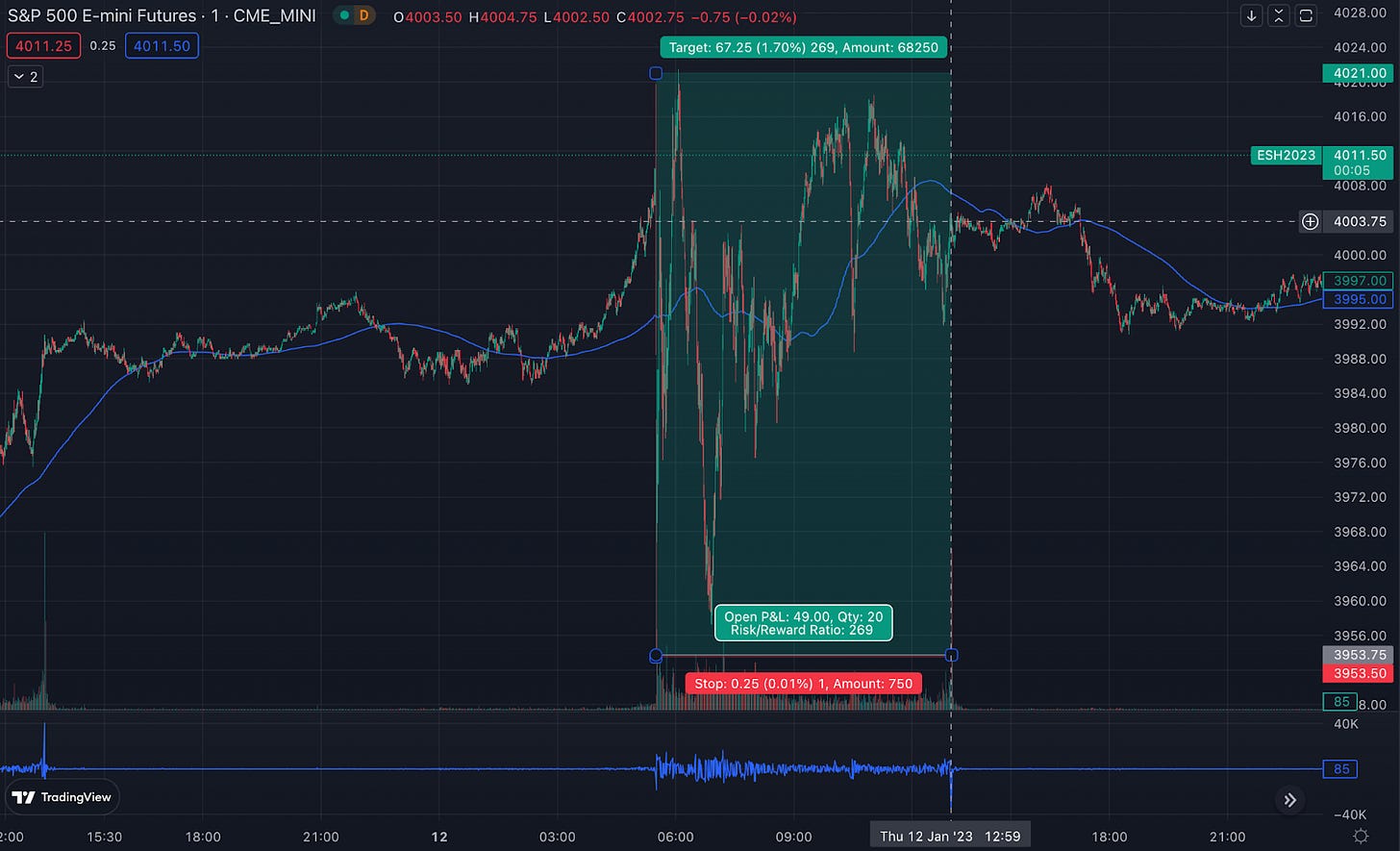
December’s decline marked the third month in a row CPI has decreased. “Beating back inflation” summarized the Fed’s monetary policy approach throughout 2022 and the Fed continues to pummel it into submission. Crucially, December’s data is seen by many macro economic pundits as the beginning of a disinflationary, or potentially even deflationary, trend for CPI.
Year-over-year CPI declined from 7.1% to 6.5%, with an unexpected 10 basis point decrease in CPI from November’s measurement. The decline can largely be attributed to the broader energy category, which saw a 4.5% seasonally adjusted decrease from the prior month.
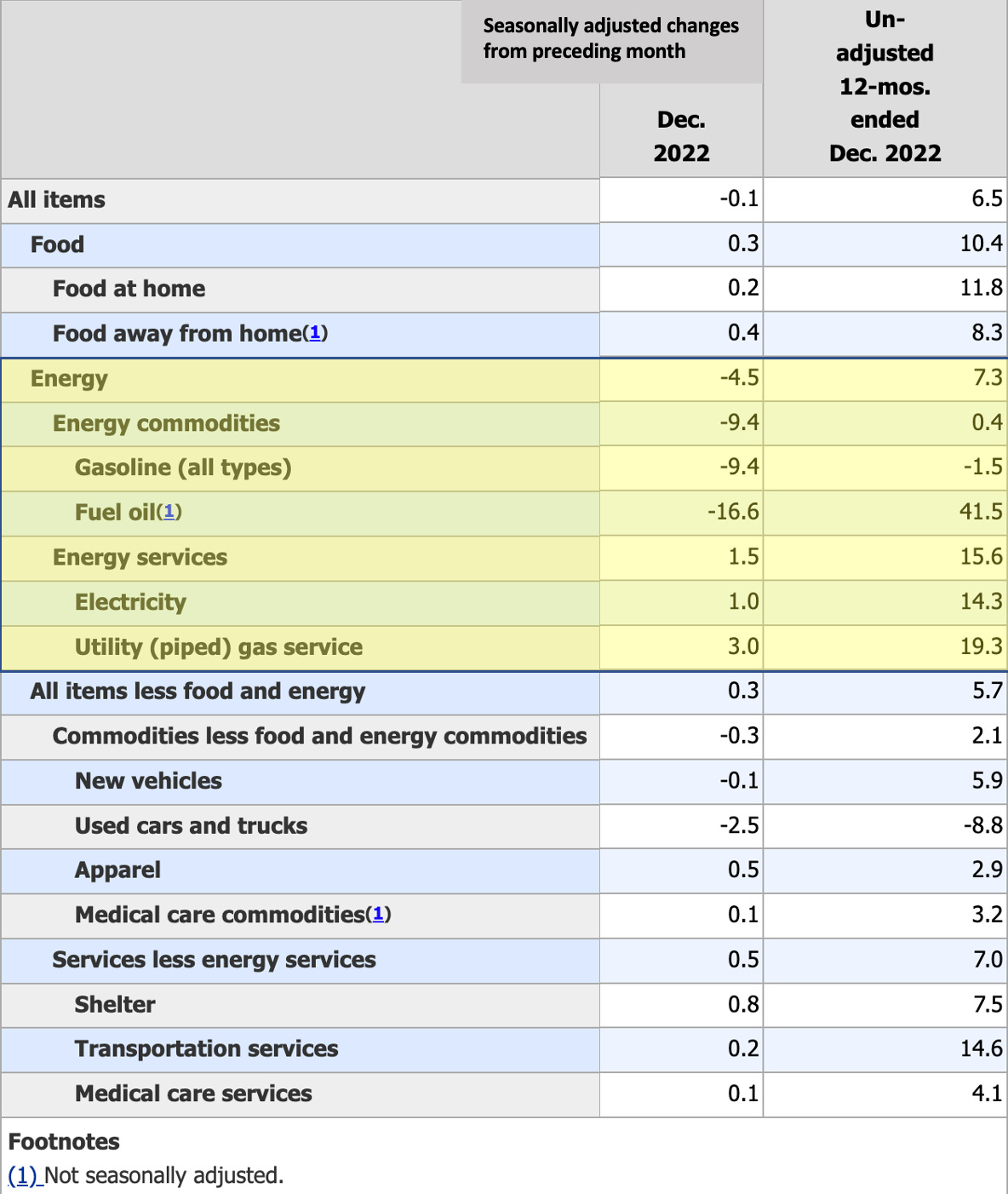
Service sector-based inflation, however, is inherently stickier than flexible-price food and energy goods, and remains elevated, increasing 0.5% mark-to-market from December. Sticky inflation components, as their name suggests, are less volatile than commodity-derived factors of CPI.
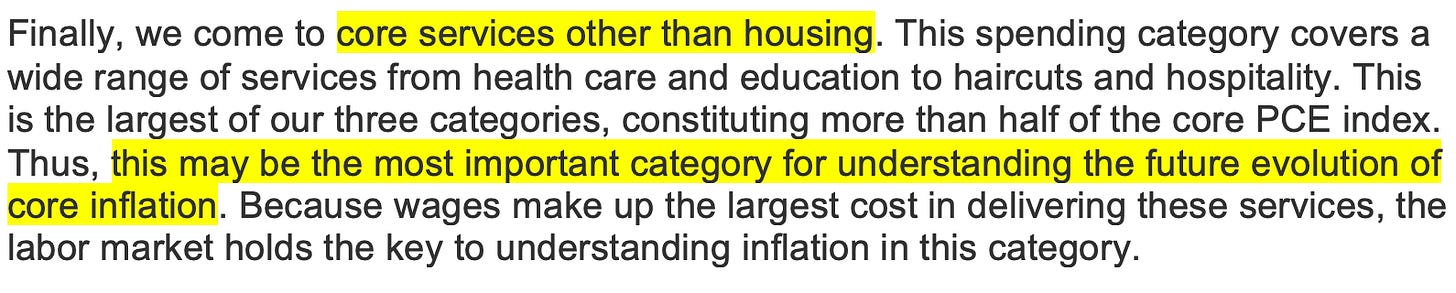
Over 2022, beating back sticky inflation was a priority of the Fed. As noted by Chair Powell, core service inflation is one of the most important metrics the Federal Reserve’s Board of Governors examines to predict economic health and steer monetary policy.
What the Fed is doing
Why does inflation matter to the Federal Reserve and how do they use monetary policy to combat it? The Federal Reserve is charged with a dual mandate, tasked with maintaining both: Price Stability and Full Employment.
In practice, simultaneously achieving these goals is difficult.
Inflation can be controlled via the tightening of economic conditions and achieved by raising interest rates. As the cost of capital increases and financing becomes more expensive, spending slows, providing downward pressure on inflation.
Contractionary monetary policy is the term used to describe the Fed’s current efforts to slow economic activity by increasing the targeted Federal Funds Rate (the aggregate interest rate charged for interbank secured overnight lending). While the Federal Reserve does not lend directly in the Federal Funds market, it can impact monetary policy with a variety of policy tools, including open market operations, discount window lending, and repo lending facilities.
Markets are forward-looking — they incorporate anticipated future Federal Reserve monetary policy into today’s cost of borrowing. Changes in how the market perceives the future path of inflation become incorporated into yields and asset valuations as the market reconciles these adjustments.
Rising interest rates slow growth and typically lower the level of employment, forcing the Fed to play a balancing game in how quickly and at what magnitude they can increase the Fed Funds rate without driving the economy off a cliff into recession.
Labor markets remained surprisingly resilient throughout 2022, with unemployment down-only, closing out the year at a post-COVID low of 3.5%.
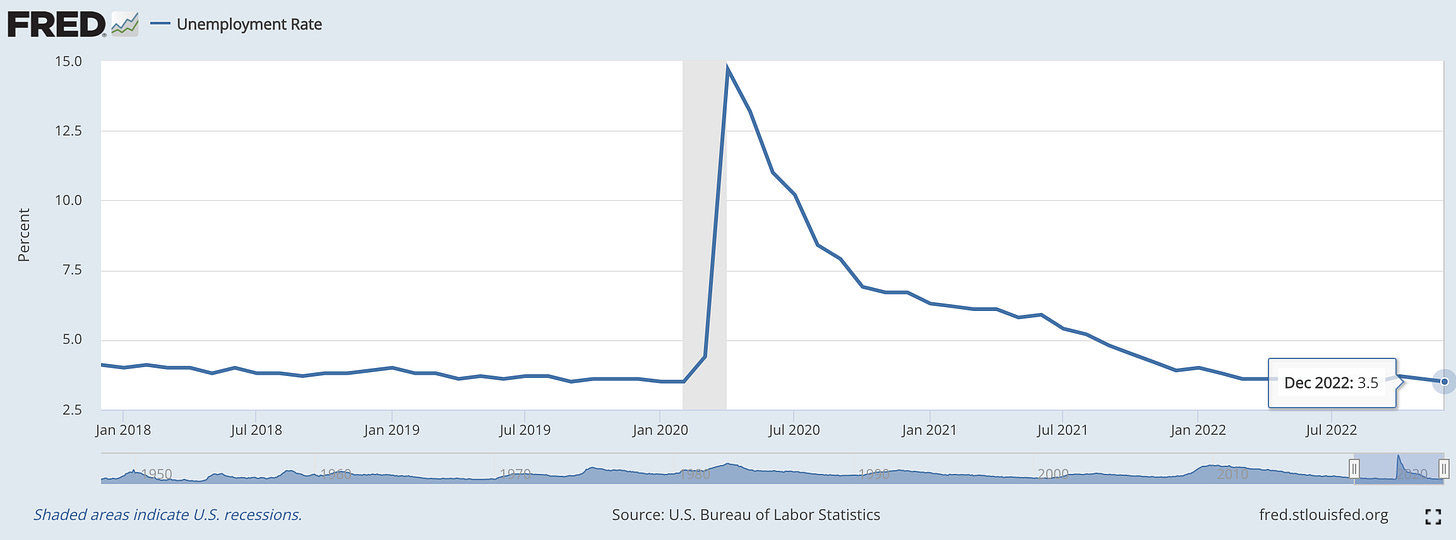
Strength in employment allows the Federal Reserve to continue to ratchet up interest rates. Asset values are not a primary consideration for the Fed when setting monetary policy. Ironically, over the past year strong employment data has spawned fears that the Fed will have greater room to raise interest rates which has negatively impacted valuations.
With limited relief in sight as the unemployment rate continued to fall, a slowdown in inflation remained investors’ life-line to looser financial conditions.
December’s CPI data finally provided that relief.
What the numbers say
While the data was not entirely rosy, given the continued inflationary pressures in sticky categories, you better believe Wall Street MBAs did the mental gymnastics to get bullish! As highlighted by the WSJ:
Core inflation, the preferred inflationary metric of many policy makers and market participants, already strips out the volatile components of commodities pricing in the measurement. Supercore inflation estimates are Wall Street’s attempt to rationalize the increasingly complicated inflation story.
Inflation metrics for many core goods categories have turned deflationary, due to normalizing supply chains and moderating demand for goods (a direct impact of contractionary monetary policy), while inflation in service-based buckets remains high, partially a result of a stubbornly tight jobs market and upwards wage pressures.
Supercore inflation scores exclude both core goods and shelter service baskets, with some market participants opting to precluding medical services, as well.
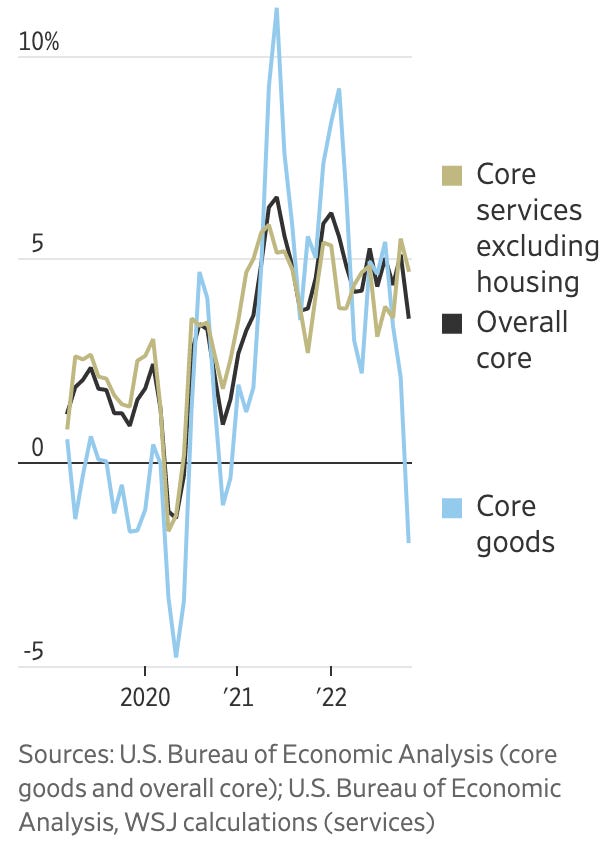
Roger Hallam, global head of rates at Vanguard, notes that, “the goods and the shelter print will get less relative focus compared to what’s happening on the services side of things,” over the course of the next year. Additionally, Hallam sees market participants placing greater emphasis on employment figures.
Okay, so thinks are looking mixed but promising — what should you do about it though?
Enjoying this article?
Subscribe to Bankless or sign in
Stay cautiously bullish
You never want to be the clown who stays in crypto throughout the bear market and misses the rally. But you really don’t want to be the fool that FOMOs into $21k BTC or $1550 ETH at their local tops, then get liquidated on the way to the actual bottom.
Even I, resident Bankless bear, admit: this may be the Goldilocks zone!
- Inflation is on the mend
- Employment remains strong
- Everyone else seems to be buying
Cautious optimism is the key, however.
Remember when Soylana and Craptos were tanking post-FTX? Perhaps, check the optimism you have in this present moment. Those fund redemptions that were going to take place? Just ask yourself if there is a chance that they are occurring right now…
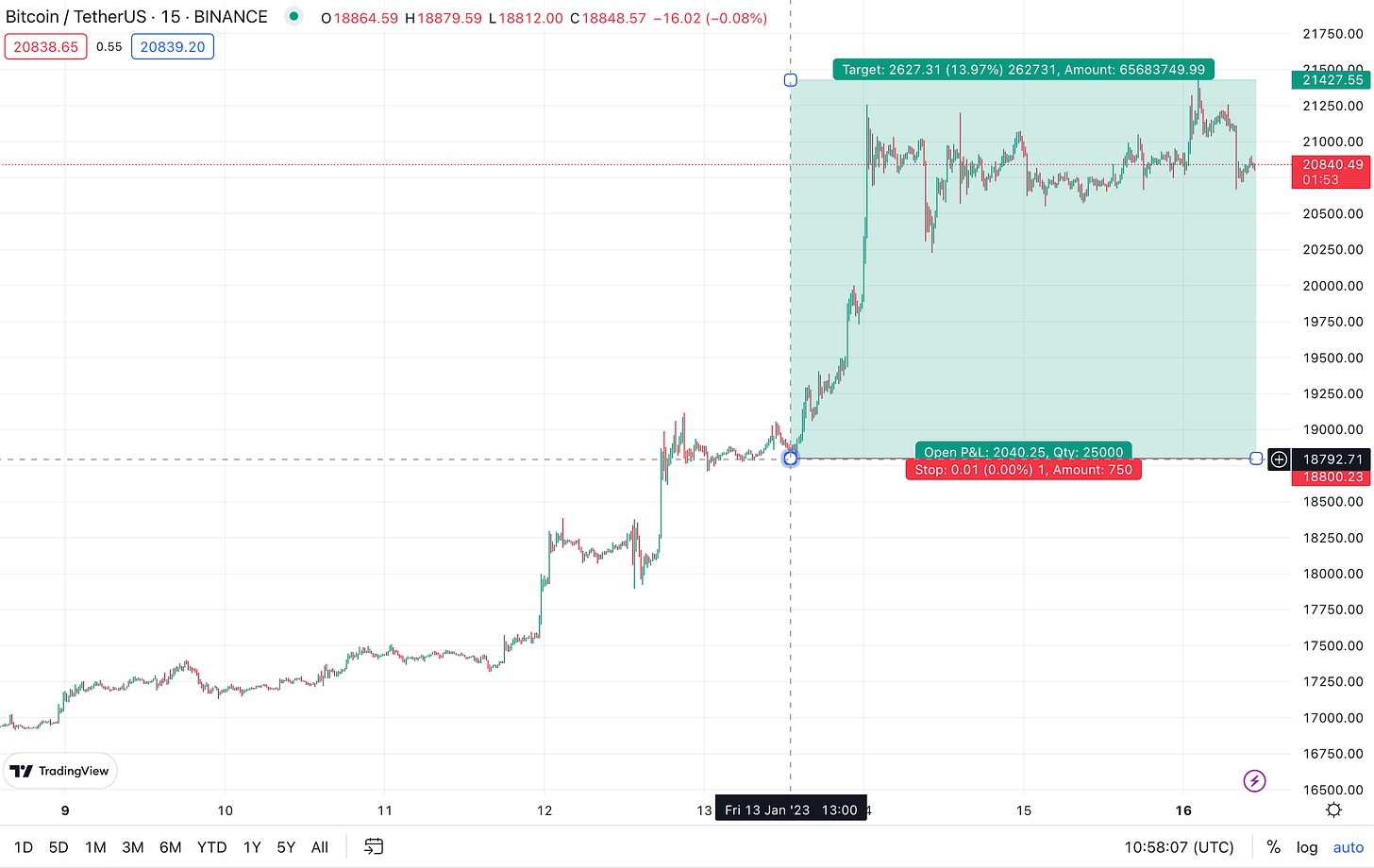
If I have learned one lesson throughout my time in crypto that has repeatedly burned me, it’s that price action on weekends (especially three day weekends) is often scam price action. Bitcoin’s largest dumps since August were all preceded by Friday pumps that carried over into the weekend (indicated by the purple box.
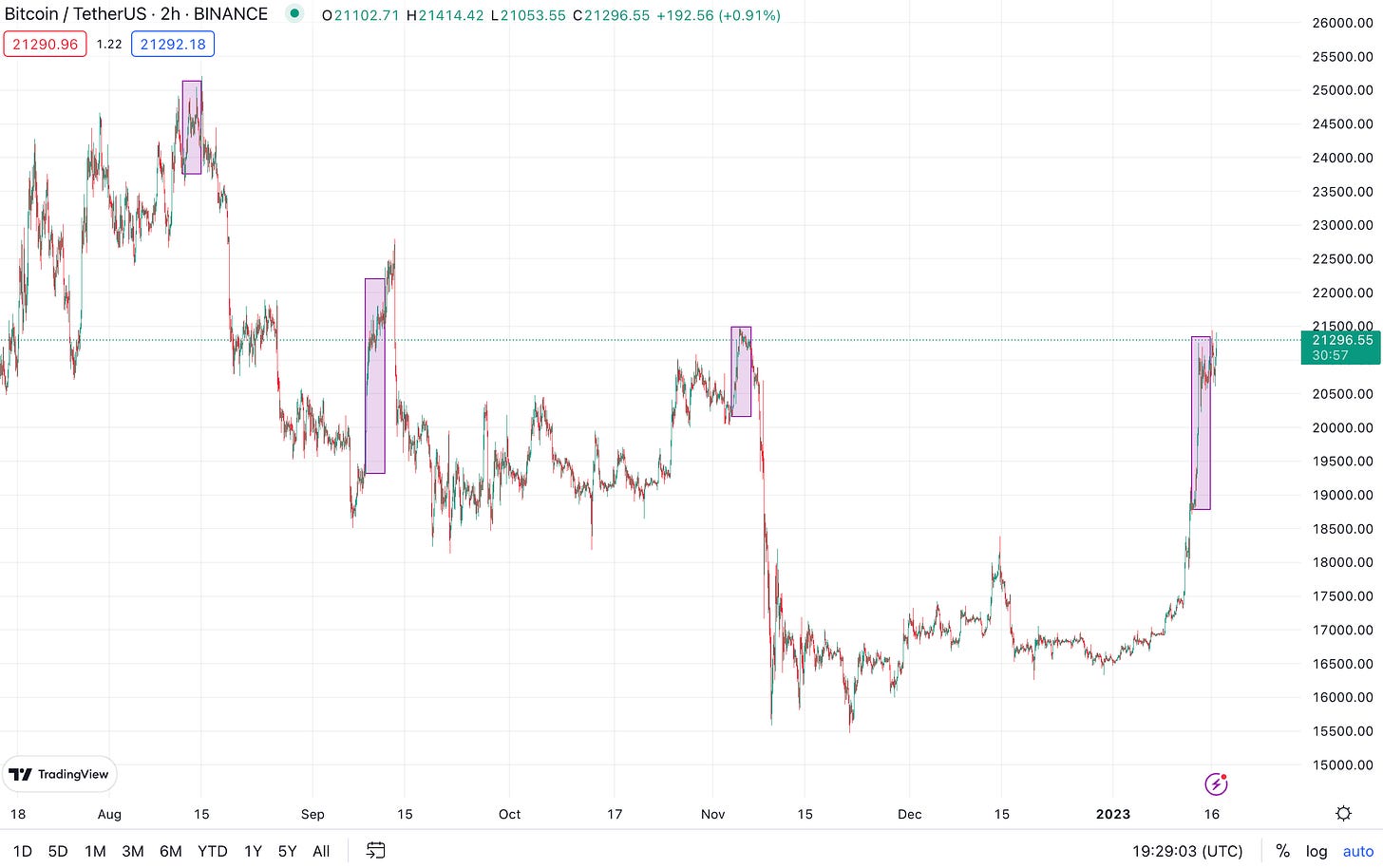
Subsequent trading action took BTC to new cycle lows every time.
As the market makers head home for the weekend and TradFi markets close for the weekend, liquidity decreases. This increases volatility and makes price more susceptible to extraordinary swings. Abnormally high trading volume can easily push price to the extreme in both directions.
This weekend high saw BTC push to highs nearly 14% above the Friday close.
Keep in mind that while BTC spot markets may be difficult for an individual or small group to manipulate, low-float altcoins are certainly not immune to such behavior.
As your token goes up in value, you can borrow more against it! Hypothetically, if you are a decently capitalized VC that just got hit with redemptions and holds a lot of low-float coins, say a collateral-tier bluechip DeFi project like Lido, you could borrow against their increasing values, long your coin in a low-liquidity market, and attract rotatooors who will pump your coin alongside you.
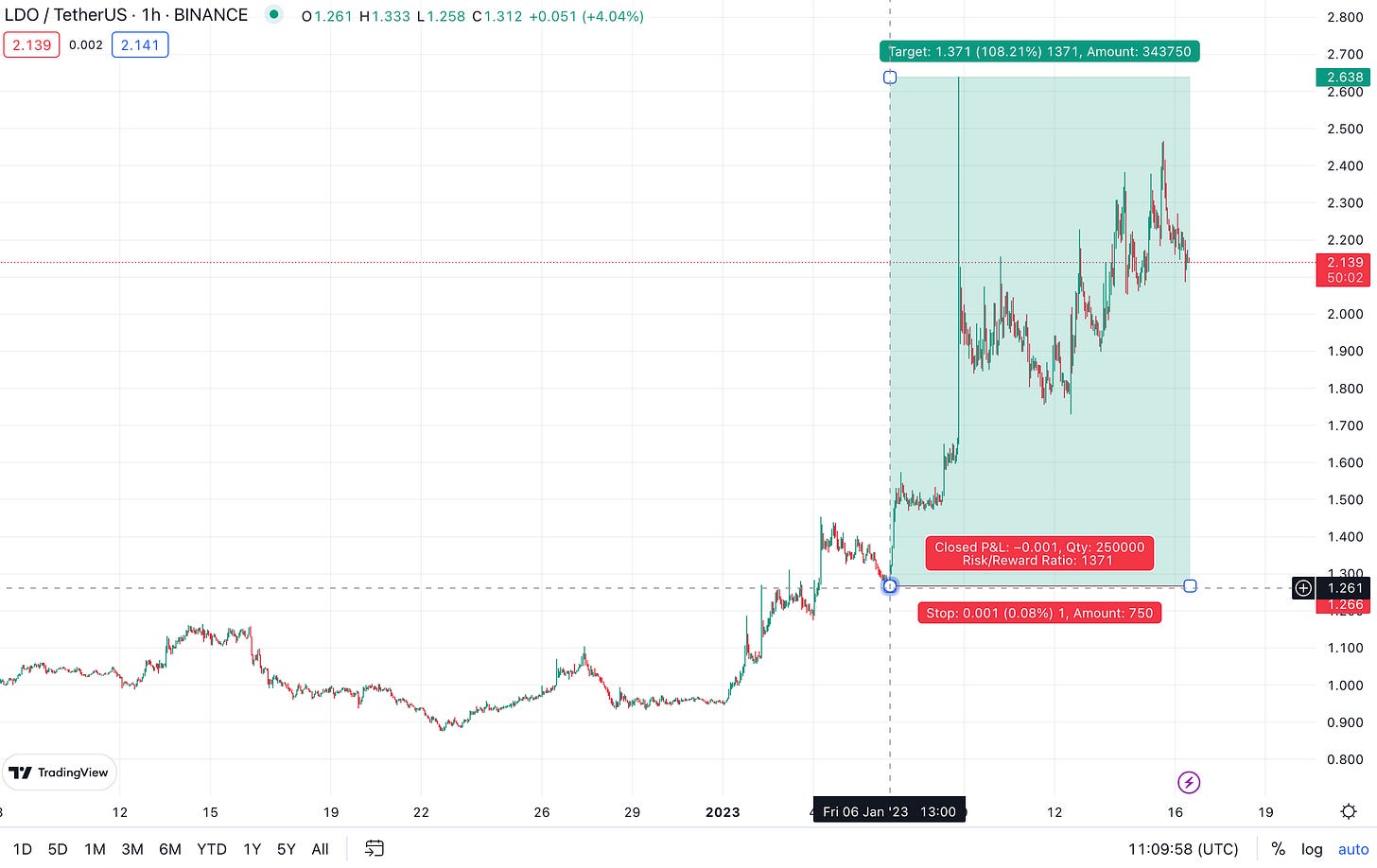
While VCs bag dumping will depress market prices, attracting fresh blood and renewed attention to their shitcoins enables them to exit at much more favorable prices. Remember anon: VCs play games! Don’t let them steamroll you on their way out the door!
Throw back to Su abandoning Ethereum, anyone?
Yes I have abandoned
— Zhu Su 🔺 (@zhusu) November 21, 2021Ethereum despite supporting it in the past.
Yes Ethereum has abandoned its users despite supporting them in the past.
The idea of sitting around jerking off watching the burn and concocting purity tests, while zero newcomers can afford the chain, is gross.
This tweet marks the beginning of an aggressive AltL1 bag shilling campaign from the folks over at 3AC.
Their efforts proved resoundingly successful, with LUNA mooning nearly 200% over the subsequent five months!
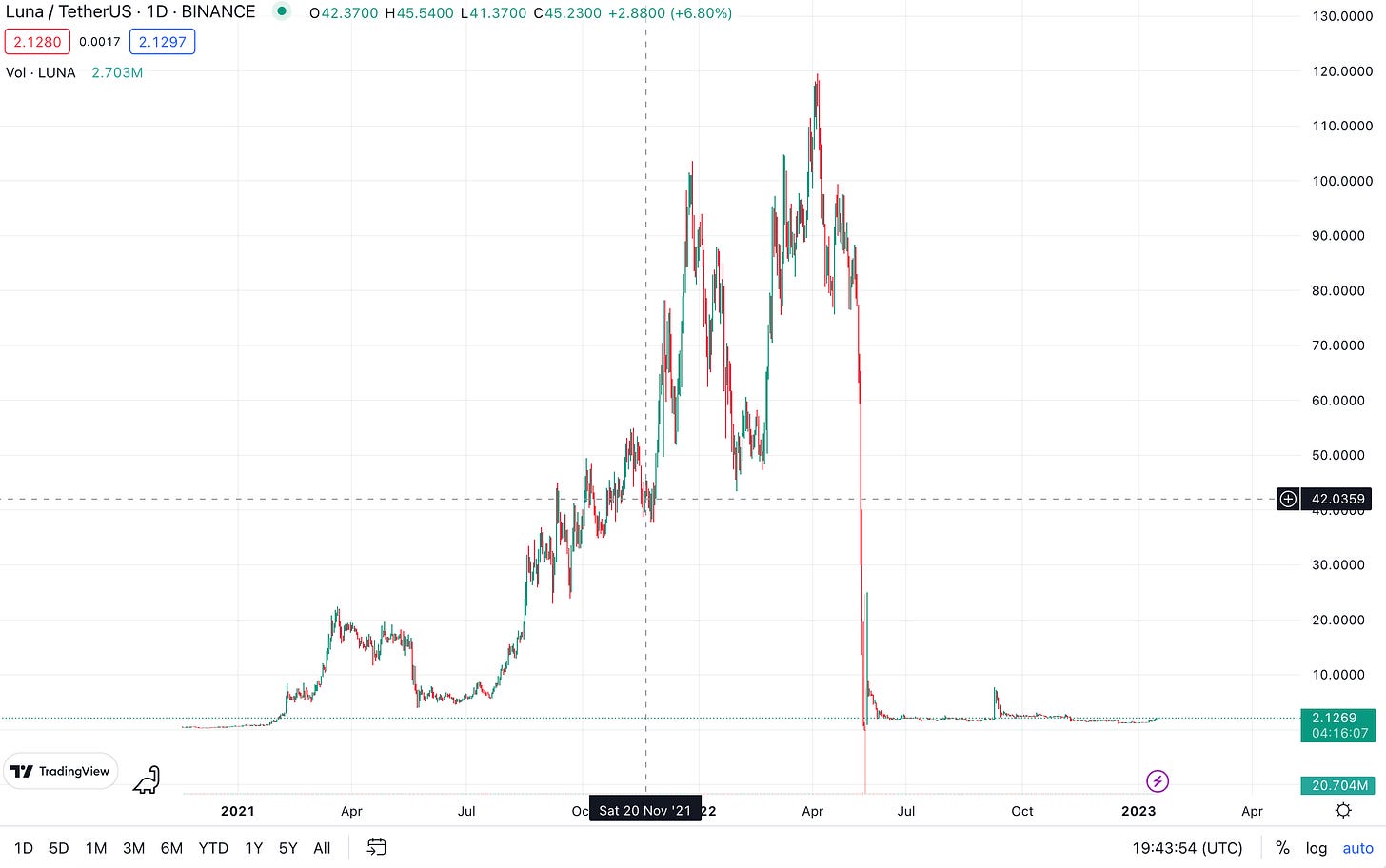
Despite publicly announcing support for Alt L1s and prophesying the death of Ethereum in late 2021, 3AC had acquired their bags long before.
Hedge funds and venture firms generally do not announce what they are actually doing in public! Why would they? They’re profit-maximizing institutions seeking to extract maximum returns from crypto markets. They play games of misdirection and distraction designed to separate you from your capital and to get you to ape their bags.
If you’ve read all of this and are still intending on playing the markets right now:
- Avoid leverage
- Don’t marry your bags
- Hit the big red button at the first sign of increasing unemployment
- Exercise a healthy dose of skepticism towards anyone shilling their bags
If you can do these three things and stay cautiously bullish, you’ll (hopefully) have enough ammo for wherever the market goes!
Don’t ape. Don’t FOMO. DYOR.
And most importantly, ignore the noise on Twitter 🤝
MARKET MONDAY:
Scan this section and dig into anything interesting
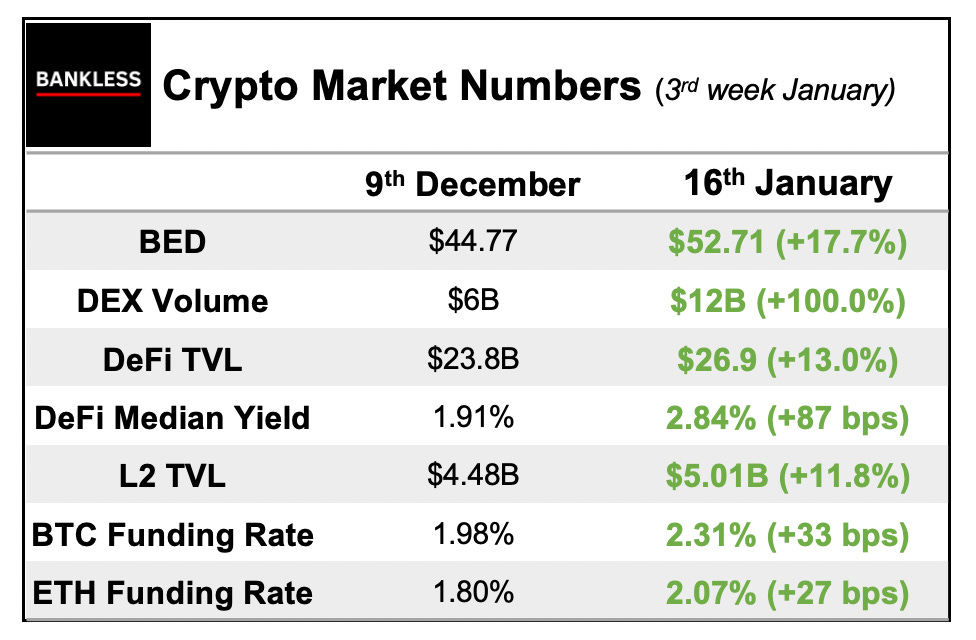
Market Numbers 📊
Market Opportunities 💰
- Protect yourself from scams with Metamask’s guide on how to avoid address poisoning
- Explore perpetuals funding-rate yield opportunities with DeFi Llama’s new dashboard
- Stake ETH via
 Lido or
  Rocket Pool in MetaMask
 - Join the VIP sign-up list for Vouch from Discoxyz
- Mint Yuga Labs’s Sewer Passes on January 17
Yield Opportunities 🌾
- ETH: Earn 14% staking sETH-ETH Curve LP tokens in Convex on Ethereum
- ETH: Earn 9% staking ETH-swETH
 Balancer Pool Tokens in Aura on Ethereum
 - BTC: Earn 5% LPing Curve’s sBTC-BTC on Optimism
- USD: Earn 16% LPing in Curve’s sUSD-3CRV pool on Optimism
- USD: Earn 11% LPing the 3Pool in Curve on Optimism
What’s Hot 🔥
- AWS teams up with Avalanche
- Avraham Eisenberg is charged with fraud by the CFTC
- Ondo announces their plans to tokenize US Treasury Bonds
 Binance announces plans to increase its headcount by 15-30%
- FTX recovers over $5B in customer assets
Money reads 📚
- Staking Exit Queues (Thread) - @WesiteCapital
- An Open Letter To The Board of DCG - Cameron Winklevoss
- CoinMetrics State Of The Network: Issue 189 - CoinMetrics
- 10 Biggest Crypto Narratives for 2023 - Korpi
- MEV: The Next Five Years - James Prestwich
Governance Alpha 🚨
- Olympus DAO votes in favor of acquiring AURA
- 1inch weighs implementing a token burn mechanism
- Rocket Pool looks to adjust protocol parameters in anticipation of the Atlas Upgrade
 Aave determines which assets will be added to V3 on Ethereum
- Compound plans their migration from V2 to V3
Trending Project: Stader 📈
Analyst: Ben Giove
- Ticker: SD
- Sector: Liquid Staking
- Network: Ethereum
- FDV: $116.8M
- Hotness Rating: 🔥🔥🔥
Tl;dr: A multi-chain liquid staking protocol is coming to Ethereum.
- Stader is a multi-chain liquid staking protocol, enabling users to receive staking rewards while maintaining access to liquidity and DeFi yield opportunities through the issuance of an ERC-20 token known as a liquid staking derivative (LSD). Stader is deployed on Hedera Hashgraph, Polygon, Fantom, Binance Smart Chain, Near, and Terra 2.0, with $123.7M in assets staked across these networks. Stader is governed by the SD token, which validators for the protocol can also stake to receive increased delegations on delegated Proof-Of-Stake (dPOS) networks.
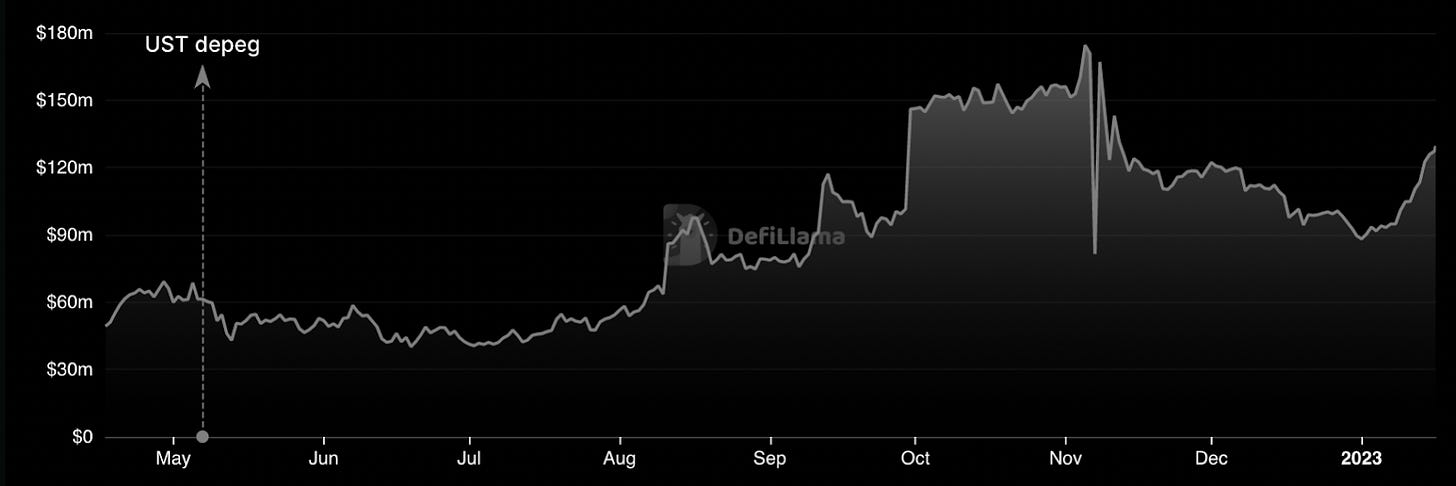
- Stader recently announced their plans to expand to Ethereum and released a whitepaper for their LSD, ETHx. ETHx will utilize a cToken model, meaning it will not have rebases. The protocol will also create three distinct groups of validators including a permissioned pool of whitelisted operators, a permissionless pool which validators can join if they post a 4 ETH bond, and a final pool that utilizes Distributed Validator Tech (DVT) via SSV network.
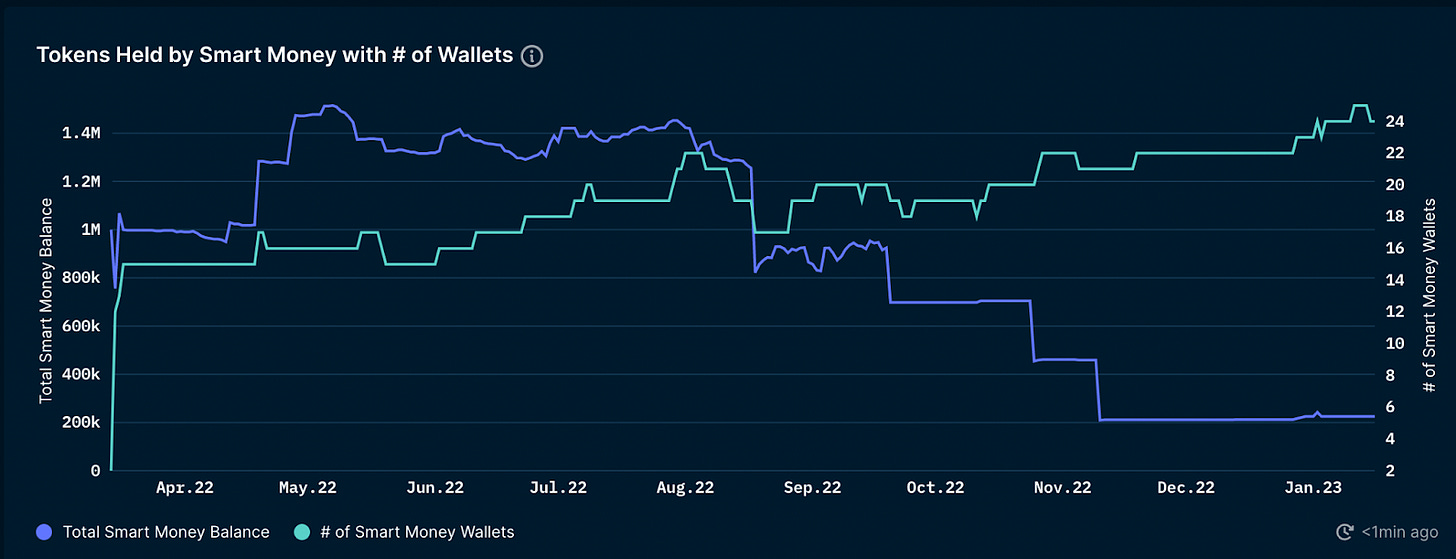
- SD has outperformed considerably to start 2023 as the broader market has recovered and as investors have been buying LSD governance tokens in anticipation of the Shanghai network upgrade, which will enable withdrawals from Ethereum staking. SD has soared on the back of these catalysts, with the token up 199.2% and 120.5% YTD against USD and ETH respectively. Despite this it appears as though some whales have watched this move from the sidelines. Nansen Smart Money Balances of SD have fallen 50.9% since the collapse of FTX, indicating that these entities sold the bottom, rather than helping fuel the rally.
Hotness Rating (🔥🔥🔥/5):
Stader is looking to seize the opportunity in liquid staking post-Shanghai with the launch of ETHx. Although it remains to be seen how much market-share the LSD will capture, given its $7.9M market-cap, SD could represent a way for short-term traders to get high-beta exposure to liquid staking protocols. However, given that the low-market cap is the result of just 6.7% of the SD supply circulating, long-term investors may want to exercise a bit more caution.
Meme of the Week 😂
Miss El Salvador dressed in #Bitcoin outfit at Miss Universe 2023.
— Crypto Crib (@Crypto_Crib_) January 12, 2023
Bullish?
pic.twitter.com/PqBNmlRj0k
Job opportunities 🧑💼
- Bankless: Director of Business Development
- Uniswap Labs: Senior Software Engineer, Protocols
Browse more roles (or add your own) at the Bankless Jobs Board
Action steps
- 🤑 Execute any good market opportunities that you saw
Subscribe to Bankless. $22 per mo. Includes archive access, Inner Circle & Badge.

Jack Inabinet
Jack Inabinet is a Senior Analyst with a passion for exploring the bleeding edge of crypto and finance. Prior to joining Bankless, Jack worked as an analyst at HAL Real Estate where he conducted market research and financial analysis for commercial real estate development and acquisition activities in the Seattle region. He graduated from the University of Washington’s Michael G. Foster School of Business.