A Conversation with Michael Ippolito
David livestreams with Blockworks's Mike Ippolito in a freestyle conversation covering all things crypto.

Up next
All episodes 00:19:39
Podcast Premium
00:19:39
Podcast Premium
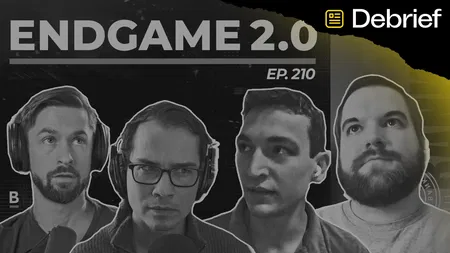
DEBRIEF - Endgame 2.0: A Guide to Vitalik’s Ethereum Roadmap
 02:30:00
Ethereum
02:30:00
Ethereum
210 - Endgame 2.0: A Guide to Vitalik’s Ethereum Roadmap with Mike & Dom
 01:06:07
Podcast
01:06:07
Podcast
ROLLUP: BTC $1T Market Cap | More ETH ETF Filings | $STRK Airdrop Pushback?
 01:24:48
Podcast
01:24:48
Podcast
The Pudgy Penguins Comeback Story With Luca Netz
 00:51:37
Podcast
00:51:37
Podcast
Starknet Token Launch Is Here! ($STRK)
 01:09:51
Podcast
01:09:51
Podcast
Hasu & Hart on Oval & The Recapturing of Billions in DeFi Liquidations
 00:19:57
Podcast Premium
00:19:57
Podcast Premium
DEBRIEF - Why e/acc Is Right with Beff Jezos (Guillaume Verdon)
 01:53:52
Podcast
01:53:52
Podcast
209 - Why e/acc Is Right with Beff Jezos (Guillaume Verdon)
Inside the episode
David livestreams with Blockworks's Mike Ippolito in a freestyle conversation covering all things crypto.
Transcript
Bankless Nation, happy Friday. We got an unscripted conversation coming at you live. Me and Mike and Bolito are just gonna go at it. Uh whenever we talk a bunch in real life, uh it's always super I always learn a ton from Mike and Bolito. And so I'm going to do that again today, but this time live on the stream. So we're gonna get into that conversation, but first I'm gonna talk about some of these fantastic sponsors that make this show possible. How's it going, Mike? How you doing?
Doing very well, man. Do very well. No complaints. Almost the end of the week.
Yeah.
Happy
never happy We never ever talk. Wait, what's up with that?
The joke is we actually we talk quite often, but we never get to talk, I think, open-ended. Uh when we do, it's usually in a some sort of like crowded, loud environment and not
as productive as it could be.
So I hope that uh I hope we can kind of change the game a little bit with uh what we talked about today.
Yeah, I agree. Um well
do you want to start first? I mean, it's been it's been an interesting week. Um
It's been it's been an interesting week. It's been an interesting quarter. Uh I think things are crescendoing in their interests. Maybe maybe we could start um
uh just as like uh where we left off when we had you on the podcast like half a year ago now.
Uh and you had, I think, one of the most banger podcasts that we had in a while, really just talking about the Solana thesis, the um Ethereum thesis, the Cosmos thesis, and how they're all kind of like representative of different points to enter into a becoming a blockchain. And how you were saying like everything is kind of converging. Uh that was like a banger episode. Everyone loved it. Uh and I'm just wondering like uh that was six months ago. Um, there's a lot of stuff that has happened since then. Um maybe that I can just present that to you and see where you want to go with it.
yeah, I think um
I think since then we've started to see even more, even more convergence. And one of the, you know, there's actually a great, you know, this is basically anything that Vitalik writes is gold, right? But he's got this great, very nicely summed up uh
Very nicely summed up diagram, which is uh the the basically three different ways that blockchains are evolving. Uh, and the common component of that is centralized block production, uh, but decentralized uh proofs and verification. And there are three different ways that that's playing out across a whole bunch of different ecosystems right now. So, like let's take two of these examples, which would be Ethereum, where there's uh Ethereum um and there are centralized builders and a couple of different roll ups, or there, or maybe let's call it one large rollup, where there's one.
Uh centralized sequencer that's doing a lot of the block construction up there. Or there's uh many different roll-ups, which is sort of what we're seeing now. But MEV is ultimately what end up ends up re centralizing that block production because you have uh MEV that gets extracted with very expensive proposition to build blocks across all these different fragmented rollups that requires a big centralized builder to stand in the way. And then on the Solana side of things, like this would be sort of the high TPS chain, which is the third leg of that stool. You've got obviously higher bandwidth and hardware requirements for validators. Uh, but you actually saw this was pretty cool from Sovereign Labs. You saw the very beginnings of a light client over there, an SPV type light client. And we know we're going to get tiny dancer on the Solana side of things. So I think that Vitalik, uh, as per usual, said it much better than I ever could in a million years. But
Additionally, like we just saw uh Polygon release something pretty cool this week called the Ag Layer, which is this we we've been talking a little bit about aggregated ZK proofs, which do something very similar. Celestia, which I I to be honest, at the time I didn't really get too deep on the design, is also very similar, kind of big blocks, a few chunky validators, but they've got these light nodes which verify and have special powers within the chain. So
I think if anything, it's it's pretty live and well.
So I think like uh the before Bankless, I did this podcast with my old buddy uh Christian Caroles, who then went on to work at uh Bitcoin Media. And my my arc in that role was like the everything guy. So I'm I I'm all the chains, the multi layer ones, the the cosmos, the interoperability, uh the bridges. Uh and then he was Bitcoin. He was the Bitcoiner. And then slowly over time, I kind of morphed my thinking, my like my like uh just like ideas for how the space would converge. And then I converged into the Ethereum uh camp.
And then it became like a Bitcoin versus Ethereum podcast.
And now I'm kind of like
going back a little bit the other way, where just like you're seeing the writing on the wall. Like, Solana's not going away. There's so there's always so much excitement on like newer change, no matter what era you're in. Like right now, Celestia is super hyped and actually getting real real adoption.
Uh Monad isn't even live yet, and people love it already.
Uh, there's always gonna be the move towards uh just like newer chains. I think people are always going to enjoy new chains. And so like I'm kind of like waving the flag on just like one central chain that will like gobble up everything. Even though I do think that like there are forces that push towards that direction and there always will be, but there's also like push forces that push away from that direction and there likely always will be because we've definitely seen that over the last like you know, it's eight years in crypto.
So, David, what do you think, if you had to outline, what do you think the forces that push us towards that direction of one chain to rule them all, and what are the forces that disperse us from that consequences?
I think the very, very simple one is like if the bigger that the the top dog chain is, like the one chain to rule them all, the bigger that that one is, the stronger of an incentive there is to fork off from that chain and try and uh build a new one, a better, like a better Bitcoin, build a better Bitcoin, like an Ethereum killer. So like there's like this natural equilibrium that is set in between like it doesn't matter how successful you are, the larger, the more successful you come become.
The stronger the incentive it is to be to dethrone you. And then you get into like the VCs playing like the alt-layer one games, which you know retail also loves. Retail loves that game too. And so like there isn't, I don't know if there's ever
and then also like there there was that meme that John Charbonneau tweeted out that I think you retweeted maybe, and it was like
generalized chain wants to become more specific, more specific, or app app wants uh more sovereignty, so it becomes an app chain on a generalized chain. And then app wants more features, becomes more generalized. A new app comes and uh is born on that slightly more generalized chain. And then now that app wants more sovereignty, so it makes an app chain, and there's like a cycle. There's always just like you can't have too much of anything.
Because there will always be some sort of opposing force to check on that. Uh and so that's kind of what I'm seeing. Like I'm just ready for like the new crop of layer one to like gain of attention of attention in this bull market and the cycle repeats.
I'm I'm with you. Another way of saying that VCs and retail love new layer ones is entrepreneurs love it too. That is, I think, the single driving force, which is just that.
Entrepreneur sees inevitably with these, you know, with uh blockchain architectures, you have to make trade offs. And there's always like one smart person who's like, I don't really like that you made this trade off. I actually think there's a market for someone who made the opposite side of this trade off, and then they go do that. So every experiment ultimately ends up getting run. And again, I think that's I think that's a positive thing. But that's a that's a funny meme because.
I think also one thing that might be changing at least my worldview about how I used to think about things. I used to think about the world very black and white between general block space versus app specific. So like general is like Ethereum, right? Like you can do anything you want, it's the world computer. And then Osmosis is an example of an app specific chain. It just wants to be a DEX. That's what its block space is optimized for.
But it's kind of converging in both directions. And
even the general blockchains, like Ethereum's roadmap now looks like the main chain is a bulletin proof or bulletin board for hosting ZK proofs, and it's exporting money. And it's like
Well, Bitcoin kind of started general, but now it's the app chain for money. Ethereum looks like it's heading in that direction. So Ethereum is specializing, but then some of those DEX is like Osmosis, like, hey, yeah, we've got a DEX, but you should come build a DEX on our DEX, you know, and say it's like, yeah, we're actually, you know, we're building, you know, sector specific block space. So all of our validators have to run their own order matching engines. Like,
you know, we're kind of converging on it, probably both sides. That, you know, once you have an app that reaches some amount of product market fit, you want to expand. But the big, really general ones are like, actually, the world is just too big. We need to specify. So we're kind of converging there as well, I would say.
Are you c are you saying that there's no such thing as actually truly general block space?
I think, yeah.
I think I'm landing on that. I don't think I think it might be a myth.
Similar to bridging.
Okay, so but Ethereum at block uh at the Genesis block.
In 2015, and then before it became had any sort of like actual real uh applications on it. That was general block space, right?
Yeah. Yeah.
Yeah. Unmorphed. And then had to specialize at some point. And then had to specialize, yeah. But is Ethereum specializing now? I guess now it it will still be pretty general um until Dankun. And that is the first intra instance of Ethereum specializing with um blob space, right? Like it's still pretty general up until that point. It's just like the apps have started to force it into being more
dedicated towards specific reasons.
But not anything inherently at the base protocol.
I think ultimately every
even like Solana, which is the, you know, it's the light speed, it's the world uh it's
uh consensus at the speed of NASDAQ, global, all that stuff, it's probably gonna have to end up specializing. I'm not technical enough to be like at this level of throughput, this many transactions, this globally distributed, is when you'd have to start specializing.
But I sort of do trust the modular camp that eventually not the entire internet can sit on one layer with one set of validators. Ultimately, you're going to need to start specializing. So I think it's coming for Ethereum and Solana and not in a bad way. It's just, hey, we have product market fit on these certain things. We should double down on this and really expand.
Yeah. Well, I think we we just did this um super long podcast with Mike Newter uh and Domathy.
Two hours, 45 minutes around the Ethereum roadmap. Uh, and that's kind of like when like once again, uh, it was impressed upon me that the long term conclusion of Ethereum is this like super lightweight layer one blockchain that just receives and verifies proofs of what could be anything at higher levels.
Um
And then that's also what the Bitcoiners want Bitcoin to be.
Like, that is if you're a Bitcoin builder, if you're a Bitcoin Renaissance, not a Bitcoin maxi, then like
you're really interested in Bitcoin being like the truth layer for any sort of expressive alternative layers. They've just never been able to figure out how to get Bitcoin to become that. But that is what Bitcoin wants to be, according to them.
Um, and the thing is, like,
if Bitcoin achieves that, like, there's a lot of focus on the BitVM right now. Uh, if Bitcoin achieves that, then like it's actually achieved that faster than Ethereum did, and without all of the like technical debt that Ethereum has.

David Hoffman
Co-owner at Bankless. Optimistic storyteller of frontier technology.

.jpg-48bb3b8a9a7a83dee5836f716023f733.jpg)


.png-a616dc52961c1edd72b0c1fdf5f47e7a.png)
.png-336efc5e35995e6b184e7e830baa688b.png)