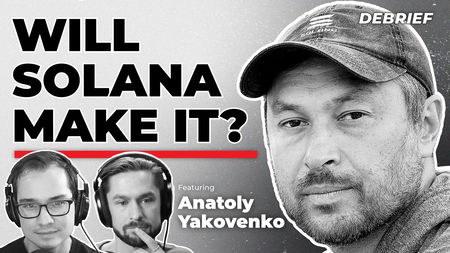
157 - Will Solana Make It with Anatoly Yakovenko
In today’s episode, we have the creator of Solana and the Co-founder of Solana Labs, Anatoly Yakovenko. We brought on Anatoly to ask: is Solana going to make it?


Up next
All episodes 01:37:05
News
01:37:05
News
ROLLUP: Bitcoin NFTs | Canto | FOMC Interest Rates | Blur OpenSea Royalties
 01:14:53
Podcast
01:14:53
Podcast
The Power to Mint Money
 00:24:57
Podcast Premium
00:24:57
Podcast Premium
DEBRIEF - Will Solana Make It?
 01:26:58
Podcast Premium
01:26:58
Podcast Premium
EARLY ACCESS - Will Solana Make It? with Anatoly Yakovenko
 01:54:07
Ethereum
01:54:07
Ethereum
156 - Investing in Waves with Chris Burniske
 00:11:36
Podcast Premium
00:11:36
Podcast Premium
DEBRIEF - Investing in Waves
 01:49:06
Podcast Premium
01:49:06
Podcast Premium
EARLY ACCESS - Investing in Waves with Chris Burniske
 01:38:31
Podcast
01:38:31
Podcast
155 - The Rise of Decentralized Social Networks with Farcaster’s Dan Romero
Inside the episode
In today’s episode, we have the creator of Solana and the Co-founder of Solana Labs, Anatoly Yakovenko. We brought on Anatoly to ask: is Solana going to make it?
Price is down. A major public backer…SBF is down for the count…will Solana make it? Will it survive the bear market? Anatoly shares his thoughts.
In addition, he also shares the full Solana story, back to its earliest inflection points all the way to the current state of Solana today.
TIMESTAMPS:
0:00 Intro
7:58 2022 & 2023
10:05 Solana Origins
14:40 Passage of Time as Data
25:30 Bandwidth Trade-offs
29:29 SOL as Money?
32:04 Security
36:24 Continuing the Solana Story
44:10 Early Day Solana Vibes
48:20 Solana Growth Acceleration
51:31 2021 Solana Price
53:12 The Crypto VC Narrative
54:37 Solana Haters
59:55 FTX & SBF
1:07:16 Solana Critique
1:09:35 Cultural Debt
1:14:46 The State of the Solana Community
1:19:37 The Future of Solana
1:24:36 Solana VM
1:26:39 Will Solana Make It?
1:31:15 Final Solana Questions
RESOURCES
Anatoly
https://twitter.com/aeyakovenko
Firedancer
Transcript
My guess is if you like looked at all the product launches from inception of crypto to now to what's gonna happen in the next like twelve to eighteen months, then the next twelve to eighteen months is probably gonna be way more than everything else combined up to this point. And if people are launching products, they're grinding for product market fit, they're gonna get users, means crypto's gonna survive. It's just like that's gonna happen.
Welcome to Bankless, where we explore the frontier of internet money and internet finance. This is how to get started, how to get better, how to front run the opportunity. This is Ryan Sean Adams, and I'm here with David Hoffman, and we're here to help you become more bankless. Talking about Solana today. The chips are down, prices are down. A major public backer of Solana, SBF, he's down for the count as well. He's definitely not helping the sentiment. So we brought on the Solana co founder to ask the question Is Solana gonna make it?
A few things to look out for in this episode. Number one, we go through the full story of Solana back to its earliest moments. Number two, we talk about the state of Solana today, both post-FTX, uh pre-FTX as well, and at the bottom of the bear market that we find ourselves in. Well, it might not be the bottom yet. We'll see. And number three, Anatoli's reaction when he first heard the news of SBF. And lastly, we asked the question that I think is on a lot of people's minds in this market will Solana survive the bear? And if it does, how he thinks it will make it out. David, you really wanted to have this podcast. Tell us why.
I really think the timing for this episode is right. I see currently a lot of parallels between the moment that I decided to grow a bunch of conviction about Ethereum and the state of the Solana ecosystem right now. I've wanted to bring Anatoly on for a long time, and I think right now is the best moment to do that. And that's because of really where Solana is as it relates to its community, its builders, and its leadership. I think right now the Solana ecosystem is going through a moment of self-reflection as it looked back upon its own absolutely insane bull market throughout 2021 and 2022. And I think I see a lot of parallels to how Ethereum progressed through 2017 to 2018. I kind of think Solana is taking a lot of the same paths that Ethereum took. A crazy, crazy adoption story of a bunch of what ultimately ended up to be a lot of hot air, like Ethereum had ICOs in 2017. Solana had a lot of hot air in this last 2021 bull market. And at the end of this very bad year of just downward price action, a big pillar that really held up the Solana ecosystem, FTX and SPF, turns out to be a complete fraud. And so because the Solana community is really going through this period of self-reflection, that makes me bullish about the Solana community. That makes me really interested in seeing how they choose to take on hardship, how they choose to go about what is going to be a very difficult long bull market to pull Solana out of the hole that it's in. And that's why I wanted to bring Anatolia on. Because Solana is different than almost any other chain that is in crypto. It's different from all the EVM clones, Avalanche, Phantom, like whatever, in that it's got a multi-client architecture. It's the only other ecosystem that has a multi-client architecture. And there's a real builder community there. There's a real Solana community there. And so, like, Ryan, I know like you and I have been branded as like, you know, we have a big ETH bias. Of course, can't really deny that. But now that we are in this bear market, it feels safe to take down my walls during the bear market because of all of the crap that we flushed out during the bull market. My walls go up during the bull market because a bunch of newcomers come in and, you know, don't really understand the deep fundamentals about what makes crypto work. And now that that is well behind us, now that we are deep inside of this bear market, the people that are here are now here for the tech, no longer for the money. They must be here for the tech. And so that's what I see in the current state of the Solana community people that are here for the tech. And I think now is the right time to bring on Anatoly to tell that story and to ask.
What's Solana gonna do in 2023?
Well, I can't wait to talk about that with you in the debrief because there's some things maybe we agree on, but I think there's some things we might disagree on about the Solana ecosystem.
I think for the first time, yeah.
And you know, we'll have that discussion, that debate, and the debrief. So premium subscribers, if you want to hear all of that, the episode we record right after this episode, then click the link in the show notes, sign up for a bankless premium membership, and you can get access to that on the bankless premium feed, full of special episodes that aren't available on the public feed. Guys, we're gonna get right to our conversation with Anatoly. Bankless Nation, we have Anatoly Yakovenko on the podcast. He's the creator of Solana, the co founder of Solana Labs. Anatoly, great to have you on Bankless. How are you doing?
Good. Thank you for having me.
Hey, how is 2023? Are you glad to have 2022 in the rear of your window?
I think
Uh Dave and I were just talking about this, like whether we would go back in time and crush 2022, make it so it never happened or not. Well, what's your feeling on the year of 2022?
uh yeah, I'm glad it's behind us. But if that was the year that I was like spent obsessing over.
Priority fees and dealing with spam on Solana. So if I could just like take that engineering effort and move it a year back,
that would be awesome.
I mean how are you feeling coming into this year though? Are you feeling like burnt out? Are you feeling jaded? Are you feeling discouraged? Are you feeling optimistic? Are you feeling energetic?
All of the above, like if I I don't feel burned out. Like I think it it'll probably take
like these cycles come and go, right? Like I think the 1819 cycle was really bad.
Like people were really depressed and like nobody like people were, I don't know.
Companies were just like shutting down, like left and right, like people that were true believers. So far, that's not happening. So there's a lot of energy that keeps you going. Like people are still coming up with like crazy ideas.
Like things that seem like they have a one in a thousand shot of working, and they're and they believe they're the ones that are gonna crack it. Like Uber and blockchain, right? Like that stuff like that, I think.
Is like energizing because that's kind of like evoking all of the promises and all the cool shit and like of an open financial system built on open source software. And there's somebody with a lot of energy that's just driving it right now. That to me is like really energizing.
All the shit that happened in 22 definitely is a drag and does burn you out.
Yeah, yeah, we definitely feel a lot of that as well. And and Anatoly, one of the things I think we want to do on this podcast today is tell the story of Solana pre-2021. I think a lot of people, a lot of the Solana community came into Solana in 2020 or 2021. But the story of Solana begins actually much earlier than that. And bankless listeners will certainly know of mine and Ryan's bias towards ETH. And so for our own purposes, I'd also like to hear this story as well. So let's go back to the very beginning. Where does the story of Solana begin? Where was the inception moment for it?
Um so 2017, like I've been following crypto loosely. Like I thought it was cool to figure out if I could build like a faster miner. And like my first experience, true experience with crypto was when
Forget the company, but they promised to ship you an ASIC
Mm-hmm.
and they mined all of Bitcoin with the ASIC before shipping it to you. And I got like the first taste of what crypto's all about.
The original r front run.
Yeah, I I like thought it was like kind of silly, but
I got it. Like, you know, my family
left the Soviet Union. They saw like the full devastation of what like a centralized,
badly run economy and currency can do to like people, and like that like
Belief of sound moneyness and like what Bitcoin promised, I think like resonated with me. But I wasn't serious about it until 2017
when I saw that one, there was Ethereum like demonstrated that there's now like an application platform. And this is what I did all my entire career. I build application platforms like everywhere I worked. Qualcomm, majority of my career, like if folks ever had a flip phone and ever played like any of those games, I wrote a bunch of code that made that possible. Like I was a kernel engineer brew and like learned how to be an engineer in that environment.
So when
2017 came around and like the fees spiked uh across all these networks, is when I started noodling on how do you make these things, these systems fast and efficient and cheap
while maintaining like that property of
trust minimization.
And I literally had like two coffees and a beer. This is a true story at Cafe Soleil.
At that time, I had like this cheesy side project with.
One of the folks who became a co-founder of Solana, we were mining crypto while building deep learning hardware.
Like we were into deep learning. We were putting up racks of GPUs.
And we were mining crypto with it in the background to pay for the GPUs. And we were just like arguing about proof of work. Is it stupid? Like, why are people like paying for our GPUs? Like, what is the point of all this?
And I had two coffees and a beer, and I had this like Eureka moment that there's a way to encode passage of time as a data structure in a similar way that you encode entropy as a data structure in Bitcoin. You generate this
difficulty, like you solve the difficulty challenge, right? Like you generate this log string of zeros. You can infer from that that a certain amount of energy was spent to generate that. And that means you've proven entropy, right? There's some amount of energy was spent.
And the time piece was like uh sequential, just run shaw sequentially. And I couldn't Google for it because
I didn't know the term verifiable delay function. I didn't know that Dan Bonnet and a bunch of other very smart people are working on this,
and that there's very sophisticated versions of this. But that was enough to
make me think that I had something interesting because
the time component is very important for optimizing wireless networks.
And if you think of censorship resistance as a communication channel,
As a means for a e-user to send a message reliably to all the subscribers. That's what censorship resistant means, right? It guarantees delivery.
You can think of it as a communication channel.
And once you
start thinking of it as a communication channel, there's a very obvious optimization called time division multiple access. This is what 2G cellular networks run on.
The tricky part is the time part.
How do you say that everybody agrees in a certain time? And that's a very pain in the ass problem to solve.
Can we uh cause Ryan and I aren't developers, we kinda get it, but the Bankless Nation is also gonna be largely non-technical. Could we just really drill down on this like Eureka moment that you're explaining and just make sure that we 'cause this is the inception idea of Solana.
Yeah.

Ryan Sean Adams
Crypto investor going bankless.
.png-798e4efb158e146f244ec4fecf2eabb3.png)
.png-cde5b9c0aa4838d09c634abbd1136ff2.png)
.png-a616dc52961c1edd72b0c1fdf5f47e7a.png)