128 - Scariest Macro Setup In 20+ Years | Luke Gromen
Luke Gromen is a macro analyst and founder of Forest for the Trees, a research company that helps investors find the signal. Luke is another one of our big macro-brained guests in the same vein as Lyn Alden, Raoul Pal, and Jim Bianco.
Up next
All episodes 01:38:48
News
01:38:48
News
ROLLUP: Celsius Bankruptcy, Vitalik's Book, GHO Aave Stablecoin, 3ac StarkWare Token
 01:40:36
Investing
01:40:36
Investing
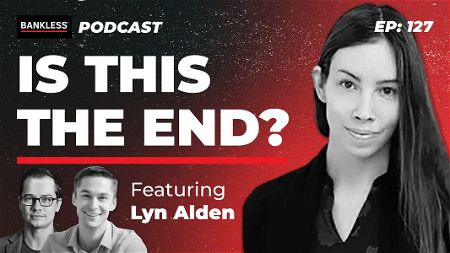
127- Is This the End? | Lyn Alden
 01:29:30
News
01:29:30
News
ROLLUP: Voyager Bankrupt | Solana Phone | ENS Domains | Facebook NFTs | Reddit NFTs | EU Crypto Regulation
 01:12:58
Bitcoin
01:12:58
Bitcoin
Leaving the Bitcoin Religion with Nic Carter
 02:09:37
Podcast
02:09:37
Podcast
126 - The Crypto Revolution | Josh Rosenthal
 01:26:50
DeFi
01:26:50
DeFi
Bear Market War Stories with DCinvestor & Eric Conner
 01:22:08
DeFi
01:22:08
DeFi
Resilient DeFi with Kirk Hutchison | Layer Zero
 01:40:47
Ethereum
01:40:47
Ethereum
125 - Ethereum's Hidden Power Structures | Matt Cutler
Inside the episode
On this episode, Luke unpacks how macro got this bad, what the end game looks like, why this is the scariest macro setup Luke has seen in 20+ years, and how to prepare.
The fog of what’s going on is thick, but we're on a quest to find out what in the world is going on. Knowing this is key to understanding the next steps crypto takes. Buckle up.
TIMESTAMPS
0:00 Intro
6:08 Scariest Macro Setup In 20+ Years
14:15 Why This is the End
22:10 How’d We Get Here
26:45 Bursting Sovereign Debt Bubble
36:45 Fed Data Interpretation
42:42 How the End Game Plays Out
1:01:21 The Affect on The Average Person
1:07:35 U.S. Middle Class vs. Treasury Holders
1:14:58 The Future of Assets & Currencies
1:20:20 What Happens to Energy Commodities?
1:25:40 Equities, Gold, & Crypto
1:31:46 How to Prepare
1:36:50 Closing & Disclaimers
RESOURCES
Luke Gromen
https://twitter.com/LukeGromen
Forest Through the Trees
https://fftt-treerings.com/
Luke’s Youtube Channel
https://www.youtube.com/c/LukeGromenFFTTLLC
Lyn Alden
https://youtu.be/XaHuwUDd1C8
Jim Bianco
https://youtu.be/VMNmxFzKI64
Transcript
Welcome to Bankless, where we explore the frontier of internet money and internet finance. This is how to get started, how to get better, how to front run the opportunity. This is Ryan Sean Adams, and I'm here with David Hoffman, and we're here to help you become more bankless. Guys, amazing podcast episode. I hope you've been enjoying our macro episodes because here is yet another as we're trying to understand the landscape in front of us right now. Luke Grohman is our podcast guest today. He calls Where We Are Now the scariest macro setup he's ever seen in his career. That's where we start.
A few things to take away from this episode. Number one, why is this the scariest macro environment Luke Grohman has ever seen in his career? Number two, what a bursting sovereign debt bubble does to the world, what it does to individuals. Why the choice for America is between bailing out the middle class or bailing out the treasury, the asset class. Number four, the future of all of the asset classes that are investable, including what he thinks about bonds and gold and equities and crypto and energy. And finally, number five, how we get ready. What is the ultimate portfolio to weather this storm? David, this was another fantastic episode. I'm just taking notes because I feel like I'm getting schooled in macro today with all of the content coming our way in Bankless over the last few episodes.
Yeah, this is definitely one of the perks of being a podcaster is that like it's not like I know the answers, but it's my job to go and discover them. And so when I'm in these podcasts with people like Lynn Alden and Luke, I'm just receiving the best information possible to answer my own questions. The way that you phrased the start of this, I hope you're enjoying these very dark podcasts about this future. But also at the same time, like Luke definitely presented one of the more optimistic outcomes, not guaranteed, but definitely positive outcomes. You said that there's a choice between bailing out the American middle class versus treasuries. And that was one of my big takeaways. I'm gonna go back and listen to this podcast to go through that again. The American middle class versus treasury holders. Those two entities are in a tug of war. And while you know, there's certainly a way where both we can split the difference, one of these two sides, you know, like definitely is going to win versus the other. And obviously, you will understand as a listener that we want the American middle class side to win because the other side of things turns us into the top-down, high controlled nation-state surveillance state that we don't really want in this world. And so that was what really stuck out to me, where like if we can figure out a path out of this extremely chaotic, extremely volatile macro environment that involves increasing wages for the United States middle class, that actually can be really bullish for America as a whole. I don't know how likely that is, but the fact that Luke sees a path towards that is a light in this very dark time.
David, you and I have got to talk more about that during the debrief. And of course, a reminder we do a debrief episode after the episode for every single podcast. And you can catch the debrief where David and I go over the podcast content, inject our thoughts, inject our comments on it after the episode by becoming a bankless premium member. We'll include a link in the show notes where you can go do that. All right, let's get right to the conversation with Luke Grohman, Bankless Nation. We are super excited to introduce you to our next guest. Luke Grohman is a macro analyst. He's the founder of Forest for the Trees, which is a research company that helps investors find signal right now. And boy, do we need some signal in the midst of all of this mind. He has a big macro brain in the vein of some episodes we've done recently. Lynn Alden, Raul Paul, Jim Bianco, that sort of individual. And I think, Bankless listener, you can tell we are really on a quest to figure out what in the world is going on with macro because this is the key to understanding what's going to happen next with crypto. So, Luke, thank you so much for helping us out with that agenda. Welcome to Bankless, my friend.
Thank you for me on, right? It's great to be here.
So Luke, we're gonna go through this, you know, as simply as we can. High level questions. This is a definitely a investor engaged, macro engaged, but primarily crypto audience. So we're gonna ask questions here. Like in some of these might be dumb, you know, noob type questions, but we want to go through what's going on in macro right now. First of all, how bad actually is it? Because it seems really bad right now. Then we want to touch on what's gonna happen next. Maybe go through this asset by asset. And then is all of this fixable? And finally ending with what do we do? You game for that?
Sure. Let's do it.
All right, let's talk about this. How bad is it? You called this the scariest macro setup in twenty plus years. Tell us about this. Why did you say that?
It is. We've written it numerous times and have been uh
really writing a lot of warnings all year, basically culminating with those that view that this I think is the scariest macro setup that I've seen in my 27 years in finance. And the reason I wrote that
is really a confluence of factors that individually either they haven't been seen in a very long time or they've never been seen. And when you put them all together, we've never seen something like this before.
Certainly in the scale at which it's happening. And so to break each of those down, the first is that
this is the first global sovereign debt bubble that we have had in a hundred years, really, I think since the aftermath of World War I,
particularly because it is centered in the developed markets, the advanced economies, not in the emerging markets. So a lot of what we're seeing in US, Japan, Europe has been seen from a sovereign debt perspective in emerging markets since 1980, but not in developed markets for much longer than that. And the reason for that is we had a stock bubble in 2000. Policymakers decided rather than letting that play out in a austerity or deflation type.
Outcome, they kicked the problem upstairs to the banking system via the creation of a housing bubble. That burst, they kicked that problem upstairs to the sovereign level by virtue of effectively backstopping the banking system, bailing out pretty much everything, which is an oversimplification. But that created a sovereign debt bubble. And the problem is once it's at the problems at the sovereign debt level, there's nowhere else to kick that problem upstairs to. I mean, unless you can find Martians willing to come down and sort of you can kick the problem to Mars, the release valve has to be the currency. They're gonna have to print money at some point. So you've got this bursting global sovereign debt bubble, I think, for the first time in a hundred years.
When you then overlay that with, I think the second big issue, you have a resource problem. We've been writing about peak cheap energy for quite some time. And that's not to say we're running out of energy. The issue is that the marginal barrel of oil keeps getting more expensive to find. And if
we didn't have all the debt we had, in particular the sovereign debt we had,
this would be economically problematic, but it would not be economically catastrophic. The energy is ultimately
the true discount rate, nature's true discount rate of economic activity. And a simplified way to think about that is.
They're implied in the value of every asset on the board, every asset, with the exception of I think really two, physical gold and Bitcoin,
there is implied a growing supply of cheap and affordable energy. And what I mean by that, think about it as you have a house in the suburbs, your house in the suburbs is worth $400,000. The valuation of that $400,000 is based on gasoline being $2, $3, $4 a gallon. If gasoline goes to $10 or $20 a gallon, the $400,000 value of that house gets haircut significantly. And that's you can do that to every asset. Some move up, some move down, but the price of all bonds, stocks, real estate, all of it.
implied within it, with the exception of gold and Bitcoin, is a cheap and growing supply of energy, a growing supply of cheap energy.
And supplies aren't really growing that much.
And they're certainly not getting cheaper. They're getting more expensive. To basically stay in one place, for energy to not grow enough is taking more and more expensive energy.
And that then brings you to sort of the third leg of this, which is
given peak cheap energy and some of these cheap resource scarcity issues,
they are now leading to geopolitical tensions when overlaid with the debt. And we've seen that obviously in spades since February of this year.
And that then also makes it very scary for macro because you can see the Russians weaponizing energy, weaponizing commodities, you can see the Americans weaponizing the dollar, and everybody else in between is getting caught between that rock and the hard place, particularly foreign creditors of the US that are short energy. So that's EU, Japan, China, India, these major economies, they're short dollars
and they're short energy.
And if they're short dollars, the financial system collapses.
If they're short energy, they have hundreds of millions of citizens starve to death and probably riot before they do. And we started to see symptoms of that in some smaller places around the world. It's likely going to get a lot worse over the next three to six months on that front. So when you overlay
what's happening, the first thing global sovereign debt bubble in 100 years, when you overlay what's happening with peak cheap resources, when you overlay the geopolitical tensions that are, I think, amongst major powers at their highest in probably at least 30 years and probably closer to 40 or 50 years. And then you layer in some other factors, such as the Western policymakers, US in particular, have they allowed this system to evolve in a way that the US absolutely needs asset prices to rise to keep the wheels on the cart. So you've created this pro cyclical.
uh asset price inflation driven economy.
And now you overlay these three factors, global sovereign debt bubble bursting, geopolitical, and peak cheap energy, that are making it difficult for that to happen. So when you blend all these together, that's why I say we haven't really seen
any of these on their own, either in a very long time or ever, when you blend them all together, it is. It's the scariest macro environment I've seen in my twenty seven years in finance.
Wow. Um, we recently did a podcast with Linalden and we titled this podcast, Is This the End? And what you said, where there is no place to kick this can down the road for, we're at the end of the road to kick this can down the road, kind of sounds pretty similar. But as we go into the global markets contagion with energy prices, commodity and resources, and all of this fallout, I really want to just emphasize the source of all of this contagion, these issues, which in my mind is the US dollar. And perhaps like why we are at the end and why this is such a big thing to discuss is that the US dollar connects absolutely everything. And this seems to be the focal point of this whole story. And so I'm wondering, Luke, can you just help ground us as to what it means when there is nothing, there's no further road to kick the can down the road towards and what is the current state of like the US economy, the Federal Reserve, and the dollar? It's like, why is this seemingly like the end of the story of the dollar in its current phase? Can you just really just ground it?
So for me, I don't think anything's ever ending. I think it's always a case of you know what's normal for the spider is chaos for the fly. Right. So I agree that we are quickly getting to the end of the road in terms of where to kick this to. You're really left with a very binary choice, which is you let the system as it is structured collapse into deflationary chaos. And that is going to be widespread sovereign defaults. That's going to be commodity price collapse. That's going to be the United States. I mean, when I say sovereign debt collapse, yeah, others will go first, like weeks first. And you know, Europe defaults on sovereign debt, and people think there's going to be some big lag. Oh, well, Europe will go and then all the capital will flow to America and stock. No.
There is no capital if it defaults there. The contagion will be measured in weeks, if not days. And that deflationary spiral, if the Fed and policymakers continue to stand aside, would be up to and including the United States government defaulting on its entitlement promises to baby boomers. Hey, mom and dad, I know you were collecting a couple grand a month in Social Security. It's now 200 a month. And oops, uh, you don't have enough to make ends meet. You don't have enough to buy groceries. You can't make your house payment. Um,
sorry.
And it would possibly include once tax receipts fell enough, which wouldn't take very long. It's already happening, the U.S. government defaulting on treasury bonds. Sorry, treasury bond holders, we're gonna miss this quarter's coupon payment. We're not making it. And now
that's very down the line. I do not think that is going to happen. Right now, we are on that path. It is a nonlinear path. And if the Fed just continues to stand aside and do nothing, that is where this will go. That is a very, very bad outcome. The dollar goes to the moon in that scenario.
But it would be a somewhere between here and the moon for the dollar, something very weird would start to happen, which is already starting to happen if you pay attention, which is
dollar is 200 on the DXY index,
but there's no gasoline at the gas stations. Why are US gas stations running out of gas? Why are grocery stores running out of food
when the dollar is
Strong. Well, it'd be strong against other currencies, other paper currencies, but the reality is the amount of economic dislocation that would take place would be a catastrophic breakdown of global supply chains and widespread shortages around the world. Would it be worse elsewhere? Absolutely. But you would have this strong dollar and widespread global shortages of stuff. So the physical commodities, I think, would be the dollar would be weakening dramatically against physical commodities,
even in that strong dollar scenario. So that is leg one of where do we go from here? Leg two is.
Something that's very familiar to anyone that's lived in an emerging market, has invested for long enough in emerging markets, which is the sovereign balance sheet of the West is so bad that ultimately in a fiat currency system, policymakers they talk tough, they're gonna raise rates, they're gonna let the dollar go. All of this sort of where I think
the mind of the market really is at this point, uh, maybe not quite fully there, but getting there.
And then policymakers ultimately have to step back in and grow the balance sheet again to prevent. And this is, I think, the biggest thing that people are missing now versus when they talk about the 70s or the 40s or any other time.
There has been no other time
in hundreds of years where
the sovereign solvency of the reserve currency issuer is at risk.
And so basically,
Leg two is the Fed comes in and begins growing their balance sheet again aggressively to prevent the sovereign insolvency of the United States, of the United States' allies, and in particular the EU and Japan. And I think we're getting very close to that moment. I think we're probably months away from the Fed having to print money to either buy, you know, renew QE domestically, or potentially print dollars and buying Euro debt, buying Japanese debt as a way of fighting deflation. So
When you say we're coming to the end of the road in terms of where we can kick the can to, I think there is an element of truth to that from the standpoint of sort of this
linear path that people have gotten used to seeing. I think from here things get very nonlinear. And the question then is do they get nonlinear inflationary or do they get nonlinear deflationary? And
ultimately,
if you're a month to month trader and this applies to crypto, this applies to Bitcoin,
this is not a good out, you know, between now and when they have to print the money to keep Sovereign's solvent, which I think they ultimately will do, they will be probably the

David Hoffman
Co-owner at Bankless. Optimistic storyteller of frontier technology.
.png-cde5b9c0aa4838d09c634abbd1136ff2.png)