115 - The Stagflation Mega-Trade | Dan Morehead
How to prepare before it's too late


Up next
All episodes 00:22:12
Bitcoin Premium
00:22:12
Bitcoin Premium
Debrief - In Defense of Bitcoin Maximalism | Vitalik Buterin
 01:56:24
Bitcoin
01:56:24
Bitcoin
114 - In Defense of Bitcoin Maximalism | Vitalik Buterin
 01:44:35
News
01:44:35
News
ROLLUP: Elon Musk Buys Twitter?! | 8.5% Inflation | Tax Week | Epic Games Building the Metaverse
 01:33:51
NFTs
01:33:51
NFTs
Alpha Leak | The Bull Case for TreasureDAO
 00:57:54
Podcast
00:57:54
Podcast
9 - Proof of Regeneration with Gregory Landua
 01:24:52
DeFi
01:24:52
DeFi
FRAX & the 4pool Curve Takeover | Sam Kazemian
 01:33:01
Ethereum
01:33:01
Ethereum
The Divine DAO with Tracheopteryx | Layer Zero
 00:29:00
Investing Premium
00:29:00
Investing Premium
DEBRIEF - How to Be Early | Olaf Carlson-Wee
Inside the episode
⬆️ Join Bankless Premium to listen to the Ad-Free version of this episode and the exclusive Debrief to hear Ryan & David’s unfiltered takes on this episode. 🚀
Dan Morehead is the Founder & CEO of Pantera Capital, a blockchain investment firm that’s up nearly 65,900% since inception. Dan has spent decades successfully managing global macro funds throughout countless cycles.
We’ve said it before and we’ll say it again, macro plus crypto is a deadly combination. These two skills are some of the most important when it comes to navigating the remainder of this decade and beyond. Who better to share their expertise than Dan?
Tune in as Dan peels back the layers of inflation, the bond bubble, and other economic crises. How did they become so extreme? What’s the difference between today and the 70s? And most importantly, how can you prepare yourself to weather the storms of economic instability?
🎙️ NEW PODCAST EPISODE
Bankless Sponsor Tools:
⚖️ ARBITRUM | SCALED ETHEREUM
https://bankless.cc/Arbitrum
❎ ACROSS | BRIDGE TO LAYER 2
https://bankless.cc/Across
🏦 ALTO IRA | TAX-FREE CRYPTO
https://bankless.cc/AltoIRA
🔐 LEDGER | NANO S PLUS WALLET
https://bankless.cc/Ledger
👻 AAVE V3 | LEND & BORROW CRYPTO
https://bankless.cc/aave
⚡️ LIDO | LIQUID ETH STAKING
https://bankless.cc/lido
RESOURCES
Dan’s Letters from Pantera
Charts
🏴 JOIN THE NATION 🏴
Subscribe: Newsletter | iTunes | Spotify | YouTube | RSS Feed
Follow: Twitter | Instagram | Reddit | TikTok | Facebook
Not financial or tax advice. This newsletter is strictly educational and is not investment advice or a solicitation to buy or sell any assets or to make any financial decisions. This newsletter is not tax advice. Talk to your accountant. Do your own research.
Disclosure. From time-to-time I may add links in this newsletter to products I use. I may receive commission if you make a purchase through one of these links. Additionally, the Bankless writers hold crypto assets. See our investment disclosures here.
Transcript
Welcome to Bankless, where we explore the frontier of internet money and internet finance. This is how to get started, how to get better, and how to front run the opportunity. This is Ryan Sean Adams. I'm here with David Hoffman, and we're here to help you become more bankless. Guys, we have a fantastic episode with Dan Moorhead. We're talking about the year ahead for crypto, how to survive this bond bubble. We've got inflation at all-time highs. What do we make of this? Dan is the perfect combo of macro plus crypto investor to help us navigate these uncharted waters. A few takeaways to look out for. Number one, we actually talk about why inflation is 8.5% right now. Number two, we talk about this thing he calls the bond bubble and the coming great unwinding of that bond bubble. Figure out what that means as we do the episode. Also, are rising interest rates bad for crypto? Maybe not. Maybe not this time. That's what Dan makes the case for. How to structure your crypto portfolio in the midst of all this? And finally, a little bonus tidbit, somewhere mid show. You'll have to look for how to short bonds. If you believe what Dan is saying, bonds are going to go down.
He talks about how to short them.
David, this was a really fun podcast. I learned a lot, brought a lot of pieces together, I think, with what's going on in the current macro environment, which is hugely relevant to the crypto industry and the crypto story over the last like decade. It's been in existence and will continue to be massively relevant into the future. I mean, Dan was actually talking about when the nation states of the world, central banks, would start purchasing crypto. He thinks that's coming in the future. What were some of your thoughts?
I think this moment in history is the moment that Dan himself, Dan specifically, was really meant for. Dan has been paying attention to just the macro markets, I think, since he became an investor in general, back in the 70s and 80s. And he started Pantera as a macro fund, but pivoted into a crypto fund in 2013 because he saw the writing on the walls that so many who were early in this industry saw and realized that crypto is macro. But he dropped this one line that I think explains it well. Crypto is like buying gold, but back in like the BC era, right? Back when people were trading just like apples for gold, right? Like imagine buying gold before it even had a dollar price. And that's what Dan saw in 2013. So a macro person who saw the writing on the wall and saw that crypto was eventually going to become a macro relevant crypto asset class. So pivoted entire fund to become a crypto fund. And this moment, right now, where inflation is at 8.5%, the timing of this podcast couldn't be better because Dan has been paying attention to the bond markets, what the Federal Reserve is up to, and what he is calling the great unwinding of $9 trillion of the Federal Reserve balance sheet is going into the bond market, which usually would spell the death for a lot of risk on assets. But Dan's making the case that not this time. People are waking up to that perhaps it's time to vote with your dollars and exit the system. And while this is very similar to stagflation in the 70s, which was another topic that we got into, the main difference this time is we didn't have crypto in the 70s, Ryan. Like we have the escape route, we have the escape hatch, and that is crypto. So how is this similar to the 70s? Is a big theme of this episode. But how is it different? Because crypto's here is also a big theme of this episode. And I just learned an absolute ton with Dan here.
Yeah, you guys are gonna absolutely love it. Of course, after the show, Dave and I are getting ready to record our debrief where we talk about our thoughts on the show that we just recorded, our thoughts with this Dan Moorhead episode. So if you're a premium subscriber, you can click into that on the Bankless Private Premium RSS feed. Some bonus content for you guys. We're gonna get right to the conversation with Dan. Bankless Nation, we are super excited to introduce you to our next guest. Dan Moorhead has spent 25 years managing global macro funds. He had a career at Goldman, then he founded Pantera. Later, he pivoted into crypto, still early in 2013. He went all in on crypto at that time. And at Bankless, we just think macro plus crypto is such a deadly combination, particularly for navigating this next decade. And we think you need the skills to navigate this next decade because it's going to be different than all of the decades preceding it. That's why we're having Dan on to help equip us with some of the insight and skills. Dan, welcome to Bankless. It's great to have you.
Hey, thanks for having me.
Hey man, we're gonna cover like two things today, if that's cool. The first is sort of like what's happening, the big macro landscape, inflation, bonds, the Fed, that sort of thing. And the second is
once we understand what's happening, how to position for that. Does that sound good?
Sounds great.
All right, let's talk about what's happening then. Inflation bonds, the Fed. All right, so the big thing right now in the news this week is inflation. It's been in the news for the last months, but I think this is the highest inflation, something like 40 years, 50 years, something like this. 8.5% CPI.
What's happening here? Can you tell us what's going on?
Yeah, so it's actually 35 years I've been doing this. So I've seen a lot of cycles. This is the craziest one ever.
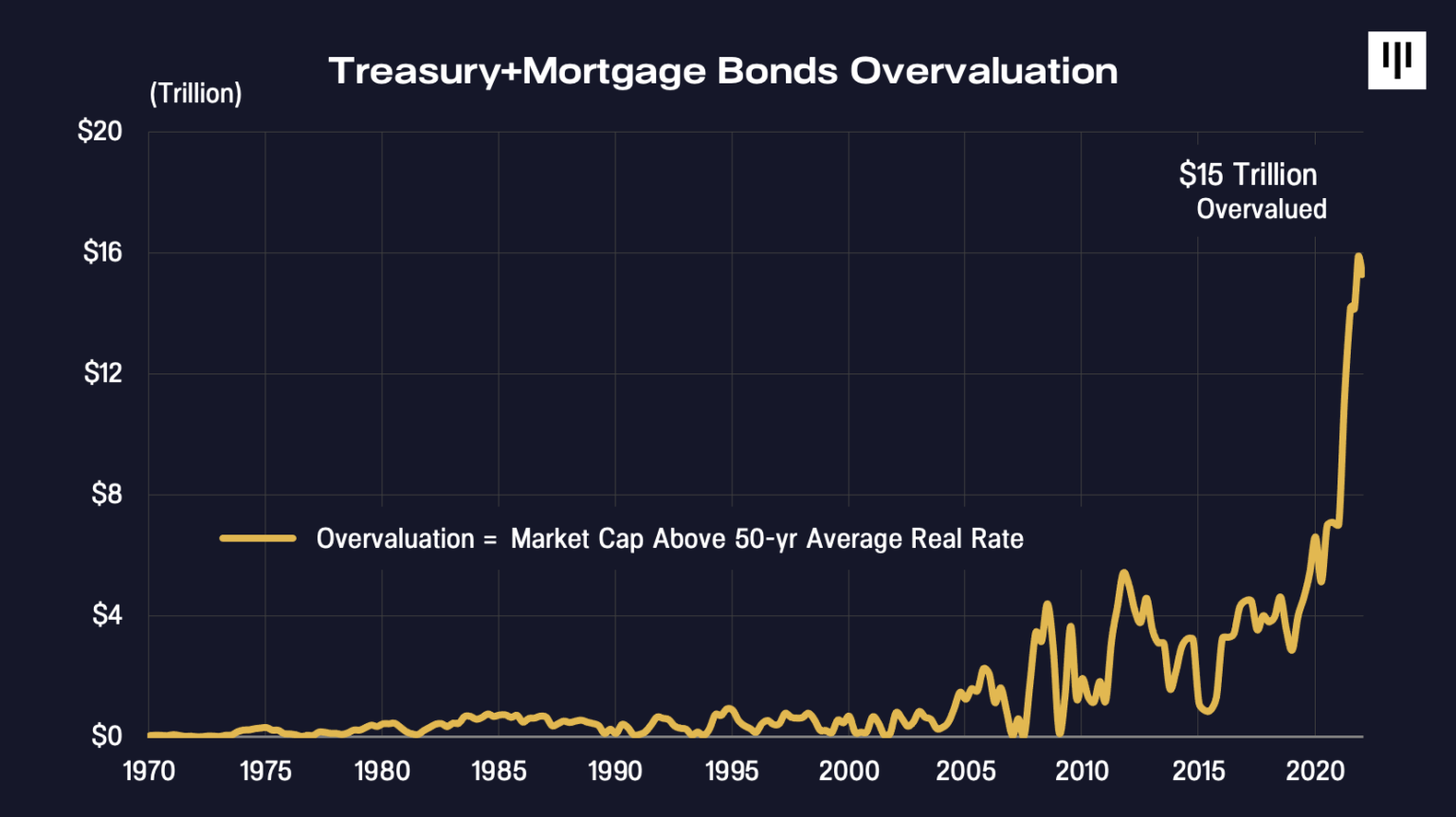
The Federal Reserve pumped up a bubble in bonds that
is just really off the charts. It's got the bond market so far ahead of where it could or should be.
And the bond market is obviously what fuels the mortgage industry. And a record number of Americans took out a mortgage last year and bought property. Not surprisingly, houses are up 19%. So if you are a homeowner, that's a good thing, but 35% of Americans are not. So that I think it's a terrible thing. So the Fed's pumped up this massive bubble
and it's created a massively overheated economy. And the chairman of the Fed
about a year ago said it was a transitory blip in inflation. This is not transitory. This is a massive, massive problem. Each month since Powell said it was transitory, it's printed a new record high. And as you said, we're back to inflation rates.
As measured as high as 1982. Here's the wild thing:
the inflation rate really isn't a very good measure of the cost of housing. In 1982, coincidentally, the government decided to replace the cost of houses, which is a very obvious thing you would use in housing inflation, with a very arcane formula called owner's equivalent rent.
And if you use a normal index of house prices,
You'll see a much higher inflation. So, for example, right now the year-on-year change in owner's equivalent equivalent rent is only 4.2%. And for anybody out there trying to buy a house and only trying to offer 4% more than last year, they know that doesn't work. And anybody trying to rent an apartment knows 4.2% does not work. So
that if you used any kind of housing index, like Case Schiller, for example, which is a very widely respected index, the inflation rate's already 11% in kind of
I consider true terms. So we really are back to the craziest bit of the 70s.
So this is a kind of a question about the 8.5% figure. Do you think that's really the lower bound then? You're saying maybe the CPI, the metric that the Fed uses to quote unquote measure inflation is somewhat off in some ways. What do you think the actual range of inflation might be if that's the case?
Yeah, so I have been doing this a long time. There's all kinds of nuts talking about inflation doesn't fairly, you know, the government doesn't fairly measure things. And yeah, you know, sometimes people make the argument for maybe an affluent consumer basket, it's higher and all that stuff. And so what my argument here is is not to take any of those kind of little things. It's just to focus on 35% of people's expenditure, their biggest expenditure is housing.
You have to rent an apartment, you have to buy a house. And so it's by far the most important thing in inflation.
And the way the government currently calculates it with this owner's equivalent rent thing
is very, very slow. It'll all come through over in the next two or three years. All that pressure will actually show up, but it resets very, very slowly.
And so if you take the current core inflation rate, because the Fed
likes to exclude food and energy, but again, those are very big expenses for us. So, you know, I think it is
somewhat suspect to exclude those. But if you exclude food and energy and take the core inflation rate, but use Case Schiller's index.
Which is currently running 19.2% year over year. You get a true core inflation rate of 10.7.
And we have overnight Fed funds at 25 basis points. That's the problem. The Fed is fueling a massive overheating of the market.
And frankly, it's shocking how far behind they are on this. That they're talking about.
Maybe getting to neutrality? Like the US is clearly overheated. Like today's front page newspaper has the highest inflation rate in 40 years. And they're talking about maybe over the next year or two and these little quarter point increments getting back to 2%.
I mean, honestly, it really is shocking how far the Fed is away from reality.
Dan, I think a lot of listeners are feeling this, right? It's one thing when you see the numbers, it's another when you actually feel them. And so grocery bills going up in price, like gas and energy, you know, housing, cost of living, all of these things, like like Americans, and I think not just the US, but people around the world are really starting to feel these numbers in a way I think a lot of people who've been alive have never experienced before. What do you make of this? That we're starting to feel these numbers more.
No, it is totally true that, you know, when inflation's, you know, very, very low single digits,
it's kind of easy to not notice it. But so many things now have a surcharge for whatever, you know, all these expenses. And
in our, I think, November investor letter used a really cool index, I think, because people can relate to it.
The cost of Ubers has doubled.
And that to me, that's such a great indication of the tightness in the labor market because gig economy workers are obviously people that are kind of right on the edge of wanting to work, not wanting to work. And, you know, a few years ago, uh, a lot of people wanted to do that, and various government programs and the booming economy have taken a lot of people out of the gig economy.
And so
people are actually literally seeing it. You know, every time they do a ride, it costs twice as much as it did two years ago. And
You know, like used cars now
are higher priced than when they were brand new.
That's super crazy. It's never happened in history.
The price of a 2021 average model year car
is more expensive today than when the person drove off the lot.
And that one, there's a little bit of a supply chain issue there. But it's just there are things happening right now that literally never happened before. And it's happening across the spectrum. You know, basically everything is on fire and more expensive.
And this is the thing that everyone is experiencing for themselves, Dan. So we all know this to be true. We can see it in the gas prices. We can see it in like the milk prices and the grocery prices. And so no one really questions that. Like everyone knows, like, oh yeah, we have inflation now. This is the paradigm that we live under. But for a lot of people, I think a lot of bankless listeners, including myself, who kind of got educated on money and finance through crypto, are kind of confused as to how we got here. Like you started this conversation off saying there's a bubble in the bond market. And I actually don't really know what that means. Can you explain, like, how did we get a bubble in the bond market? How did this bubble just emerge? Where did it come from? Can you explain how we actually arrived to this point?
Sure, so there's really two sides to the same coin here. First is Congress essentially approving $9 trillion worth of spending. The US's deficits in the last two years have literally been bigger than any year in World War II.
World War II, we were fighting fascism. It was a big thing, right? And here,
the amount of money that's been spent fighting this invisible virus
is staggering and very inefficient.
It's literally been 50 grand per family in the United States. I mean, that's just an enormous amount of money. And obviously, there were some policies that needed to happen, and there's some people that really needed help. But most of the people that got stimulus checks saved them. The savings rate went up in a recession. Again, something that's never happened in history. So 9 trillion new pieces of paper dollars were printed
and sent around to everybody. Again, some, a minority of whom really needed to help and probably needed more help. But most of the people didn't. So what did they do with it?
They bought stuff with it. They bought stocks. Stocks are at record highs. They bought, you know, gold, they bought bonds. So people invested all that free new printed money. And there's a great line from Milton Friedman in the 70s inflation is always and everywhere a monetary phenomenon. And I know there's some sticklers that say it's not totally always true. But in this case, if you print 9 trillion new pieces of paper money,
It takes more pieces of paper money to buy a 2021 car or a median home in the United States or a share of the SP 500. It just really is that simple. And so if you print all this money,
there's just more dollars running around to, you know, buy things. And we put a cool graphic up on our Twitter feed a while ago,

David Hoffman
Co-owner at Bankless. Optimistic storyteller of frontier technology.
.png-cde5b9c0aa4838d09c634abbd1136ff2.png)